
If you're reading this, there's a good chance your family already feels real in every way that matters. Maybe you've tucked your stepchild into bed for years. Maybe your granddaughter has lived with you long enough that her backpack hangs by your front door and her favorite cereal fills your pantry. Maybe you and your spouse are ready to adopt and want to know how Texas law treats your home, your history, and your hopes.
That moment can feel tender and confusing at the same time. You know the love is there. You just need the law to catch up.
A Family Law Firm San Antonio families trust shouldn't only help people through conflict. It should also help people build something lasting. At Law Office of Bryan Fagan, PLLC, adoption and guardianship work are about stability, belonging, and protecting the child at the center of the case. Texas families often begin this process with practical questions about consent, home studies, and timelines, but underneath those questions is a simpler one. How do we make this official?
Building Your Family in San Antonio
Ana had already done the daily work of parenting. She packed lunches, signed school forms, and sat through soccer practice in the San Antonio heat. Her husband's son called her when he was sick and looked for her in the stands. What she wanted wasn't a new relationship. She wanted legal recognition of the one they already had.
A grandfather in a different part of the city may be standing in a similar place. He never planned to raise his grandchild, but life changed. Now he wants medical authority, school stability, and a path toward a permanent home. These stories don't begin in a courtroom. They begin around kitchen tables, in school pickup lines, and during quiet talks about what a child needs most.
Why this work matters
Family law in Texas includes difficult cases, but it also includes joyful ones. Adoption, kinship care, and guardianship give families a legal structure for the care they are already providing. That's especially important in a system with a heavy family-case load. In Texas, the divorce rate was about 1.4 divorces per 1,000 residents in 2021, and U.S. state courts handle about 66 million cases yearly, including nearly 3.8 million family law cases, with 1.09 million divorces, 880,000 child support matters, and 380,000 paternity cases according to Clio's family law statistics overview.
Those numbers remind families of something important. Courts see family transitions every day. Adoption isn't unusual or out of place. It's part of the actual work family courts do.
Practical rule: A strong adoption case isn't only about forms. It's about showing the court that the child already has safety, continuity, and care.
Some parents also want help organizing records and communication during a family case. In that context, tools like Recepta.ai for family law can be useful to understand how legal teams manage intake and client communication in a structured way.
Navigating Family Law in San Antonio Beyond Divorce
Many people search for a family law firm in San Antonio because they assume family law means divorce, custody fights, or support disputes. Those cases are part of the field, but they aren't the whole picture. Family law also covers the legal steps that create and strengthen families.
What a family law firm may handle
In adoption-focused work, the legal needs are different from a divorce case. A lawyer may help with:
- Adoption petitions: Filing the paperwork that asks the court to create a legal parent-child relationship.
- Termination issues: Addressing whether another parent must consent, can voluntarily relinquish rights, or whether the court must decide termination.
- Guardianship and related care issues: Helping relatives or other caregivers secure authority to protect a child or vulnerable adult.
- CPS matters: Working through foster care, permanency, and reunification-related concerns when a child has been in state care.
A good lawyer in this space should understand the emotional side as much as the court process. The legal question may be technical, but the human question is usually simple. Who has been showing up for this child, and how do we protect that bond?
The process is broader than many people expect
Texas adoption law often points families into Chapters 162 through 166 of the Texas Family Code, depending on the issue involved. In plain English, those chapters cover who may adopt, whose consent is needed, what the court reviews, and how the final order is entered. For many readers, The Texas Adoption Process Step by Step is a useful overview because it lays out the six core stages of a Texas adoption from type selection to final decree.
Some families also need behind-the-scenes legal support when paperwork, records, and deadlines start piling up. If you're trying to understand how legal teams staff that work, a directory to find remote family law paralegals can give helpful context on the support roles often involved in family law matters.
Family law doesn't only end marriages. It also formalizes parenthood, preserves family unity, and gives children a more secure legal future.
Understanding Your Adoption Path in Texas
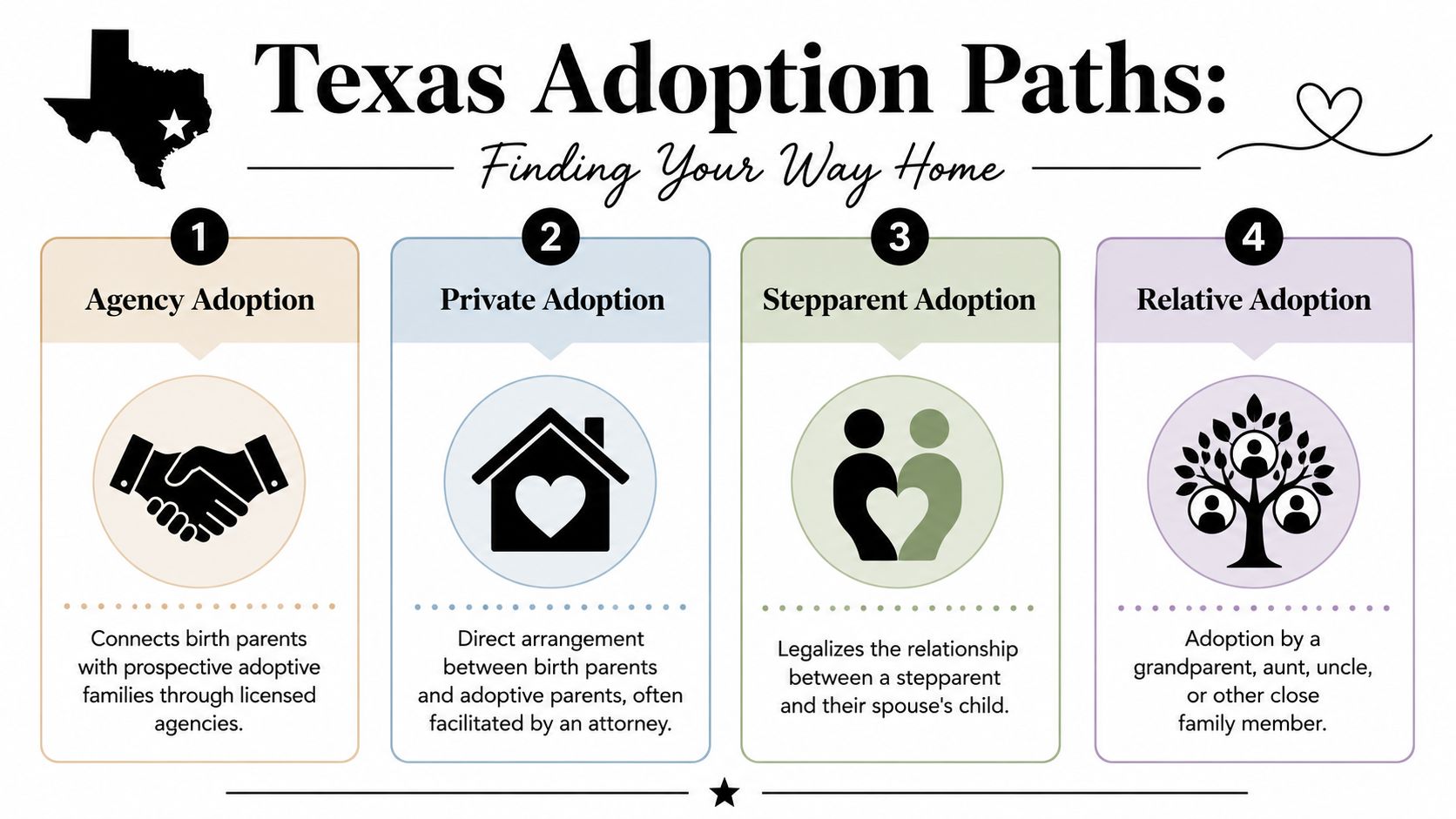
No two adoption stories start in the same place. One family may be planning for a private infant adoption. Another may already be caring for a niece, stepchild, or foster child. The legal road changes depending on that starting point.
Private infant adoption
In a private adoption, the match may happen through an agency or directly through arrangements guided by attorneys and other professionals. These cases usually involve more planning on the front end, more documents, and closer attention to birth parent rights and expenses.
The financial difference matters here. The total cost of a domestic private adoption in Texas typically ranges from $25,000 to $50,000, covering agency fees, legal representation, and birth parent expenses. In contrast, foster care adoptions through Texas CPS are significantly lower, often under $500, as the state covers most costs and provides subsidies for eligible children under Texas Family Code 162.505 and Texas Health and Human Services Fiscal Guidelines 2025.
For many hopeful parents, confusion frequently emerges. Search results often lump all adoptions together, but the budget, paperwork, and pace can look very different depending on the path.
Stepparent and relative adoption
These cases often begin with an existing bond. The child may already live in the home, call the adult “Mom” or “Dad,” or rely on a grandparent, aunt, or uncle every day. That emotional reality matters, but the court still needs legal proof that adoption serves the child's best interests.
Here are a few key differences:
| Path | Common starting point | Legal issue families often face |
|---|---|---|
| Stepparent adoption | A married stepparent is already parenting the child | Whether the other biological parent must consent or whether consent can be waived |
| Kinship adoption | A relative has stepped in to care for the child | Showing family unity and handling parental rights issues |
| Private adoption | No existing legal relationship with the child | Home study, matching, and approved expenses |
| CPS adoption | The child has been in state care | Permanency, subsidy eligibility, and post-placement requirements |
Texas law gives some relatives a narrower, more practical route. In relative or kinship adoptions under Chapter 162.002, the home study requirement is waived if the relative has lived with the child for at least 6 months before filing, and parental consent can be waived in some situations if support or contact has not been maintained, under Texas Family Code Chapter 162.002 and 162.010(b). Even when the process is simpler, the court still focuses on the child's physical and emotional well-being.
CPS and foster care adoption
Families adopting from foster care often come to the process with a long relationship already built through placements, school meetings, and medical appointments. These cases can feel meaningful because the legal goal is permanency after instability.
Texas families should also know that over 60% of children in state custody are adopted by relatives, according to the verified DFPS report information above. That helps explain why kinship adoption is so important in practice. It keeps children connected to familiar people, routines, and family history.
The right path isn't the one that looks simplest online. It's the one that matches your actual relationship to the child and your legal starting point.
Your Step-by-Step Texas Adoption Journey
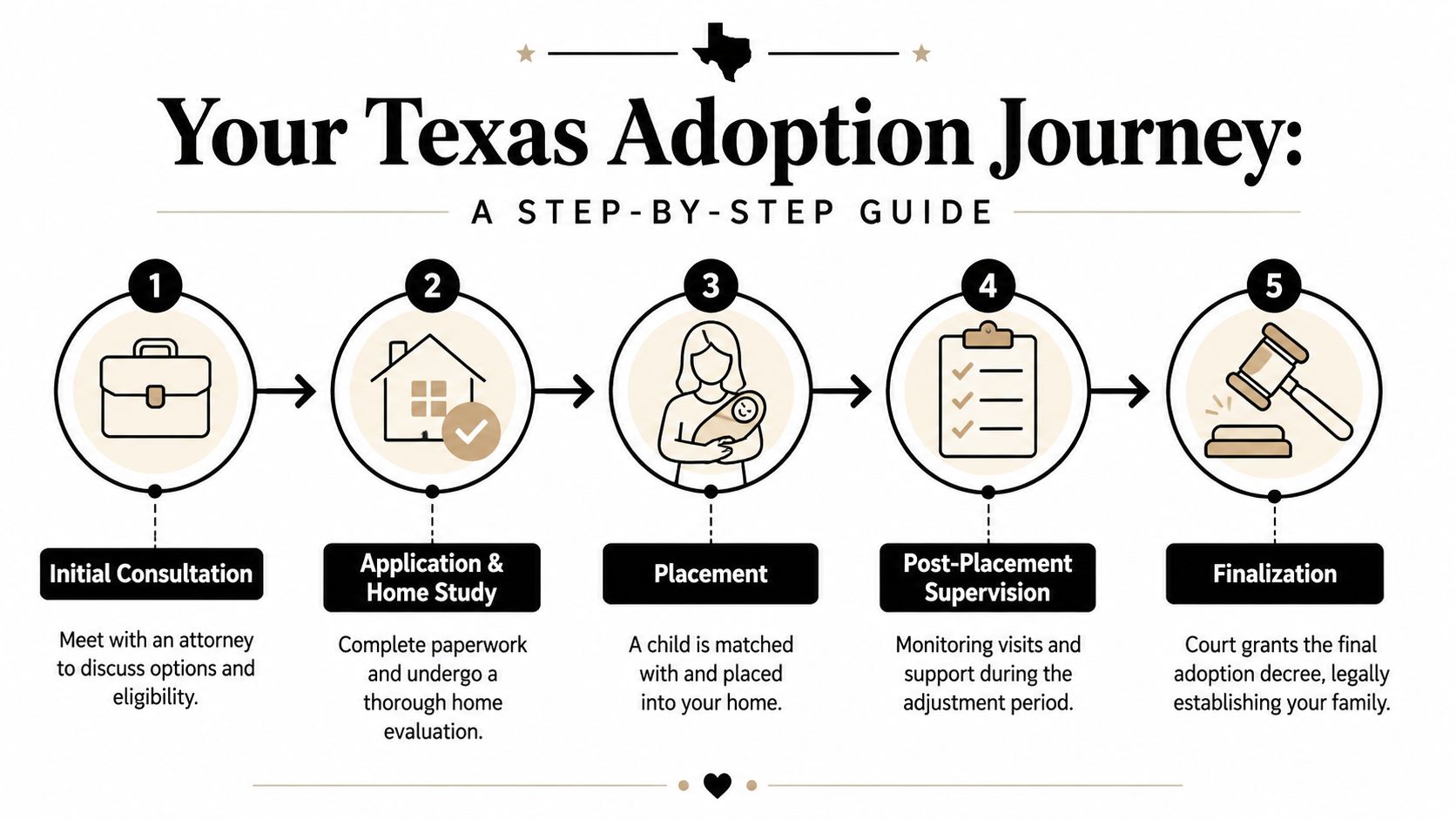
Most families feel calmer once they can see the process in order. Adoption still takes care and patience, but it becomes much easier to manage when each stage has a purpose.
A visual overview helps many parents grasp the big picture first.
Step 1 through Step 3
Initial consultation
During this consultation, families sort out the type of adoption, likely consent issues, and whether guardianship or another legal route should be considered first. The goal is to identify what the court will need before anyone files.Application and home study
In many cases, this is the first major checkpoint. Under Texas Family Code Chapter 162, a home study is mandatory for most non-kinship adoptive parents. It must be completed by a licensed agency and includes a criminal background check, evaluation of financial stability, and assessment of the home environment to ensure it meets the child's best interests under Texas Family Code 162.001, 162.003, and 162.005.Filing and addressing parental rights
The petition goes to court, and then the case turns to consent, notice, or termination questions. In stepparent and relative cases, this is often where the legal complexity sits.
A few practical details help families prepare for the home study itself:
- Safety matters: The social worker is checking whether the home is stable and safe, not whether it looks perfect.
- Records matter: Parents should gather identification, financial records, and any requested medical or background documents early.
- Training matters: For non-kinship cases, Texas requires pre-adoption education that includes topics like attachment, trauma, and the legal process.
Step 4 and Step 5
After placement, the court usually expects a period of adjustment and supervision before finalization. In some cases, a post-placement supervision period applies before the judge signs the final decree. This is the court's way of confirming that the child is settling into a stable environment.
Many parents like to hear a straightforward explanation before they begin. This short video gives a helpful overview of how the process unfolds in Texas.
The final hearing is often brief, but it carries enormous weight. That is the day the legal relationship becomes official.
Some of the happiest courtroom moments happen at finalization hearings. The legal file may be thick, but the heart of the case is simple. A child now has a permanent legal family.
Families who want a broader plain-English roadmap can also review When to Hire a Texas Adoption Attorney if they're deciding how much legal guidance they need as the process moves forward.
Specialized Paths to Building Your Family
A child may already be calling you Mom, Dad, Grandma, or Auntie long before the court signs anything. That is often true in the family-building cases that need the most careful legal work. The relationship is real. The law still needs to catch up.

LGBTQIA+ adoption and careful case building
Consider a married same-sex couple in San Antonio. One spouse has raised the child for years, handled bedtime, school pickup, and doctor visits, but only one parent is legally recognized. A confirmatory or second-parent adoption can turn that daily reality into lasting legal protection.
Families in this position often worry about scrutiny. A careful attorney addresses that concern by building a clear, organized record that shows stability in the child's life. That may include school records, medical records, proof of residence, testimony about caregiving routines, and other documents that help the court see the full family picture. Good preparation works like assembling a family album for the judge. It shows consistency, attachment, and safety in a format the court can rely on.
Kinship care and family unity
Kinship adoption often begins in the middle of a family emergency. A grandmother takes in two children after a parent is arrested. An uncle steps up because a sibling is struggling with addiction. A family friend has been caring for a child for months and needs legal authority to make long-term decisions.
In these cases, the question is rarely whether love is present. The legal question is how to turn caregiving into permanence.
Texas courts usually give serious attention to continuity and existing bonds when relatives have already been doing the work of parenting. If you are trying to understand how those cases are handled, this guide to kinship adoption in Texas explains the issues families often face. Some steps may be more direct than in a stranger adoption, especially when the child has already been living in the home, but relatives still have to address consent, termination of parental rights, and the court's best-interest review.
The emotional part can be heavier than people expect. Relatives are often protecting a child while grieving what has happened to the child's parents. That mix of loyalty, fear, and hope is common.
Foster care, CPS cases, and special-needs planning
Some families build their family through the foster system or after CPS involvement. These cases often carry more paperwork, more supervision, and more questions about the child's history. They also call for more preparation after placement, not just before it.
Children coming from foster care may need therapy, school accommodations, medical follow-up, or a home that understands trauma responses. A home study is not only a safety check. It is also a closer look at whether the adults in the home understand the child's needs and have a workable plan to meet them.
That is why experienced adoption counsel often helps families gather more than legal forms. Counseling plans, school support information, medical summaries, and realistic caregiving plans can all matter. The goal is simple. Show the court that this child is entering a home ready for real life, not an idealized version of it.
A home study asks more than whether a house is safe. It asks whether the adults in that house are ready for this child's routines, history, fears, and healing.
Adult guardianships and lifelong care
Family creation is not limited to infant or child adoption. Some families need legal authority to care for a vulnerable adult with cognitive, medical, or developmental needs. In those cases, guardianship may be the right tool.
Guardianship is different from adoption, but the purpose is similar. The court wants proof that the proposed guardian can provide lawful, stable support and that the arrangement protects the person who needs help. For parents of a child with disabilities who is nearing adulthood, this issue can arrive faster than expected. Planning early can prevent a gap in decision-making authority for medical care, housing, or benefits.
These paths are different, but they share one theme. Family law in San Antonio is not only about ending relationships. It is also about protecting the families people have already formed and helping those families become secure under Texas law.
How to Choose Your San Antonio Adoption Attorney
Not every family lawyer is the right fit for an adoption case. When seeking a Family Law Firm San Antonio families use for adoption, look for someone who treats the case as more than a filing project.
What to look for
A strong adoption attorney should understand both procedure and family dynamics. Ask whether the lawyer regularly handles stepparent, kinship, CPS, and contested consent cases. Those details matter because adoption law is full of forks in the road. A small mistake with notice, consent, or required records can delay a case that means everything to a child.
You should also ask how the attorney approaches emotional readiness. That isn't a soft extra. The verified data from the Child Welfare Information Gateway explains that high rates of post-adoption disruption are often linked to a family's unpreparedness for trauma-informed care, not legal errors. A careful attorney helps families present not just legal fitness, but emotional preparedness too. If you want a practical checklist for evaluating counsel, how to choose the right adoption attorney in Texas is a useful place to start.
Questions worth asking in a consultation
- How often do you handle adoption cases like mine? A stepparent case isn't the same as a CPS adoption or relative placement.
- How do you prepare families for home studies and court review? The answer should include records, stability, and the child's best interests.
- What happens if consent becomes contested? You want clarity on process, not vague reassurance.
The right lawyer should help you feel informed, steady, and prepared. If you leave a consultation more confused than when you arrived, keep looking.
Frequently Asked Questions About San Antonio Adoption
What if the other biological parent won't cooperate in a stepparent adoption
Texas doesn't always require a non-participating parent's consent forever. For a Texas stepparent adoption, the consent of a non-participating biological parent can be waived if they have failed to support the child for at least 6 consecutive months. If the child is over 12, their written consent to the adoption is also legally required under Texas Family Code 162.001, 162.010, and 162.011. If the parent cannot be found, the court may require notice procedures and proof of diligent efforts to locate them.
Is open adoption legally the same as co-parenting with the birth parent
Usually, no. Open adoption can involve ongoing contact, updates, or communication, but adoptive parents become the legal parents after finalization. Birth parent contact may be important emotionally, and many families value it, but it doesn't usually mean shared legal custody. The exact structure depends on the facts, the agreements made, and what serves the child well.
How long does a kinship or CPS adoption take in San Antonio
The answer depends on the child's current placement, whether parental rights have already been resolved, and whether the court needs more evidence before finalizing. Kinship cases may move more smoothly when the child has already been living with the relative and records are organized. CPS matters can involve additional state procedures and post-placement review. A lawyer can usually identify the likely pressure points early, even if no one can promise an exact date.
If you're ready to make your family's next step official, Law Office of Bryan Fagan, PLLC offers guidance on Texas adoption and guardianship matters for stepparents, relatives, foster families, LGBTQIA+ parents, and others pursuing permanency. A free consultation can help you understand your options, the likely process, and what documents to gather first.
