
Some families arrive at kinship adoption texas after a long talk with CPS. Others get there after months of school pickups, doctor visits, and bedtime routines that turned into daily parenting. A grandmother keeps extra clothes at her house, then realizes the child hasn’t gone home in weeks. An aunt signs one more field trip form and understands she’s become the stable adult in the room.
If that sounds familiar, you’re not behind. You’re already doing one of the hardest parts. You’re showing up.
Kinship adoption is the legal path that can turn that loving, day-to-day care into lasting security. It can give a child a permanent home within their own family circle, while giving you the legal authority to protect them at school, at the doctor’s office, and in the future. The process can feel heavy, especially when grief, loyalty, money worries, and family conflict all sit at the same table. But it is manageable, step by step, with care.
Stepping Up for Family The Heart of Kinship Adoption
Elena thought she was helping for a weekend. Her grandson needed a safe place to stay while the adults sorted things out. She packed snacks, found his favorite blanket, and told him he could stay as long as he needed. Weeks passed. Then months. By then, she wasn’t “helping out.” She was parenting again.
That kind of story is common in Texas. Family often steps in before anyone else can. A grandparent, an older sibling, an uncle, or a close family friend becomes the person making dinner, checking homework, and calming fears at night.

Texas leans into that family-first approach. During the 2024 fiscal year, an average of 39.9% of all children in state care were placed with relatives or other close caregivers, compared with the national average of 34%, according to the Texas DFPS Relative and Other Designated Caregiver Report.
Why kinship matters so much
Children usually do better when the adults around them can preserve familiar bonds, routines, and family identity. A child who already knows your voice, your house rules, and where the cereal bowls are may feel less uprooted than a child placed with strangers.
Kinship adoption builds on that foundation. It doesn’t erase the child’s history. It gives the child legal permanence inside a family connection that already exists.
What adoption changes
When a kinship adoption is finalized, the law recognizes you as the child’s parent. That matters in ordinary moments, not just courtroom moments.
You can usually make decisions about:
- Medical care
- School enrollment
- Therapy and support services
- Daily parenting choices
- Long-term planning for the child’s future
Families often tell me the legal part matters because it finally aligns with their daily life.
For many relatives, the hardest part is emotional, not procedural. You may love this child and still grieve how your family got here. You may want to protect the child without wanting to punish the parent. Those feelings can exist at the same time.
Kinship adoption texas is often less about replacing family than about preserving it in the safest, most stable way possible.
Defining Your Role Kinship Adoption vs Guardianship
Relatives often ask the same first question. “Do I need to adopt, or is guardianship enough?”
That confusion makes sense. Both options can help a child. But they do different jobs.
Who counts as kin in Texas
In everyday Texas child welfare practice, kinship can include relatives by blood, marriage, or adoption. It can also include fictive kin, meaning someone who has a close emotional bond with the child or family, such as a longtime family friend, godparent, or trusted neighbor.
That matters because some caregivers assume, “I’m not a blood relative, so I probably don’t qualify.” Sometimes they do.
The biggest difference
Adoption creates a permanent legal parent-child relationship. Guardianship gives authority to care for a child, but it usually doesn’t have the same finality.
If you’re weighing the two, this side-by-side view helps.
| Feature | Kinship Adoption | Legal Guardianship |
|---|---|---|
| Legal status | You become the child’s legal parent | You receive legal authority to care for the child |
| Permanence | Intended to be permanent | Often temporary or subject to later court changes |
| Parental rights | Biological parents’ rights must be terminated before adoption is finalized | Biological parents’ rights usually remain in place |
| Decision-making | Broad parental authority for education, medical care, and daily life | Authority depends on the court order |
| Inheritance and family status | Child becomes your legal child | Child does not automatically gain the same legal status as in adoption |
| Future court involvement | Usually less ongoing court oversight after finalization | Guardianship may require continued court involvement |
When guardianship may fit better
Sometimes adoption isn’t the right next step. A parent may still be working services and reunification may remain possible. A family may want a legal structure that protects the child now without fully severing parental rights yet.
In that kind of situation, guardianship of a minor in Texas may be worth exploring.
When adoption may be the stronger path
Adoption often makes more sense when the child has already been living with you as family in every practical sense, and everyone involved knows the child needs lasting stability.
Here are a few common examples:
Grandparents raising a child long term
If the child has been with you for a substantial period and there’s no realistic path back to the parents, adoption may provide the most secure future.Aunt or uncle after a CPS case
If CPS is moving toward permanency, adoption may create a clearer endpoint than continuing temporary arrangements.Fictive kin caregiver
If you’ve become the person the child relies on for safety and consistency, adoption can formalize that bond.
Practical rule: Ask yourself whether you need temporary authority or permanent parenthood. That question often brings the answer into focus.
Why families get stuck here
Many relatives hesitate because adoption sounds too final. That’s understandable. It can feel like a legal statement about another family member’s pain, struggles, or absence.
But choosing adoption doesn’t always mean rejecting the child’s roots. In many families, it means protecting the child’s day-to-day life while still honoring their history. The law looks at the child’s best interests first. That lens can help guide decisions when emotions pull in different directions.
Preparing Your Home The Kinship Home Study
The words home study make many caregivers nervous. People hear them and picture white gloves, perfect furniture, and a stranger hunting for reasons to say no.
That’s usually not what this process is about.
Texas uses kinship-specific verification standards that are meant to reduce barriers for relatives. Even so, the process still includes a full home study and background checks, as described in the Texas DFPS Kinship Manual. The point is safety and stability, not perfection.
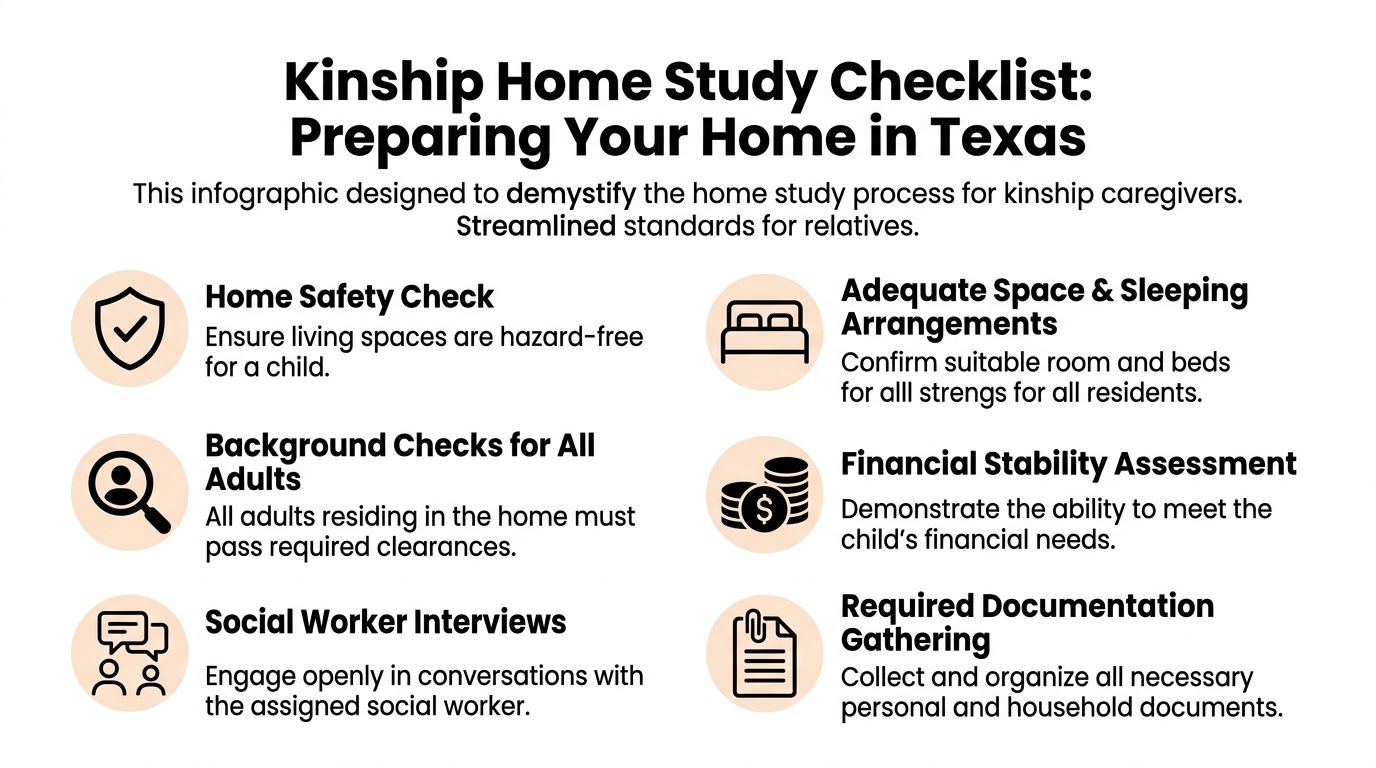
A helpful companion resource is this adoption home study checklist, which can help you organize what to gather.
What the home study usually looks at
A social worker or evaluator is trying to answer a simple question. Is this a safe, stable, loving place for this child?
They often look at:
Safety in the home
Working utilities, safe sleeping arrangements, and a home environment that doesn’t place the child at risk.The adults in the household
Who lives there, who helps care for the child, and whether everyone required to do so completes background checks.Your relationship with the child
How long you’ve known the child, what role you’ve already played, and how the child responds to you.Your understanding of the child’s needs
School needs, emotional needs, medical care, routines, and any special concerns.Your support system
Who helps when you need backup. That might be a sibling, neighbor, church friend, or adult child.
What to gather before the visit
Try not to overthink this part. Start with a folder or binder and collect documents as they come in.
A basic prep list often includes:
Identification and household information
Driver’s license, proof of residence, and basic information about everyone living in the home.Financial records
Pay stubs, benefit letters, or other proof that you can meet the child’s needs.Medical and school information for the child
Names of doctors, schools, medications, counselors, or therapists.Background check materials
Information needed for the required checks for adults in the home.
What the interview feels like
Some conversations are practical. Others are personal.
You may be asked things like:
- Why do you want to adopt this child?
- What changes has the child gone through?
- How do you handle discipline?
- What support do you have if the child is struggling?
- How will you help the child stay connected to important family relationships, if appropriate?
Those questions aren’t traps. They help the evaluator see whether you’ve considered the practical aspects of parenting this child for the long run.
The strongest answer is usually the honest one. “I don’t know everything yet, but I’m committed to learning what this child needs” often lands better than trying to sound perfect.
Where relatives often worry too much
Kinship caregivers sometimes think, “My house is small,” or “I’m older than I was when I raised my own kids,” or “We’ve had a hard year financially.” None of those facts automatically disqualify you.
A home study is not a contest for the fanciest house. It’s an assessment of whether this child can be safe, cared for, and emotionally supported in your home.
If there are issues to address, it’s better to raise them early. A loose handrail, missing paperwork, or confusion about household members can often be fixed. Silence usually creates bigger delays than the issue itself.
The Legal Journey From Filing a Petition to Finalization
Once your family decides adoption is the right path, the legal side begins. At this point, many loving caregivers feel intimidated. Court forms, hearings, and legal standards can sound cold when what you’re trying to do is protect a child you love.
Still, the process becomes easier when you see it as a sequence instead of one giant problem.

The petition starts the case
In Texas, an adoption case usually begins with filing a petition for adoption in the proper court. Chapters 162 through 166 of the Texas Family Code govern much of the adoption process, with Chapter 162 playing a central role in adoption procedure and legal effect.
The petition tells the court who the child is, who wants to adopt, and why adoption serves the child’s best interests.
For kinship cases, the court often wants a clear picture of:
- your relationship to the child
- how the child came into your care
- the child’s current living situation
- and whether any CPS case or prior court orders are involved
Parental rights must be addressed first
This is the part families often fear most. Before an adoption can be finalized, the biological parents’ rights usually must be legally terminated.
That can happen in two broad ways.
Voluntary termination
A parent may sign legal documents relinquishing parental rights. Even when everyone agrees, the court still reviews the case carefully because termination is serious and permanent.
This can be emotionally painful for families. A parent may love the child and still recognize they can’t safely parent.
Involuntary termination
If a parent does not agree, the court may have to decide whether legal grounds exist to terminate that parent’s rights. This usually requires evidence and a formal hearing process.
In plain language, the court doesn’t terminate rights just because a relative can offer a better home. The legal standard is much stricter. The court looks for legally sufficient grounds and whether termination is in the child’s best interests.
If your case involves contested parental rights, careful legal guidance matters more than ever. Small mistakes in pleading or proof can slow everything down.
The child may have their own representative
In some cases, the court appoints an attorney ad litem or another representative for the child. That person’s role is to focus on the child’s interests, not the adults’ preferences.
Families sometimes feel nervous about this, but it often helps. A child-focused professional can give the court a fuller picture of the child’s needs, adjustment, and sense of safety.
Post-placement review and required checks
Even in a family placement, the court usually wants more than your word that things are going well. The judge may review the home study, background clearances, and post-placement information before granting the adoption.
This stage often includes practical questions:
- Is the child settled in the home?
- Are medical and school needs being met?
- Does the caregiver understand the child’s emotional needs?
- Have all legal prerequisites been satisfied?
What the final hearing feels like
The final hearing is often short, but it carries enormous emotional weight. Families walk into court with years of chaos, worry, and hope behind them.
The judge reviews the file and decides whether the adoption should be granted. If the court signs the adoption order, you become the child’s legal parent.
For many relatives, that’s the first moment they can breathe differently.
A simple example
Maria had been raising her nephew after a family crisis. At first, she only needed temporary authority to keep him safe. Over time, it became clear he needed permanence. She completed the home study, worked through the court process, and attended the final hearing with a folder full of records and a nervous stomach.
The judge asked a few questions about the child’s adjustment, schooling, and daily life. Then the judge signed the order. On paper, the law finally matched what the child already knew. Maria was his parent in every way that counted.
Why Chapters 162 through 166 matter
You don’t need to memorize the Texas Family Code, but it helps to know what those chapters do in broad terms.
| Chapter | General purpose in plain English |
|---|---|
| Chapter 162 | Adoption procedures, required reports, and legal effect of adoption |
| Chapter 163 | Interstate issues in some cases |
| Chapter 164 | Limits on challenging completed adoptions in certain situations |
| Chapter 165 | Registry-related issues in some adoption matters |
| Chapter 166 | Alternate dispute resolution and related family law concepts that may affect some cases |
The legal journey in kinship adoption texas is rarely just paperwork. It is a formal way for the court to confirm that permanence, safety, and the child’s best interests all point in the same direction.
Navigating Common Hurdles and Sensitive Topics
One of the hardest days in a kinship adoption case often looks ordinary from the outside. You are standing in your kitchen, your phone lights up, and a relative sends a message saying you are "breaking up the family." Ten minutes later, the child in your care starts crying because dinner is late, even though the actual reason has nothing to do with food. That is what this part of the process often feels like. Legal stress on one side. Family grief on the other.
Those moments can make a loving caregiver feel very alone. You are not alone.

Family conflict can grow even when your intentions are good
A parent may say, "You’re trying to take my child." Another relative may accuse you of controlling the situation. Someone who stayed quiet for months may suddenly appear right before court and demand a say.
Pain often speaks badly.
That does not excuse harmful behavior, but it can help you understand why family conflict gets so intense in kinship adoption cases. Relatives are not just reacting to a legal filing. They are reacting to guilt, fear, shame, and loss. The court still has to focus on the child’s safety and long-term stability, and you may need to be the calm adult in the room even when others cannot.
A few habits can protect both you and the child:
Keep communication centered on the child
Bring the discussion back to school attendance, medical care, routines, and safety. Old family arguments usually make the conflict bigger, not clearer.Write things down
Save texts and emails. Keep notes about missed visits, school concerns, medical appointments, and major incidents. A simple notebook can become as useful as a stack of legal forms.Use one communication channel when conflict is high
Text or email often works better than scattered phone calls and messages through other relatives. It creates a clearer record and lowers the chance of heated back-and-forth.
CPS involvement can pull your heart in two directions
If CPS is part of the case, many relatives feel torn. You may love the child’s parent and still believe the child needs a permanent home with you. Those feelings can sit side by side.
That tension is common in kinship cases because family members are carrying two jobs at once. You are trying to protect a child while grieving what another loved one has lost or may lose. Many caregivers feel guilty for wanting permanence, as if stability for the child means betrayal of the parent. It does not.
The law asks a different question. What arrangement gives this child the safest and most dependable future?
Criminal history issues need early, honest attention
This is one of the most overlooked problems in Texas kinship adoption. Families often assume that a temporary placement means adoption approval will come later. Sometimes it does. Sometimes a criminal history check stops the case or blocks certain financial support.
According to the DFPS policy guidance on criminal history and kinship care, a temporary kinship placement does not guarantee adoption eligibility or related assistance if the caregiver or another person in the home has certain past offenses.
That surprises many good relatives. An old charge may feel buried in the past, but adoption review can bring it back to the surface. In other homes, the issue is not the caregiver at all. It is an adult child, partner, or other household member whose history creates a problem no one saw coming.
Ask these questions early:
- Who in the home must complete screening and background checks?
- Does anyone have an old arrest, conviction, dismissal, or deferred case that should be disclosed now?
- Would changing who lives in the home affect the case?
- Are there records that show rehabilitation or changed circumstances?
Early honesty gives your attorney more room to solve problems. Waiting usually makes them harder to fix.
Because criminal history can also affect benefits after adoption, it helps to learn how Texas adoption subsidy programs may apply in kinship cases before you get into the process. That way, you are not making permanent plans without a clear picture of possible support.
A child may feel safe with you and still struggle profoundly
Kinship placements can look easier than stranger adoptions because the child already knows the caregiver. But knowing you does not erase what the child has lived through. A familiar home can reduce fear, yet grief still comes through the door.
A child may worry that another move is coming. They may miss a parent who was unsafe. They may test limits because they need proof that your love will hold steady on bad days too. To an adult, the behavior may seem out of proportion. To the child, it often makes perfect sense.
At home, that can look like:
- hoarding food after periods of instability
- panic during transitions or school drop-off
- bedtime battles
- anger after visits with parents or relatives
- confusion about what to call you
None of that automatically signals a failing placement. It often signals loss, fear, and divided loyalty.
A child can love their parent, miss their parent, and still need adoption with you. Children do not experience family in neat legal categories. They carry relationships in pieces. Your job is not to force those feelings into a tidy box. Your job is to provide steadiness while the child learns that permanency is real.
Sometimes the most helpful response is also the simplest. Keep dinner at the same time. Keep bedtime predictable. Tell the truth in age-appropriate ways. Get counseling support when needed. Small routines work like handrails for a child whose world has felt shaky.
Sensitive topics do not make your case weaker. They are part of what makes kinship adoption both loving and hard. Families who handle them early, clearly, and with support are usually in a much stronger position than families who try to push them aside.
Understanding Adoption Costs and Financial Support
Money worries stop many families from even asking about adoption. A grandparent may think, “I’m already stretching groceries and school clothes. I can’t afford a legal case too.” That fear is common and understandable.
The financial picture in Texas can feel unfair for kinship caregivers. Licensed foster parents may receive around $812 per month per child, while many kinship caregivers receive only TANF support of $327 per month for a family of three, according to Every Texan’s discussion of kinship care benefits and payment disparities. That same source notes that post-adoption support such as Permanency Care Assistance, or PCA, may be available, and adopting directly from DFPS care can significantly reduce or eliminate some costs.
Where costs may come from
The exact amount varies by case, so it’s better to think in categories than promises.
Possible expenses may include:
- Court filing fees
- Attorney’s fees
- Home study or update costs
- Certified records and paperwork
- and travel or missed work for hearings and appointments
Some kinship cases cost less than families fear, especially when the child is already in DFPS care and public support programs apply. Others become more expensive when parental rights are contested or when the case requires repeated hearings.
Support worth asking about
A lot of families leave money on the table because no one explains what to request.
Ask about:
Permanency Care Assistance
This may apply in some DFPS-related cases, depending on the path your case takes.Adoption assistance connected to DFPS care
In some adoptions from state care, certain expenses may be reduced or covered.Medical coverage and related support
Some children may qualify for ongoing benefits tied to their care history or needs.Available adoption subsidies
This overview of what adoption subsidy means in Texas can help you start the right questions.
A practical way to approach the money issue
Don’t wait until the end of the case to ask about financial help. Ask early, and ask more than once if the answers are unclear.
Keep a file with:
- receipts
- benefit letters
- caseworker emails
- placement paperwork
- and notes from calls about PCA or adoption assistance
That paperwork can matter later. It also helps you see the difference between “this feels impossible” and “this has a process.”
Taking the Next Step Toward Building Your Forever Family
A child who has already been sleeping in your home for months may still go to bed wondering, "Is this where I get to stay?" Kinship adoption gives that child a clearer answer. It turns day-to-day caregiving into lasting legal security, and for many Texas families, that peace matters just as much as the final court order.
By this point, you may feel pulled in two directions at once. Part of you is relieved to be close to the finish line. Another part is tired, worried about background checks, court paperwork, family tension, or whether the costs will keep piling up. Those feelings make sense. Kinship adoption asks families to care for both legal details and tender emotions at the same time.
That is why many relatives need guidance. As noted earlier, kinship families often struggle with court procedures and child welfare red tape. Getting legal help early can make the process feel more manageable, especially when questions come up about criminal history, consent, contested rights, or financial support that could ease the strain on your household.
It may help to think of the process like putting a permanent foundation under a house you have already been living in. The love is already there. The routines are already there. Adoption adds the legal structure that helps protect the child, and it gives you clearer authority to make decisions for the future.
You do not need to have every document, every answer, or every dollar figured out before you ask for help.
If you are caring for a grandchild, niece, nephew, sibling, or another child you love, the Law Office of Bryan Fagan, PLLC can help you understand your options and move ahead with confidence. A free consultation can give you practical guidance on kinship adoption, guardianship, parental rights, home studies, CPS-related questions, and financial support issues, with the compassion Texas families deserve.
