
A lot of families come to this topic after they've already been doing the hard work of parenting.
You may be a grandmother who makes breakfast, helps with homework, and gets a child to bed every night, but the school still wants legal paperwork before discussing enrollment. You may be a stepparent who's there for every fever, practice, and parent meeting, yet a hospital asks whether you have authority to consent to care. You may be a relative thinking about adoption and wondering why an old court order from a divorce case suddenly matters so much.
That's where Texas conservatorship comes in. In Texas, this is the legal structure that gives adults the authority to care for a child, make decisions, and create stability. For families building through stepparent adoption, kinship care, foster care, or guardianship, understanding conservatorship is often the first real step toward lasting security.
Why Understanding Conservatorship Matters for Your Family
Maria had been raising her grandson for many months. She knew his teacher's name, his favorite cereal, and the song that calmed him down at night. But when she tried to handle a school issue, she ran into a wall. Love wasn't the problem. Legal authority was.
That's a painful moment for many caregivers. The child already sees you as the safe adult. The day-to-day parenting is happening. But without the right court order, schools, doctors, and agencies may not be able to treat you as the person in charge.

When love and legal rights don't match
This issue shows up often in family-building situations:
- Grandparents and relatives may be doing the parenting without a clear order that lets them make school or medical decisions.
- Stepparents may have a strong bond with the child but no independent legal rights.
- Foster or kinship caregivers may be preparing for adoption and learning that earlier custody orders still shape the path forward.
- Adult children of aging caregivers may also worry about whether a grandparent's memory issues affect caregiving decisions. In that situation, a practical medical resource like Orange Neurosciences' dementia care guide can help families notice early warning signs and plan ahead with compassion.
One reason families feel lost is that existing Texas conservatorship content rarely explains how a conservatorship order made in a divorce or SAPCR case interacts with later adoption or termination proceedings, especially when one parent seeks to adopt a stepchild or relative and must first terminate the other parent's conservatorship rights, as discussed by Texas Public Radio's overview of conservatorship and guardianship.
Practical rule: If you're trying to build a permanent family through adoption, an old conservatorship order isn't background paperwork. It's often the legal foundation the court must address first.
Why this matters so much in adoption cases
A child needs more than affection. A child needs consistency, safety, and adults who can act effectively when something important happens.
Conservatorship gives structure to that reality. It can define who has decision-making power, who has access to records, and who can guide the child's daily life. For hopeful adoptive parents and relatives, that clarity often becomes the bridge between helping a child and becoming the legally recognized parent or caregiver that child needs.
What Is Conservatorship in Texas
“Custody” is a common term; Texas usually says conservatorship.
The words sound different, but the idea is familiar. Conservatorship is the legal framework a Texas court uses to assign rights and duties involving a child. It separates who makes important decisions from when the child spends time with each adult.
Think of it as a bundle of rights
A simple way to understand conservatorship is to picture a bundle of labeled keys. Each key opens a different part of a child's legal care.
Under Chapter 153 of the Texas Family Code, conservatorship splits decision-making authority from possession and access schedules. The court assigns rights and duties to conservators, including the right to receive information about the child's health, education, and welfare, as explained by WomensLaw's Texas conservatorship overview.
Some of those keys may include the right to:
- Get information about the child's medical care, schooling, and overall welfare
- Access records from doctors, dentists, and schools
- Participate in activities like school events and conferences
- Support the child during the time the child is in that adult's care
That's why conservatorship Texas cases aren't just about a visitation calendar. They're about authority.
Why the term matters in adoption planning
This becomes especially important when a family is moving toward adoption. A stepparent might assume that living with the child and acting like a parent is enough. A relative caregiver may believe a notarized agreement from the parents settles things. In court, those assumptions often fall apart.
A conservatorship order tells the court who currently holds legal rights and which rights may need to be changed, limited, or ended before an adoption can go forward. Families who want a clearer overview of custody-related concepts often start with resources on custody and guardianship in Texas.
Conservatorship answers, “Who gets to decide?” Possession answers, “When is the child with each person?” Adoption answers, “Who becomes the legal parent?”
For many families, especially those exploring Stepparent Adoption in Texas, that distinction is the turning point. Stepparent adoption is the most common Texas adoption, and understanding current conservatorship rights helps explain why consent, termination, and court approval all matter so much.
The Different Types of Conservatorship
Texas courts use a few main conservatorship categories. The names can sound stiff, but the daily impact is very real. The difference usually comes down to who makes major decisions and how much legal authority each adult has.
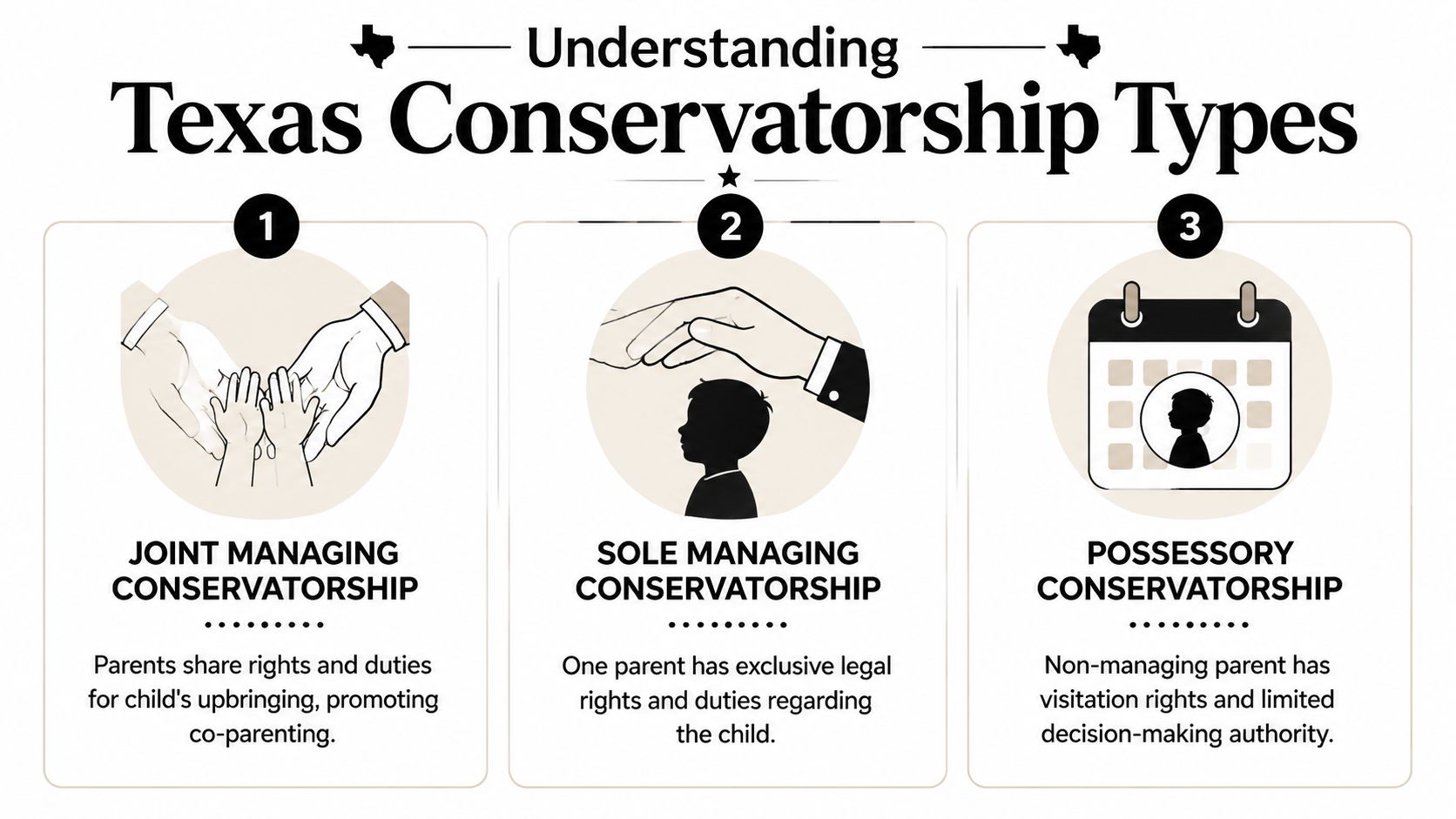
Joint Managing Conservatorship
In Texas, child custody law is governed mainly by Chapter 153 of the Texas Family Code, and a central rule is the presumption that Joint Managing Conservatorship is in the child's best interest unless evidence shows harm, as described in this Texas conservatorship law summary.
Joint Managing Conservatorship, often called JMC, means both parents share important rights and duties involving the child's upbringing. That can include education, medical care, and emotional well-being. Even when parents share those powers, one parent is often given the right to decide the child's primary residence.
In everyday life, JMC can look like this:
- School decisions are shared. Parents may both stay involved with teachers and records.
- Medical choices may require cooperation. The order may say whether a decision is joint, independent, or exclusive.
- The child may live mainly in one home. Shared rights don't always mean equal time.
Sole Managing Conservatorship
A court may appoint one person as the Sole Managing Conservator, often called SMC, when shared decision-making would not protect the child well enough.
This type of order gives one adult the main legal authority over major issues. That can include choosing the child's residence and making certain serious decisions without needing the other parent's agreement.
Families often see this in cases involving major safety concerns, high conflict, or a parent who can't participate in a healthy way. If you want a closer look at that structure, this resource on sole managing conservator in Texas can help frame the issue.
Some parents hear “sole” and assume the other parent disappears from the child's life. That isn't always true. “Sole” usually describes decision-making power, not automatic loss of all contact.
Possessory Conservatorship
A Possessory Conservator usually has visitation or parenting time, plus certain limited rights. This role matters more than many people realize.
A parent in this category may still receive information, spend meaningful time with the child, and remain part of the child's life. But that parent typically does not hold the same power to make binding major decisions.
Here's the practical difference:
| Role | Main focus |
|---|---|
| JMC | Shared major rights and duties |
| SMC | One adult holds primary decision-making authority |
| PC | Time with the child and limited legal rights |
For adoption planning, these labels matter because the court will want to know exactly whose rights exist today before it can create a new legal parent-child relationship tomorrow.
Conservatorship vs Guardianship vs Adoption
Families often use these words as if they mean the same thing. They don't.
All three can protect a child, but they do different jobs. Conservatorship organizes parental rights and responsibilities. Guardianship is often used when someone else must step in and manage care or decision-making because the parent cannot. Adoption creates a new and permanent legal parent-child relationship.
A side-by-side look
Under Texas Family Code Chapter 162, adoption starts with a petition showing that the person filing has standing to adopt, that the child is eligible for adoption, and that the required consents or grounds for termination of the parent-child relationship are in place, according to Texas Law Help's adoption and custody guidance.
That requirement alone shows how adoption differs from conservatorship. Adoption doesn't just manage rights. It replaces the legal structure of parenthood itself.
Comparing Family Legal Statuses in Texas
| Characteristic | Conservatorship | Guardianship | Adoption |
|---|---|---|---|
| Main purpose | Assigns rights and duties involving the child | Allows another adult to care for or make decisions when needed | Creates a new legal parent-child relationship |
| Effect on existing parent rights | May divide, limit, or assign rights without ending all of them | Often used when a parent cannot fully act, depending on the case | Usually requires consent or termination of prior parental rights |
| Permanence | Can be modified by later court order | Often tied to ongoing need and court supervision | Intended to be permanent |
| Best fit for | Parents, relatives, or caregivers needing legal authority now | Families needing substitute decision-making authority | Stepparents, relatives, foster parents, or others seeking permanency |
Which path fits your family
A short example helps. If an aunt is caring for a child because the parents are unstable, conservatorship may give her authority to handle school and medical issues right away. If a stepparent has been parenting the child for years and the family wants full legal unity, adoption may be the long-term goal. If an adult caregiver cannot safely manage responsibilities and another adult must step in, guardianship may be the more fitting tool.
Families often compare these options when they're deciding whether they need temporary stability or permanent legal change. A more detailed discussion of that choice appears in legal guardianship vs adoption in Texas.
The right legal path depends on your goal. If the goal is authority, conservatorship may help. If the goal is permanence and full parenthood, adoption is often the answer.
Where Chapters 162 through 166 fit in
When families think about adoption procedure, they usually focus on the final hearing. The legal work starts much earlier.
In plain English, Texas adoption law in Chapters 162 through 166 covers the petition to adopt, required consents, termination issues when needed, court review, and the final order that establishes the adoptive relationship. Depending on the case, families may also encounter practical steps like background review, a home study when applicable, gathering birth records, and preparing affidavits or consents. In many private, kinship, and stepparent cases, the court also reviews whether the existing conservatorship setup has been properly addressed before finalization.
The Process for Establishing Conservatorship in Texas
A lot of families reach this stage because real life has already changed before the paperwork does. A child may already be living with a grandmother, a stepparent may already be handling school pickups and doctor visits, or a foster parent may be preparing for a more permanent placement. The court process turns that day-to-day reality into a legal order people can rely on.
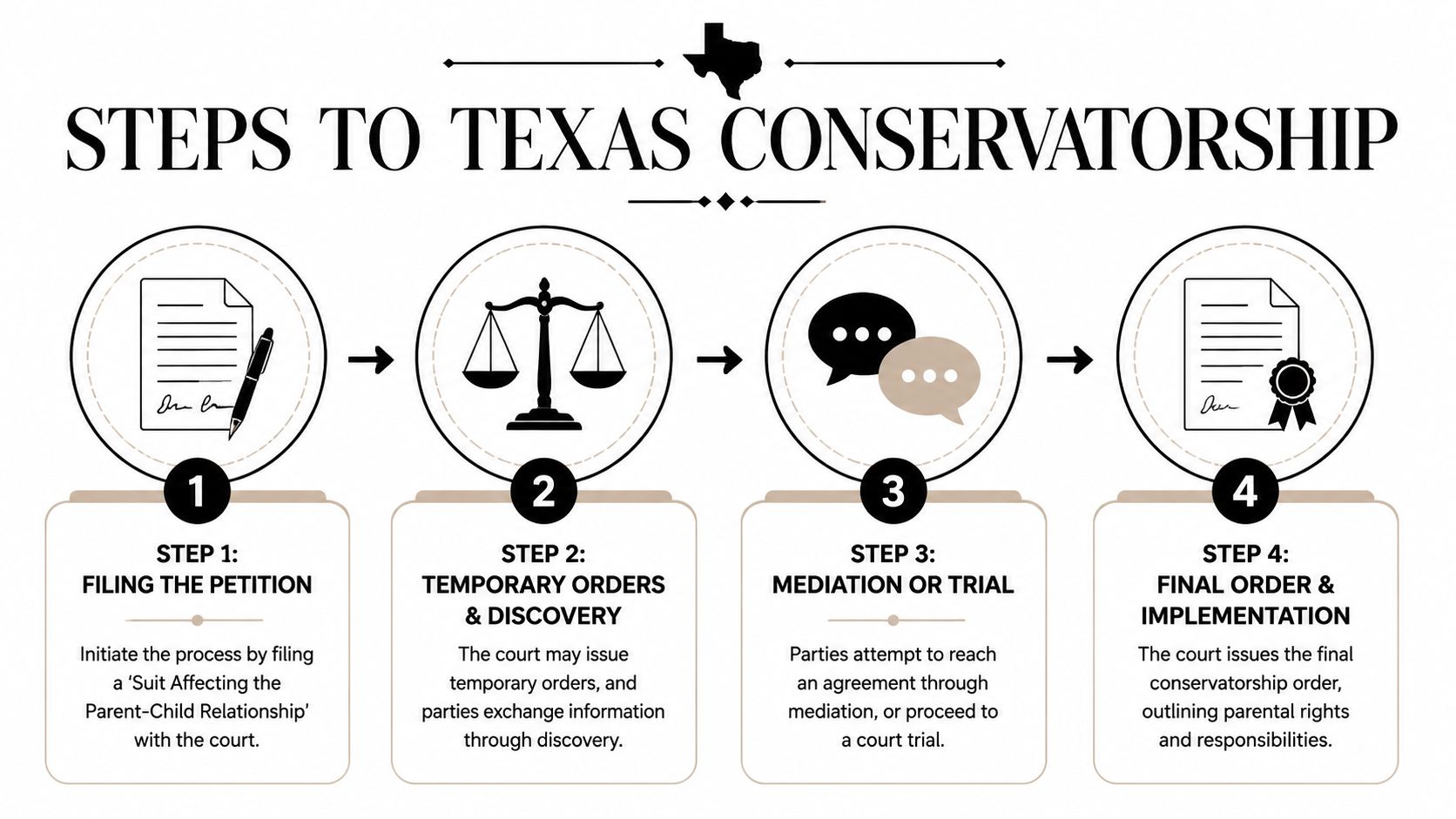
When a family asks a Texas court to set conservatorship, the case often begins with a Suit Affecting the Parent-Child Relationship, usually called a SAPCR. The name is formal. The job is practical. It gives the court a way to decide who can make decisions for the child, where the child will live, and how each adult will share rights and duties.
Step one starts with standing and filing
The first question is whether the person filing has standing. In plain English, standing means the law recognizes that this person has enough connection to the child to ask the court for orders. A parent usually has standing. In some cases, a grandparent, relative, or other caregiver may also qualify, especially if that person has been doing the daily work of raising the child.
The petition is the written request that starts the case. It tells the court what the family is asking for. That may include who should make medical and educational decisions, who should decide the child's primary residence, and what possession or visitation schedule fits the child's needs.
For families building toward adoption, this filing step often answers a basic but important question: who has legal authority right now? If a stepparent hopes to adopt, or a relative caregiver wants to create a stable path toward permanency, the court usually needs that foundation in place first.
Temporary orders can bring stability quickly
Court cases take time. Children still need structure while the adults sort out the legal side.
That is why temporary orders matter. They can set short-term rules about where the child stays, who can consent to care, who handles school issues, and how contact will work while the case is pending. It helps to view temporary orders like a temporary map during road construction. The route may change later, but families still need a safe way to get through each day.
A court may begin with the idea that both parents should be named joint managing conservators, but Texas courts can depart from that when the evidence shows that JMC would “significantly impair the child's physical health or emotional well-being” under Texas Family Code § 153.134(b), as described in this Texas conservatorship overview.
What judges look for: specific facts about the child's safety, health, stability, routines, and care usually matter far more than broad complaints between adults.
A short video can help make the process easier to picture.
Some cases settle by agreement, others need a hearing
Many conservatorship cases end with an agreement, often after negotiation or mediation. That can help reduce conflict and let the adults shape details the court can approve. Other cases require a hearing because the adults disagree about safety, decision-making, or where the child should live.
This is often the point where family-building goals become easier to see. A relative may need to show that the child has already been in their home for a meaningful period of time. A parent may need to respond to concerns about instability, substance abuse, neglect, or family violence. A stepparent preparing for adoption may need the current conservatorship arrangement stated clearly so the next case is built on solid ground instead of assumptions.
The final order matters more than many families expect. A clear order works like the instruction sheet everyone can follow. Schools, doctors, counselors, and later an adoption court may all look to that order to see who has authority and what still needs to change.
The adoption piece often comes next
Once conservatorship is established, some families remain in that structure for the long term. Others use it as the legal base for adoption.
That next stage often includes:
- Reviewing the current order to identify whose rights and duties still exist
- Determining whether consent or termination is required before adoption can move ahead
- Preparing adoption paperwork under the Texas Family Code, including Chapter 162 requirements
- Completing a home study when applicable and gathering supporting documents
- Attending finalization if the court finds adoption is in the child's best interest
Families looking at service options may explore support from attorneys, court self-help resources, or firms such as Law Office of Bryan Fagan, PLLC, which handles adoption and guardianship matters in Texas, including case preparation and court proceedings.
Taking the Next Step to Secure Your Family's Future
When people hear the word conservatorship, they often expect something cold and technical. In real life, it's usually about something very personal. A child needs the right adult to be able to say yes at the doctor's office, speak to the school, provide a steady home, and make decisions that keep life safe and predictable.
That's why learning conservatorship Texas law matters so much for adoptive parents, birth parents, grandparents, relatives, foster parents, and stepparents. It helps you understand who has legal authority now, what must change, and how to move toward more security for the child.
A strong legal foundation supports family unity
For some families, conservatorship is the long-term answer. For others, it's the first step before adoption. In either situation, clarity helps.
It helps a grandmother know whether she can enroll her grandchild in school. It helps a stepparent understand why love alone doesn't create legal parenthood. It helps relatives compare guardianship with adoption. It helps families in LGBTQIA+ and non-traditional parenting situations identify where legal recognition may need to be built more carefully.
The court's focus is the child's best interest. When your legal plan matches the child's real life, the path forward usually becomes much easier to understand.
Small steps count
You don't need to solve everything in one afternoon. Start with the questions right in front of you.
- Read your current order carefully. Look for who holds decision-making rights and whether any rights are exclusive.
- Gather the child's core records. School papers, medical records, and prior court orders often shape the next legal step.
- Define your goal clearly. Are you seeking day-to-day authority, long-term care, or full adoption?
- Ask how adoption law applies. In many cases, Chapters 162 through 166 matter because they govern the path from petition to final order.
If you're feeling overwhelmed, that doesn't mean you're doing anything wrong. It usually means the situation matters.
The legal system can feel intimidating, especially when your family was formed through hardship, second chances, or an unexpected caregiving role. But legal clarity can bring peace. It can protect the child's routine today and strengthen the family's future tomorrow.
If you're trying to understand conservatorship, guardianship, or adoption in a Texas family situation, a conversation can bring the facts into focus. The Law Office of Bryan Fagan, PLLC offers free consultations for families exploring stepparent adoption, kinship care, guardianship, and other child-centered legal options. A confidential meeting can help you sort out your current court orders, understand what steps may come next, and choose a path that supports your child's well-being and your family's future.
