
A lot of people start looking for Texas adoption records at a very ordinary moment. A doctor hands over a family medical history form. A passport application asks for original birth details. A son or daughter asks a simple question about where they came from, and there isn't a simple answer.
For adult adoptees, birth parents, and relatives, that moment often brings a mix of hope and worry. You may feel ready for answers, but unsure where to begin. You may also be carrying grief, loyalty conflicts, or fear about what opening old records could stir up.
Texas law gives some people a clear administrative path. For others, the process is harder and far more legal than they expected. That's why understanding adoption records Texas law matters so much. The right first step can save time, reduce frustration, and help you avoid filing the wrong request with the wrong office.
Some families also come to this issue from the adoption side, not the search side. An adoptive parent may want to understand what information a child can access later. A birth parent may wonder whether a past private adoption can still lead to contact. A stepparent or relative who completed an adoption may want to know how sealed records work after finalization. Texas Family Code Chapters 162 through 166 shape that broader adoption framework, including final adoption orders, the child's legal status, and the record changes that follow adoption.
The First Step on a Journey to Your Past
One of the hardest parts of this process is that the legal question and the emotional question arrive together. Legally, you want to know what records exist and how to request them. Emotionally, you may be asking something much larger: Who am I connected to, and what happened before the adoption became final?
A common example is an adult adoptee who has a loving adoptive family but still feels the pull of missing information. They're not rejecting one family by searching for another. They're trying to fill in blank spaces. Another example is a birth mother who placed a child years ago and now wonders whether the child is safe, healthy, or curious too. Texas law treats these situations through record rules, registries, and court procedures, but the people living them experience them as family questions.
Why this search feels different from other legal tasks
Most legal paperwork is transactional. Adoption records aren't. Even a simple request can carry decades of meaning.
That matters because people often expect a single form and a quick answer. Texas usually doesn't work that way. The state seals adoption records by default, and the route forward depends on what you already know, who handled the adoption, and whether the other party has also taken steps toward contact.
Practical rule: Before filing anything, write down every fact you already know. Full names, possible name spellings, dates, cities, the adoption agency, the court, and whether the adoption involved CPS can all affect where records are held.
Families moving through adoption today should understand this too. When an adoption is finalized under Texas Family Code Chapter 162, the legal parent-child relationship changes in a permanent way. That finality protects stability for the child, which is why Texas also protects records. The law tries to balance privacy, permanency, and a person's interest in their own history. Sometimes those goals fit together. Sometimes they clash.
A calmer way to begin
Start by identifying your role:
- Adult adoptee: You may have access to certain records directly, depending on what identifying information you already know.
- Birth parent: A registry route may be more realistic than expecting open court files.
- Adoptive parent or relative: You may be trying to understand what records exist for a child now and later.
- Family member seeking answers: Your access may depend on consent, registry status, or court involvement.
If you're feeling overwhelmed, that reaction makes sense. Texas offers a path forward, but not the same path for everyone.
Understanding What Texas Adoption Records Contain
A common first frustration sounds like this: “I asked for my adoption records, and they sent me something with half the names removed.” In Texas, that usually does not mean the request failed. It means the file contains different layers of information, and the law treats those layers differently.
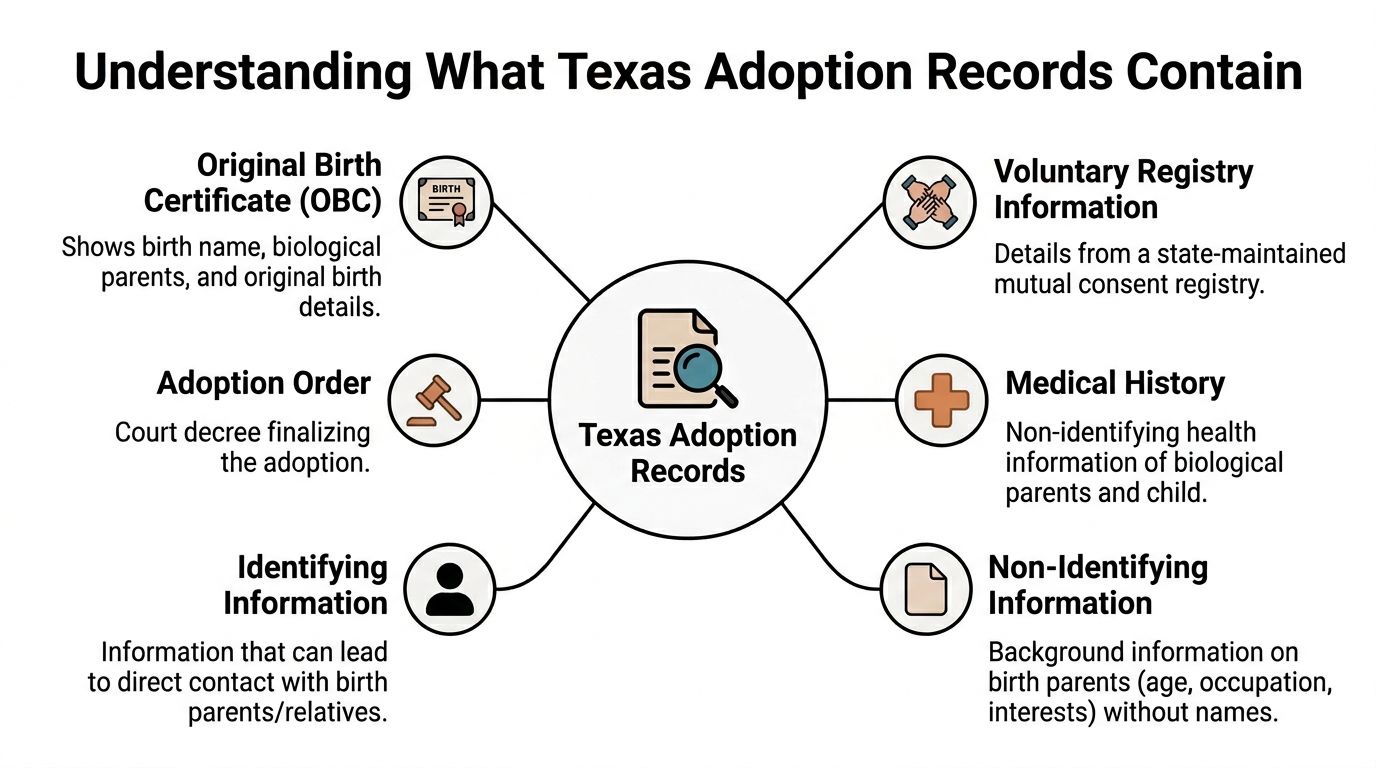
Texas seals adoption files as a default rule. Even so, some people can still get limited records, redacted records, or background information without getting a judge involved. That distinction matters because many families start by asking for “everything,” when a narrower request often gets a better result.
The main record types
“Adoption records” is really a group of documents, not a single file. Some papers prove the adoption happened. Others explain family background, medical history, or the legal steps that changed the child's birth record and parentage.
| Record type | What it generally means |
|---|---|
| Original Birth Certificate | The record created at birth, which may list the birth name, biological parents, and original birth details |
| Final Decree or Adoption Order | The court order that makes the adoption legal |
| Agency file | Records created by the placing agency, sometimes including background details, correspondence, or intake notes |
| Court file | The sealed court record tied to the adoption proceeding |
| Registry information | Information connected to voluntary matching through the state system |
For families still in the process, the final decree is the document that changes legal status. Finalizing a Texas Adoption: The Final Hearing explains what the court reviews and what the judge signs at the end of the case.
Identifying information and non-identifying information
This is the line that controls many access requests.
Identifying information can reveal who a person is or how to locate that person. Names, addresses, dates tied to a specific person, and similar details usually fall into this category.
Non-identifying information gives history without directly exposing identity. That may include medical background, general family traits, education, ethnicity, religion, or circumstances surrounding the placement, depending on what the file contains and what the agency can release.
In practice, many people encounter an emotional wall. They hoped for names and direct answers, but received summaries instead. I often tell clients to treat non-identifying information as a starting point, not a dismissal. It may answer medical questions, confirm family history, or narrow the path before anyone files a court petition.
Requests often succeed or fail based on the category of information requested. A person asking for non-identifying background may get a response through an administrative route. A person asking for names or sealed court records may need a different path entirely.
Where records may be stored
The right office depends on how the adoption was handled and how old the case is. The courthouse may have part of the record. The placing agency may have another part. State agencies may hold birth-record or registry information.
- CPS adoptions: DFPS may hold records connected to adoptions handled through Child Protective Services.
- Private adoptions: The placing agency, attorney, or state vital records system may hold different pieces of the file.
- Closed or merged agencies: Older files may have been transferred, archived, or become harder to trace.
That is why I separate these cases into two tracks early. If you already know key parent names, dates, or agency details, an administrative request may be realistic. If you do not, or if the file sought is sealed court material, the case may be heading toward a petition. If you want to understand how the birth record itself changes after the adoption is completed, this guide to the Texas adoption birth certificate explains what is amended, what remains sealed, and why that distinction matters.
Three Main Pathways to Access Your Records
A client calls after months of searching. She wants one clear answer: where do I start? In Texas, the right first move depends less on how badly you want the information and more on what you already know.
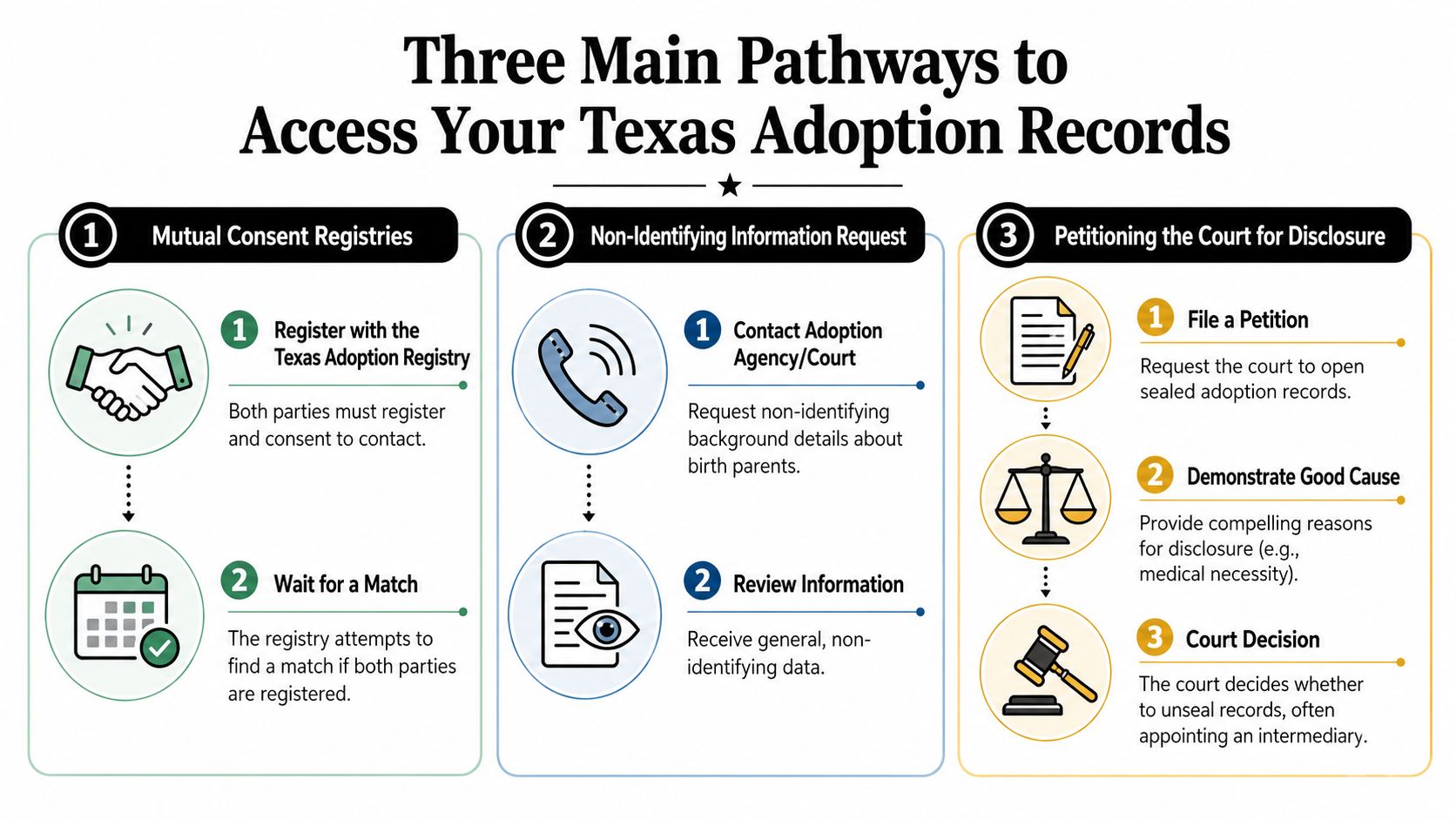
Texas adoption-record access usually falls into three separate paths. The first is a consent-based registry route. The second is an administrative records request. The third is a court case. Keeping those paths separate saves time and disappointment because each one serves a different purpose. For a broader explanation of whether adoption records are sealed in Texas and how to access them, start there, then return to the path that fits your facts.
Path one through the Central Adoption Registry
The registry is the least adversarial option. It only works when both eligible people choose to participate.
Texas uses the Central Adoption Registry as a mutual-consent system. An adult adoptee, birth parent, or eligible biological sibling can register. If another qualifying person has also registered, the state can help connect the parties.
This route makes sense when the goal is contact rather than forced disclosure. It is often a better emotional starting point for people who want to respect privacy and avoid litigation. The trade-off is simple. You can complete every step correctly and still get no match because the other person never enrolled.
This path usually fits best when:
- You believe the other party may welcome contact
- You can wait without a fixed deadline
- You do not need sealed court records opened
Path two through an administrative request
This is the path I review first when a caller already knows key identifying facts, especially parent names.
Texas law allows an adult adoptee to request a noncertified copy of the original birth certificate from the Vital Statistics Unit if the adoptee can identify the parent or parents named on that original record. For people who already have those names from family papers, prior correspondence, or agency information, this can be the most direct route.
If those names are missing, the administrative path becomes narrower. You may still be able to request non-identifying or redacted material, but that often does not answer the question that brought you here.
In practice, the administrative path tends to break down this way:
- Known parent names: request the noncertified original birth certificate
- Unknown parent names: request non-identifying information and assess what it adds
- Agency records involved: determine whether the placing agency still exists and where older files were transferred
People also ask about process. Administrative requests usually require an application, identification, and a fee. The exact paperwork can change, so check the current agency instructions before filing. If you are submitting related pleadings or supporting papers electronically, secure online court document filing can help keep that part organized.
Path three through the court
The court route is for the hard cases. It applies when the registry does not produce a match, the administrative process cannot release what you need, or the records you want are sealed court materials.
A judge will usually expect a specific reason to open sealed records. Medical need, legal status questions, or another concrete necessity generally carry more weight than a general wish to know family history. That wish is real and understandable. It just does not always satisfy the legal standard.
I tell clients to view the court path as a focused petition, not a fishing expedition. The stronger the factual reason, the better the chance of getting meaningful review.
A quick decision guide
| Your situation | Most likely first move |
|---|---|
| You want mutual contact and think the other party may agree | Start with the registry |
| You're an adult adoptee and know the parent names on the original record | Contact Vital Statistics |
| You need sealed records opened and don't meet the administrative rule | Prepare for a court petition |
Petitioning the Court When Other Doors Are Closed
For some people, the court isn't a backup plan. It's the only plan left.
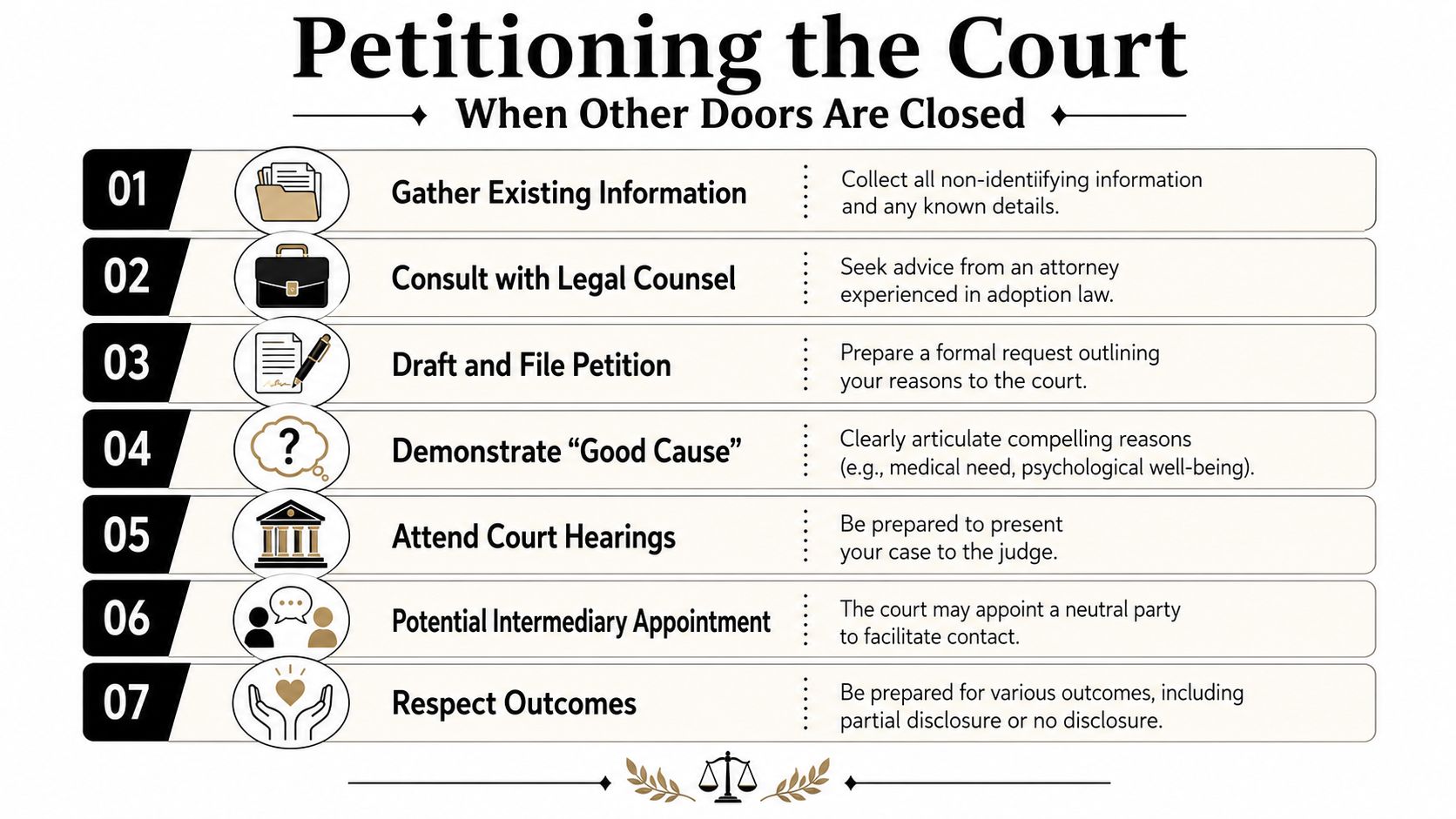
The difficulty is that the judicial process can feel circular. A person needs records to prove why the records matter, but the court wants a strong reason before opening the file. The Texas policy paper on this issue describes the problem clearly. The judicial petition process remains opaque and hard to access for many adult adoptees who do not know their parents' names, and the required showing of good cause can be difficult to prove without the missing information itself, creating a legal paradox discussed in the Texas adoption records access report.
What good cause usually looks like
Texas courts look for more than a general wish to know family history. That wish is deeply human, but judges usually want a reason they can frame as legally compelling.
Examples that may carry more weight include:
- Medical need: A serious health issue where biological family history matters.
- Legal necessity: A need tied to representation, status, or another concrete legal matter.
- Verified family-status concerns: Situations where sealed information affects a legally important question.
Requests built only on ancestry or curiosity often face a steeper climb. That doesn't mean they're unworthy. It means they're harder to fit into the legal standard.
A practical filing checklist
Before filing, gather what you can:
- Every document you already have: Non-identifying information, old correspondence, amended birth records, or prior agency responses.
- Custody history of the file: Who handled the adoption first, and where those records may have gone if the agency closed.
- Reason for the request: State it clearly and support it with documents if possible.
- Correct forms and court details: Accuracy matters early.
If you're handling filing logistics yourself, a resource on secure online court document filing can help you think through document submission and recordkeeping. It isn't specific to Texas adoption law, but it's useful for understanding filing mechanics.
A strong petition is organized, specific, and documented. A vague petition leaves the judge to do too much interpretive work.
What to expect from the process
Some courts may require hearings. Some may deny the request. Some may allow only partial disclosure or use an intermediary approach.
That uncertainty is why many people benefit from legal guidance before filing. For readers comparing options, this page on how to unseal adoption records in Texas outlines the issue from a Texas-focused perspective. The point isn't that every case needs litigation from day one. It's that once you're in court, precision matters.
Navigating Common Hurdles and Emotional Realities
People often blame themselves when a records search stalls. In many cases, the problem is procedural, not personal.
The biggest failure points in Texas adoption record searches are often incomplete name data, misidentifying the original placing agency, and filing the wrong request form first. Those mistakes can cause major delays because the system is built around voluntary registry matching before court intervention, as noted in this discussion of common Texas record-access problems from Angela Adoption.

What tends to go wrong
Some setbacks are very common:
- An agency closed years ago: The record may have been transferred, but not where you expect.
- A family story turns out to be incomplete: A date, spelling, or county may be off.
- A request is legally correct but strategically weak: The form may be fine, but it doesn't match the best route for your facts.
One practical habit helps more than people expect. Keep a search log. Write down every office contacted, every form submitted, every response date, and every new name or clue. Adoption record work often moves in fragments, and memory alone isn't reliable enough.
Preparing for the emotional side
Even a successful search can be hard. The file may answer one question and raise five more. It may confirm a painful story. It may contain very little. Or it may lead to contact when you're still deciding what contact should look like.
That's why emotional preparation matters as much as legal preparation. Some readers find it helpful to journal, work with a trusted friend, or use a communication tool before sending a first message. If you're struggling to put complex feelings into words, this step-by-step guide to sharing feelings may help you sort out what you want to say and what boundaries you want to keep.
You don't need to be certain about reunion, contact, or forgiveness before you start searching. You only need to be honest about what you're looking for today.
For families currently adopting, these realities are worth understanding early. Chapters 162 through 166 of the Texas Family Code reflect the state's focus on permanency, privacy, and the child's best interests. Those values matter at finalization, but they also shape what a child or adult adoptee may face years later when searching for history.
You Are Not Alone on This Journey
A lot of people reach this point after months, or years, of carrying the same question. They have a name but no records. They have records but no answers. Or they have reached a dead end and are trying to decide whether the next step belongs with an agency, a registry, or a judge.
That is why choosing the right path matters. If you already know identifying details such as a birth parent's name, the administrative route may save time and expense. If your goal is contact and both sides are open to it, a registry can be a lower-conflict option. If those routes do not produce results, the court process may be the only workable path, and it usually goes better when the request is narrow, well-documented, and tied to a clear reason.
The legal process is only part of this. Adoption record searches can stir up grief, anger, relief, loyalty conflicts, and fear of what the file may say. I often tell clients that emotional support is not separate from the legal work. It helps people make steadier decisions about whether to search, what to ask for, and how to handle contact if it happens. For readers who want that kind of support, resources about seeking Vernon therapy may be a useful starting point.
You also do not need to solve every question at once.
Some people want medical history and nothing more. Some want a copy of the file. Some want contact, but only after they understand the legal ground first. Those are different goals, and Texas law does not treat them the same way. A clear goal usually leads to a better plan.
Legal help can be especially useful when the record trail is messy. That often happens when an agency closed, the adoption was handled decades ago, family details conflict, or a sealed court file is likely involved. In those cases, Law Office of Bryan Fagan, PLLC handles Texas adoption and guardianship matters, including adoption-related legal process questions.
For many people, this search is really about context. Context can mean medical information, a fuller family history, or the chance to understand what happened. Whatever brings you here, the process tends to feel less overwhelming once you separate the emotional need from the legal route and deal with each one directly.
