
You may be sitting at your kitchen table with a notebook, a list of agency emails, and a question that keeps circling in your mind. “What exactly happens in a home study, and what if we do something wrong?”
That worry is normal. Most hopeful adoptive parents hear the phrase home study and picture a stern inspection, a clipboard, and a pass or fail moment. In real life, texas adoption home study requirements are much more human than that. The process is thorough, yes. But it’s also meant to help you prepare your home, your paperwork, and your family story for a child who needs safety, stability, and love.
If you're pursuing a private adoption, a stepparent adoption, a kinship adoption, or a foster care adoption, the same core truth applies. The home study is not there to trip you up. It’s there to help the court and the professionals involved understand whether your home is ready for this child, and what support your family may need along the way.
Your Journey to Parenthood Understanding the Texas Home Study
A couple often starts this process with a simple goal. They want to become parents, or they want to make an existing parent-child bond legally secure. Then someone says, “You’ll need a home study,” and the mood changes. Suddenly, the joy gets mixed with nerves.
That reaction makes sense. The term sounds clinical. It can make kind, capable people wonder if they’re about to be judged for the color of their walls, the age of their couch, or whether the laundry is folded.

A better way to see it is this. The home study is a guided partnership. It helps you show who you are, how you live, and how you plan to care for a child. It also helps identify paperwork issues, safety fixes, or unanswered questions before they become courtroom delays.
Take a common example. A family may be warm, stable, and fully ready to parent, but they forget to gather medical forms, or a background check needs clarification, or an evaluator wants to hear how each spouse handles stress. Those aren’t signs of failure. They’re normal parts of a process designed to slow down and protect a child’s best interests.
The families who do best in a home study usually aren’t the ones with the most perfect homes. They’re the ones who answer honestly, stay organized, and treat the process as preparation.
Texas adoption law centers on the child’s welfare. That theme appears again and again in the Family Code, especially in the adoption chapters that guide petitions, evaluations, and final court approval. If you understand that one principle, the home study starts to make much more sense.
The Heart of the Matter What Is a Texas Adoption Home Study
A Texas adoption home study is a professional evaluation of your home life, family relationships, background, and readiness to parent. In plain English, it asks a simple question. Is this a safe and stable place for a child?
That question carries legal weight. Texas courts don’t finalize most adoptions without careful information about the proposed home. The home study gives the court a structured, documented picture of the family seeking to adopt.
Who performs the home study
Not just anyone can do this work. In Texas, qualified home study evaluators must hold an accredited degree in human services and a professional license in a social services field, and the law also requires training and experience standards under Texas Family Code § 107.154. The evaluator’s role is broad. The evaluator looks at the child’s needs, the safety of the home, and the adoptive parents’ strengths and weaknesses, using professionally verified information rather than self-report alone, as explained in this overview of Texas home study evaluator qualifications and assessment standards.
That matters for two reasons. First, it protects children. Second, it protects families by making sure the final report is credible and legally usable.
What the home study is really measuring
People often think the home study is mainly about cleanliness. It isn’t. Safety matters, but the evaluator is also looking at your daily life and long-term stability.
They want to understand things like:
- Your motivation to adopt. Why are you pursuing adoption, and how have you prepared emotionally?
- Your household relationships. How do the adults in the home communicate, solve problems, and support one another?
- Your parenting approach. How do you think about discipline, attachment, routines, school, and emotional needs?
- Your stability. Can you provide consistency, care, and practical support for a child?
This is one reason many families feel relief after the first meeting. The conversation usually feels less like an inspection and more like a serious but respectful interview.
Why the process feels personal
It is personal. Adoption is personal.
The evaluator may ask about your childhood, your marriage or partnership, past losses, fertility struggles, your support system, and how you handle conflict. These questions can feel intimate, especially if you’ve never said parts of your story out loud to a professional.
That doesn’t mean you’re being judged for having a real life. It means the evaluator is trying to understand how you’ll parent a child with real needs, real feelings, and possibly real trauma.
Practical rule: Don’t aim to sound perfect. Aim to sound thoughtful, self-aware, and honest.
If you want a helpful overview of what families are typically asked to address, this guide on the top components of a Texas adoption home study is a useful companion.
Preparing Your Paperwork A Document Checklist for Your Home Study
A lot of families reach this stage with the same worry. The forms start piling up on the kitchen table, every agency email seems to request something new, and the whole process begins to feel like a test you did not study for.
It helps to reframe what is happening.
Your paperwork is not there to trap you. It works more like the foundation under a house. Before an evaluator can assess readiness, they need a clear, accurate picture of who you are, how your household functions, and whether the basic pieces are in place to support a child. Once you sort the documents into a few clear categories, the process usually feels far more manageable.
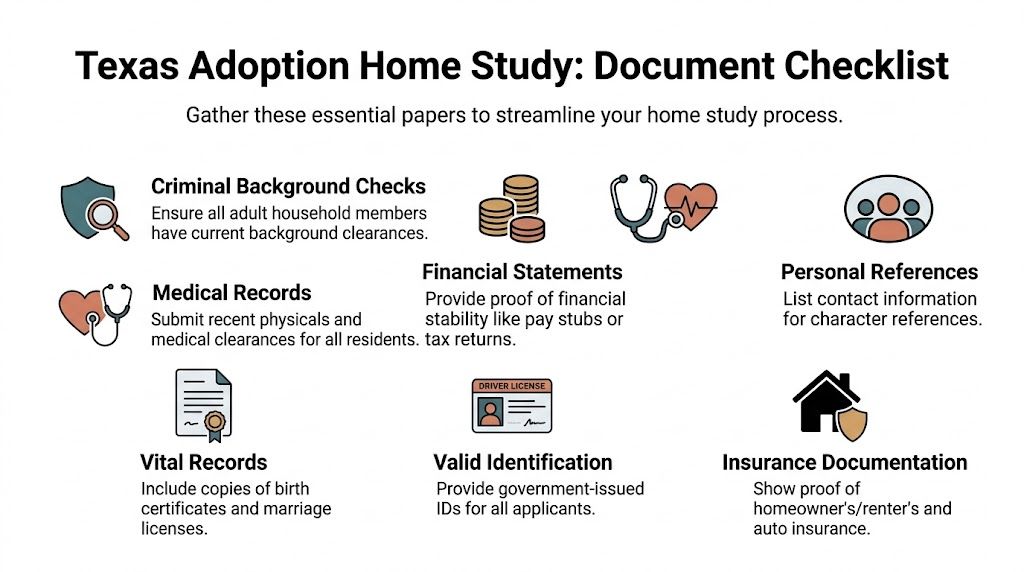
Start with identity and vital records
These documents form the spine of your file. They confirm who the applicants are and help the evaluator match the rest of the paperwork to the correct people.
You may be asked for:
- Birth certificates for the applicants
- Driver’s licenses or passports
- Marriage or divorce records, if those apply to your family history
These records can also clarify family relationships in certain cases. A stepparent adoption may require documents that show the legal relationship between the adults and the child. A kinship adoption may call for records that help establish how relatives are connected.
Show stability in your finances
This part causes a lot of unnecessary fear.
The home study is usually looking for stability and planning, not a particular income bracket or a perfect financial profile. A social worker wants to see that your bills are manageable, your income is documented, and your household can make room for a child’s day-to-day needs.
Families are often asked to provide:
- Tax returns
- Pay stubs
- Debt statements or related financial records
- Insurance information, if requested by the provider
A modest household with steady income and a realistic budget can present very well. By contrast, a household with strong earnings but missing records or inconsistent payments may face follow-up questions. The issue is usually clarity, not wealth.
Gather medical records early
Medical paperwork often takes longer than people expect because doctors’ offices may need time to complete forms or release records.
Common requests include:
- Medical records or physician statements
- Information about ongoing treatment, if relevant
- Basic health information for household members, depending on the provider and adoption path
If you live with a chronic condition, that alone does not disqualify you. Evaluators are generally trying to understand whether the condition is being treated, whether you can meet a child’s needs consistently, and whether you have backup support if you need it.
Choose references who know your real life
Personal references carry weight because they give the evaluator a picture of how you relate to other people outside the interview setting. Texas home studies commonly ask for three personal references.
Choose people who can describe more than your good intentions. The strongest reference is often someone who has seen you handle disappointment, keep commitments, care for children, or show patience under stress. A shorter letter with specific examples usually helps more than a polished letter full of general praise.
A useful reference explains why the writer believes you can offer a child safety, consistency, and care.
Prepare background check authorizations
This category is administrative, but it matters a great deal. The evaluator may ask you to sign releases or authorizations for criminal history checks, child abuse or neglect registry checks, and other verifications required by the provider or adoption type.
That request can feel intimidating. In practice, it is part of building a verified file, not a signal that something is wrong.
A simple system helps. Keep one folder, paper or digital, with clearly labeled sections for identification, finances, medical forms, references, and signed authorizations. If a provider asks for an updated version later, you will not have to start from scratch.
Here is a practical quick list:
Home study document checklist
- Identity records such as birth certificates and photo IDs
- Financial records such as tax returns and pay stubs
- Medical statements from a physician
- Three personal references
- Background check authorizations related to criminal and abuse or neglect histories
If you want a fuller filing plan, this guide to essential required documents for a Texas adoption home study gives a more detailed way to organize everything before your first appointment.
Welcoming the Evaluator What to Expect During Home Visits and Interviews
The doorbell rings. You glance at the kitchen counter, notice a pair of shoes by the couch, and wonder whether the evaluator will see a warm family home or a list of flaws.
That moment carries a lot of pressure. It helps to know what the visit is for. A Texas adoption home study is meant to give the evaluator a real picture of your household, your routines, and your readiness to care for a child. It works more like a guided assessment than a pass or fail inspection.

What the evaluator looks for in your home
During the home visit, the evaluator is checking whether the space is safe, stable, and workable for a child.
A tidy home helps, but perfection is not the standard. A home study is closer to a safety walkthrough than a design review. The evaluator will usually pay attention to practical concerns such as working smoke detectors, clear exits, safe storage for medications and cleaning products, and secure firearm storage if firearms are present. They will also want to see where a child will sleep and whether the home is generally cared for.
Ordinary family life is expected. Laundry in a basket, school papers on the table, or breakfast dishes in the sink usually do not create concern. Problems tend to arise when there are genuine safety risks, major unrepaired hazards, or conditions that suggest a child could be harmed.
Who may be interviewed
The conversation usually extends beyond the prospective adoptive parent or parents. Evaluators often speak with each adult in the home and with children in the household, depending on their ages. They may also try to contact older children who live elsewhere if those relationships are part of the family picture.
That wider lens can catch families off guard. But it serves a simple purpose. Adoption affects the whole household, so the evaluator is trying to understand how people relate to one another, how conflict is handled, and whether the home feels emotionally steady as well as physically safe.
What the interview usually feels like
Families often expect something formal and intimidating. In practice, the interview is usually a structured conversation.
You may be asked about your reasons for adopting, your relationship history, your childhood experiences, your parenting views, and the support you have around you. If there has been counseling, a job loss, a legal issue, or a difficult family period, honesty matters far more than a polished answer. Evaluators are not looking for people with perfect histories. They are looking for adults who understand their own lives and respond responsibly to challenges.
A good comparison is a doctor taking a full history before treatment. The questions can feel personal, but the point is to understand the whole situation, not to catch you making a mistake.
One spouse may answer quickly while the other pauses and chooses words carefully. That difference is normal. Quiet does not mean unprepared, and nervousness does not mean unfit.
To get a feel for the emotional side of these conversations, this short video may help:
How to prepare without sounding rehearsed
Good preparation is calm and practical.
- Talk together before the visit about why you want to adopt, what concerns you have, and how life may change after placement.
- Walk through your home with fresh eyes and fix clear safety issues such as missing detector batteries, exposed hazards, or unsecured medications.
- Review your paperwork so names, dates, and major life events match what you have already submitted.
- Let children know who is coming in simple, age-appropriate language, without coaching them on what to say.
- Answer directly and truthfully if hard topics come up.
You are not trying to perform. You are helping the evaluator understand whether your home and your family relationships can support a child.
That shift in perspective matters. Families often relax once they see the home study for what it is: a partnership designed to identify strengths, address concerns early, and clear away avoidable roadblocks before a child joins the family.
One Goal Different Paths Home Study Rules for Stepparent Kinship and Foster Adoptions
Texas adoption home study requirements don’t look exactly the same in every case. The child’s relationship to the adoptive parent, the route into adoption, and the court’s role can all affect what the process looks like.
The shared goal stays the same. Texas wants enough reliable information to decide whether the adoption serves the child’s best interests. But the path can differ in meaningful ways.
Stepparent adoptions
Stepparent adoption often feels emotionally straightforward. A stepparent may already be raising the child every day, attending school meetings, handling bedtime, and acting as a parent in every practical sense.
Legally, though, the court still needs to protect the child. In some uncontested stepparent adoptions, a court may waive the full study. Even then, criminal records are still reviewed. That balance allows the court to streamline a familiar family situation while still keeping child safety at the center.
This is one reason stepparent families shouldn’t assume the process is automatic. Even when the facts feel simple, the legal steps still matter.
Kinship and relative adoptions
Kinship adoption can be profoundly meaningful and extremely complicated at the same time. Grandparents, aunts, uncles, older siblings, and other relatives often step in during a crisis. By the time they consider adoption, they may already have done months or years of parenting.
Texas sometimes treats those existing relationships as important context. Some relative caregivers with an ongoing significant relationship to the child may move through a more customized process, depending on the case posture and the agency involved.
Interstate kinship cases add another layer. For out-of-state relative placements under ICPC, Texas requires a full home study with background checks for all adult household members, and there is also a “new model” aimed at reducing completion times for identified kinship requests. That issue matters because 40%+ of Texas foster adoptions involve kin, according to this discussion of Texas kinship ICPC home study procedures.
Relative caregivers often assume the family connection will make paperwork simple. Sometimes it helps. It doesn’t remove the need for complete documents and careful court presentation.
Foster care adoptions
Foster to adopt usually brings the most structured oversight. The state has a direct role in placement, supervision, and permanency.
Families in the foster system must be at least 21, financially stable, mature, and responsible. DFPS-related home studies also require references, background and registry checks, home visits, and proof of marriage or divorce when applicable. Foster-specific standards can include limits of no more than 6 children total in the home, pet vaccination requirements, fire and safety inspections, CPR and First Aid certification, TB testing, and 20+ hours of annual training, as summarized in this Texas adoption statistics and requirements overview.
That doesn’t mean foster families face a hostile process. It means the system is designed for ongoing state involvement and a child population that may have experienced significant instability.
Private domestic adoptions
Private domestic adoption often combines agency, attorney, and evaluator involvement. The home study is still thorough, but the case may move on a different rhythm than a foster care adoption.
Parents usually gather personal, financial, medical, and background documents, complete home visits and interviews, and later complete post-placement supervision before finalization. In these cases, timing and document coordination matter a great deal because the file may pass through several hands before it reaches the court.
A side by side comparison
| Requirement | Private Infant Adoption | Stepparent Adoption | Kinship (Relative) Adoption | Foster Care Adoption |
|---|---|---|---|---|
| Typical home study need | Usually required | May be waived in uncontested cases, depending on the court | Often required, though existing family relationship may shape the process | Required |
| Background review | Yes | Criminal records still reviewed even if study is waived | Yes | Yes |
| Household interviews | Common | May be narrower depending on the case | Common | Common |
| Home visit | Common | May vary if the court waives a full study | Common | Common, with added state standards |
| Training requirements | Provider-specific | Usually less intensive than foster cases | Depends on the case and placement route | Ongoing training required |
| Interstate issues | May arise if placement crosses state lines | Less common | ICPC can be a major factor for out-of-state relatives | Can involve interstate coordination in some cases |
| Court focus | Readiness for initial placement and final adoption | Existing parent-child bond and legal stability | Family continuity, safety, and legal permanency | Safety, permanency, and child adjustment |
Where families often get confused
The confusion usually comes from assuming one adoption path works like another.
A stepparent may read foster care guidance and panic about training rules that won’t apply in the same way. A relative caregiver may read a private adoption checklist and miss interstate requirements. A foster parent may not realize the court will still need a final adoption report submitted before the hearing.
For example, in adoption matters tied to foster care, studies must be submitted to the court 10 days before the adoption hearing, and post-placement review generally occurs after the child has lived in the home for at least 5 months, unless a court orders otherwise. Those timing rules can affect finalization planning.
That’s why the smartest first question isn’t “What does a Texas home study require?” It’s “What does a Texas home study require in my kind of case?”
Avoiding Delays Common Home Study Hurdles and How to Prepare
You have your documents spread across the kitchen table, your calendar is filling up, and one question keeps surfacing: what slows a home study down? In Texas, the answer is usually something ordinary. A form expires. A signature is missing. A background record needs context. An evaluator asks a follow-up question that no one expected.
That can feel discouraging, especially if you are already carrying the emotional weight of adoption. But the home study works less like a pass or fail exam and more like a guided review. Its job is to identify questions early, give you a chance to answer them clearly, and help create a safe, well-documented path toward placement.

Where delays usually begin
Delays often start with small administrative gaps, the legal equivalent of forgetting one page in a packet that otherwise looks complete.
A few trouble spots come up often:
- Incomplete paperwork. One missing medical form, reference, or signed release can pause the entire file until the evaluator has what is needed.
- Background check questions. Older arrests, dismissed cases, or records with limited detail may need court papers or a written explanation.
- Financial loose ends. Pay stubs alone may not answer questions about self-employment, recent job changes, child support obligations, or significant debt.
- Different answers from adults in the home. If spouses or household members describe different expectations about parenting, routines, or discipline, the evaluator may need clarification.
- Correctable safety issues. Unsecured medication, missing smoke detectors, firearms that are not properly secured, or minor repairs can lead to a follow-up visit or updated photos.
None of these issues necessarily means something is wrong with your family. They usually mean the evaluator needs a clearer record.
Preparation that prevents the avoidable problems
A good way to prepare is to treat the home study like both a family conversation and a legal file. One part asks, "Is your home ready?" The other asks, "Can the court verify that readiness on paper?"
Start with your records. Create one organized folder, digital or paper, for identification, tax returns, medical forms, references, financial records, and any authorizations you have signed. If a document has an expiration date, write that date on your calendar now. That small step prevents a common problem: a family submits everything on time, then learns one item expired while the rest of the file was being reviewed.
Next, review your own history before someone else asks about it. If there was a prior legal issue, even one that feels old or minor, gather the paperwork and prepare a short, honest explanation. Evaluators are usually less concerned by a past problem that is documented and addressed than by a vague answer that leaves questions open.
Then talk as a household. Discuss work schedules, childcare plans, discipline approaches, sleeping arrangements, transportation, and who will help in the first weeks after placement. Families are often surprised by how helpful this conversation is. It does more than prepare you for interviews. It helps you build the kind of shared understanding that children need once they arrive.
Walk through your home the same way a careful guest would. Open the medicine cabinet. Check cleaning supply storage. Test smoke detectors. Look at stairs, pools, pets, and any space where a child might sleep or play. The goal is not a picture-perfect house. The goal is a home that shows thought, safety, and follow-through.
One more habit matters. Respond to follow-up requests promptly. A two-minute email confirming a document is on the way can prevent a week of unnecessary silence. If you are trying to estimate how much time to build into your plans, this guide on how long a home study takes in Texas can help you set a more realistic timeline.
A simple rule for hard questions
If part of your file needs explanation, address it early and directly.
That includes prior custody disputes, criminal history, financial disruptions, mental health treatment, or unusual living arrangements. These topics can make families nervous, but honesty usually reduces delay. An evaluator can work with clear information. An incomplete answer often leads to more paperwork, more interviews, and more waiting.
Some families also decide to get legal guidance at this stage, especially if the case involves interstate concerns, prior court orders, or a household situation that may need added explanation. The Law Office of Bryan Fagan, PLLC assists Texas families with adoption paperwork, home study preparation, and court filing strategy.
Your Next Step Toward Building Your Family
The home study asks a lot from families. It asks for documents, reflection, interviews, and patience. That can feel heavy when you’re already carrying hope, uncertainty, and the emotional weight of adoption.
But there’s another way to see it.
The home study is where your family begins telling its story in a form the court can trust. It turns your intentions into a record. It gives shape to the daily life you’re offering a child. It shows that adoption is not an impulsive act. It’s a thoughtful commitment.
Texas adoption law, including the procedures found in Chapters 162 through 166 of the Family Code, is built around the child’s best interests. That principle can make the process feel strict, but it also gives adoption its seriousness and meaning. The same legal system that asks for background checks, evaluations, and verified documents is the one that ultimately gives a child legal permanence and a family legal security.
If you’re a hopeful parent, a stepparent, a grandparent, or another relative caregiver, it helps to remember this. You don’t need to perform your way through a home study. You need to prepare, stay honest, and ask for help when something feels unclear.
That’s often the difference between a stressful process and a manageable one.
The families who move through this stage with the most confidence usually do three things well. They organize their paperwork. They treat the evaluator like a professional partner. And they keep the focus where Texas courts keep it, on building a safe, loving, legally secure home for a child.
If you’re ready to take the next step, the Law Office of Bryan Fagan, PLLC offers free consultations for Texas families exploring adoption and guardianship. Whether you’re preparing for a home study, sorting out a stepparent or kinship case, or getting ready for finalization, a confidential conversation can help you understand your options and move forward with clarity.
