
You may be sitting at your kitchen table with a notebook open, a list of questions in front of you, and one worry repeating in your mind. What if the home study goes badly?
That fear is common. So is the feeling that someone is about to grade your home, your marriage, your finances, or your past. Many hopeful parents in Texas start the adoption process with that exact concern.
It is gentler than that. An adoption home study texas process is not supposed to be a search for perfection. It is a legal and practical review that helps confirm a child can be placed in a safe, stable, and prepared home. It also gives your family a chance to slow down, gather important records, talk openly about parenting, and get ready for one of the biggest changes of your life.
Texas adoption law centers on the best interests of the child, and that principle runs through the adoption chapters families often hear about in the Texas Family Code, especially Chapters 162 through 166. In plain English, that means the court wants reliable information before creating a permanent legal parent-child relationship. The home study is one way the court and the professionals involved collect that information.
If you're a stepparent, grandparent, foster parent, same-sex couple, single parent, or hopeful adoptive family pursuing a private adoption, the questions may look a little different. But the heart of the process stays the same. Can this family meet a child's needs with safety, honesty, and commitment?
Your Adoption Journey Begins The Texas Home Study
You may be sitting at the dinner table after the kids are asleep, looking at a legal pad full of notes, and hearing one phrase over and over in your mind: home study. For some families, that moment comes after infertility treatment. For a grandparent, it may come after months of doing the daily work of parenting without legal certainty. For a stepparent or same-sex couple, it may come after years of loving a child and wanting the law to catch up with real life.
Then the questions start. Will someone judge our house? What if our family does not fit a traditional mold? What if we say the wrong thing?
A Texas home study is a collaborative preparation process. A licensed social worker learns about your household, your history, and your plan for parenting through adoption. The written report helps form part of the legal record in your case, but the process also serves another purpose. It helps your family get ready, spot issues early, and talk through the practical and emotional parts of adoption before a child is placed.
That distinction can calm a lot of fear. A home study is closer to building a strong foundation before a house goes up than to sitting for a final exam. The goal is not to present a flawless life. The goal is to show that your home is safe, your expectations are realistic, and your family can meet a child's needs with honesty and stability.
In Texas, families often complete a home visit, interviews, background screening, document review, and health-related paperwork as part of the process. The exact path can look different depending on the adoption. A kinship caregiver may need to explain an existing family history. A stepparent may already have years of daily parenting to discuss. LGBTQ+ parents sometimes worry about being misunderstood, but the focus should remain on safety, readiness, and the child's welfare, not on whether your family looks like someone else's.
Many parents feel the most tension before the process starts. Once it begins, the uncertainty usually gives way to concrete tasks and clearer expectations.
The social worker is not looking for magazine-perfect rooms or rehearsed answers. A lived-in home is normal. What raises concern is usually something more practical, such as missing records, unsafe storage of medication or firearms, unclear finances, or unanswered questions about who lives in the home and how the family handles stress.
That is why mindset matters. If every question feels like a trap, the process can feel heavier than it is. If you approach it as guided preparation, the same questions become useful. Why adoption? How do you resolve conflict? Who helps when work gets busy, a child is struggling, or grief surfaces after placement? Good home studies ask for thoughtful answers because good parenting does too.
If you want a clearer picture of the purpose behind the process, this guide explaining what a home study is for adoption offers helpful background in plain language.
Understanding Home Study Requirements for Your Adoption Type
A home study changes shape depending on the kind of adoption you are pursuing. The legal standard stays the same. Texas courts want enough information to decide whether the placement serves the child’s best interests. But the questions asked, the records reviewed, and the family history discussed can look very different from one case to another.
That difference can feel confusing at first. Families often compare notes with friends or relatives and assume the process should match. It rarely does. A grandmother raising her grandchild is starting from a different place than a couple hoping for a private infant placement. A stepparent who has packed lunches and attended parent teacher conferences for years will be evaluated differently than someone preparing to welcome a child not yet in the home.

It helps to view the home study as a map, not a hurdle. The map is drawn around your family’s actual path.
The baseline requirements most families share
Texas sets general qualifications for adoptive applicants. According to Texas adoption requirements summarized here, applicants must be at least age 21, financially able to provide for their family and the child, healthy enough to assume parenting responsibilities, and willing to parent an adopted child while respecting the child’s religious affiliation, if any.
Across adoption types, the home study usually examines four areas:
- Household stability. Who lives in the home, how daily life works, and whether the household can offer consistency.
- Financial capacity. Courts are not looking for wealth. They want to see that bills are managed and a child’s basic needs can be met.
- Physical and emotional readiness. A medical condition or past hardship does not end the conversation. Clear treatment, honest discussion, and a realistic care plan matter far more.
- Home safety. The question is whether the home is safe and appropriate for a child, not whether it looks perfect.
If you like to prepare by reading ahead, this guide to required Texas home study documents can help you see how these broad requirements turn into specific paperwork.
How the adoption type shapes the process
The easiest way to understand this is to ask one question: what does the court need to learn about this family that it does not already know?
| Adoption type | What the home study often focuses on |
|---|---|
| Private adoption | Readiness for placement, motivation to adopt, support system, full household review |
| Kinship or relative adoption | Existing relationship with the child, current caregiving role, long-term stability |
| Stepparent adoption | The child’s established bond with the stepparent, family dynamics, and local court requirements |
| Foster care adoption | Ability to meet the child’s behavioral, emotional, developmental, and trauma-related needs |
That table is a starting point, not a script. Real families do not fit into neat boxes. A kinship placement may also involve trauma history. A private adoption may raise questions about interstate rules or prior infertility grief. The home study should make room for those realities.
Kinship and relative adoption
Kinship adoption often carries two stories at once. One is legal. One is deeply personal.
You may already know the child’s bedtime habits, allergies, school struggles, and fears. You may have stepped in during a crisis, long before anyone mentioned adoption. In that setting, the home study usually spends less time asking, “Can this family begin caring for this child?” and more time asking, “How has this caregiving relationship worked, and can it continue in a stable, permanent way?”
That can be a relief, but it can also stir up grief, family conflict, or guilt. Relative caregivers sometimes feel that asking for documents or references minimizes the love already present. It does not. Courts still need a clear record. Family history opens the door. Documentation helps complete the legal picture.
Stepparent adoption
Stepparent adoption usually feels familiar because the parenting relationship already exists. The child may already rely on you for discipline, comfort, rides to practice, and everyday routines. The legal system, though, still has to confirm that the adoption is proper and that all required consents, notices, or termination issues have been addressed.
For that reason, the evaluation in a stepparent case often centers on the life already being lived inside the home. How does the child relate to the stepparent? How long has the relationship been stable? What role does the other legal parent play, if any? Some courts may require a more formal adoption evaluation, while others may handle the case with a narrower review, depending on the facts and local practice.
Private adoption
Private adoption home studies often cast a wider net because the child may not yet be placed with the family. The reviewer may spend more time on your reasons for adopting, your support system, your plans for leave from work, and how you would handle medical or emotional uncertainty after placement.
For many hopeful parents, this is also the part where self-discovery becomes real. Questions about infertility, expectations, openness with birth parents, and flexibility are not side issues. They are part of preparing to parent a child with a story that began before you met.
Foster care adoption
Foster care adoption usually involves the most detailed discussion of the child’s needs. If a child has experienced neglect, abuse, multiple placements, or developmental delays, the social worker will want to know how you plan to respond during hard moments, not only calm ones.
That focus is not meant to intimidate you. It is closer to planning for weather before a trip. Families do better when they know what may come and what support they will use if it does. Training, therapy resources, school advocacy, respite care, and informed expectations all matter here.
Families who worry they do not fit the “standard” picture
Many families wonder whether their structure will create extra scrutiny. Kinship caregivers may worry that past family turmoil will overshadow present stability. LGBTQ+ parents may worry about bias. Single parents may worry every question about support is really doubt in disguise.
The law should remain centered on the child’s welfare and the adults’ readiness to parent. A strong home study reflects that. It should examine safety, consistency, support, honesty, and preparation. It should not reward one family style over another.
The goal is a clear, truthful portrait of your home. Once you understand which parts of your adoption story matter most, the process usually feels less like guessing and more like getting ready.
Gathering Documents and Preparing for Background Checks
This part of the process often feels less emotional and more administrative. It can also create avoidable delays if families wait too long to start. The good news is that paperwork becomes much easier when you organize it early and treat it like a shared project instead of a last-minute scramble.
Texas home studies involve extensive background checks overseen by DFPS, including criminal history screenings, child abuse clearances, and FBI fingerprint checks for applicants and qualifying household members, as described in this detailed guide to required Texas adoption home study documents.
The core document folder
Start with one physical folder, one digital folder, or both. Label everything clearly. If you are adopting as a couple, keep separate subfolders for each adult and one shared household folder.
Organizing tip: Use the same name format on every file, such as "Smith_TaxReturn" or "Garcia_PhysicalForm." Small habits save time when an agency asks for one missing item.
A typical document request may include the following:
Identity records
Driver’s licenses or other identification, birth certificates, marriage records if applicable, and documents showing who lives in the household.
Financial records
Pay stubs, tax returns, proof of employment, and paperwork that helps show you can support your household.
Medical information
Health forms or evaluations requested by the provider to confirm household members are healthy enough to meet parenting responsibilities.
Personal references
Names and contact information for people who can speak honestly about your character, stability, and readiness to parent.
What background checks usually involve
This is one of the most sensitive parts of the process because families worry that a mistake from years ago will automatically end the case. Sometimes it can create a serious issue. In other cases, the better approach is full disclosure and context.
The review commonly includes:
- Criminal history screening for adults who must be checked
- Child abuse or neglect registry review
- FBI fingerprint checks as required through DFPS procedures
- Review of household member information when others living in the home fall within the screening rules
If you know something will appear, tell your attorney or provider early. A surprise is usually harder to manage than a disclosed issue with supporting records and explanation.
Common paperwork mistakes that slow families down
The most common delays are usually simple.
- Missing signatures. One unsigned release form can stall the file.
- Outdated records. Medical or financial paperwork may need to be current.
- Inconsistent information. An address mismatch across forms can trigger follow-up questions.
- Waiting on references too long. Friends and colleagues are often willing to help, but they may not respond quickly without reminders.
Here is a simple way to stay ahead:
- Make a master checklist.
- Put deadlines next to each item.
- Follow up weekly on anything you don't control.
- Keep copies of everything you submit.
If your family situation is less traditional
Some households don't fit a standard template. A grandparent may be retired. A single parent may rely on a support network. A blended family may have children from prior relationships. None of that makes adoption impossible. It just means your documentation should tell a clear and honest story.
For example, if income comes from several sources, provide a straightforward explanation. If a relative lives in the home, be ready to explain that person's role. If your schedule depends on child care help from a sibling or parent, include that practical support in your planning.
The strongest file is not the one that looks perfect. It is the one that answers questions before the social worker has to ask them twice.
The Home Visit and Interview What to Really Expect
It is the evening before your home study visit. The floors are clean, the paperwork is stacked on the table, and one question keeps circling in your mind. What if we say the wrong thing?
That fear is common. It also misses what this part of the process is for.
The home visit and interview are not a performance review. They work more like a conversation with a trained guide who is trying to understand how your family lives, solves problems, and makes room for a child. The goal is preparation, not perfection. For many families, this is the first moment the home study starts to feel personal, and that can be emotional in ways people do not expect.
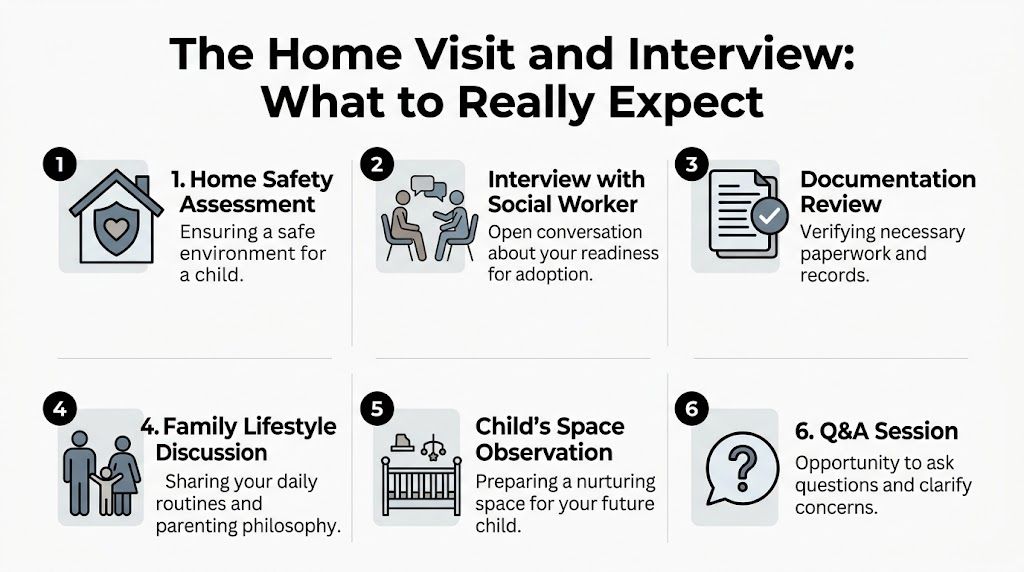
A social worker is usually trying to answer practical questions. Is the home safe? Do the adults understand the needs of an adopted child? Does this household have the stability, insight, and support to parent well? That is why the visit often feels more like a guided discussion than an inspection.
What the social worker is actually looking for
Start with the home itself. The standard is safe, functional, and ready for a child's daily life.
That usually includes:
- Working safety devices such as smoke detectors
- Safe storage for medication, cleaning supplies, and firearms if any are in the home
- Enough space for the child to sleep, play, and keep personal belongings
- Reasonable cleanliness that supports health and supervision
- A practical routine for meals, school, bedtime, and transportation
A helpful comparison is a car seat check. The person checking it does not care whether your car is fancy. They care whether a child can ride safely in it. Your home visit follows that same logic.
For a more detailed review of what is commonly assessed, this guide to the top components of a Texas adoption home study gives a useful overview.
A short home readiness checklist
You do not need to create a picture-perfect house. You do need to show that daily life in your home is manageable and child-centered.
| Area | What to check |
|---|---|
| Entry and common areas | Clear obvious tripping hazards and secure unstable furniture or loose items |
| Kitchen and bathrooms | Store chemicals, medication, and sharp objects safely |
| Bedrooms | Identify where the child will sleep, or explain your plan if placement has not happened yet |
| Emergency basics | Test smoke detectors and know your basic emergency plan |
| Pets and outdoor areas | Make sure pets are under control and outdoor spaces are reasonably safe |
If your setup is still in progress, say so plainly. A family waiting for a specific child may not have every bedroom detail finished yet. That is usually fine if the plan is realistic and close to implementation.
What the interviews usually feel like
The interview portion is where families often tense up. In practice, the questions are designed to show how your family works from the inside.
You may be interviewed together and separately. Other adults in the home may also be interviewed. Children may be included in age-appropriate ways. The social worker may ask about your upbringing, your relationship history, your reasons for adopting, your parenting approach, how you handle stress, and what support system you can rely on.
Those questions are not random. Each one connects to a parenting skill. A question about conflict is really a question about repair. A question about your childhood is often a question about self-awareness. A question about adoption motivation is often a question about whether you are ready for the child's needs, not just your hopes.
Here is how that looks in real life.
A stepparent seeking adoption may be asked how the family will talk with the child about the other biological parent over time. A grandparent in a kinship adoption may be asked how she will balance authority and comfort when she has already been a familiar relative. An LGBTQ+ couple may be asked the same core questions any other couple receives about support, stability, and parenting plans, while also choosing how to explain the strengths of the community around them. The details differ. The purpose stays the same. The social worker is trying to understand whether this child will be cared for with honesty, consistency, and respect for the child's story.
Here is a short video many families find useful before the visit:
The questions that feel personal
Some topics land hard. You may be asked about infertility, prior relationships, counseling, mental health treatment, discipline, grief, or tension within the extended family.
A lot of parents hear those questions and assume there must be a right answer. Usually there is a better standard to aim for. Be truthful, reflective, and specific.
If you saw a counselor after a loss, explain what support you received and what you learned. If you and your spouse disagree under stress, explain how you work through it. If you are a single parent, explain who helps when work runs late or a child gets sick. If you are in a kinship adoption, be ready to talk about how you will help the child process divided loyalties. If you are adopting as a same-sex couple, you may want to describe the affirming adults, schools, faith communities, or social networks that will surround the child.
That kind of answer gives the social worker something much more useful than a polished script. It shows judgment.
What to do on the day of the visit
Keep the day calm and ordinary.
- Have key documents easy to reach
- Wear comfortable clothes you would normally wear for an appointment
- Tell children the truth in simple, age-appropriate language
- Write down your own questions ahead of time
- Answer truthfully instead of trying to sound ideal
One final reassurance matters here. Families sometimes worry that any sign of real life will hurt them. Toys on the floor, a busy toddler, a nervous answer, or a home that looks lived in usually does not create a problem. What raises concern is avoidance, inconsistency, or a safety issue that has no plan.
A good home study interview does something many families do not expect. It helps you see your own readiness more clearly. By the end of the visit, many parents feel less like they were judged and more like they were invited to put words to the kind of family they are trying to become.
Navigating Common Hurdles and Special Considerations
Families often assume a delay means failure. It usually doesn't. Many issues can be addressed if you respond early, stay transparent, and understand what the concern really is.
Some hurdles are practical. A missing medical form, an old address on a record, or slow fingerprint scheduling can hold things up. Other issues feel more personal, such as a prior criminal charge, a health diagnosis, debt, or questions about relationship stability.

Problems that call for explanation, not panic
A concern in your file does not always mean a denial. It often means the reviewer needs context.
Consider these examples:
- Past legal trouble. Be ready with certified records, completion documents, and a direct explanation of what changed.
- Financial strain. Show how the household budget works now, not just what was difficult before.
- Health concerns. A diagnosis doesn't automatically disqualify you. Reviewers usually want to know whether you can safely and reliably parent.
- Relationship history. Divorce, blended families, or prior conflict may lead to more questions, but those questions are manageable when answered openly.
Guidance for LGBTQIA plus families
This is one area where generic checklists often fall short. Existing guidance frequently doesn't address the more nuanced challenges LGBTQIA+ families can face in a Texas home study. Prospective parents may need to prepare for questions about relationship stability or their ability to support a child from a different ethnic or cultural background, as noted in DFPS-related discussion of home study expectations and gaps in guidance.
That doesn't mean you should expect hostility. It means you should prepare with care.
Helpful ways to approach this include:
- Define your family structure clearly. Don't assume the reviewer understands your household roles without explanation.
- Document stability. If you're a couple, be ready to discuss how you make decisions, resolve conflict, and share parenting responsibilities.
- Address support systems. Show who supports your family emotionally and practically.
- Prepare for cultural questions. If you are considering transracial adoption, be ready to discuss how you'll support the child's identity and connections.
If a question feels vague or loaded, it's okay to pause and answer it in practical terms. Bring the conversation back to parenting, safety, commitment, and the child's needs.
Other family structures that may need tailored planning
Single parents often worry that being the only parent in the home will count against them. Usually, the discussion centers on logistics and support. Who helps when you're sick? What is your child care plan? How do you manage work and home responsibilities?
Military families may need to explain relocation possibilities, deployment planning, or extended family support. Families adopting across racial or cultural lines should be ready to discuss how they will preserve the child's identity, community connection, and sense of belonging.
In more complicated cases, some families choose to work with an attorney during preparation. The Law Office of Bryan Fagan, PLLC assists Texas families with adoption planning, home study guidance, and court filings, which can be useful when the case involves kinship issues, stepparent adoption, LGBTQIA+ adoption, or other questions likely to draw closer review.
After Your Home Study Approval Your Next Steps to Finalization
Approval feels huge because it is huge. It confirms that a major legal and practical hurdle has been cleared. But it doesn't end the adoption case. It opens the next chapter.
Once the home study is approved, the remaining steps often involve placement-related requirements, post-placement supervision, legal filings, and the final court hearing. The exact sequence depends on the type of adoption, but Texas law still requires the court to review whether finalization serves the child’s best interests.
What happens after approval
For some families, approval means you are now ready to be matched or move forward with placement. For others, especially in kinship or foster-related matters, the child may already be in the home and the focus shifts to monitoring adjustment and completing the final court process.
A common point of confusion is whether the first home study is always enough. It often isn't. According to this discussion of Texas home study updates, for many adoptions, particularly those involving kinship care or children with special needs, post-adoption updates and re-evaluations are mandatory before finalization to assess the child’s adjustment and the family’s ability to meet their needs.
Why updates matter
Families sometimes hear "approved" and think no further review is coming. But adoption is about a permanent legal relationship, and courts want current information before issuing a final order.
That is especially true when:
- The child has special needs
- The placement has lasted long enough to evaluate adjustment
- The adoption is kinship-based and the court wants updated circumstances
- The original study needs refreshing because household facts changed
Those updates often focus on how the child is doing, how the family is handling daily life, and whether any support needs have emerged since placement.
The path to court finalization
Finalization is the legal moment when the adoptive parent or parents become the child’s legal parents under a court order. Depending on the case, that may involve termination issues, consents, agency paperwork, reports to the court, and a final hearing under the Texas Family Code.
A few practical reminders help here:
- Keep your paperwork current. Don't assume older records are still acceptable.
- Respond quickly to requests for updates. Delay after approval can be frustrating and preventable.
- Track changes in the household. New addresses, jobs, health issues, or household members may need to be disclosed.
- Prepare for the hearing emotionally too. Finalization is joyful, but it can also stir grief, relief, and complicated family feelings.
Court finalization is a legal event, but for most families it is also a deeply personal one. Bring the documents the court needs. Bring tissues too.
Many parents describe the final hearing as the moment the long process suddenly becomes real. A judge signs the order. Pictures are taken. A child who may already feel like yours becomes yours in the eyes of the law as well.
If you're still waiting for that day, don't underestimate the value of careful legal guidance. Good preparation can make the period between approval and finalization smoother, clearer, and less stressful for everyone involved.
If you're preparing for an adoption home study texas process and want clear, compassionate guidance specific to your family, the attorneys at Law Office of Bryan Fagan, PLLC can help you understand your options, prepare for requirements under Texas law, and move toward finalization with confidence. Whether you're pursuing a stepparent, kinship, foster, private, or LGBTQIA+ adoption, scheduling a free consultation can give you a calm place to ask questions and plan your next step.
