
You may be sitting at your kitchen table with a notebook open, comparing agencies, reading profiles, and wondering whether private adoption is the right path for your family. Maybe you've tried to grow your family in other ways. Maybe you're a relative stepping in for a child you love. Maybe you're an expectant parent looking for a plan that feels safe, respectful, and thoughtful.
Whatever brings you here, it's normal to feel hopeful and overwhelmed at the same time. A private adoption agency texas search can pull up dozens of options, but not all of them explain the process in plain language. Fewer still explain the hard parts, like contract terms, agency fit, or whether an agency will respect your family's values.
Texas law gives families several paths to adoption, but private agency adoption has its own rhythm. There are social workers, home studies, matching decisions, consents, court filings, and a final hearing that makes your parent-child relationship legally permanent. There are also emotional questions that no checklist can fully answer, like how open adoption may work, what support a birth parent receives, and how to choose an agency you can trust.
Your Journey to Building a Family Through Private Adoption
A couple calls after months of late-night conversations. They aren't asking for guarantees. They're asking where to begin. They want to know if an agency will walk with them or just hand them a packet and a bill. They want to know how long things might take, what Texas courts require, and how to protect the child's future from the very start.
That's a common place to begin. Private adoption often starts before any paperwork is filed. It starts with a family trying to picture daily life with a child in their home. It starts with an expectant parent trying to make a loving plan in a difficult season. It starts with relatives deciding that a child needs stability now, not someday.

Why private adoption feels different
A private agency adoption is usually more hands-on than people expect. The agency may help with education, matching, counseling, paperwork coordination, and post-placement support. For many families, that structure feels reassuring because there is a team involved, not just a stack of forms.
For birth parents, the agency relationship matters just as much. Respect, informed choice, counseling, and space to ask questions can make a major difference in whether the process feels ethical and humane. That matters because adoption isn't only a legal event. It's a lifelong family story.
Practical rule: The right adoption path should protect the child's best interests and leave the adults better informed, not more confused.
What Texas families usually need most
Families often come in with three concerns.
- Clarity about the steps: They want to know what happens first, what happens later, and what could slow things down.
- Confidence about the agency: They want to know whether the agency is properly licensed, responsive, and experienced with their kind of adoption.
- Peace of mind about the legal side: They want to know that parental rights, court filings, and final orders will be handled correctly under Texas law.
Texas Family Code Chapters 162 through 166 shape much of the adoption process. In plain English, those laws deal with who may adopt, when consent is needed, how the court reviews the case, and how an adoption becomes final. Families don't need to memorize statute numbers, but they do need to understand that adoption in Texas isn't complete until the court signs the final order.
That may sound formal. It is. But it can also be profoundly joyful. When the legal process is handled carefully, it gives a child something every family wants to offer. Stability, belonging, and a clear legal foundation.
What is a Private Adoption Agency in Texas?
A private adoption agency is a licensed organization that helps place children for adoption outside the public foster care system. In Texas, these agencies may work with expectant parents making an adoption plan, hopeful adoptive parents, stepparents in some support contexts, and relatives exploring permanency options. Their role is usually practical and relational. They help organize the process, not just introduce people.
A good agency often helps with several parts of the journey. It may provide orientation, pre-adoption education, home study services, matching support, counseling, and post-placement visits. Some agencies have in-house staff for several of those tasks. Others coordinate with outside professionals.
The legal definition matters
Texas doesn't let just anyone operate as an adoption agency. Private adoption agencies in Texas must be licensed as child-placing agencies by the Residential Child Care Licensing division of the Department of Family and Protective Services. Texas also requires agencies to follow licensing rules under Chapter 42 of the Texas Human Resources Code and related administrative rules. The state notes that RCCL can cite agencies for violating minimum standards, but it has "very limited authority over the financial contract between a licensed adoption agency and adoptive parents," which is why families should review contracts carefully and check agency records through Texas DFPS adoption options guidance.
That one point surprises many families. People assume that if an agency is licensed, every fee and contract term has been closely reviewed by the state. That's not how it works. Licensing is important, but it doesn't remove the need for your own due diligence.
What agencies usually do and what they don't do
Agencies are not the same as courts, and they aren't a substitute for independent legal advice. Their job is often to manage placement services and family support. The court's job is to decide whether the adoption should be finalized under Texas law. Your attorney's job is to protect your legal interests through that process.
Here are common agency functions:
- Screening and education: Orientation meetings, applications, and policy explanations.
- Home study coordination: Interviews, document collection, and home visit planning.
- Matching support: Presenting family profiles and facilitating communication, when appropriate.
- Birth parent services: Counseling referrals, planning support, and help with adoption logistics.
- Post-placement supervision: Required follow-up before finalization.
Agencies help move the process forward. They do not replace the need to understand your contract, your rights, or the court requirements.
Why this distinction helps families
When families know what an agency is supposed to do, they ask better questions. They stop looking for promises and start looking for process. They ask how communication works, who handles the home study, how openness is discussed, and what happens if a match changes.
That shift matters because Texas Family Code Chapter 162 focuses on adoption itself, including the legal petition and final order. Chapters 161 and 162 often intersect in practice because a child's legal adoption usually depends on proper termination or relinquishment of parental rights before finalization. Families who understand that difference are better prepared to choose a solid agency and build the right legal team around them.
The Texas Private Agency Adoption Process Step by Step
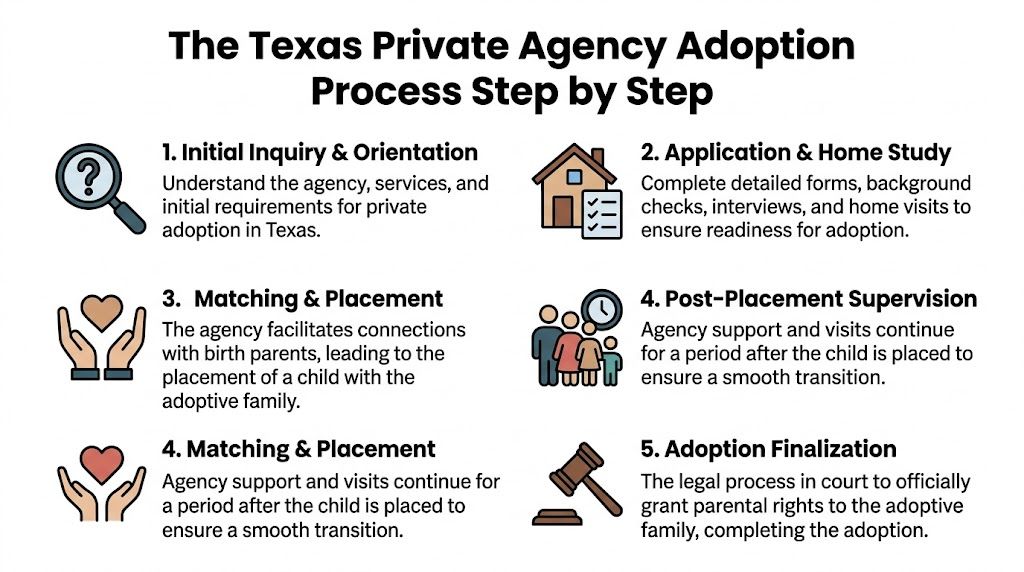
Most private agency adoptions in Texas move through the same general stages, even if each family's story looks different. The names of the steps may vary from agency to agency, but the path is usually familiar. There is preparation, evaluation, matching, placement, supervision, and court finalization.
Families often feel better once they can see the whole path in order.
The early stage
The first step is usually an inquiry call or orientation. During this, you learn how the agency works, what services it offers, and what kinds of adoptions it handles. If you're pursuing infant adoption, relative adoption with agency support, or another private path, this is the time to ask direct questions.
After that comes the formal application. You'll fill out detailed forms, provide background information, and begin gathering records.
A home study is mandatory in Texas. It typically takes two to three months, and the overall timeline for a private agency adoption generally averages 9 to 18 months from start to finalization, depending on the agency and the matching process, as explained by American Adoptions' Texas home study overview.
The home study and family profile
Many parents hear "home study" and worry they're being judged. In reality, it is a readiness review. A social worker looks at safety, stability, background information, health history, relationships, and your plan for parenting. The goal is not perfection. The goal is to help the court and agency confirm that the placement is appropriate.
Most home studies include:
- Document collection such as identity records, financial information, and background materials.
- Interviews with a licensed social worker about your family life, history, and parenting approach.
- A home visit to confirm that the space is safe and suitable for a child.
Families also usually create a profile. This may include photos, letters, and information about daily life. If the adoption involves an expectant parent choosing a family, that profile becomes very important.
For a broader overview of the legal path, many families also find this guide on how to do a private adoption in Texas useful when comparing what agencies handle and what the court requires.
A short overview can help you see the sequence in context:
Matching, placement, and finalization
Once the home study is approved, the waiting period begins. Some families match quickly. Others wait longer. That part can be emotionally demanding because it involves real people and changing circumstances.
After placement, Texas usually requires a period of post-placement supervision before the court finalizes the adoption. A social worker checks on how the child and family are adjusting. Then your attorney files the necessary petition and supporting documents so the court can review the case.
A finalization hearing is the legal moment the court creates a permanent parent-child relationship. Until then, your agency process is moving toward finalization, but it isn't the same thing as finalization itself.
Under Texas Family Code Chapter 162, the court looks at whether the legal requirements have been met and whether the adoption is in the child's best interest. In many families' memories, that hearing is both simple and unforgettable. It may take only a short time in court, but it reflects months of careful preparation.
Comparing Your Adoption Paths in Texas
Private agency adoption is only one route. Some families decide it fits their goals because they want structured support and matching services. Others prefer a direct attorney-managed path, or they may pursue adoption through foster care or a kinship case.
Texas adoption data shows how important both public and private paths are. In 2023, Texas recorded 7,168 total adoptions, including 4,181 involving children from state-run foster care and 2,864 from private care, according to reporting on Texas adoption trends. That tells families something useful. There isn't just one "normal" way to adopt in Texas.
Texas Adoption Paths at a Glance
| Adoption Path | Typical Cost | Average Timeline | Key Benefit |
|---|---|---|---|
| Private agency adoption | Usually higher than foster-to-adopt pathways | Often varies by home study, matching, and court timing | Structured support and matching assistance |
| Independent adoption with an attorney | Varies by services needed and case complexity | Varies widely | More direct control over the legal process and professional team |
| Foster care adoption through DFPS | Often lower-cost than private adoption | Depends on child welfare case progress and court status | May provide a path to permanency for children already in care |
| Kinship or relative adoption | Varies based on family history, consent issues, and court needs | Varies by whether parental rights issues are resolved | Keeps a child within the family network |
Private agency adoption
This path usually works well for families who want a guided process. Agencies often provide education, home study coordination, and help with matching. That support can be especially valuable for first-time adoptive parents who want a clear framework.
The tradeoff is that agency policies, fees, and communication style matter a great deal. Families need to evaluate those points carefully before signing anything.
Independent adoption
An independent adoption usually means the legal process is handled more directly through attorneys rather than through a full-service agency model. In some cases, the adoptive family and the expectant parent have already connected. In others, professionals coordinate parts of the process without a traditional agency relationship.
This route can offer flexibility, but families may need to build their own support team. That can include a home study provider, counselor, and attorney.
Foster care adoption
This path runs through the public child welfare system. It may involve children whose parents' rights have already been terminated or may be terminated later through court proceedings. Foster care adoption can be a strong option for families open to older children, sibling groups, or children with more complex backgrounds.
It is not the same process as a private infant adoption. The goals, timelines, and case dynamics can look very different.
Kinship and relative adoption
Sometimes the child is already with family. A grandparent, aunt, uncle, sibling, or other relative may be providing day-to-day care. In those cases, adoption may be the next legal step toward permanency.
Kinship cases often carry a very different emotional weight. The family is not only building a future. They may also be responding to crisis, grief, or instability.
The best adoption path is the one that fits the child's needs, the adults' capacity, and the legal facts of the case.
A simple way to choose between paths
If you're deciding which route fits your family, ask:
- Do we want agency support with matching and services, or do we already have a connection and mainly need legal guidance?
- Are we open to foster care or kinship permanency, or are we focused on private domestic adoption?
- How much uncertainty can we realistically manage?
- Do we need an agency with proven experience serving our family structure and values?
Those questions won't decide the case for you. But they can help you stop comparing everything at once and start comparing what matters in your situation.
The Financial Reality of Private Adoption in Texas
Money is one of the hardest parts of private adoption to discuss, partly because many agencies don't make it easy. Families often see general language on a website, but they don't get a full picture until later. That creates stress at the exact moment they need clarity.
A common issue in private adoption is financial transparency. Vague fee structures can conceal hidden expenses tied to legal complexities or un-itemized birth mother support, and private adoption costs can be substantially higher than foster-to-adopt pathways, as discussed in Angela Adoption's guide to choosing an agency in Texas.

What families are often paying for
Agency fees may cover staff time, intake work, family education, matching services, birth parent coordination, profile review, and post-placement supervision. But not every charge is always folded into one package. Some agencies separate legal work, counseling, outside home study fees, or certain expectant parent expenses.
That doesn't automatically mean the fees are improper. It means the family needs a written, itemized explanation before moving forward.
For a closer look at the questions families usually ask, this article on how much private adoption costs in Texas can help you build a list of costs to discuss with both the agency and your attorney.
Red flags in agency pricing
Some concerns should make you slow down and ask for more detail.
- Vague descriptions: If the contract uses broad labels without saying what each fee covers, ask for itemization.
- Pressure to pay quickly: A family should understand the charge before sending money.
- No explanation of failed match policies: If a match changes or falls through, you need to know what happens to funds already paid.
- Unclear third-party costs: Legal fees, counseling, medical issues, and support expenses should be explained in writing.
- Resistance to contract review: If someone discourages you from having a lawyer read the agreement, take that seriously.
Questions worth asking before you sign
A short list can protect you from a lot of confusion later.
| Ask this question | Why it matters |
|---|---|
| Which fees are agency fees and which are outside professional fees? | It helps you tell bundled costs from separate costs. |
| What expenses may arise after a match? | It reveals whether support or legal costs may change. |
| What is your refund or credit policy? | It clarifies risk if the case does not move forward as planned. |
| Can you show me the payment schedule in writing? | It prevents misunderstanding about due dates and triggers. |
Financial clarity is not a rude request. It's part of responsible adoption planning.
Families don't need to become contract experts overnight. They do need to slow down enough to understand what they are agreeing to. In a process this emotional, clear writing and calm review are forms of protection.
How to Choose the Right Agency for Your Family
You may be sitting at the kitchen table with two agency brochures, a notebook full of questions, and a feeling that every option sounds good until you look closer. That is a normal place to be. Choosing an agency in Texas is less like picking a service provider and more like choosing the team that will walk beside your family through one of the most personal legal processes of your life.
The right question is not which agency sounds the most polished. The better question is which agency fits your family's needs, communication style, budget realities, and values. A licensed agency can still be the wrong fit. That gap often shows up later, after money has been paid and expectations have already formed.
A good consultation should leave you more informed and more settled. If you leave with warm feelings but fuzzy answers, slow down.
Questions every family should ask
Start with the basics, but do not stop there. Agency selection works like hiring both a guide and a coordinator. You need to know how they work, how they communicate, and how they handle stress when a case becomes complicated.
Ask questions such as:
- Licensing and services: Is the agency licensed as a Texas child-placing agency? Does it complete home studies in-house or refer them out?
- Communication: Who will be your point of contact? How are updates given, and how quickly are urgent calls returned?
- Expectant parent support: What counseling, education, and decision-making support is offered to expectant parents?
- Openness: How does the agency talk with families about open adoption, boundaries, and future contact?
- Case changes: How does the agency handle disrupted matches, changed timelines, or placements that do not move forward?
Those questions help you measure more than friendliness. They show whether the agency explains its process clearly and treats uncertainty transparently.
Questions many families are afraid to ask, but should
This part matters in Texas. Some agencies are inclusive in practice. Others use broad welcoming language but have limited experience with certain family structures, faith backgrounds, or openness preferences.
If you are a same-sex couple, a single parent, an older parent, an interracial family, or a family with strong views about openness, ask direct questions early. For example:
- What kinds of families do you regularly work with?
- Do you have a written non-discrimination policy?
- How do you talk with expectant parents about family diversity?
- How do you handle situations where an expectant parent has preferences that may exclude certain families?
- Do religious policies affect which families you accept or how you present them?
These are not awkward questions. They are sorting questions. They help you learn whether the agency's actual practice matches its public language.
If an agency becomes evasive when you ask about inclusivity, values, or family type, believe the answer you are getting.
If you want a practical way to compare consultations, this guide on how to choose an adoption agency can help you organize what each agency says, and what it avoids saying.
Look for fit, not salesmanship
Families often focus on whether an agency seems kind. Kindness matters, but structure matters too. A healthy agency relationship usually has four traits.
First, the staff explains the process in plain language. You should not need to decode basic answers.
Second, the agency respects every person in the adoption. Listen to how staff talk about expectant parents, adoptive families, and children. Respectful language is often a clue to respectful practice.
Third, the agency makes room for independent advice. An agency that is comfortable with outside legal review usually understands its role and its limits.
Fourth, the agency is candid about uncertainty. No ethical agency controls timing, matching, or another person's decision.
Here are some encouraging signs:
- Clear written materials: Policies, steps, and expectations are explained in readable language.
- Consistent communication: Staff tell you who handles each part of the case.
- Honest expectations: No one promises certainty or speed they cannot deliver.
- Respect for outside professionals: The agency is comfortable with your attorney reviewing documents and advising you.
Red flags families should not ignore
Some concerns show up early if you listen for them.
- Promises of a quick match
- Pressure to sign before you are ready
- Vague answers about how families are presented
- Defensive responses to questions about inclusivity
- Little discussion of counseling, consent, or the expectant parent's independent decision-making
- Resistance to attorney review
One more point deserves attention. Cost and values are often connected. If an agency is clear about fees but unclear about which families it serves, that mismatch matters. If an agency sounds inclusive but cannot explain how it handles bias in matching, that matters too. Private adoption is personal, legal, and expensive. You are allowed to ask hard questions in all three areas.
Some families also want legal guidance while comparing agencies. The Law Office of Bryan Fagan, PLLC handles private adoptions in Texas, including agency-related paperwork, consent issues, court filings, and finalization. Early legal review can help a family assess whether an agency's contract and process fit the case they are trying to build.
How an Adoption Attorney Supports Your Agency Adoption
Many families assume that if they hire an agency, they don't need a lawyer until the very end. In Texas, that can create avoidable risk. The agency and the attorney serve different roles. They are not doing the same job.
An agency may coordinate services, support matching, and handle social work functions. Your attorney represents you in the legal process. That difference matters most when the case becomes technical, emotional, or both.
Where legal counsel makes a real difference
An adoption attorney reviews the paperwork with a different lens than an agency does. The attorney looks for legal sufficiency, enforceability, timing problems, and procedural gaps. That includes the agency contract, parental consent documents, the adoption petition, and the final court order.
Texas Family Code Chapter 162 governs the adoption itself. Related provisions in nearby chapters address who must consent, how rights are relinquished or terminated, and what the court must see before signing a final decree. If those pieces are mishandled, the family can face delays and stress that could have been avoided.
Practical ways a lawyer helps
A lawyer's work often includes:
- Contract review: Explaining agency terms before you sign.
- Consent and termination review: Confirming that parental rights issues are handled properly under Texas law.
- Court filings: Preparing and filing the adoption petition and supporting papers.
- Finalization hearing: Representing the family when the court reviews the case.
This support isn't only for adoptive parents. Birth parents and relatives may also need independent legal advice depending on the circumstances. In a healthy adoption process, each person understands their rights and makes decisions with clear information.
The legal finish line in adoption is not the match or the placement. It's the signed court order.
Why families often feel calmer with both an agency and an attorney
Families don't need more complexity. They need the right division of labor. When the agency handles social services and the attorney handles legal protection, the process usually feels more understandable. People know who to call for what.
That division can also protect the child's long-term stability. Adoption is about family, but it is built through law. Careful legal work helps make that family bond secure.
Begin Your Texas Adoption Journey with Confidence
Private adoption can be beautiful, demanding, and personal all at once. Families do better when they understand the process, ask direct questions, and choose professionals who respect both the legal rules and the human side of adoption.
Texas has a strong adoption framework. Over a recent decade, the state finalized 53,412 adoptions from its child welfare system, and annual adoptions grew by 27.2%, reflecting a meaningful commitment to permanency for children, as shown in the Texas post-adoption services report. That doesn't remove the hard decisions in a private agency case, but it does remind families that adoption is not rare or unreachable here.
If you're exploring a private adoption agency texas option, start with clear questions. Ask about licensing. Ask about fees. Ask how birth parents are supported. Ask how your family structure will be treated. Then make sure an adoption attorney reviews the legal path before finalization.
A careful parent is not a difficult parent. A careful parent is preparing to give a child a stable future.
If you're considering private adoption, relative adoption, stepparent adoption, or another path to permanency, the attorneys at Law Office of Bryan Fagan, PLLC can help you understand your options and the legal steps ahead. A free consultation can give you clear answers about agency contracts, consent and termination issues, home study questions, and the court process so you can move forward with confidence.
