
Choosing the right adoption agency is one of the most important decisions you'll make on your journey to build a family. It will shape your entire experience, from the first hopeful phone call to the day your adoption is finalized in a Texas court. The best agency isn't just any licensed provider; it's a partner that aligns with your family’s goals, provides deep, compassionate support for everyone involved—especially the birth parents—and understands the Texas Family Code inside and out.
At The Law Office of Bryan Fagan, PLLC, we believe that with empathy and clear guidance, you can navigate this process with confidence. This guide is for hopeful adoptive parents, birth parents, and relatives exploring adoption in Texas, offering step-by-step advice to help you make an empowered choice.
Your First Steps on the Adoption Journey

Starting the adoption process is a profound step, one filled with hope, countless questions, and a deep desire to grow your family. This journey is intensely personal, whether you are a couple dreaming of a child, a birth mother courageously considering her options, or a relative stepping up to provide a loving home through kinship adoption.
The partner you choose to guide you is critical. Your adoption agency is far more than a service provider; they are your guide, your advocate, and your support system. A great agency ensures every action is taken in the best interests of the child—a core principle of the Texas Family Code—and provides a secure, ethical framework for this life-changing experience.
Understanding Your Adoption Path
Before you can pick the right guide, you need to know which path you plan to walk. Texas law, particularly Chapters 162-166 of the Family Code, outlines several avenues for adoption, each with its own process and emotional landscape. Your first task is to explore which one fits your family’s unique situation.
Thinking through which of these primary adoption categories best describes your goals is the perfect starting point.
Quick Guide to Adoption Paths in Texas
| Adoption Type | Best For | Key Consideration |
|---|---|---|
| Private Infant Adoption | Hopeful parents who want to adopt a newborn and are often open to a relationship with the birth mother. | This path focuses on creating a match and connection between birth parents and adoptive parents, with the agency facilitating the relationship. |
| Adoption from Foster Care (CPS) | Families open to adopting older children, sibling groups, or children with unique needs from state custody. | In these cases, the child's biological parents' rights have already been terminated by a court. |
| Kinship or Stepparent Adoption | Relatives (like grandparents or aunts) or stepparents looking to legally formalize an existing family bond. | This often involves a child already living in your home and solidifies your parental rights and responsibilities. |
No matter which path feels right for you, this guide is designed to empower you with the knowledge to choose your partners wisely. We’ll walk through how to verify an agency's license, evaluate their support services, and understand the financial and emotional commitments, always with the child's best interests at heart.
Taking a thoughtful, proactive approach to selecting an agency is your best tool for building a family with confidence. This means asking the tough questions, verifying credentials, and ensuring their values align with yours before you sign any contracts.
If you’re just starting to explore what this journey entails, our detailed article on how to start the adoption process in Texas provides a great overview. The goal is to help you find a partner who will champion your family’s future with security and compassion.
Verifying Agency Credentials and Licensing in Texas
Before you get swept away by a polished website or a moving mission statement, your first step must be a practical one. It's absolutely essential to confirm that any adoption agency you're considering is legally qualified to operate in Texas. This isn't just red tape; it's a non-negotiable safeguard for your family, your finances, and the child at the center of the process.
In Texas, only a Licensed Child-Placing Agency has the legal authority to facilitate adoptions. This credential is your assurance that the agency is regulated, monitored, and held accountable by the Texas Department of Family and Protective Services (DFPS). Working with an unlicensed entity, often called a "facilitator," opens your family up to massive legal, financial, and emotional risks.
The Heartbreak of Unlicensed Facilitators
Imagine this all-too-common scenario: A hopeful couple, let's call them Mark and Sarah, find a facilitator online who promises a quick match and a simplified process. They pay a large, non-refundable fee upfront. But after months of vague updates, they discover the devastating truth. The facilitator isn't licensed in Texas and had made the same empty promise to multiple families for the same birth mother—who wasn't even receiving proper counseling. Their match dissolved, the money was gone, and they were left heartbroken, with no legal recourse.
This painful situation is completely avoidable. A licensed agency operates under strict legal and ethical rules laid out in the Texas Family Code, which are designed to protect everyone involved—the child, the birth parents, and you. You can learn more about these critical protections in our guide to Texas adoption and the Family Code for parents.
How to Verify an Agency's License
Checking an agency's license is a simple step you can and absolutely should take yourself. The DFPS has a public search portal that makes it easy to see the status of any child-placing agency in the state.
Here’s what to do:
- Go to the DFPS Search Portal: You can access the statewide search tool directly to look up child care and residential operations.
- Search by Name: Type in the agency's exact legal name.
- Check the Status: The results will show if the license is "active," "expired," or has a history of violations. You should only move forward with agencies that have an active license.
Beyond the license, it’s smart to dig into an agency’s reputation. Look for a solid track record of successful placements and a positive history in the community. When researching, resources for finding local Texas service providers can give you a good feel for what to look for in accredited professionals. A stable, ethical agency will be completely open about its history and will welcome your questions.
Key Takeaway: An active license from the Texas DFPS isn't just a good sign—it's the bare minimum. Think of it as the very first green light you need before you invest your time, money, and heart into a potential partnership.
Finally, look for signs of financial stability and transparency. A trustworthy agency will provide a clear, itemized fee schedule. They won’t pressure you into making huge, non-refundable payments upfront without a signed contract that outlines exactly what services are included. Their financial practices should reflect a commitment to ethical service, not just profit. Choosing a well-established, fully licensed, and transparent agency is the single most important first step you can take to build your family with security and peace of mind.
Domestic vs. International Adoption: Where Should You Focus Your Journey?
When you start exploring adoption, you’ll quickly face a major decision: should you pursue a domestic or an international adoption? A generation ago, many American families grew through international adoption. But today, that path has changed dramatically. Understanding the current reality is crucial to making a heartfelt, realistic decision for your family.
Focusing your energy on the most viable path from day one will save you an incredible amount of time, money, and emotional strain. The current landscape of adoption points overwhelmingly toward the stability and predictability of adopting a child right here in the United States, especially in Texas.
The Hard Truth About International Adoption Today
The world of intercountry adoption looks nothing like it did 20 years ago. Geopolitical shifts, new laws in other countries, and a global effort to keep children in their countries of origin have created significant roadblocks.
Consider the data. Countries like China, Russia, and Guatemala once accounted for a huge portion of adoptions to the U.S., but they have since closed or severely limited their programs. The result has been a staggering drop in numbers. Total U.S. intercountry adoptions fell from a high of nearly 23,000 in 2004 to just over 1,200 by 2023—a 94% decline. You can explore the numbers and their meaning for families in the full report from the Pew Research Center.
For hopeful parents, this means international adoption now comes with unpredictable timelines, complex foreign legal systems, and a much higher chance of heartbreak. For families here in Texas, it highlights the value of working with an agency that has deep, current expertise in domestic adoption.
The Stability and Clarity of Domestic Adoption in Texas
In stark contrast to the volatility of international routes, domestic adoption offers a stable, well-defined path to building your family. Every year in the U.S., thousands of children are welcomed into loving homes through both private infant adoption and adoption from the foster care system.
This infographic highlights the three core pillars you should look for when vetting any domestic agency: its license, reputation, and financial stability.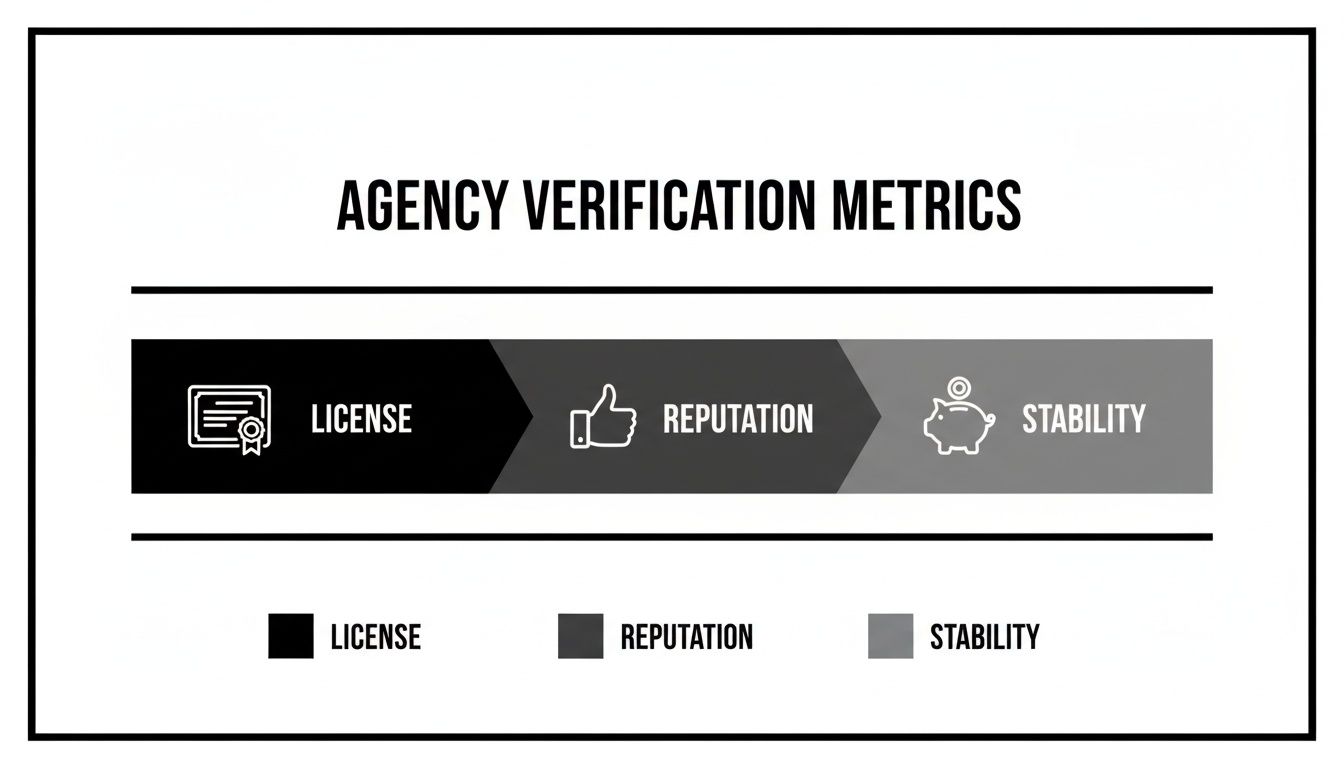
These fundamentals—licensing, reputation, and stability—are the bedrock of a trustworthy partnership with a domestic agency.
The biggest advantage of a domestic agency is its fluency in local laws. Navigating the Texas Family Code, especially Chapters 162-166 which govern all adoptions, demands specialized expertise. A Texas-based agency lives and breathes the specific legal steps for everything from completing a home study to finalizing the termination of parental rights.
Key Insight: Choosing a domestic agency that is an expert in Texas law isn’t just a good idea; it’s a strategic move. It anchors your adoption journey in a clear, predictable legal framework built to protect the child, the birth parents, and your own future parental rights.
Think about the peace of mind that comes from working with a team that knows the ins and outs of Texas adoption. They have established relationships with local courts, hospitals, and birth parent counselors. This on-the-ground presence creates a smoother, more secure process.
For instance, when a birth mother in Houston needs support, a local agency can be there in person, right away, to provide counseling and resources. That level of immediate care is not feasible for an agency managing a case from another country. It’s that hands-on support that truly honors the core principle of adoption: ensuring every decision is in the child’s best interest. By focusing on domestic agencies in Texas, you’re choosing a path with more clarity, stronger legal safeguards, and a far greater chance of success.
Evaluating an Agency’s Full Spectrum of Support

A great adoption agency does far more than just connect you with a child. They build a support system that holds everyone—adoptive parents, birth parents, and the child—through one of life's most profound and emotional journeys. When you're vetting agencies, look past the glossy brochures and ask the hard questions about their human-centered services.
This is where you’ll find the real heart of an agency. Your goal is to find one that is genuinely committed to the well-being of both the hopeful family and the birth parents, before, during, and long after a placement happens. This dual focus isn't just a nice-to-have; it's the mark of an ethical, child-centered practice.
Support for Hopeful Adoptive Parents
For you, the support journey often starts with the home study. A top-tier agency turns this often-feared requirement into an empowering, educational experience. Instead of a stressful inspection, a well-run home study should feel like a partnership.
Your caseworker’s job is to be a resource, helping you prepare your home, your heart, and your mind for parenthood. This process, governed by the Texas Family Code, is designed to ensure a safe, nurturing environment. A truly supportive agency will provide:
- Real-World Parent Education: Training on topics you’ll actually need, like understanding childhood trauma, building attachment, and navigating an open adoption relationship.
- Transparent Communication: You should never have to guess what’s next. They should provide clear, step-by-step guidance on everything from paperwork to post-placement visits.
- Emotional Preparation: Counseling and peer support to help you manage the emotional rollercoaster of the wait and prepare for the realities of parenting.
Lifelong Support for Birth Parents
How an agency treats birth parents is the clearest sign of its ethics. This is non-negotiable. A birth mother or father must have access to their own, independent counselor to walk them through all of their options—parenting, kinship care, and adoption—without any pressure.
This counseling must be a safe space for them to make a fully informed and voluntary decision. Just as importantly, the agency must offer post-placement support, including grief counseling and resources to help them move forward. This commitment shows the agency cares about their well-being as individuals, which is vital for ensuring the adoption is both ethical and legally sound.
A key sign of a quality agency is its robust, unconditional support for birth parents. This must include providing them with their own independent legal counsel to ensure their rights are fully understood and protected throughout the process.
The modern adoption landscape makes this local, hands-on support more critical than ever. In 2022, there were 53,579 foster care adoptions and 25,503 private domestic adoptions in the U.S., dwarfing the 1,516 international cases. As global policies increasingly favor keeping children in their home countries, the expertise and compassion of local Texas agencies have become paramount. You can dig deeper into these trends on the Christian Alliance for Orphans website.
A Real-World Look at Healthy Open Adoption
Let’s put this into perspective. Imagine a couple, Maria and David, who are hoping for an open adoption. They choose an agency known for its skilled mediation and post-placement support.
Their agency’s counselor facilitates early, structured conversations with the birth mother, Sarah, helping them build a foundation of mutual respect and clear expectations before the baby is born.
After placement, Sarah has moments of intense grief. Her dedicated agency counselor is right there, providing immediate support and helping her process her emotions. At the same time, the agency coaches Maria and David on how to be sensitive and supportive partners in this new, extended family relationship. This 360-degree support allows a beautiful, healthy connection to grow, ensuring the child is surrounded by a stable, loving network—the very definition of acting in the best interests of the child.
The Right Questions to Ask Before You Sign Anything

This is your moment to get clear answers. When you interview an adoption agency, you are looking past the polished brochures to see how they truly operate. Think of it less as an interview and more as a conversation that pulls back the curtain.
A great agency will welcome your questions with transparency. A defensive or vague agency will tell you everything you need to know by what they don’t say. This conversation is your single best tool for finding a partner you can trust for this life-changing journey.
Financial Transparency and Your Protection
Let’s be direct: money is one of the most stressful parts of adoption. A trustworthy agency knows this and will be completely open about its fee schedule, what every dollar covers, and—critically—what happens to your money if an adoption plan disrupts.
If an agency gives you vague estimates or can’t provide an itemized list of costs, consider it a major red flag. You need to know exactly where your investment is going.
Here are the non-negotiable financial questions you need to ask:
- Total Estimated Costs: What is the all-in, total estimated cost for a successful adoption? Can you give me a line-by-line breakdown of fees?
- Non-Refundable Fees: Exactly which fees are non-refundable, and at what specific point in the process do they become non-refundable?
- Failed Match Policy: What is your exact policy—both financially and procedurally—if an adoption match disrupts? Do our funds roll over to a new match, or are they forfeited?
Understanding the Real Timelines and Match Process
Waiting is often the hardest part. While no one can promise a specific timeline, a reputable agency should be able to share data-backed estimates based on their actual placement history. Be very cautious of anyone promising an unusually fast match—this can be a sign of high-pressure tactics, not an ethical process.
It’s also important to understand where an agency focuses its efforts. As we've discussed, intercountry adoptions have seen a 94% drop since peaking in 2004, a trend that continued to decline between 2021 and 2023. You can review the latest international social service findings to see how much this has shifted the landscape. This makes an agency’s domestic program more important than ever.
Ask these questions to get a clear picture:
- For a family with a profile like ours, what is your average wait time from home study approval to placement?
- How many families are currently waiting, and how many successful placements did you complete in the last year?
- What methods do you use to connect with expectant parents who are considering an adoption plan?
Birth Parent Support and Legal Readiness
An agency's character is most clearly revealed by how it treats and supports birth parents. A truly child-centered agency provides expectant parents with their own resources, including unbiased counseling and separate legal representation. This is non-negotiable for ensuring their decision is fully informed and free from coercion, a cornerstone of ethical adoption under the Texas Family Code.
One of the most telling questions you can ask is this:
Can you walk us through your process for supporting families and birth parents through a failed match, both financially and emotionally?
An agency’s answer here reveals its entire philosophy. A compassionate organization will have a clear, supportive plan for everyone involved in that difficult moment, not just a plan to quickly find the next match for you.
Finally, probe their legal preparedness. While your dedicated adoption attorney will manage the final court process, the agency is on the front lines of the initial legal steps. Ask about their experience with legally complex situations, like a contested adoption or a case with an unknown birth father. Their answer will show you if they’re ready to help you navigate the unexpected hurdles that can arise.
Why You Still Need an Experienced Adoption Attorney
While a great adoption agency is your indispensable partner for the social and emotional side of adoption, their work has clear legal boundaries. An agency cannot give you legal advice or represent you in court. That’s where an experienced adoption attorney becomes a non-negotiable member of your team.
Think of it this way: your agency helps you find and connect with the child meant for your family. Your attorney ensures that child legally and permanently becomes part of your family. They handle two very different—but equally critical—jobs. An attorney is the only person qualified to shield your rights and ensure your family is built on a rock-solid legal foundation.
Navigating Complex Legal Milestones
An adoption attorney’s core purpose is to handle the legal heavy lifting that an agency is not licensed to do. This includes the single most important legal event in any adoption: the termination of parental rights (TPR).
This is a formal court process, guided by Chapter 161 of the Texas Family Code, that permanently and irrevocably ends the legal ties between a child and their biological parents. Your attorney is the one who drafts and files the correct petitions, stands by you in court, and ensures every step is followed to the letter of the law. This legal precision is what prevents future challenges to your adoption.
When Unexpected Legal Issues Arise
Let’s imagine a situation we see all too often. A birth father who was previously uninvolved suddenly appears after the baby is born, deciding he wants to contest the adoption. Your agency can provide emotional support—and you'll need it—but they cannot step into a courtroom for you. They can’t file motions or argue your case before a judge.
In a scenario like this, an attorney from The Law Office of Bryan Fagan, PLLC, would spring into action. We would immediately work to verify his legal standing, manage all communication, and represent your family’s best interests in court to resolve the contest. This is the critical legal protection only an attorney can provide. You can learn more about the specific duties of an adoption attorney in our detailed guide.
An adoption agency supports the match, but an attorney secures your parental rights. Both are essential for a successful, legally sound adoption in Texas. Your attorney is your personal legal advocate from start to finish.
This partnership is how secure adoptions are built. The agency handles the home study, counseling, and matching. Your attorney ensures every legal "i" is dotted and "t" is crossed, all the way to that incredible finalization hearing where a judge officially declares you a legal family.
Your family’s future is far too important to leave anything to chance. Our experienced adoption attorneys are here to work alongside your chosen agency, providing the legal armor you need for true peace of mind.
Common Questions About Choosing an Agency
As you start researching adoption agencies, many questions will arise. It's completely normal. Let’s tackle some of the most common ones we hear from Texas families so you can move forward with clarity and confidence.
How much does it cost to adopt through an agency?
This is often the first question families ask, and for good reason. For a private infant adoption in Texas, you can generally expect the total cost to fall between $30,000 and $60,000, and sometimes more. This all-in figure typically covers the agency’s operational and matching services, legal fees, and the birth mother’s approved living and medical expenses as allowed by Texas law.
Adopting from the foster care (CPS) system is completely different. These adoptions are often very low-cost or even free, as the state provides subsidies to cover most, if not all, of the expenses.
Our advice: Never move forward without a detailed, itemized fee schedule. A reputable agency will be transparent about where every dollar goes, helping you avoid last-minute financial surprises.
Do I need both an agency and an attorney?
Yes, in most private adoptions, you need both. Think of them as two essential specialists on your team, each with a distinct and vital role. An adoption agency is your social work and support hub. They conduct your home study, prepare you for parenthood, and provide critical counseling for birth parents.
An adoption attorney, like our team at The Law Office of Bryan Fagan, PLLC, handles the entire legal side. We ensure the process is legally sound from start to finish. We file all necessary court petitions, manage the legal termination of parental rights according to the strict Texas Family Code, and represent you before the judge to finalize your adoption. An agency can’t do our job, and we can’t do theirs.
How long will we have to wait to be matched?
The wait time is a significant variable, and any agency that gives you a guaranteed short timeline is waving a red flag. Realistically, the wait can be anywhere from a few months to several years.
Several factors come into play: the agency’s size and the number of birth mothers they’re actively counseling, your family profile, and how open you are to different situations. Your openness to a child's race, potential medical history, or prenatal substance exposure will significantly impact your wait time. Ask agencies for their real, data-backed average wait times—not just the best-case scenarios they advertise.
The journey to building your family through adoption is filled with hope and important decisions. Having the right legal guidance from the start protects your rights and provides peace of mind. The team at The Law Office of Bryan Fagan, PLLC is here to offer compassionate, experienced legal counsel for every step. Schedule a free consultation with us today to discuss your family’s future.
