
Deciding to grow your family through adoption is an incredible, life-changing moment. It's a choice driven by heart and hope. But once that decision is made, you quickly realize it's also a serious legal journey. This is where partnering with a compassionate and knowledgeable family law attorney for adoption becomes the single most important move you can make. They’re not just a lawyer; they’re the legal architect building the foundation for your family’s future.
Why an Attorney Is Your Most Important Adoption Partner

Embarking on the path to adoption is one of life’s most profound experiences. It’s a journey filled with excitement, a little bit of anxiety, and a deep desire to build or expand your family. While you focus on preparing your heart and home for a new child, an experienced adoption attorney works behind the scenes to turn that dream into a legal reality.
Think of your attorney as your personal guide through the complex legal maze of Texas adoption law. They are more than just a legal professional; they're your advocate, your strategist, and your steadfast support system when things get complicated. Their entire purpose is to make the process as smooth and secure as possible, letting you focus on what really matters—the joy of becoming a parent.
Navigating Complex Texas Adoption Laws
Texas adoption laws, found primarily in Chapters 162-166 of the Texas Family Code, are incredibly detailed. They are written to protect the best interests of the child, which means every step is precise and non-negotiable. An attorney who lives and breathes adoption law knows these rules inside and out.
Your legal partner will handle the heavy lifting, including critical tasks like:
- Filing the Petition to Adopt: This is the official start of your case. Your attorney makes sure every detail is perfect and filed with the right court.
- Managing Parental Rights Termination: This is often the most sensitive and legally difficult part of an adoption. Your lawyer will guide you through terminating the biological parents' rights, a mandatory step before any adoption can be finalized.
- Overseeing the Home Study: A social worker will conduct the home study, but your attorney ensures all the legal boxes are checked and that the report is properly submitted to the court.
- Representing You in Court: On finalization day, your attorney will stand beside you, presenting your case to the judge who will legally declare you the child’s parent.
For example, imagine a situation where a birth father's location is unknown. A seasoned family law attorney for adoption knows the exact legal steps to take to provide proper notice. This satisfies the court's strict requirements and prevents devastating legal challenges later on. Without that expertise, your adoption could be delayed for months or even fall apart entirely. To get a better feel for their role, you can learn more about what an adoption attorney does in our detailed guide.
An experienced adoption attorney does more than just file paperwork; they provide the peace of mind that comes from knowing your growing family is built on a solid legal foundation, protected from future uncertainties.
By managing these intricate details, your attorney acts as a crucial safeguard. They spot potential roadblocks before they become major problems and make sure every “i” is dotted and “t” is crossed. This professional oversight isn't just helpful; it's invaluable for creating a secure, legally sound adoption.
Choosing to work with The Law Office of Bryan Fagan, PLLC, means you never have to walk this path alone. Our team is committed to providing warm, clear, and empathetic guidance to families across Texas. We’re here to answer your questions and empower you to take the next step with confidence.
Exploring Your Unique Path to Adoption in Texas
Adoption isn't a one-size-fits-all journey. Think of it less like a single highway and more like a network of local roads, each leading to the same incredible destination: building your family. At The Law Office of Bryan Fagan, PLLC, we’ve seen it all, and we know that your story is unique—so your path to adoption will be, too.
Figuring out which road to take can feel like staring at a map with no legend. But it doesn't have to be overwhelming. Let's walk through the most common ways families adopt in Texas. Our goal is to clear away the confusion so you can find the route that feels right for you and your future child.
Stepparent and Kinship Adoptions
For many Texas families, adoption is about making a bond that already exists official. This is where stepparent and kinship adoptions come in.
Stepparent Adoption: You married the love of your life and have become a full-time parent to their child. You’re there for the soccer games, the scraped knees, and the bedtime stories. A stepparent adoption legally solidifies that role, giving you full parental rights and responsibilities. This process usually requires terminating the other biological parent’s rights, which can be done with their consent or, in certain situations, involuntarily with the help of a family law attorney for adoption.
Kinship or Relative Adoption: Perhaps you’ve stepped up to raise your niece, nephew, or grandchild. Kinship adoption gives that child the legal permanence and stability they deserve. It means you can make medical decisions, enroll them in school, and provide a secure home, all while keeping the child surrounded by family.
Both of these paths are guided by one simple principle: doing what's in the best interests of the child.
Private Infant and Foster Care Adoptions
Other paths involve welcoming a child from outside your immediate family. These journeys are deeply rewarding but come with their own unique legal and emotional steps.
A private infant adoption is what many people picture when they hear "adoption." It usually involves an arrangement between the prospective adoptive parents and the birth mother, often with an agency or attorney acting as a guide. This path is built on compassion and deep respect for the birth parents making a difficult, loving decision. Legal guidance here is non-negotiable—it ensures the termination of parental rights is handled ethically and the adoption is legally sound.
Then there's the powerful option of adopting from the foster care system. Adopting from care gives you the chance to provide a loving, permanent family to a child who has known too much instability. Attorneys are critical for navigating the state system (CPS) to finalize these life-changing adoptions.
At its core, every adoption—whether with a relative or a newborn—is about creating a permanent, legal, and loving bond. The Texas Family Code provides the framework, but a compassionate attorney provides the map.
International and Other Adoption Paths
While less frequent, international adoption allows you to welcome a child from another country. Be prepared—this is one of the most legally intricate types of adoption, as it’s governed by both U.S. federal law and the laws of the child’s home country.
No matter which path you’re considering, from stepparent to international, understanding the specifics is key. To dig deeper into what each one entails, take a look at our guide on the different types of adoption available here in Texas.
The road to adoption is personal. It can be challenging, emotional, and, in the end, one of the most beautiful experiences of your life. You don’t have to walk it alone. The attorneys at The Law Office of Bryan Fagan, PLLC, are here to offer the legal clarity and supportive guidance you need.
Navigating the Texas Adoption Process Step by Step
Thinking about the legal side of adoption can feel like you've been handed a map in a foreign language—confusing and a little intimidating. But it doesn't have to be. The journey to legally grow your family is really just a series of well-defined steps, each one bringing you closer to your goal.
Here at The Law Office of Bryan Fagan, PLLC, our job is to translate that map for you. We turn a complex legal process into a predictable path, giving you the confidence to move forward. We'll walk you through each phase, explaining what the Texas Family Code requires and how a dedicated attorney can be your guide.
Step 1: The Initial Consultation
Every adoption story starts with a simple conversation. We offer a free, no-pressure consultation where you can share your family's goals, ask all your questions, and get a feel for how we work. It’s your chance to see if an attorney feels like the right partner for your journey.
During this first meeting, we’ll cover:
- Your unique family situation and what you hope to achieve.
- The different types of adoption available in Texas and which one fits you best.
- A straightforward overview of the legal process, including potential timelines and costs.
- Any immediate worries you have, like questions about the birth parents' legal status.
You'll walk away from this meeting with clarity and information, feeling empowered to take the next step when you’re ready.
Step 2: The Home Study and Background Checks
Before any adoption can move forward in Texas, the state requires a home study. That term can sound a bit scary, but it’s actually a positive and collaborative process. Its entire purpose is to confirm that a child will be joining a safe, stable, and loving home. A licensed social worker will visit your home, get to know you and your family, and help you gather the necessary paperwork.
The focus here isn't on judging your lifestyle; it's on ensuring you're ready for parenthood. The study looks at practical things like financial stability and home safety, but it also explores your reasons for adopting and your understanding of what a child needs. Everything centers on one guiding principle: the best interests of the child.
This chart shows how different adoption paths—stepparent, private, and foster care—all lead to the same wonderful destination.
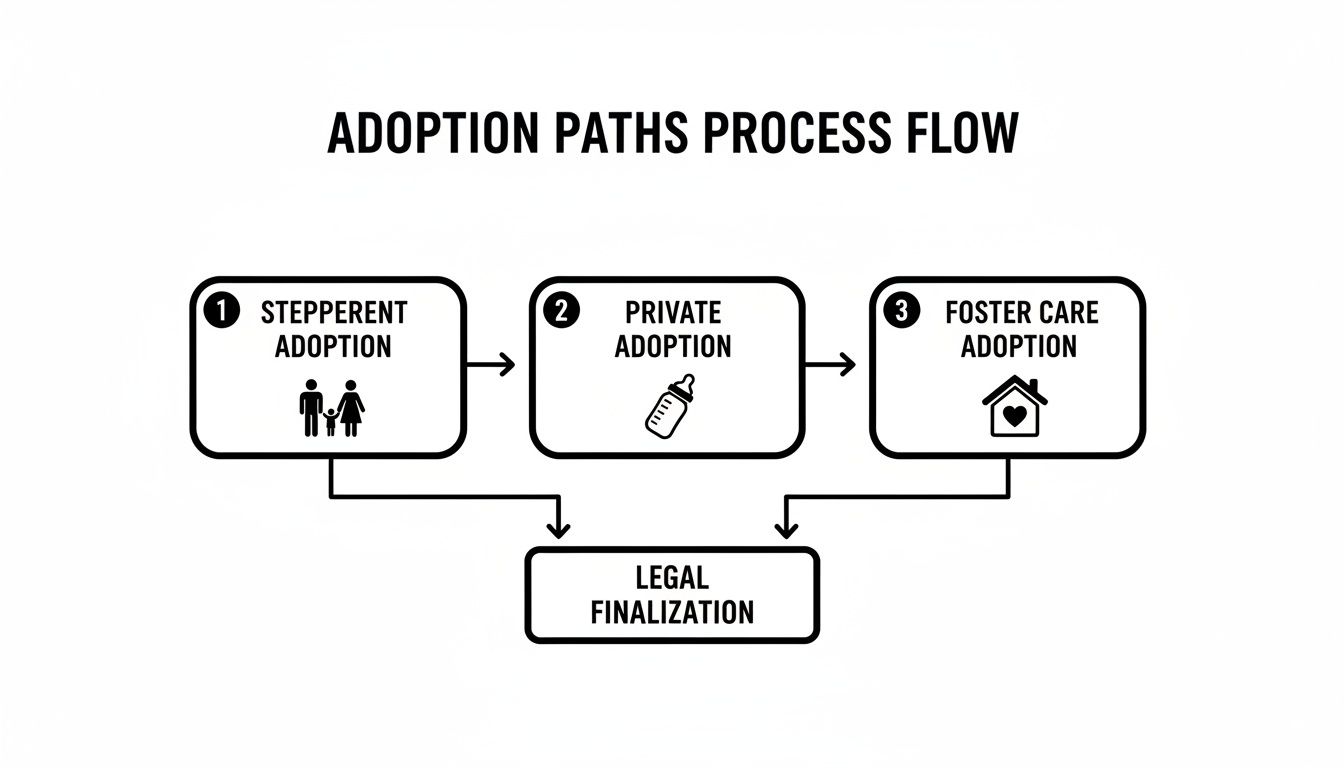
As you can see, whether you're formalizing a bond with a stepchild, working directly with a birth mother, or opening your home to a child from foster care, every journey follows a structured legal path toward becoming a family forever.
Step 3: Filing the Petition and Terminating Parental Rights
With your home study approved, your attorney will officially kick off the legal proceedings by filing a Petition to Adopt with the court. This formal document tells the court who you are and which child you intend to adopt.
At the same time, we’ll handle what is arguably the most critical legal step in any adoption: the termination of parental rights (TPR). Before a child can be legally adopted, the rights of their biological parents must be permanently ended. This can happen in one of two ways.
Voluntary TPR is when a birth parent chooses to sign an affidavit of relinquishment, willingly giving up their parental rights. In contrast, an involuntary TPR is a court-ordered process used when a parent has endangered, abandoned, or neglected a child and a judge determines it is unsafe for them to remain the legal parent.
This is where an attorney's expertise is non-negotiable. We ensure the TPR is handled correctly and ethically, protecting your adoption from any legal challenges down the road.
To give you a clearer picture, here’s a quick breakdown of the major milestones you can expect.
Key Stages of the Texas Adoption Process
| Stage | Key Objective | Typical Attorney Involvement |
|---|---|---|
| Initial Consultation | Define goals and explore adoption paths. | Provide legal advice, outline options, and establish attorney-client relationship. |
| Home Study | Get approved as a safe and stable home for a child. | Advise on requirements and connect you with licensed social workers. |
| Filing the Petition | Formally begin the court process for adoption. | Draft and file the Petition to Adopt and all other required legal documents. |
| Terminating Parental Rights | Legally end the biological parents' rights. | Manage the voluntary or involuntary TPR process, ensuring it's legally sound. |
| Post-Placement Supervision | Ensure a smooth transition for the child in their new home. | Monitor progress and communicate with the social worker and court. |
| Finalization Hearing | Legally complete the adoption and become the child’s parents. | Prepare final documents, represent you before the judge, and obtain the final decree. |
Each of these stages is a significant step forward, moving your family closer to the finish line with expert guidance at your side.
Step 4: The Post-Placement Period and Finalization
After the child is living with you and parental rights have been terminated, a post-placement supervision period begins. In Texas, this typically lasts for at least six months. During this time, the social worker who conducted your home study will visit your home a few times.
Think of these visits as supportive check-ins, not inspections. The social worker wants to see how everyone is adjusting and offer any resources you might need. Once the period is over, they'll submit a final report to the court confirming that the adoption is a success and serves the child's best interests.
Finally, the day you’ve been waiting for arrives: the finalization hearing. You, your child, and your attorney will go before a judge, who will review the case, ask a few questions, and sign the final decree of adoption. This hearing is almost always a joyful, emotional celebration—the moment you legally become a family forever.
The adoption process, while full of details, is a journey of incredible hope and love. At The Law Office of Bryan Fagan, PLLC, we are honored to walk this path with Texas families every single day. If you're ready to take that first step, schedule a free, no-obligation consultation with our compassionate team today.
Understanding the Costs and Timelines for Your Adoption
When you decide to adopt, two big, practical questions usually bubble up right away: “How much is this going to cost?” and “How long will this all take?”
These aren’t just small details; they’re the foundation for planning your family’s future. Getting straight answers is the only way to move forward with confidence. While no two adoption journeys are exactly alike, we can pull back the curtain on the typical financial and time commitments you can expect.
Our goal is to demystify the numbers and schedules so you feel prepared and empowered, not blindsided. A compassionate family law attorney for adoption will be upfront about these factors from the very first conversation—it's a sign you're in the right hands.
Breaking Down the Costs of Adoption
Adoption costs can swing dramatically depending on the path you take. A stepparent adoption, for instance, is typically the most affordable route. On the other hand, a private infant adoption often involves a wider range of expenses.
Here’s a look at the common costs you should be ready to plan for:
- Legal Fees: This is what covers your attorney’s work, from drafting the initial petitions and managing the termination of parental rights to representing you at the final court hearing. At The Law Office of Bryan Fagan, PLLC, we often use flat-fee structures for uncontested adoptions, which gives you a clear, predictable cost right from the start. For more complex or contested cases, an hourly rate might be necessary, but we make sure you understand exactly how billing works before we begin.
- Court Costs: These are the standard fees the court requires just to file your adoption petition and other legal documents.
- Home Study Fees: A licensed social worker or agency will charge a fee to conduct the mandatory home study and prepare the detailed report for the court.
- Other Potential Expenses: In private adoptions, it’s also common to cover certain allowable expenses for the birth mother, like medical care and living costs, as permitted under the Texas Family Code.
Transparency is everything. A trustworthy adoption attorney will give you a detailed breakdown of all anticipated costs and explain how different fee structures work. This allows you to budget effectively for what is truly a life-changing investment in your family.
Understanding Realistic Adoption Timelines
Just like the costs, the timeline for an adoption hinges on its type and unique circumstances. Some adoptions can be finalized fairly quickly, while others simply require more patience.
Here are a few of the key factors that influence how long your adoption might take:
- Type of Adoption: A straightforward, uncontested stepparent or kinship adoption can sometimes be finalized in as little as six to eight months. Private infant adoptions can vary widely, mostly depending on the matching process.
- Termination of Parental Rights: This is often the biggest variable affecting the timeline. If the termination of parental rights is voluntary and the birth parent consents, the process moves much faster. If a birth parent has to be located or decides to contest the termination, it can add significant time to your case.
- Post-Placement Supervision: Texas law requires a child to live in the adoptive home for at least six months before the adoption can be finalized. This post-placement period gives a social worker time to visit and ensure the entire family is adjusting well.
The journey to adoption truly is a marathon, not a sprint. Having an experienced legal guide by your side helps you anticipate each step and manage the timeline with realistic, grounded expectations.
At The Law Office of Bryan Fagan, PLLC, we believe you deserve clarity and compassion every step of the way. We’re here to give you honest answers and guide you through the financial and time-related aspects of your adoption. To get a personalized look at what your journey might entail, schedule a free, no-obligation consultation with our team today.
How We Use Technology to Support Your Adoption Journey
Let's be honest: the legal side of adoption involves a mountain of paperwork and a lot of moving parts. In a process that’s so deeply personal, the last thing you want is to feel like just another case file. That’s why at The Law Office of Bryan Fagan, PLLC, we pair our heartfelt, personal guidance with smart, modern tools to make your experience as smooth and stress-free as possible.
Think of it this way: technology is our behind-the-scenes assistant. It handles the administrative heavy lifting—organizing documents, securing your private information, and keeping communication lines open—so we can pour our energy into what really matters: you and your growing family.
Streamlining the Details So We Can Focus on You
From the first petition to the final court order, adoption is a document-intensive process. Keeping everything organized, secure, and instantly accessible is non-negotiable. We use modern, protected client portals and case management systems to ensure every piece of information is exactly where it needs to be.
This means less time for us hunting for a specific file and more time answering your questions, talking through your concerns, and developing the right legal strategy for your unique situation. It frees up your family law attorney for adoption to be exactly what you hired them for: a dedicated guide and a compassionate advocate.
The Human Touch Is Something We'll Never Automate
While we embrace tools that create efficiency, we need to be crystal clear: technology is our assistant, not our replacement. The empathy, strategic thinking, and reassuring guidance of an experienced attorney are things that can never be automated.
Sure, new technologies are always emerging, and you can read more about how AI is being adopted across different sectors on dig.watch. But in a sensitive legal field like adoption, the role of tech is purely supportive. An AI can organize a complex timeline, but it can’t offer a comforting word before a court hearing or navigate a delicate conversation with a birth parent. That’s where we come in.
Technology’s role in your adoption journey is to enhance efficiency and communication, never to replace the essential human-centric guidance and compassionate counsel that an experienced family law attorney provides.
Ultimately, every tool we use serves a single, powerful purpose: to give you a clearer and more confident path toward building your family. By managing the administrative details with precision, we make sure the focus always stays right where it belongs—on you.
At The Law Office of Bryan Fagan, PLLC, we blend modern efficiency with timeless compassion. If you're ready to see how our dedicated team can support your adoption, we invite you to schedule a free, confidential consultation with us today.
Finding the Right Adoption Attorney for Your Family

When you decide to grow your family through adoption, you quickly realize it’s not just a legal transaction—it’s a deeply personal journey. Choosing the attorney who will walk alongside you is one of the most important decisions you’ll make. This isn't just about hiring someone to file paperwork; it’s about finding a guide, an advocate, and a compassionate ally who genuinely understands what this means for your family's future.
You need more than just a legal mind. You need someone who combines a deep, practical knowledge of the Texas Family Code with the kind of empathy that makes you feel heard. The best adoption attorneys get it—they know the best interests of the child isn't just a legal phrase but the North Star guiding every single decision. That’s the person you want in your corner.
Key Questions to Ask a Potential Attorney
Think of your first meeting with a potential attorney as an interview. After all, you’re trusting them with the legal foundation of your family. To get a real sense of who they are and how they work, don't be afraid to ask direct questions.
Here’s what you should find out:
- How much of your practice is specifically dedicated to adoption cases? You want someone who lives and breathes adoption law, not a lawyer who just dabbles in it. Their day-to-day experience is invaluable.
- How will we communicate throughout the process? Will you get updates via email, phone calls, or a client portal? Setting clear expectations from the start helps you feel supported and in the loop.
- Have you handled cases similar to mine? Whether you’re navigating a complex private infant adoption or a more straightforward stepparent adoption, you want to know they’ve walked this path before.
- What is your philosophy on the "best interests of the child"? Their answer will tell you everything you need to know about their values and whether they see the child at the heart of the process.
Finding the right attorney means finding a professional you trust on a personal level—someone who makes you feel heard, understood, and confident as you take each step forward.
When evaluating potential attorneys or seeking general information about the process, it's often helpful to explore our blog for additional insights. Finding the right resources is just as important as finding the right legal team. For a more structured approach, you might be interested in our guide on how to find a good family law attorney.
Your family’s story is unique, and you deserve a legal team that honors that. If you are looking for guidance that is both professional and deeply compassionate, we invite you to schedule a free, no-obligation consultation with us. Let’s talk about your hopes and how we can help make them a reality.
Common Questions About Texas Adoption Law
It’s completely normal to have a long list of questions when you’re thinking about adoption. The mix of excitement for the future and uncertainty about the legal steps can feel overwhelming. We hear these questions every day from hopeful parents, and getting clear, straightforward answers is the first step toward feeling confident.
At The Law Office of Bryan Fagan, PLLC, our goal is to cut through the legal jargon and give you the plain-English answers you need. Think of this as a conversation to help you feel prepared for the beautiful journey ahead.
Can I Adopt in Texas Without an Attorney?
While Texas law doesn’t technically require you to hire an attorney for an adoption, trying to handle it yourself is a huge risk. The Texas Family Code is incredibly specific about every single step, from how parental rights are terminated to the exact way the final paperwork must be filed.
One simple mistake could stall your adoption for months or, even worse, give someone grounds to challenge and invalidate it years down the road. An experienced family law attorney for adoption acts as your guide and your safety net, making sure your family is built on a rock-solid legal foundation so you can have total peace of mind.
What Is the Difference Between a Private and Agency Adoption?
The main distinction is who is in the driver's seat for matching the child with your family.
- Agency Adoptions: These are handled by a licensed child-placing agency that manages almost everything. The agency screens birth parents and adoptive parents, offers counseling, and oversees the entire placement from start to finish.
- Private Adoptions: Also called independent adoptions, these are arranged directly between the birth parents and the adoptive parents. An attorney is usually at the center of this process, helping facilitate communication and navigate the legal steps instead of a large agency. This route can often feel more direct and personal.
Both paths lead to the same wonderful outcome. No matter which you choose, an attorney is crucial for handling the court proceedings and making sure the adoption is finalized correctly.
Every adoption is a profound legal event designed to protect a child's future. Having an expert legal guide ensures that protection is permanent and unshakeable, no matter which adoption path you choose.
What Happens If a Birth Parent Cannot Be Found?
This is a scenario we see often, particularly in stepparent and kinship adoptions. If a biological parent is missing or simply won't cooperate, it doesn’t mean the adoption has to stop. The law provides a clear path forward.
Your attorney will first perform what’s called a "diligent search" to make every reasonable effort to find the missing parent. If that search comes up empty, we can then follow the legal procedure for giving notice in other ways, like a public posting. By meticulously following these steps, we satisfy the court’s requirements, allowing the judge to terminate that parent's rights and let the adoption proceed securely.
The adoption journey is filled with hope, love, and a few legal hurdles. You don't have to face them alone. The compassionate team at The Law Office of Bryan Fagan, PLLC is here to provide the expert legal guidance your family deserves. To discuss your unique situation and get your questions answered, schedule a free, no-obligation consultation with our compassionate team today.
