
A child is finally sleeping in the next room. The paperwork is moving. Friends are congratulating you. And then the fear shows up: Can adoptive parents lose custody in Texas?
That question usually comes from love, not doubt. You've worked hard to build safety, routine, and connection. It's normal to worry that something could undo it.
The short answer is reassuring. Texas law is built to make adoption permanent once it is finalized. A finalized adoption is not meant to be a trial run. It creates a legal parent-child relationship that Texas treats as real, complete, and lasting.
But families often get confused because two very different situations get lumped together. One is before finalization, when placements, court orders, and parental-rights issues may still be unsettled. The other is after finalization, when the law shifts sharply in favor of permanence. There are also separate issues that can affect any parent, including an adoptive parent, such as CPS involvement, unsafe conditions, or custody disputes during divorce.
Introduction A Journey of Love and a Question of Permanence
Many families ask this question late at night, after an email from a caseworker, a hard conversation with a birth relative, or a stressful moment at home. Some are foster parents nearing adoption. Others are stepparents, relatives, or hopeful parents in a private case. The fear sounds the same: “Could someone take my child away?”
Most of the time, people are worrying about the wrong danger. They picture a birth parent returning and reclaiming the child. In a finalized Texas adoption, that usually isn't how the law works. Texas treats adoption as a permanent legal change, not a temporary caregiving arrangement.
What does deserve careful attention is something else. The primary risks usually depend on timing and conduct. Before finalization, a placement may still be under court review. After finalization, the bigger issues are the same ones that can affect any legal parent: child safety, neglect allegations, serious misconduct, and custody litigation tied to family breakdown.
Practical rule: If your adoption is finalized, your legal position is far stronger than many internet forums make it sound.
That distinction matters whether you're adopting through CPS, pursuing a relative adoption, considering a stepparent adoption under the Texas Family Code, or preparing for the final court hearing under Chapters 162 through 166. The process includes many moving parts, from background checks and home studies to consent documents, termination orders, placement requirements, and finalization. Each stage carries a different level of legal stability.
Families usually feel calmer once they can separate myth from law. The law can't remove every hard possibility from life. It can, however, give you a much clearer picture of where your family stands and what steps protect it.
The Legal Bedrock Your Final Adoption Decree
A final adoption decree is the document that changes everything. Its operation is similar to a deed to a house, except for your family relationship. Before the deed is signed and recorded, a sale may still be in process. After it is complete, ownership has legally changed. In adoption, the decree serves a similar role. It confirms that the parent-child relationship now belongs to the adoptive family in the eyes of the law.

What the decree legally does
Under Texas adoption law, finalization is not a symbolic moment. It is the legal act that makes the child a full member of the adoptive family. Texas guidance explains that once adoption is final, the child has the same rights and responsibilities as a biological child, and reopening that relationship is generally limited to exceptional problems such as fraud, coercion, or other serious legal irregularities, as discussed by HHZ Family Law on birth-parent rights after adoption.
That's why a finalized adoption carries so much weight. The court isn't lending you parental rights. The court is recognizing you as the child's legal parent.
If you're trying to understand the rare exceptions, can an adoption be reversed in Texas is a useful place to see why reversal is treated as unusual rather than routine.
Why finalization feels emotional and legal at the same time
The hearing itself is often joyful, but it's also precise. A judge reviews whether the legal requirements have been met and whether adoption serves the child's best interests. For many families, Finalizing a Texas Adoption: The Final Hearing helps explain what happens at the hearing that makes the adoption legal.
Here's the simple version of what that final decree means:
- You become the legal parent. Your rights and responsibilities aren't lesser or conditional because the family was formed through adoption.
- The old legal relationship is replaced. In most adoptions, the prior legal parent-child relationship has already been terminated by court order.
- The child gains permanence. That stability is one reason Texas courts take finalization seriously.
A finalized adoption is meant to end uncertainty, not prolong it.
Families often need to hear that more than once. Love may have made your family. The decree gives that family full legal protection.
Understanding Your Risk Before vs After Finalization
The most important timing question is this: Are you placed, or are you finalized? Those are not the same thing in Texas.
Before finalization, a child may be living with you, bonding with you, and calling you Mom or Dad. Even so, the court process may still be active. Consent issues, termination issues, placement supervision, or agency requirements may still be in motion. After finalization, the legal posture changes in a major way.
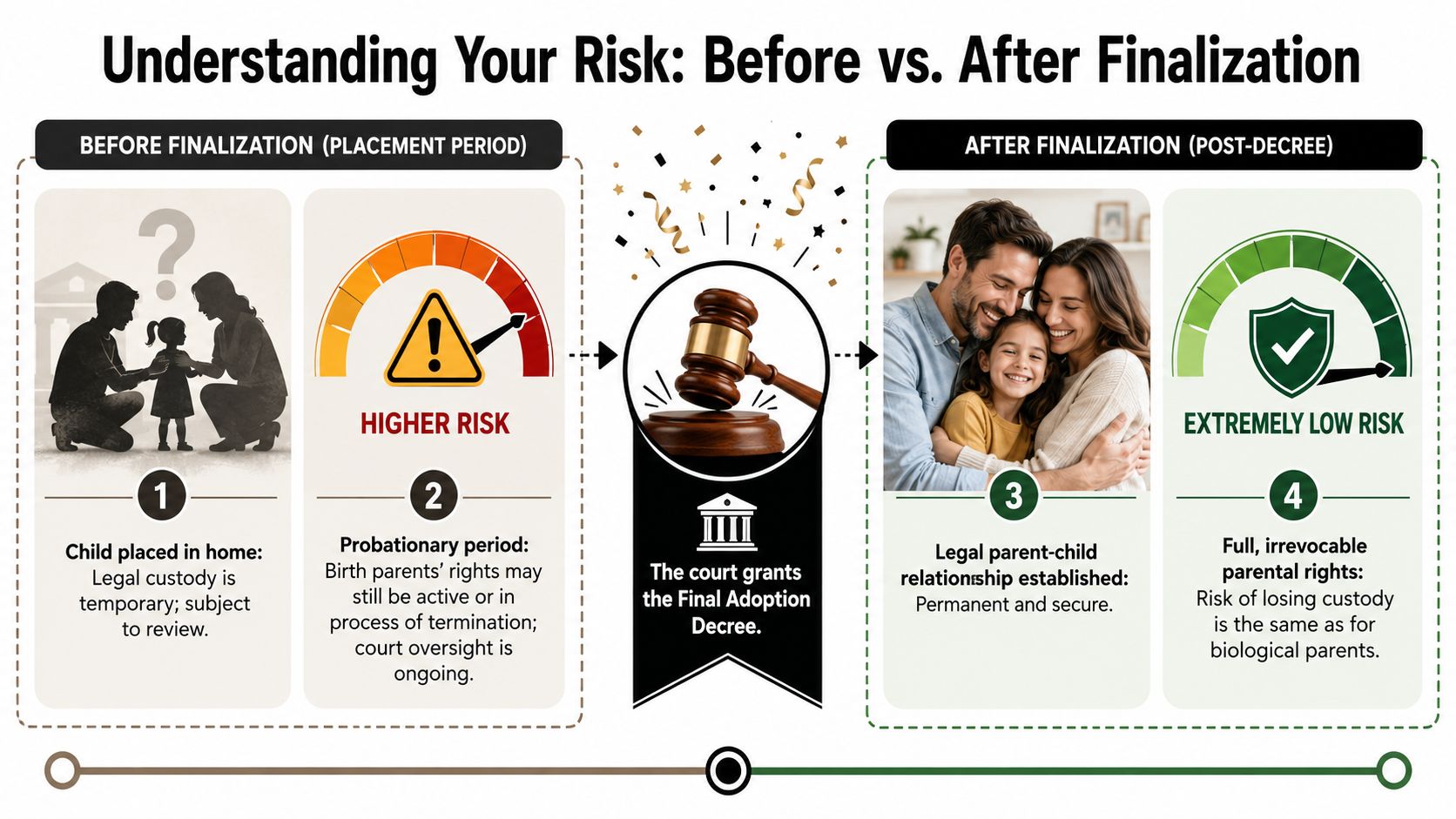
Before finalization
Here, most of the legal instability resides.
In Texas, adoption can happen only after parental rights have been permanently terminated. Reporting discussed by The Imprint on Texas adoptions and terminated rights notes that federal data show Texas has terminated parental rights for 91,589 children since 2006, reflecting how seriously the legal system treats that severance before adoption can occur.
A pre-finalization period may involve:
- Placement review: The child may be in your home, but the court may still be watching how the case progresses.
- Unresolved legal defects: Problems with consent, notice, or procedure can create challenges before the decree is signed.
- Different adoption tracks: Foster care, relative placement, private adoption, and stepparent adoption don't all move through the same risk window in the same way.
If you're worried about whether a signed consent can later be attacked, what makes an adoption consent invalid in Texas can help you understand why some disputes arise before finalization rather than after.
After finalization
Once the decree is signed, the issue usually stops being “Can the birth parent take the child back?” and becomes “Could any legal parent face court action if something serious happens later?”
That's a very different question.
A useful way to think about it is this short comparison:
| Stage | Legal status | Main concern |
|---|---|---|
| Placement period | Child is in home, but legal process may still be active | Court review, consent issues, termination status |
| After decree | Parent-child relationship is legally established | Only serious later problems, like those that can affect any family |
During placement, you may be building a family. After finalization, Texas recognizes that family as legally complete.
A simple example
Suppose a grandmother is caring for a child under a court arrangement, and everyone informally calls it “the adoption.” If the case is really a placement, PMC, or pending petition, the legal stability may still be limited. If a judge has already signed a final decree of adoption, the legal footing is far stronger.
That's why families get mixed answers online. They're often comparing two different stages and calling them by the same name.
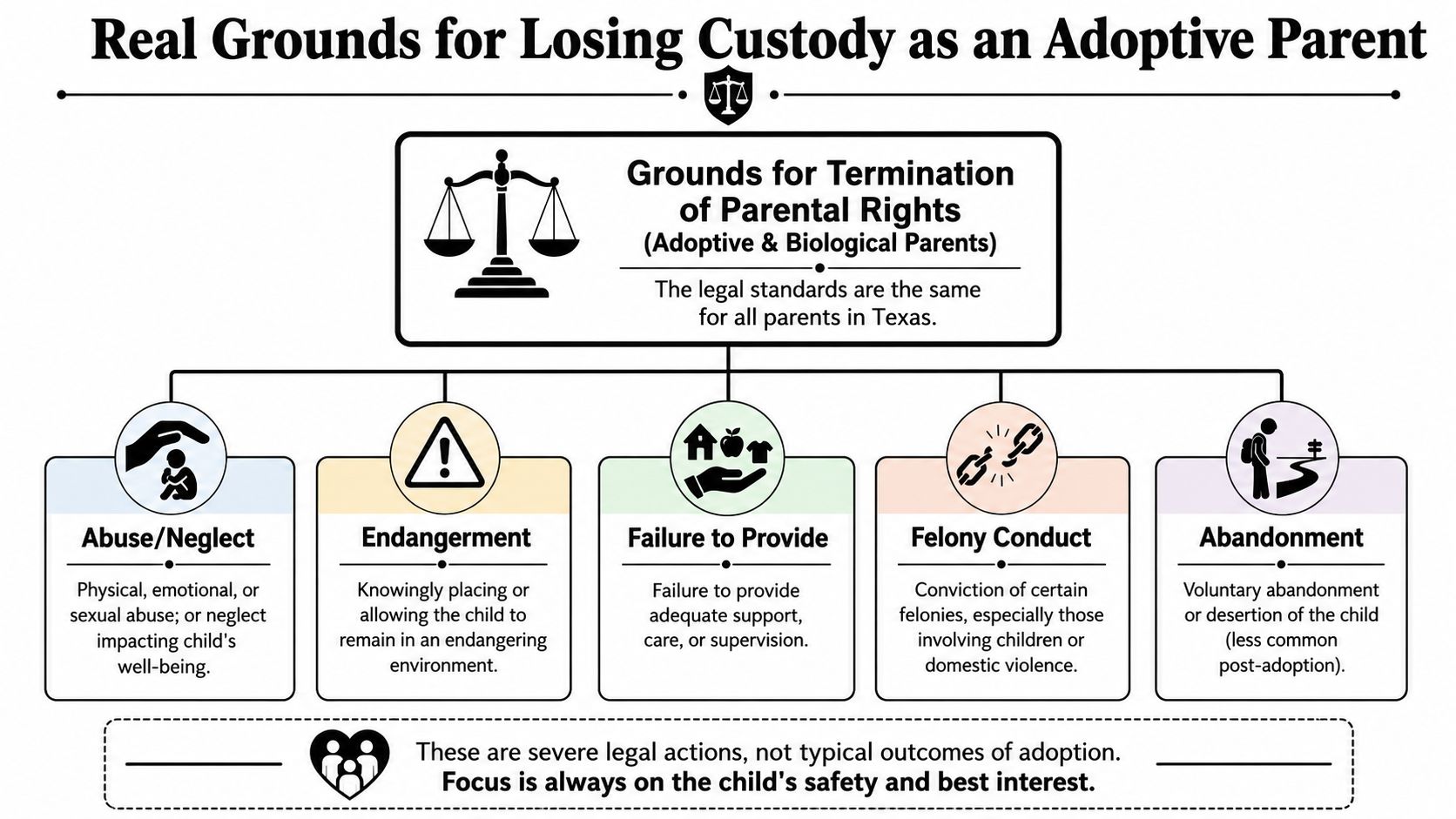
Real Grounds for Losing Custody as an Adoptive Parent
Once an adoption is final, the law doesn't treat adoptive parents as fragile parents. It treats them as parents. That is good news, but it also means the same child-protection rules apply to them as to biological parents.
The practical legal risk is usually not a routine challenge from a birth parent. It is a later court action based on serious statutory grounds. Federal and Texas child-welfare guidance describing grounds for involuntary termination of parental rights in Texas lists grounds such as abandonment, endangerment, serious criminal conduct, or incarceration preventing care.
What courts are actually looking at
The court's focus isn't how your family was formed. The court looks at whether the child is safe, supported, and cared for.
Common categories include:
- Endangerment: A parent knowingly places a child in dangerous conditions or allows dangerous behavior around the child.
- Abandonment: A parent leaves the child without proper care or support.
- Failure to support or care for the child: Ongoing inability or refusal to meet basic parental duties can matter.
- Serious criminal conduct: Some convictions can put parental rights at risk.
- Incarceration preventing care: Long periods of incarceration may become relevant depending on the facts.
Those are severe allegations. They aren't part of ordinary adoption life. But they are the actual legal pathways by which any parent, including an adoptive parent, can lose custody or even face termination proceedings.
What this looks like in real life
A few examples make the distinction clearer:
A finalized adoptive parent goes through a divorce. The other parent asks for primary custody. That is a custody dispute, not an attack on the validity of the adoption.
A school reports unexplained injuries and poor supervision. CPS investigates. That is a child-safety case, not a claim that adoption was never real.
An adult relative says the child would be better off living elsewhere and tries to pressure the parent into handing the child over informally. That is not how Texas law expects custody transfers to happen.
If CPS is already part of your story, what if CPS is involved in your adoption case can help you understand how adoption and child-protection concerns intersect.
The legal system does not rank adoptive parents below biological parents. It holds all parents to the same safety standards.
Divorce can create confusion
Adoptive parents sometimes fear that divorce makes the adoption less secure. It doesn't. After a final adoption, Texas courts generally treat the child the same as any child of the marriage or family unit. The issues then become conservatorship, possession, access, support, and best interests.
That means an adoptive parent can lose custody time in a divorce or conservatorship case if the facts justify it, just as any parent can. But that is different from saying the adoption itself has become weak or reversible.
Navigating CPS Investigations and the Court Process
A CPS investigation can feel overwhelming even when you've done nothing wrong. The process sounds frightening because people often imagine the worst-case outcome at the very start. Most cases don't begin there.
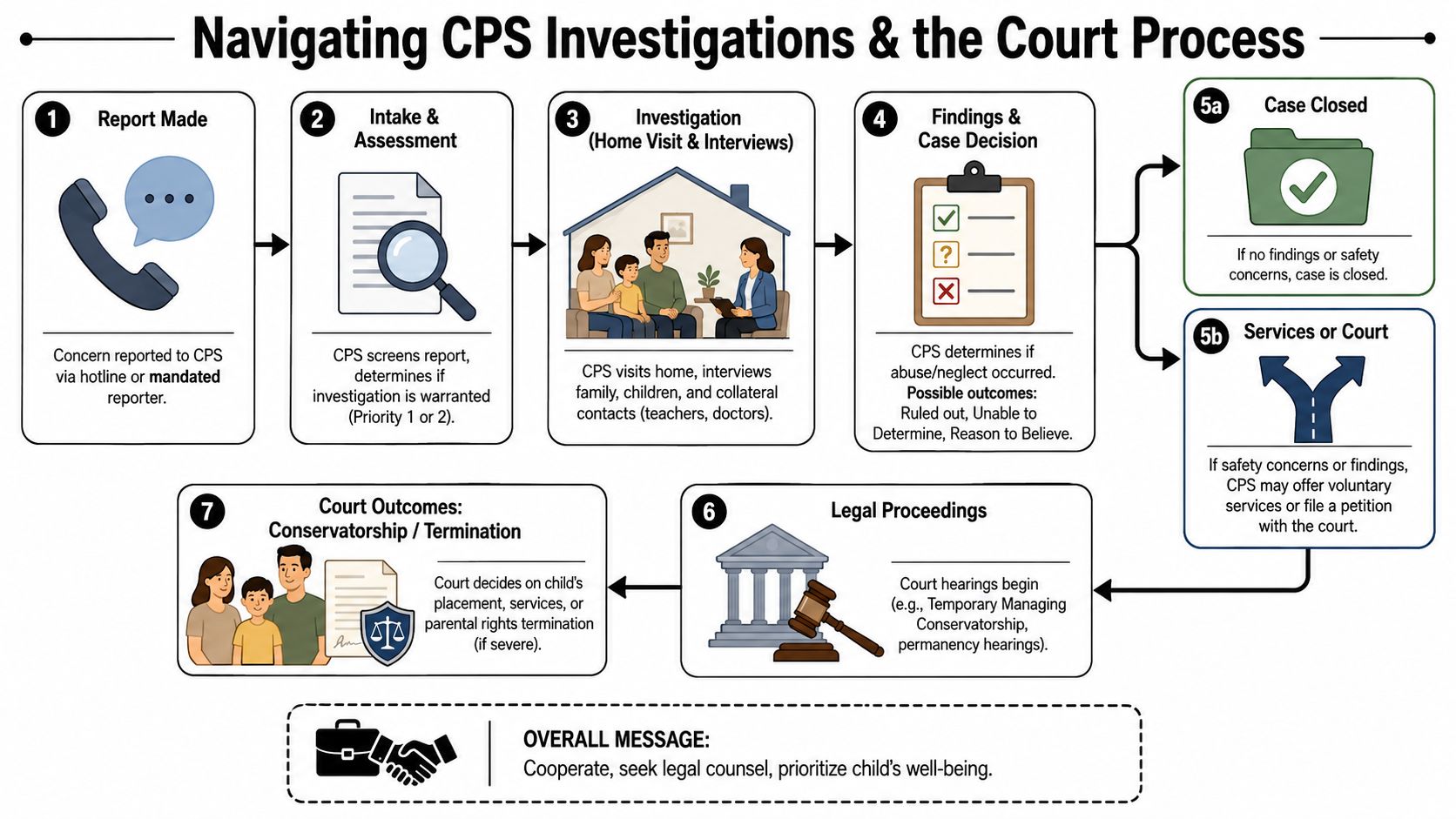
Usually, the sequence begins with a report, then screening, then investigation. CPS may interview adults, visit the home, and speak with people who know the child. If the agency doesn't find a basis for action, the matter may close. If the agency sees safety concerns, it may ask for services or go to court.
This video gives a useful overview of the process families often face:
Emergency removal is not the same as permanent loss
One of the biggest fears is immediate removal. In urgent situations, a court can allow temporary action to protect a child. That is not the same as permanently terminating parental rights. Permanent termination requires a much more serious legal process.
That difference matters. A temporary hearing may happen quickly. A final severance of rights requires strong proof, court findings, and careful legal review.
Post-adoption rules still matter
Texas makes clear that child-welfare rules continue after adoption. According to Texas Law Help on terminating parental rights in Texas, a parent, including an adoptive parent, may not make an unregulated custody transfer, and violating that rule can be a third-degree felony.
That surprises many families. They assume that if parenting becomes difficult, they can arrange a private handoff with a relative or family friend. Texas does not allow that kind of off-the-books transfer.
If substance use or treatment questions are part of the family situation, practical information on navigating legal aspects of addiction treatment can help you understand how care decisions and court expectations may overlap.
Cooperate carefully, stay calm, and get legal advice early. Panic makes hard situations harder.
A simple process map
Here's the big-picture path many families want to understand:
- A report is made.
- CPS decides whether to investigate.
- The family is contacted and assessed.
- CPS either closes the case, offers services, or seeks court involvement.
- If the court becomes involved, hearings address safety, placement, and parental rights.
Knowing the order helps. It reminds you that a report is the start of a process, not the end of your family's story.
How to Protect Your Family and Defend Your Rights
If your family is under stress, your first job is to slow the panic down. Your second job is to get organized.
Start with the basics:
- Keep records: Save emails, texts, medical notes, school communications, and court papers.
- Follow orders carefully: If a court order or safety plan exists, read it closely and comply with it.
- Stay child-focused: Judges and investigators notice when parents keep the child's routine, treatment, school, and emotional needs at the center.
- Don't make side deals: Informal custody swaps can create legal danger instead of solving a problem.
For some families, practical tools also help lower day-to-day risks. If you're caring for a younger child who spends time with relatives, school staff, or caregivers, guidance on proper sizing for ID bracelets can be useful for safety planning and identification in busy settings.
Get legal help early
The most important protective step is getting case-specific legal advice as soon as a problem appears. An attorney can help you respond to CPS, prepare for hearings, correct misunderstandings, and protect your rights without making the conflict worse.
One option Texas families use for adoption and guardianship matters is Law Office of Bryan Fagan, PLLC, which provides information and representation in Texas family-law cases.
If you're at the point where you need guidance tied to your own facts, adoption and guardianship resources in Texas can help you identify the next procedural step.
Strong families still need support. Asking for it early is often what keeps a temporary crisis from becoming a larger legal problem.
Common Questions for Adoptive Parents in Texas
Can a birth parent come back years later and simply take the child back
In a finalized adoption, that usually isn't how Texas law works. The legal relationship changes through court order, and the birth parent's prior rights have already been addressed through the adoption process. Rare challenges usually depend on serious legal defects, not a simple change of heart.
Can adoptive parents lose custody in Texas after a divorce
Yes, in the same sense that any parent can lose primary custody, visitation time, or conservatorship rights if the facts support that outcome. Divorce can lead to custody litigation, but it does not make the adoption itself less real. The court is deciding parenting arrangements, not undoing the child's legal place in the family.
Is foster placement the same as adoption
No. That's one of the most common points of confusion. Texas DFPS distinguishes between PMC with termination of parental rights, where birth parents have no legal rights, and PMC without termination, where they may still have rights, as explained by Texas DFPS on adoption or PMC. That difference can change the level of legal stability before finalization.
Are kinship and stepparent adoptions weaker than other adoptions
Not once they are finalized. The path to finalization may look different, especially in stepparent cases or relative cases, but a final adoption decree still creates a legal parent-child relationship. The route may differ. The permanence of a valid final decree is the key issue.
What if CPS contacts me after my adoption is final
Take it seriously, but don't assume the worst. Cooperate thoughtfully, document everything, and get legal advice quickly. A CPS contact does not automatically mean removal, and an investigation is not the same as termination of parental rights.
What should I focus on most if I'm still in the process
Focus on the stage you are in. Home studies, background checks, consent issues, termination orders, placement requirements, and final hearing preparation each matter for different reasons. Families often feel better when they stop treating “placement” and “finalization” as the same legal event.
If you're carrying this worry right now, you don't need to sort it out alone. Clear legal advice can turn a vague fear into a concrete plan, especially when the issue involves CPS, divorce, a relative placement, or questions about whether your adoption has reached the point of permanence.
If you have questions about your specific adoption, custody risk, or post-adoption concerns, a confidential conversation can help. The attorneys at Law Office of Bryan Fagan, PLLC work with Texas families on adoption and guardianship matters, including finalization, CPS-related issues, and family court disputes. Scheduling a free consultation is a practical next step if you want clear answers about where your family stands and what to do now.
