
Adoption can feel steady one day and frightening the next.
A birth mother may be sitting at home after signing papers, wondering if she was rushed and whether what she signed will hold up. An adoptive couple may already have a crib assembled and a pediatrician chosen, but now they're worried that one mistake in the paperwork could shake everything. A grandparent pursuing kinship adoption may want to know whether the process is secure, fair, and centered on the child.
Those fears are real. So is the law's effort to balance them.
Texas treats adoption consent as a serious legal act because it affects a child's identity, safety, and long-term stability. The law tries to protect birth parents from pressure while also protecting children and adoptive families from uncertainty that drags on without end. If you're asking What Makes an Adoption Consent Invalid in Texas?, you're usually looking for one of two things: reassurance that the process was done correctly, or clarity about whether something went wrong.
Both needs matter.
This topic also sits inside the larger Texas adoption process under the Family Code, especially Chapters 162 through 166, where courts focus on the child's best interests, careful screening, home studies where required, and final court approval. Consent is only one piece, but it's a foundational one. If that piece is weak, the entire adoption can become vulnerable.
The Heart-Wrenching Question of Adoption Consent
A common call to a family law office starts with a pause. Then someone says, “I need to know if this adoption can be challenged.”
Sometimes that person is a birth parent who signed during an exhausting and emotional time. Sometimes it's an adoptive parent who just learned a paper may have been signed too soon, or not witnessed properly. Sometimes it's a relative who thought everyone agreed, only to find out one person now disputes what happened.

In real life, this question doesn't feel technical. It feels personal. It touches grief, hope, fear, and sometimes guilt. That's why it helps to slow the conversation down and separate regret, confusion, and legal invalidity. Those are not the same thing.
Why families get confused
Many people assume that if someone later feels pressured, the consent must be invalid. Others assume the opposite, that once a signature is on paper, nothing can ever be questioned. Texas law is more careful than either of those extremes.
A valid adoption consent has to be voluntary and properly handled. If the required rules weren't followed, the consent may be open to attack. If the rules were followed, courts usually protect the adoption because children need permanence.
Practical rule: The legal question is usually not “Was this painful?” It is “Was this consent voluntary, informed, and completed the way Texas law requires?”
If you're trying to understand whether a challenge is even possible, a good starting point is this guide on when consent to adoption can be challenged in court.
The child is still at the center
That focus can be hard to accept when adults are hurting. But Texas courts don't look at adoption consent in a vacuum. They look at the paper, the process, the timing, and the effect on the child.
That doesn't mean a birth parent's rights are ignored. It means the law is trying to guard two truths at once. Parents deserve protection from coercion, and children deserve a stable home life that isn't left in constant suspense.
The Legal Cornerstone The Affidavit of Relinquishment
A parent sits in a hospital room or lawyer's office with a pen in hand, exhausted, emotional, and trying to understand whether this one document will change everything. In many Texas adoptions, it will. The Affidavit of Voluntary Relinquishment of Parental Rights is the written consent that allows the case to move ahead by ending a birth parent's legal rights.
That is why this document is treated with unusual care.
The affidavit works like the signature page on a major contract, but with far more at stake than money or property. It can permanently change who has legal authority to raise a child, make medical decisions, and build that child's future home life. For birth parents, it marks a significant personal turning point. For adoptive parents, it is one of the papers that helps turn hope into legal security.
What this document has to do
Texas does not treat an affidavit of relinquishment as a casual statement of intent. The document must be completed in a specific way. For example, Texas law requires the affidavit to be signed before a person authorized to take oaths and witnessed by two credible persons. Those steps are there to create a reliable record of who signed, what they were signing, and whether the act was handled formally.
That formality can feel cold in a very human moment. But the reason behind it is protective, not bureaucratic.
If a dispute comes up later, the court needs more than someone's memory of a painful day. It needs clear markers that help answer practical questions:
- Was the parent properly identified?
- Was the signing done under oath?
- Did other adults witness the event and help confirm what happened?
- Does the paperwork show a deliberate legal decision rather than an informal conversation?
Each requirement works like a checkpoint. One checkpoint alone may not tell the whole story. Together, they help the court decide whether the consent deserves to be trusted.
If you want to see how this paperwork is generally structured, this overview of a release of parental rights form can help make the document easier to follow.
Why these rules matter in real life
Families often assume the hardest part is deciding whether to sign. Legally, the harder question is often whether the signing process was done correctly.
For example, a mother may sincerely want the adoption to happen. She signs in her hospital room with one relative nearby, and everyone in the room believes they are doing the right thing. If no authorized officer administers the oath, or if the required witnesses are missing, the problem is not her sincerity. The problem is that Texas uses these formal steps to protect everyone involved from uncertainty later.
That protection runs in both directions. Birth parents get safeguards against rushed or poorly documented decisions. Adoptive parents and children get a stronger legal foundation, so the adoption is less vulnerable to later attack based on avoidable paperwork problems.
Courts care about these details because a child's stability should not rest on a document that was handled casually. In private adoptions, agency cases, stepparent matters involving termination of another parent's rights, and some kinship cases, the path may look different. The need for a properly executed relinquishment does not.
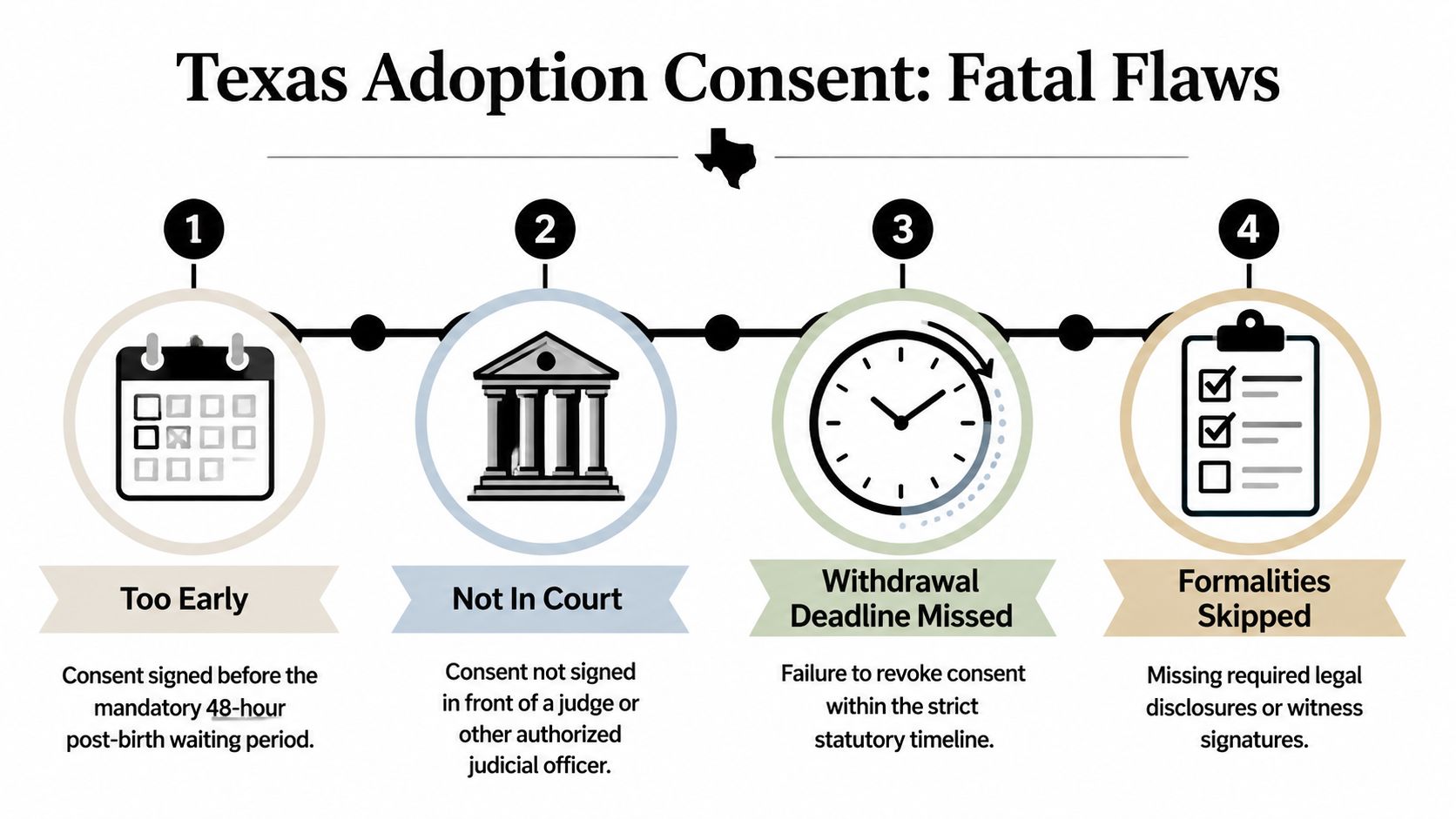
Fatal Flaws Strict Timelines and Formalities
A common real-world problem looks like this: everyone agrees the adoption plan is right, the paperwork gets signed in a rush, and months later someone discovers the timing or signing process did not meet Texas rules. At that point, the dispute is no longer about anyone's love for the child. It is about whether the document can legally carry the weight everyone placed on it.
The waiting period that cannot be skipped
Texas gives special attention to timing for a reason. A birth mother generally cannot sign an affidavit of voluntary relinquishment until at least 48 hours after birth. A father may be subject to different timing rules. That waiting period is a legal guardrail, not a paperwork preference.
The reason is deeply practical. The first two days after delivery can involve pain, medication, sleep deprivation, fear, pressure from family, and emotional shock. The law creates a short pause so a life-changing decision is less likely to be made in the blur of those first hours.
A hospital-room signature can feel final. Legally, if it came too soon, it may not be.
Errors that can break an otherwise sincere consent
These cases often confuse families because the parent may have fully intended to consent. Intent alone is not enough if the formal steps were mishandled. Adoption paperwork works a lot like a deed to a house. Everyone may agree on the transfer, but if the signing rules are wrong, the document can still fail.
Some of the most common trouble spots include:
- Signing too early: If the birth mother signed before the waiting period expired, the consent may be invalid.
- Witness defects: If required witnesses were missing, disqualified, or not present, the affidavit may be challenged.
- Improper oath or acknowledgment: The signer usually must appear before a person authorized to take oaths.
- Incomplete execution: Missing information, missing signatures, or other formal defects can weaken the document.
These are not minor clerical slips. They are the safeguards that help a court decide whether the consent deserves confidence.
Why courts treat these details so seriously
Families sometimes ask, "If everyone meant well, why does one mistake matter so much?" Because adoption orders are meant to create lasting stability for a child. Courts want to know that the foundation was laid carefully.
A useful comparison is a car seat. It may look secure from a distance, but one missed latch changes everything if safety is tested. Adoption formalities serve a similar purpose. They may seem quiet in the background until a challenge arises. Then they become the first thing the court examines.
If you are trying to understand deadlines tied to a signed relinquishment, this guide on how long a birth parent has to revoke consent in Texas can help clarify the timing questions that often cause the most anxiety.
Careful process protects everyone involved. It gives birth parents meaningful safeguards and gives adoptive families a stronger path toward permanence.
Challenges Beyond Paperwork Fraud Duress and Incapacity
Not every invalid consent case turns on signatures and witness lines. Sometimes the paper is formally correct, but someone argues that the consent wasn't voluntary because of fraud, duress, or incapacity.
These claims are harder to prove.
Regret is not the same as legal coercion
A parent may later feel heartbreak, panic, or second thoughts. Those feelings are human. But Texas courts generally draw a line between painful regret and legally recognized wrongdoing.
Fraud usually means someone lied about something important to get the consent. Duress usually means pressure so serious that it overpowered the person's free choice. Incapacity usually means the person did not have the ability to understand what they were signing.
Here's a quick comparison:
| Issue | What it usually means |
|---|---|
| Regret | “I wish I had not signed.” |
| Fraud | “I signed because someone deceived me about a material fact.” |
| Duress | “I signed because severe pressure or threats overcame my free will.” |
| Incapacity | “I could not understand the nature or consequences of signing.” |
Mental health concerns and postpartum stress
Many families need a compassionate explanation in these sensitive situations. Postpartum depression, anxiety, trauma, or emotional collapse after birth are serious health issues. But they do not automatically void adoption consent.
Texas courts evaluate capacity under general contract principles, invalidating consents if duress or incapacity is proven via medical evidence. However, data from 2015-2024 shows that successful challenges on these grounds occur in less than 2% of cases, as regret alone is insufficient, according to this analysis of informed consent in a Texas adoption case.
That means the court usually wants more than a later statement that the parent felt emotionally shattered. It may look for medical records, treatment history, testimony about the parent's condition at the time of signing, or other evidence showing the parent lacked real capacity or acted under unlawful pressure.
If a parent says, “I was devastated,” the court hears that. If a parent says, “I was medically unable to understand what I signed,” the court will expect proof.
A real-world way to think about it
Consider two scenarios.
In the first, a birth mother says she cried through the signing and has regretted it every day since. That is heartbreaking, but by itself it usually isn't enough.
In the second, a birth mother has medical evidence showing a severe mental health crisis at the time of signing, and there is evidence that others pushed the process forward despite obvious incapacity. That may raise a very different legal question.
What families should do
If fraud, pressure, or incapacity may be involved, documentation matters. Families often need to preserve texts, emails, medical records, and names of everyone present. In some situations, legal counsel may also recommend a psychological evaluation before signing, or immediate legal review after concerns arise.
This is one area where legal advice before the signature can prevent pain later.
How Consent Rules Vary in Different Adoptions
The rules around consent don't play out exactly the same way in every case. A private infant adoption feels different from a stepparent adoption. A grandparent adopting a grandchild faces different practical issues than a couple adopting through an agency. The child's age can also change everything.
Stepparent and kinship cases often surprise families
In a stepparent adoption, the household may already feel like a family. That can make people think the legal side will be simple. Sometimes it is simpler emotionally, but the court still has to deal with the rights of the other legal parent, and sometimes with the wishes of the child.
In kinship adoptions, relatives may focus on stability, school routines, and keeping the child connected to family history. Those goals matter. So does proper consent. Being related to the child doesn't erase the need for careful legal steps.
A child's consent can become a major issue
For older children, Texas gives them a voice. For children aged 12 or older, consent is required for adoption and is revocable until the final court order is signed. In 2025-2026, 22% of contested stepparent adoptions involved child consent revocations, though courts often waive this if it's not in the child's best interest, according to this Child Welfare Information Gateway resource on consent to adoption in Texas.
That rule catches many families off guard.
A stepparent may have raised a child for years and assume the teen will gladly consent. Then the teen hesitates. Sometimes the hesitation comes from loyalty conflicts. Sometimes from pressure by another adult. Sometimes the child fears that saying yes means betraying a biological parent.
Here's a helpful way to compare key situations:
| Adoption type | Consent issue that often matters most |
|---|---|
| Private infant adoption | Proper parental consent procedures and timing |
| Stepparent adoption | Termination or consent of the other parent, plus child consent if age applies |
| Kinship adoption | Family agreement may exist emotionally, but legal consent still must be clear |
| Foster or CPS-related adoption | Court orders and prior rights termination may shape who still has a say |
A short video can also help families understand how these issues show up in practice:
Why older children may change their minds
Children in this age group often understand more than adults realize, but they don't always process change in a steady way. A teen may want the adoption one month and resist it the next after a difficult phone call, a social media exchange, or pressure from extended family.
That doesn't mean the adoption is doomed. It means the court may need better evidence about best interests, counseling support, and the child's true wishes.
Older children don't just need paperwork. They often need space, explanation, and support before the court hearing.
The Legal Path to Challenge or Defend an Adoption
A case often reaches this stage after a tense phone call, a court notice, or the moment someone says, "I did not understand what I was signing." That can feel terrifying for everyone involved. Birth parents may fear they are out of time. Adoptive parents may fear the life they have built with a child is suddenly uncertain.

Texas courts try to balance two human needs that can pull in opposite directions. One is fairness. If consent was obtained through a serious legal defect, the court needs a way to address that. The other is stability for the child. A child cannot live indefinitely with the question of whether the adoption will hold.
The deadline that matters most
Texas generally limits how long a final adoption decree can be challenged. In many cases, a person must act within six months after the decree is signed, unless the challenge involves fraud or lack of jurisdiction under Texas Family Code §162.012.
A simple comparison helps here. Finalization is not like an open conversation that can be restarted at any time. It works more like a door that begins to close once the decree is entered. For families who believe something went legally wrong, waiting can sharply reduce the options available.
That time limit exists for a reason. Courts want children to settle into daily life, school, medical care, and family routines without years of legal uncertainty hanging over them.
What a challenge or defense usually involves
Once a dispute reaches court, the process often follows a practical sequence rather than a dramatic courtroom showdown.
A close review of the record
The attorney looks at the affidavit of relinquishment, termination orders, court filings, and any messages, notes, or medical records that may shed light on how consent happened.A petition or response is filed
One side asks the court to set aside or question the adoption. The other side explains why the adoption should stand.Evidence is gathered carefully
This can include testimony from witnesses, proof about the signing appointment, records showing a parent's mental condition, or communications that may suggest pressure, deception, or confusion.The judge weighs credibility and legal proof
The court does not focus only on who is more upset or more persuasive. The judge looks for legally meaningful facts that fit the rules Texas applies in adoption cases.
What proof looks like in the real world
Many parents assume their honest account will be enough by itself. Sometimes it helps, but courts usually want more than a heartfelt statement.
For example, a birth parent who says, "I was pressured," may need texts, witnesses, counseling records, or testimony about what was said before signing. An adoptive parent defending the case may rely on a properly executed affidavit, testimony from the notary or attorney present, and records showing that each legal step was handled correctly.
That is why paperwork matters so much, even in an emotional case. The documents are not there to ignore people's feelings. They are there because memory can blur under stress, and a written record gives the court something firmer to examine.
The strategy is different depending on your role
A birth parent usually needs answers to questions like these: Is there a legally recognized reason to challenge the consent? Was the deadline missed? What evidence can support the claim?
An adoptive family often faces a different set of concerns. Can someone clearly explain how consent was obtained? Are all signatures, filings, and prior court orders in the file? Is there any gap that could make the judge question whether the process was fair?
The same case can feel completely different from each side of the courtroom. One person may see a rushed and painful decision. Another may see months of careful planning and a child finally finding permanence. Good legal work helps the court sort out which facts matter under Texas law.
Delay usually makes every problem harder. Witnesses forget details. Records become harder to locate. The story each side tells can become less precise. Early legal advice can help a family protect evidence, understand the available claims or defenses, and make calmer decisions in a very painful moment.
Find Stability and Peace of Mind with Legal Guidance
Adoption consent disputes are painful because they sit where law and human emotion meet. A signature may represent a hopeful beginning for one family and a devastating goodbye for another. Texas law tries to respond to both realities with structure, caution, and finality.
That's why understanding What Makes an Adoption Consent Invalid in Texas? matters so much. Invalid consent usually comes down to one of two broad problems. Either the required process was not followed, or the consent was not voluntary because of a serious legal defect such as fraud, duress, or incapacity.
Care before signing is often the best protection
Many of the hardest cases could have been handled more safely with better guidance early on. Birth parents need time, explanation, and room to ask difficult questions. Adoptive parents need confidence that every step was handled properly. Relatives need help translating family understandings into legally sound court filings.
For families still early in the process, that may mean reviewing the consent language carefully, confirming witness and oath requirements, and making sure any home study, placement approval, and finalization plan are moving in the right order. In some situations, it may also mean slowing down long enough to address mental health concerns before anyone signs.
Good legal help should lower confusion
A lawyer in this area isn't only there for courtroom fights. Legal counsel can help prevent disputes before they start. That includes reviewing relinquishment documents, preparing for hearings under Chapters 162 through 166, addressing child consent issues in stepparent and kinship cases, and organizing records in case a challenge arises.
One option families may consider is Law Office of Bryan Fagan, PLLC, which handles Texas adoption and guardianship matters including stepparent, kinship, private, LGBTQIA+, and CPS-related cases.
The safest adoption is usually the one built slowly, transparently, and with every party fully informed.
Reassurance for every side of the process
If you're a birth parent, asking questions doesn't make you difficult. It means you're taking a permanent decision seriously.
If you're an adoptive parent, wanting certainty doesn't make you insensitive. It means you're trying to protect the family you're building.
If you're a grandparent, stepparent, aunt, uncle, or foster parent, you're not expected to know all of this on your own. The process is technical because the stakes are so high.
Understanding the rules can bring relief. Getting advice specific to your own facts can bring peace of mind.
If you need guidance about consent, termination of parental rights, child consent, home studies, or finalizing an adoption in Texas, schedule a free consultation with the Law Office of Bryan Fagan, PLLC. A clear legal review can help you protect your rights, support your child, and move forward with greater confidence.
