
A quiet hospital room can hold more emotion than words can carry. A birth mother may be staring at her baby, exhausted and overwhelmed, wondering whether she still has time to change course. Across town, hopeful adoptive parents may be sitting beside a packed diaper bag, afraid to ask the question out loud. How long does a birth parent have to revoke consent in Texas?
That question sounds simple. Texas law makes it more complicated than many families expect.
Some people have heard there is a 10-day rule. Others believe consent can always be revoked before finalization. Still others assume a phone call to the agency is enough. Those misunderstandings can cause panic, missed deadlines, and heartbreak.
Texas adoption law does give birth parents important protections. It also places real weight on the exact words in the signed document and on the formal court process that follows. In other words, the answer isn't just in a rumor, a checklist, or something a friend once heard. It's in the timing, the paperwork, and the court's role.
For many families, this is also a mental health moment, not just a legal one. During periods of fear and second-guessing, reflective practices like shadow work for anxiety can help a person slow down and name what they're feeling before making a major decision.

The Most Difficult Question Answering the Call of Your Heart
Maria had barely slept. Her baby had been born recently. Nurses came and went. Family members texted. An adoption worker spoke gently, but every sentence felt heavy. She didn't want pressure. She wanted clarity.
At the same time, the adoptive couple waited with equal intensity. They cared profoundly about Maria and the baby. They also feared the uncertainty that comes with not knowing when a decision becomes legally settled.
That's where many Texas families find themselves. They aren't asking a cold legal question. They're asking whether there is still space to breathe, reconsider, and make sure the decision is entirely their own.
Why this question creates so much confusion
The confusion often starts with one phrase: the 10-day rule.
People repeat it as if it applies to every case. It doesn't. In Texas, the signed consent document matters enormously. The wording of that affidavit can control when consent becomes irrevocable. That means two birth parents in two different adoption situations may have very different legal timelines, even if both signed papers in the same week.
A birth parent's rights in Texas don't turn on a slogan. They turn on the document actually signed and the court procedure that follows.
This is one reason adoption cases need careful handling under Texas Family Code procedures, including the broader adoption process in Chapters 162 through 166. Consent and revocation are only one part of a larger legal path that can also include termination of parental rights, placement, court review, and finalization based on the child's best interests.
What families usually need most
Most readers don't need more jargon. They need plain answers to practical questions like these:
- Before signing: Can a birth mother take more time after delivery?
- After signing: Is there always a revocation window?
- Agency placement: Does agency paperwork work differently?
- Deadline concerns: What happens if someone changes their mind at the last moment?
- Court process: Is telling the agency enough?
Those are the questions that matter when real people are making life-changing decisions. The law should serve those families, not confuse them.
The 48-Hour Waiting Period A Protective Pause
Before anyone can talk about revoking consent, there has to be valid consent in the first place. Texas builds in a pause before that happens.
Under Texas Family Code §161.103(a)(1), a birth mother can't sign an adoption consent affidavit until at least 48 hours after childbirth. That rule is described in plain terms in this explanation of Texas adoption consent law, and the same rule is discussed by Angela Adoption's overview of birth mothers' legal rights in Texas adoptions.
This waiting period applies to the birth mother, not the birth father.
Why the law requires this pause
Childbirth is physical, emotional, and disorienting. Texas law recognizes that. The state doesn't allow a birth mother to make this legal decision in the immediate aftermath of delivery.
This operates as a mandatory pause button. Not because anyone doubts a mother's ability to decide, but because the law wants that decision made with a clearer head and a body that has had at least some time to recover.
This matters in a very practical way. During that period, there is no signed relinquishment affidavit yet. So there is nothing to revoke.
What this means in real life
A birth mother who says, "I'm not ready to sign yet," is exercising a legal right. She doesn't need to apologize for needing time. She doesn't need to justify wanting space. The law gives her that space.
A simple way to understand the timeline is this:
- Birth happens.
- The 48-hour waiting period runs.
- Only after that may the birth mother sign an affidavit.
- Only after signing does the question of revocation arise.
Practical rule: If a birth mother hasn't signed a consent affidavit yet, she hasn't given up her rights through that document.
A common point of confusion
Some families hear the phrase "revocation period" and assume it starts at birth. That's not how this works. The period people are usually talking about begins only after a valid affidavit is signed, and even then the details depend on the actual document.
That distinction matters because birth mothers often feel rushed by the emotional pace of events around them. Hospital discharges happen. Plans move forward. Everyone wants certainty. But Texas law intentionally slows the first step.
For many families, that legal pause supports the larger goal of adoption law in Texas. A child needs stability, yes. But a child also benefits when every adult involved knows the decision was made carefully, lawfully, and with respect for family integrity.
Decoding Revocation Timelines What Your Paperwork Really Says
Here is the clearest answer to How Long Does a Birth Parent Have to Revoke Consent in Texas?
It depends on the exact consent document.
Texas does have a default rule in some situations. But the state also allows different revocation terms in the affidavit itself. That is the part many websites gloss over, and it is where families can get hurt by oversimplified advice.
The default rule is not the whole story
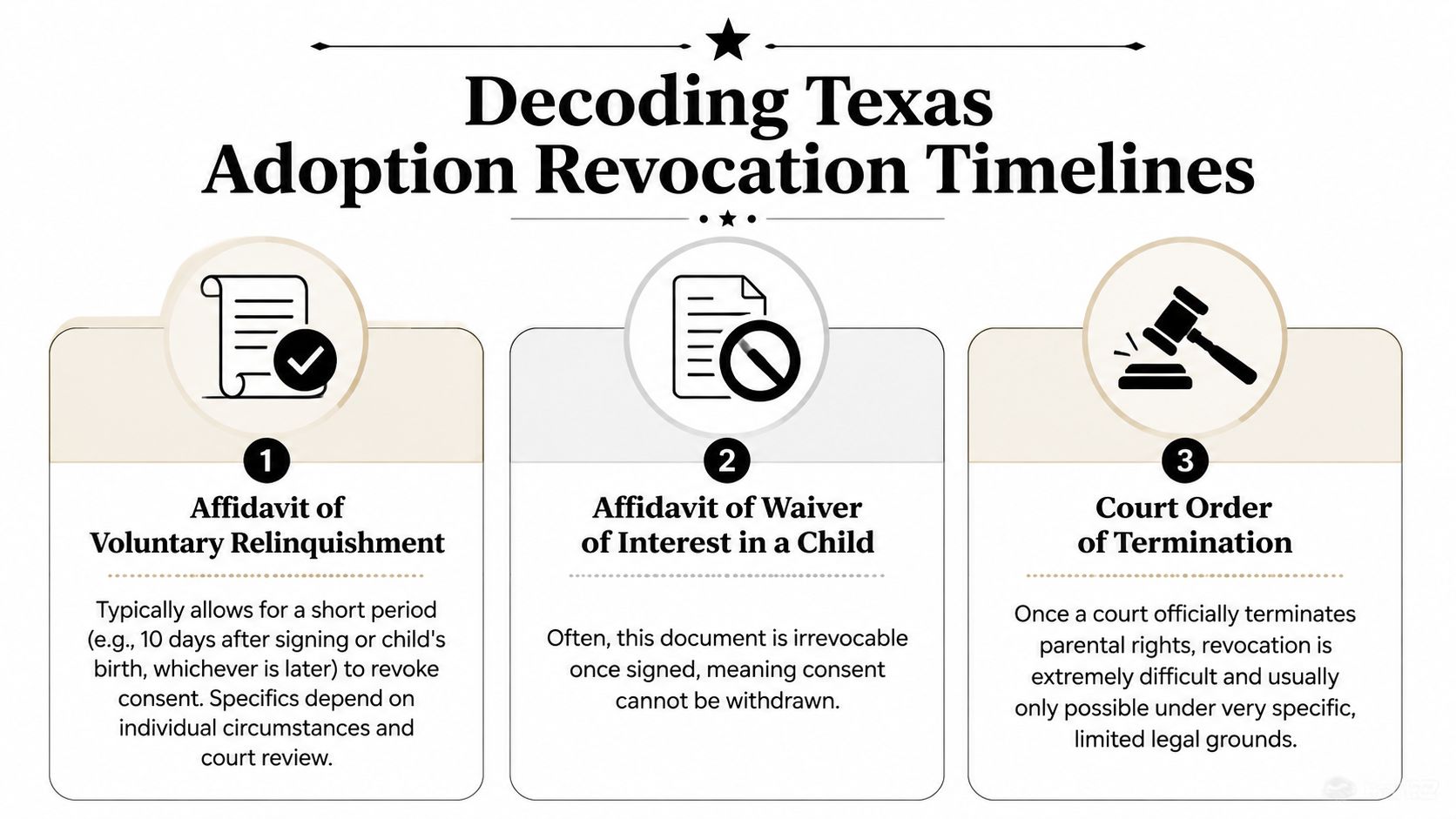
Under Texas Family Code § 161.1035, a standard affidavit of relinquishment is generally revocable for 10 days, and that period can be extended up to 60 days if the document says so. By contrast, consent given directly to an adoption agency can be structured to become irrevocable immediately upon signing, meaning a 0-day revocation period. That distinction is explained in this discussion of Texas adoption revocation periods.
Therefore, the key guideline is this: the affidavit's language controls.
If the affidavit is silent in a way that triggers the default rule, a birth parent may have the standard window. If the affidavit contains different permitted language, the revocation timeline may be longer, shorter, or immediate depending on the document type and structure.
Texas Adoption Revocation Timelines at a Glance
| Type of Consent Document | Revocation Period | Governing Factor |
|---|---|---|
| Standard affidavit of voluntary relinquishment | 10 days by default | The affidavit's terms and Texas Family Code § 161.1035 |
| Affidavit with extended revocation language | Up to 60 days | The specific language written into the affidavit |
| Direct relinquishment to an adoption agency | May be 0 days | Whether the document is structured as immediately irrevocable |
For a broader look at when paperwork becomes binding, see when adoption consent is final in Texas.
Why the 10-day myth causes so many problems
The phrase "you always have 10 days" sounds comforting. It can also be dangerously incomplete.
A birth parent may sign in a hospital and assume the law gives an automatic cooling-off period. But if the signed document says otherwise within what Texas law permits, that assumption may be wrong. On the other hand, an adoptive family may believe consent became final the moment the pen touched the page, when the affidavit leaves room for revocation.
That is why no one should rely on summaries alone. The key questions are:
- What document was signed?
- Who received the relinquishment?
- What does the affidavit say about revocation or irrevocability?
- Has the deadline already passed?
A helpful way to think about it
Think of the statute as the framework and the affidavit as the operating manual for that specific case.
The framework gives permitted rules. The operating manual tells you which rule applies to your exact situation. If you read only the framework and ignore the manual, you're likely to misunderstand your rights.
The paper in front of you matters more than the rumor someone shared in the waiting room.
A simple example
Suppose a birth mother signs a standard affidavit that does not change the default timing. In that situation, she may have the standard revocation window. If she signs a different affidavit that lawfully extends the period, the timeline may be longer. If the relinquishment is made directly to an adoption agency under terms making it immediately irrevocable, the window may be gone upon signing.
Those are very different outcomes. Yet people often describe all of them with the same phrase.
This is why families should slow down before signing anything. A single paragraph in the affidavit may matter more than hours of verbal explanation.
How to Formally Revoke Consent The Step-by-Step Legal Process
Knowing the deadline is only half the problem. The other half is procedure.
Many people think revoking consent is like canceling an appointment. They assume a phone call, text message, or email to the agency will do it. In Texas, that is not enough.

What Texas requires
A birth parent's revocation is legally effective only if it is approved by court order. Under §161.1035(b), the birth parent must file a signed revocation document with the court before the deadline, and the court must grant the revocation. That process is explained in this summary from American Adoptions on changing your mind about adoption in Texas.
That means there are two parts to a valid revocation:
- The birth parent acts before the deadline.
- The court approves the revocation.
The practical steps
If a birth parent wants to revoke within an allowed period, these are the core steps:
Read the affidavit immediately
Don't rely on memory. Don't rely on what someone said in the room. Look at the actual revocation language.Prepare a signed revocation document
The court needs a formal written revocation, not an informal statement.File it with the court before the deadline expires
Missing the deadline can change everything.Follow through on the court process
Filing is critical, but the law also requires court approval.
Some families find it useful to review legal documents line by line the same way contract professionals do. A practical resource like this professional redlining guide can help readers understand how wording changes legal meaning, even though adoption documents should always be reviewed with legal counsel.
What doesn't count
These actions may feel urgent, but by themselves they are not the legal revocation process:
- Calling the agency
- Texting the adoptive family
- Telling a social worker
- Leaving a voicemail
- Posting on social media
Important: Informal notice may communicate distress or disagreement, but it does not replace filing the required revocation document with the court.
A real-world example
A birth parent signs paperwork on Friday and regrets it on Sunday. She calls the agency and says she wants her baby back. The agency now knows how she feels, but the legal question is still unresolved. If the affidavit allows revocation, she must still complete the formal court step before the applicable deadline.
That can feel harsh, but the reason is not hard to see. Courts want a reliable process. Adoptive families need stability. Birth parents need a system that records their decision clearly and formally, especially when emotions are running high and facts may later be disputed.
The best response to uncertainty is speed and clarity. Read the affidavit. Identify the deadline. Get legal help. File properly.
Navigating Special Scenarios CPS Cases Fraud and Contested Revocations
Some adoption cases don't fit neatly into the usual private placement picture. A child may come through foster care. A parent may later claim pressure or deception. An adoptive family may face a contested revocation and feel blindsided.
In those moments, families need calm, case-specific advice. The legal path can become much harder.

When the deadline has already passed
Once the revocation period expires in Texas, overturning the adoption becomes "extremely difficult." At that point, a birth parent usually must pursue court action based on grounds like fraud, duress, or coercion, and those claims are described as rare and requiring substantial evidence in this overview of adoption consent and revocation laws.
That is a very different situation from a timely revocation.
A timely revocation asks, in effect, "I am still within the allowed period." A late challenge says, "Something was legally wrong with how this happened." Courts treat those as very different arguments.
Brief examples of hard cases
A CPS-related adoption
A foster parent has cared for a child for a long time and is preparing for adoption after prior court action involving parental rights. Cases connected to child protective proceedings often involve a very different procedural history from a private infant adoption. Families in that position should understand the placement path before assuming the same consent rules apply in the same way. This overview of adoption after CPS placement in Texas helps explain that setting.
A claim of coercion
A birth mother says she signed because she felt cornered by pressure from people around her. Feeling emotional, conflicted, or sad is not the same as legal coercion. Courts will look for evidence supporting the claim, not just regret after the fact.
A claim of fraud
A parent says someone lied about what the document meant. That is serious. But the parent still has to prove the fraud claim in court. The burden becomes much heavier once the ordinary revocation period is gone.
A late challenge is no longer about changing your mind. It becomes a legal fight over whether the consent should count at all.
What adoptive parents should do during a contested situation
Adoptive parents often feel helpless when a revocation dispute begins. They may want to reach out directly and fix things with conversation alone. That instinct is human, but it can complicate a legally sensitive moment.
A steadier approach is usually better:
- Preserve documents: Keep copies of affidavits, communications, and court filings.
- Avoid informal promises: Don't make side agreements in panic.
- Let the court process work: Revocation and post-deadline challenges are legal matters, not just emotional disputes.
- Stay child-focused: Every decision should reflect the child's stability and best interests.
The child remains at the center
Texas courts don't treat adoption as a paperwork game. The legal rules matter because the child's future matters.
That is true in private adoptions, stepparent adoptions, kinship adoptions, and CPS-related permanency cases across Chapters 162 through 166. Adults may be grieving, hopeful, conflicted, or frightened. The court's job is to bring legal order to that reality while protecting the child's need for safety and permanence.
Your Next Step Finding Clarity and Support
The biggest takeaway is simple. There is no one-size-fits-all answer to how long a birth parent has to revoke consent in Texas. The answer depends on the timing of birth, the existence of a valid signed affidavit, the exact wording in that affidavit, and whether the parent follows the formal court process.
For birth parents, that means it's wise to slow down, ask for the document, and read every line before signing. If you're unsure, get support right away. Emotional counseling and legal guidance can work together. One helps you process the decision. The other helps you protect your rights.
For adoptive parents, careful legal preparation matters just as much. A well-handled adoption process protects everyone involved, including the child. Clear paperwork, proper timing, and respect for each party's rights reduce the chance of confusion later.
The points most families should remember
- The 48-hour waiting period protects birth mothers before consent is signed.
- The affidavit's wording matters more than the myth of an automatic 10-day rule.
- Some documents may allow a longer period, while some agency-based relinquishments may be immediately irrevocable.
- A revocation must be handled through the court, not by informal notice alone.
- After the deadline passes, challenges become much harder and usually require proof of serious legal wrongdoing.
Families make better decisions when they have both time and truthful information.
Texas adoption law can feel overwhelming when you're living it in real time. But clarity is possible. With the right guidance, families can move forward in a way that respects parental rights, protects the child's best interests, and brings greater peace to an emotional process.
If you're facing questions about adoption consent, revocation timelines, kinship placement, stepparent adoption, or finalization, the Law Office of Bryan Fagan, PLLC offers compassionate guidance for Texas families. A free, confidential consultation can help you understand your options, protect your rights, and take the next step with confidence.
