
You may be staring at your phone, waiting for an update from an agency, a caseworker, or an attorney. Maybe you're a stepparent who has tucked a child into bed for years and now wants the law to reflect what your heart already knows. Maybe you're a birth parent trying to make a careful decision under heavy emotions. In each of these moments, one legal idea carries enormous weight: consent.
In Texas, adoption consent isn't just paperwork. It's the legal act that helps protect the child, respects the rights of the adults involved, and gives an adoptive family the stability to move forward with confidence. When consent is handled correctly, it creates a stronger path to permanency. When it's rushed, incomplete, or misunderstood, it can lead to fear, delay, and conflict at a time when families need clarity most.
That matters because adoption touches many Texas families each year. Texas saw 4,586 children adopted in fiscal year 2021, and more than half of those adoptions were by relatives, according to Texas adoption statistics and requirements. That tells us something important. Adoption consent texas issues don't just affect private infant adoptions. They also affect grandparents, aunts, uncles, foster families, and stepparents trying to build secure homes for children they already love.
The Sacred Promise of Adoption Consent
A couple gets the call they have waited on for months. A baby has been born. Everyone is hopeful, excited, and careful with their words. They begin picturing the ride home, the nursery, the first night together. But the next steps aren't only emotional. They are legal, and they need to be handled with patience.

In a healthy adoption process, consent acts like a promise made in the open. It says the decision is voluntary. It says the court can rely on what was signed. It says the child's future won't rest on guesswork. That is why Texas law places so much attention on who must consent, when they may sign, and how the documents must be completed.
Why consent matters emotionally and legally
Families sometimes think of consent as the last obstacle before finalization. In truth, it's the foundation. A valid adoption needs more than love and good intentions. It needs clear legal authority for the court to recognize the new parent-child relationship.
For birth parents, consent gives structure to a life-changing decision. For adoptive parents, it provides legal security. For the child, it supports a more stable transition into permanency. In that sense, consent serves the child's well-being from every angle.
Practical rule: The more carefully consent is handled at the beginning, the more protected the adoption tends to be later.
The heart of the process
Consent also forces everyone to slow down. That can feel frustrating when emotions are high. But slowing down has value. Adoption should never feel like a race to signatures.
If you're reading about adoption consent texas requirements because your family is already in motion, you're not alone in feeling overwhelmed. Those entering this process don't come into it fluent in Texas Family Code Chapters 162 through 166. They just want to know what the law expects, what happens next, and how to avoid painful surprises.
A helpful way to think about it is this:
- For hopeful adoptive parents: Consent creates the legal path to a secure family bond.
- For birth parents: Consent should be informed, voluntary, and treated with dignity.
- For relatives and stepparents: Consent often determines whether a child can stay within a familiar circle of care.
- For the court: Consent is part of deciding whether the adoption serves the child's best interests.
That is why even one missing signature, one wrong procedure, or one unresolved parent can change the course of a case.
Who Must Give Consent for a Texas Adoption
The answer depends on the child's family situation. Some cases are simple. Others involve a birth mother, a legal father, an alleged father, a presumed father, or a child old enough to have their own legal voice. Those categories can sound technical, but the basic question is straightforward: who still has legal rights that the court must address before adoption can move forward?

The birth mother
In most Texas adoptions, the birth mother's consent is required unless her parental rights have already been terminated by a court. Her consent is usually given through a formal affidavit that relinquishes parental rights. Because the law recognizes the seriousness of that step, courts look closely at whether the consent was voluntary and properly signed.
A common point of confusion is timing. A mother may be emotionally certain about her plan before birth, but Texas still requires the legal process to follow its own timeline. That protects the integrity of the adoption and helps reduce claims that the decision was made under pressure.
Fathers aren't all treated the same under the law
Texas law doesn't use one simple category for every father. That is where many families get confused.
A presumed father is often someone married to the mother at the relevant time. A legal father is someone whose paternity has already been established through legal means. An alleged or putative father is someone who may be the father but has not secured the same legal status.
Those differences matter because the required consent may change depending on the father's legal relationship to the child.
Here is a plain-English view:
| Father category | Why it matters in consent cases |
|---|---|
| Presumed father | His rights usually must be addressed directly because the law already recognizes a parental connection |
| Legal father | His consent is generally required unless his rights have been terminated |
| Alleged or putative father | His rights may depend on whether he took legal steps to assert paternity |
This is one reason private adoptions and stepparent adoptions can become complicated. A father who has been absent from daily life may still need to be legally addressed.
After families understand the basic categories, this overview can help clarify the bigger picture:
The child's voice matters too
Texas law recognizes that older children aren't passive observers in their own adoption. Under Texas Family Code §162.010, a child age 12 or older must provide written consent for the adoption to proceed, unless the court waives that requirement in the child's best interest, as explained in this discussion of child consent in Texas adoption.
That rule often surprises adults. They may assume that if everyone else agrees, the court will move forward. But older children can have strong feelings about names, family identity, loyalty conflicts, and whether adoption feels comforting or frightening.
When a child hesitates, the answer usually isn't pressure. It's conversation, preparation, and a careful look at what the child is experiencing.
A simple example
Consider a grandmother raising her grandson. The child's mother agrees to the adoption. The father has not been involved, and his legal status is unclear. If the grandson is old enough under Texas law, his consent may also be part of the case. What looks like a family arrangement around the kitchen table can quickly become a multi-layer legal issue.
That is why families should identify every possible person with consent rights early, not after filing.
The Step-by-Step Process of Documenting Consent
Consent in adoption isn't valid just because someone says yes. Texas requires the right form, the right timing, the right witnesses, and the right filing. Much like building a house foundation, if one part is poured incorrectly, the rest of the structure may not hold the way you expect.
Step one begins with information and preparation
Before anyone signs, the adults involved need clear information about what adoption means. Consent is not casual permission. In most cases, it is part of permanently ending one legal parent-child relationship so another can begin.
That is why families often work through documents, identity details, timing questions, and logistics before the actual signing date. In private cases, attorneys often help organize the paperwork. In agency or CPS matters, the process may involve additional professionals and court oversight.
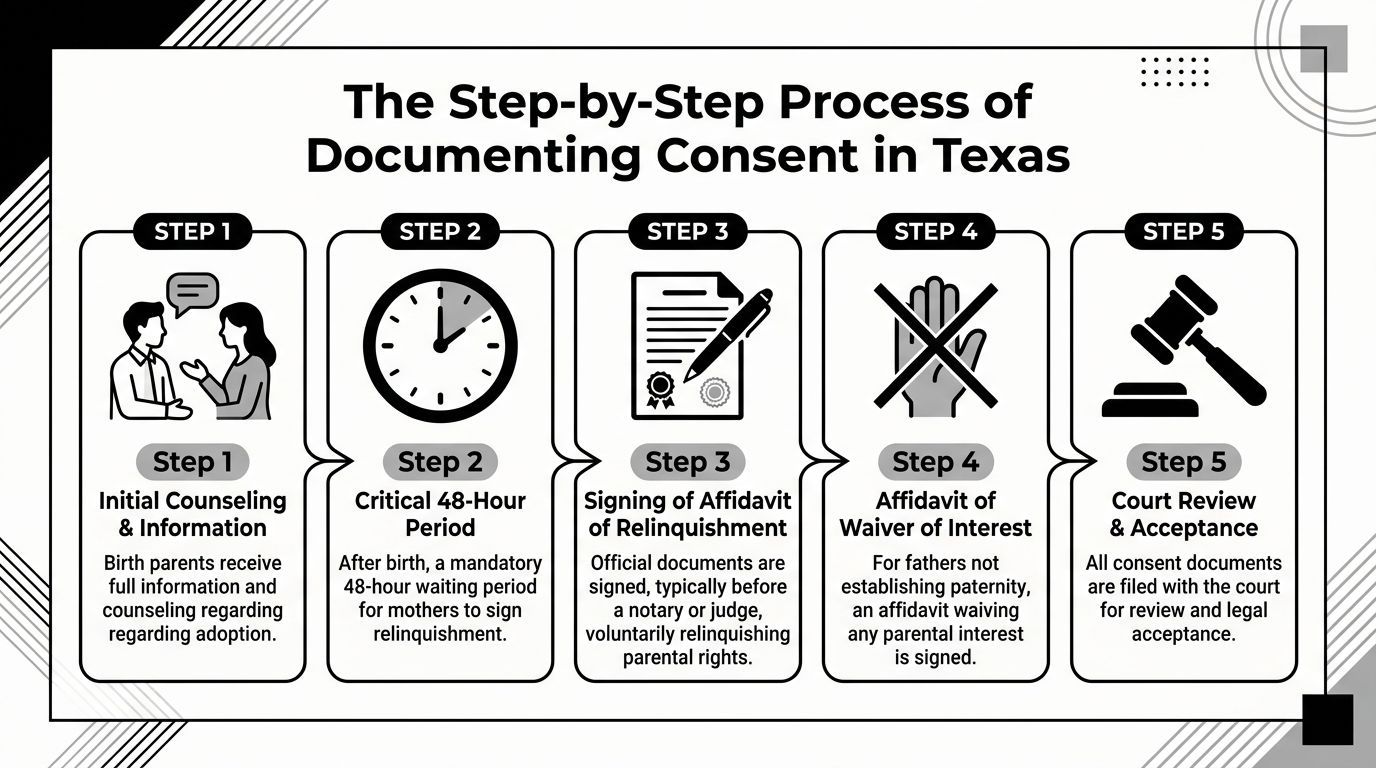
Step two follows the waiting period for the birth mother
Texas Family Code §161.103(a)(1) requires a birth mother to wait at least 48 hours after giving birth before signing her consent affidavit, and courts pay close attention to that timing because the rule is meant to guard against coercion. Flawed affidavits are a leading cause of delays, as noted in this review of Texas adoption consent laws.
This waiting period can be emotionally difficult for adoptive families. They may already feel attached. They may already be caring for the baby in some circumstances. But the law builds in that pause for a reason. It gives the birth mother time to recover and reflect before signing a document with permanent consequences.
Birth fathers are treated differently for timing purposes. Their legal role can still be significant, but the waiting rule described above applies specifically to the mother's consent affidavit.
Step three is the affidavit itself
The key document is often called an Affidavit of Voluntary Relinquishment of Parental Rights. This is the written instrument that states the parent is relinquishing parental rights. It is not ordinary paperwork. If the affidavit does not meet Texas requirements, the adoption can stall.
The affidavit generally needs to be executed before a person authorized to take oaths and in the presence of two credible witnesses. That means families should not treat signing as an informal event.
A practical resource for understanding the form itself is this guide to a Texas release of parental rights form.
Step four requires proper execution
The signing process matters as much as the wording. Texas requires formalities for a reason. Those formalities help prove that the signer understood the document and completed it voluntarily.
A careful signing usually includes:
- Identity confirmation so the court can trust who signed.
- Authorized oath administration because the document must be properly verified.
- Two credible witnesses who observe the signing.
- Review of final language so no one signs a version they did not understand.
A rushed signing can create problems long after the day itself feels over.
Step five is court review and legal effect
Once the affidavit is signed and filed, the court reviews whether the consent meets legal standards. If it does, the consent carries major force. Under Texas law, consent becomes irrevocable according to the express terms of the affidavit, and revocation only takes effect if approved by court order. That means people should never assume they can call later and undo a signed relinquishment.
Families often get nervous about the word irrevocable. It means exactly what it sounds like. This is why experienced legal review before signing is so important. The law wants these decisions made carefully, not corrected later through crisis.
Where readers often get tripped up
Many people confuse these three things:
- Wanting adoption
- Intending adoption
- Having legally valid adoption consent
Those are not the same. A birth parent may intend adoption but still need to wait to sign. A father may say he agrees but still need proper legal documentation. A family may have all signatures in hand but still need court acceptance before the case is secure.
If you're at the paperwork stage, slow and accurate is almost always safer than fast and hopeful.
Adoption Without Consent Exceptions and Complex Cases
Some of the hardest cases involve a parent who won't sign, can't be located, or has never fully stepped into a legal role. Families in these situations often fear that the adoption will stop completely. Sometimes it does slow down. But Texas law does provide paths forward in certain cases, especially when the court finds that a parent's rights should be terminated or that legal notice requirements have been met.
When one parent won't cooperate
A refusal to consent doesn't always end the case. In some adoptions, the issue becomes whether the court has grounds to terminate that parent's rights without voluntary consent. This often arises in stepparent cases, kinship matters, and CPS-related adoptions.
Courts do not grant that relief lightly. Judges look for evidence, proper notice, and a clear showing that the child's best interests are being served. Families usually need records, testimony, and a clean procedural history.
Unknown or uninvolved fathers create special stress
This is one of the least understood parts of adoption consent texas law. Many families ask some version of the same question: what happens if the father is unknown, missing, or barely involved?
Between 15 percent and 20 percent of private infant adoptions in Texas involve an unknown or unidentified father, and a father who does not register within 31 days of the child's birth may lose the right to object to the adoption, according to this Child Welfare Gateway discussion of consent in Texas adoption.
That doesn't mean families can skip steps. It means they need to follow the right ones.
The Putative Father Registry and diligent search
The Putative Father Registry is one of the most important tools in these cases. It helps address whether an alleged father has taken action to claim rights. If he has not, that can affect whether his consent is required.
At the same time, courts expect careful effort when a possible father cannot be located. That often means a diligent search. In plain language, the family's statement, "We don't know where he is," is not sufficient. They need to show reasonable efforts to identify or notify him when required.
That may involve steps like these:
- Checking known identifying information such as names, prior addresses, or family connections.
- Reviewing case history if CPS, prior court orders, or paternity records exist.
- Using registry procedures to determine whether a putative father has registered.
- Giving legal notice in the correct manner when direct service is not possible.
A single missed procedural requirement can give a contested case new life.
The emotional burden in unknown-father cases is real. Birth mothers may feel fear, guilt, or dread about renewed contact. Adoptive parents may feel helpless because so much depends on facts they can't control.
Families dealing with a nonconsenting parent in a stepparent case often find it helpful to review this explanation of what happens when the other parent won't consent in a Texas stepchild adoption.
A realistic scenario
A mother wants her husband to adopt the child he has raised for years. The biological father is listed in older records, but no one has heard from him in a long time. The family assumes that silence equals consent. It doesn't. The court will still want proof that the father received proper notice or that legal grounds exist to move forward without his consent.
That is why these cases require both patience and precision. The child may already feel that the family is complete. The law still requires the missing legal pieces to be addressed the right way.
How Consent Works in Stepparent and Kinship Adoptions
Stepparent and kinship adoptions often feel more personal than private infant cases because the adults usually know each other already. That closeness can help. It can also make consent more emotionally layered. Family history, old conflicts, and loyalty issues often sit just beneath the legal questions.

Stepparent adoption
In a stepparent adoption, the parent married to the stepparent usually remains the child's legal parent. The legal challenge often centers on the other parent. That parent must usually either consent or have parental rights terminated before the stepparent can adopt.
Often, families face an emotional wall. The child may call the stepparent "Mom" or "Dad." Everyone in the home may already function as a family unit. But the court still has to address the other biological parent's rights.
A quick comparison helps:
| Adoption type | Main consent issue |
|---|---|
| Stepparent | The other biological parent's consent or termination is usually the core issue |
| Kinship | The same consent rules apply, but family relationships often make communication and emotions more delicate |
If you're considering this route, this article on whether a biological father must consent to a Texas stepparent adoption can help frame the issue.
Kinship and relative adoption
Relative adoptions often involve grandparents, aunts, uncles, adult siblings, or other caregivers who stepped in when a child needed stability. The legal rules on consent still apply. Being family does not erase the need for proper signatures or termination orders.
But kinship cases do bring unique human realities. A grandmother may need consent from her own child. An aunt may be trying to adopt while preserving holiday relationships with the rest of the family. Even when everyone agrees adoption is best, grief can still be present.
How they differ in practice
Stepparent and kinship cases often move through similar legal gates, but they tend to feel different on the ground.
- Household continuity: In stepparent cases, the child often stays in the same home and school.
- Extended family pressure: In kinship cases, more relatives may have opinions about whether adoption is the right step.
- Proof issues: Stepparent cases often focus on the absent parent's legal status. Kinship cases may involve a broader family history and prior caregiving arrangements.
- Child emotions: A child may welcome the adoption but still feel torn about a parent or relative whose rights are being ended.
Some of the most tender adoption hearings involve children who are gaining safety and permanence while also grieving what their family could not be.
A note about support
Families pursuing these adoptions usually need more than forms. They may need help with home studies, notices, court filings, and case strategy. One option some Texas families use is the Law Office of Bryan Fagan, PLLC, which handles adoption and guardianship matters including stepparent and kinship cases.
Your Next Steps for a Secure and Loving Adoption
Most families don't need more legal jargon. They need a calm, reliable next step. The safest approach is to treat consent as one of the most important parts of the entire adoption, not as a formality to get through on the way to court.
Start with clarity, not assumptions
If you're a hopeful adoptive parent, identify early who may need to consent. If you're a birth parent, ask for every document to be explained in plain language before signing. If you're a relative or stepparent, don't assume that long-term caregiving automatically solves the consent issue.
These cases often become stressful because someone relied on family custom instead of legal process. Texas adoption law asks for both compassion and procedure.
A practical checklist
Use this short list as a grounding tool:
- Confirm the legal parents: Don't rely only on what appears informal or obvious.
- Check the child's role: If the child is older, their consent may be part of the case.
- Protect the paperwork: Signatures, witnesses, and verification rules matter.
- Address missing parents early: Unknown or uninvolved fathers can create major delays if ignored.
- Keep records organized: Save notices, communications, and filed documents.
Build your team carefully
Many adoptions involve a mix of support. That can include an agency, a home study provider, a counselor, and a family law attorney. Each person serves a different role. A counselor may help with emotion. An agency may help with placement logistics. An attorney helps make sure the legal structure will hold.
That matters most when the case seems simple. Straightforward cases can become difficult when one affidavit is flawed, one person was not notified correctly, or one legal relationship was never fully identified.
Keep the child's well-being at the center
It is easy for adults to become consumed by deadlines, signatures, and court dates. The law, at its best, is trying to serve a larger purpose. It is trying to create a secure, lawful family structure for a child.
That means the most compassionate path is usually the most careful one. A child deserves more than a hopeful arrangement. A child deserves an adoption built on valid consent, clear court orders, and a foundation that can last.
If you're feeling anxious, that doesn't mean you're doing anything wrong. It means the process matters to you. And it should. Adoption can be one of the most beautiful steps a family takes. It can also be one of the most legally sensitive.
When families approach adoption consent texas issues with patience, honesty, and strong legal guidance, they give themselves the best chance at a smoother road to finalization and a more secure future for the child they love.
If you have questions about consent, termination issues, stepparent adoption, kinship adoption, or a missing parent, the Law Office of Bryan Fagan, PLLC offers free consultations for Texas families. A conversation can help you understand your options, protect the child's best interests, and move forward with greater peace of mind.
