
Some women land on this topic late at night, exhausted, scared, and trying to sort through a dozen questions at once. They may be asking whether they still have control, whether anyone can pressure them, whether the baby’s father has to agree, or whether signing papers means they can never change course. Those questions are normal.
Others are adoptive parents or relatives who want to do this the right way. They want to support a birth mother with compassion, not pressure. They also want to understand how Texas law protects everyone involved, especially the child.
Texas adoption law is structured around both choice and stability. Texas reported 4,586 adoptions in fiscal year 2021, and the legal framework puts serious weight on final consent while still protecting a birth mother’s autonomy and decision-making rights, as explained in this overview of birth mother legal rights in Texas adoptions.
If you’re searching for clear information about birth mother rights texas, start with this truth. You still have rights before any adoption is finalized, and those rights matter. If you’re in the earliest stage of considering adoption, this guide on giving a baby up for adoption in Texas can also help you understand the first decisions ahead.
Your Journey Your Choices An Introduction
A woman in Texas may be sitting in her car outside a prenatal appointment, holding paperwork she hasn’t fully read, wondering whether adoption is even something she can talk about without being judged. She may already have children at home. She may be trying to keep a job, find childcare, or get through a difficult relationship. She may love her child very much and still feel unsure whether parenting is the path she can take right now.
That uncertainty doesn’t mean she’s weak. It means she’s carrying a serious decision.
Texas law gives birth mothers real protections, but many people only hear part of the story. They hear that adoption is permanent. They don’t hear enough about privacy, medical choice, the right to receive information, the role of the father, or how practical barriers like distance from medical care can affect decision-making. Those details matter because legal rights only help when a person understands them clearly.
For hopeful adoptive parents and relatives, this topic matters too. A healthy adoption process depends on informed consent, respect, and a steady focus on the child’s best interests. A process built on pressure can create harm for everyone. A process built on clarity gives a child a stronger foundation.
What follows is a plain-English guide to the rights a birth mother has in Texas, how consent works, what happens when the father is unknown or uninvolved, and how real-world problems can affect free choice. The law can feel intimidating. It becomes much easier to understand when it’s broken into simple steps.
Understanding Your Foundational Rights in Texas

Long before any adoption papers are placed in front of you, Texas law recognizes that you have rights as a parent and as a patient. Those rights matter in everyday moments, not just in a courtroom. They matter when you are deciding who can come to a prenatal appointment, what information you want to share, and whether you need more time before making a life-changing decision.
A helpful way to view this is to separate two tracks that run side by side. One track is your pregnancy and medical care. The other is the adoption plan. Talking about adoption does not hand control of either track to an agency, an adoptive family, or a relative. Until legal rights are formally ended through the process Texas requires, you remain the person making key decisions.
Practical rule: If anyone is pressuring you to sign, meet, disclose, or decide before you feel ready, pause. A voluntary choice should come from clear information and your own judgment.
Your medical decisions stay with you
Your pregnancy does not become public property because adoption has been discussed. You can speak privately with your doctor. You can ask for time alone with hospital staff. You can decide who is in the room during labor or recovery, subject to hospital policy and your own safety needs.
This protection matters even more in parts of Texas where maternity care is hard to reach. Some women must drive long distances for prenatal visits or delivery because local labor and delivery services have closed. If you are dealing with missed appointments, transportation problems, or limited provider options, those hardships do not cancel your rights. They often make it more important to slow things down and make sure your decisions are your own.
Your privacy is still yours
Privacy is one of the rights people often overlook. Yet for many birth mothers, it is one of the first concerns.
You may choose to share some medical history that could help a child later in life while keeping other details private. For example, you might disclose family heart disease, diabetes, or genetic concerns, but keep counseling notes or sensitive parts of your own health history confidential. That boundary is reasonable. It can protect your dignity while still giving useful information for the child's care.
Privacy can also matter for safety. If the father is unknown, if there has been abuse, or if you are trying to avoid conflict with family members, careful control over what is shared and with whom can make the process safer and less chaotic.
You have the right to ask questions before agreeing to anything
No one should expect you to say yes to a plan you do not fully understand. You can ask who is arranging the adoption, what type of adoption is proposed, what contact is being discussed, and what paperwork means before you sign it. You can also ask how Texas requires consent forms to be handled and reviewed. If you want a clearer picture of the documents involved, this guide to Texas consent to adoption forms and filing requirements can help you understand the terminology before you are under pressure.
Questions are not a delay tactic. They are part of informed decision-making.
In some private adoptions, you may have a voice in selecting the adoptive family
A private adoption is often more personal than people expect. In many situations, a birth mother may review profiles, ask direct questions, and decide what kind of relationship, if any, feels appropriate before placement. That can give you a better sense of whether the home fits what you want for your child.
You might ask about:
- Daily life: What does an ordinary weekday look like in their home?
- Parenting style: How do they handle discipline, school, and emotional support?
- Contact after placement: Are they open to updates, photos, or visits if everyone agrees?
- Support around the child: Who will help care for the child, and what kind of family network do they have?
Those questions are practical. They are also highly personal. Both matter.
A short video can also help make these ideas feel more concrete.
Support before paperwork can protect your decision
Many women feel pressure from more than one direction at once. They may be recovering physically, missing work, trying to arrange childcare for other children, or worrying about whether the father will appear and object. Good support gives you room to think through those pressures instead of letting them make the decision for you.
That support may include counseling, legal advice, a trusted friend, a clergy member, or a medical professional who will answer questions plainly. The goal is simple. Your choice should reflect your values, your circumstances, and the child's best interests, not someone else's timeline.
The Legal Process of Consent and Relinquishment
The most important legal document in many Texas adoptions is the Affidavit of Voluntary Relinquishment of Parental Rights. The name sounds formal, but the core idea is simple. It is the document a birth mother signs to legally give up parental rights.
Texas does not allow this to happen immediately after delivery. Under Texas Family Code § 162.010, a birth mother cannot sign a legally binding relinquishment affidavit until at least 48 hours after the child’s birth, and when it is properly executed with a licensed agency, it is irrevocable. That rule is explained in this review of Texas consent to adoption timing and finality.
The waiting period is there for a reason
The 48-hour waiting period is a legal safeguard. Childbirth is physically demanding and emotionally intense. Texas law creates a pause so a birth mother is not asked to make a binding legal decision in the immediate aftermath of labor.
This waiting period often confuses people. Some assume it means there is a longer grace period after signing. That is not how Texas usually works in agency cases. The 48 hours come before valid signing, not after.
The safest way to think about the timeline is this. Before valid signing, the birth mother keeps full parental rights. After proper signing, Texas law strongly favors finality.
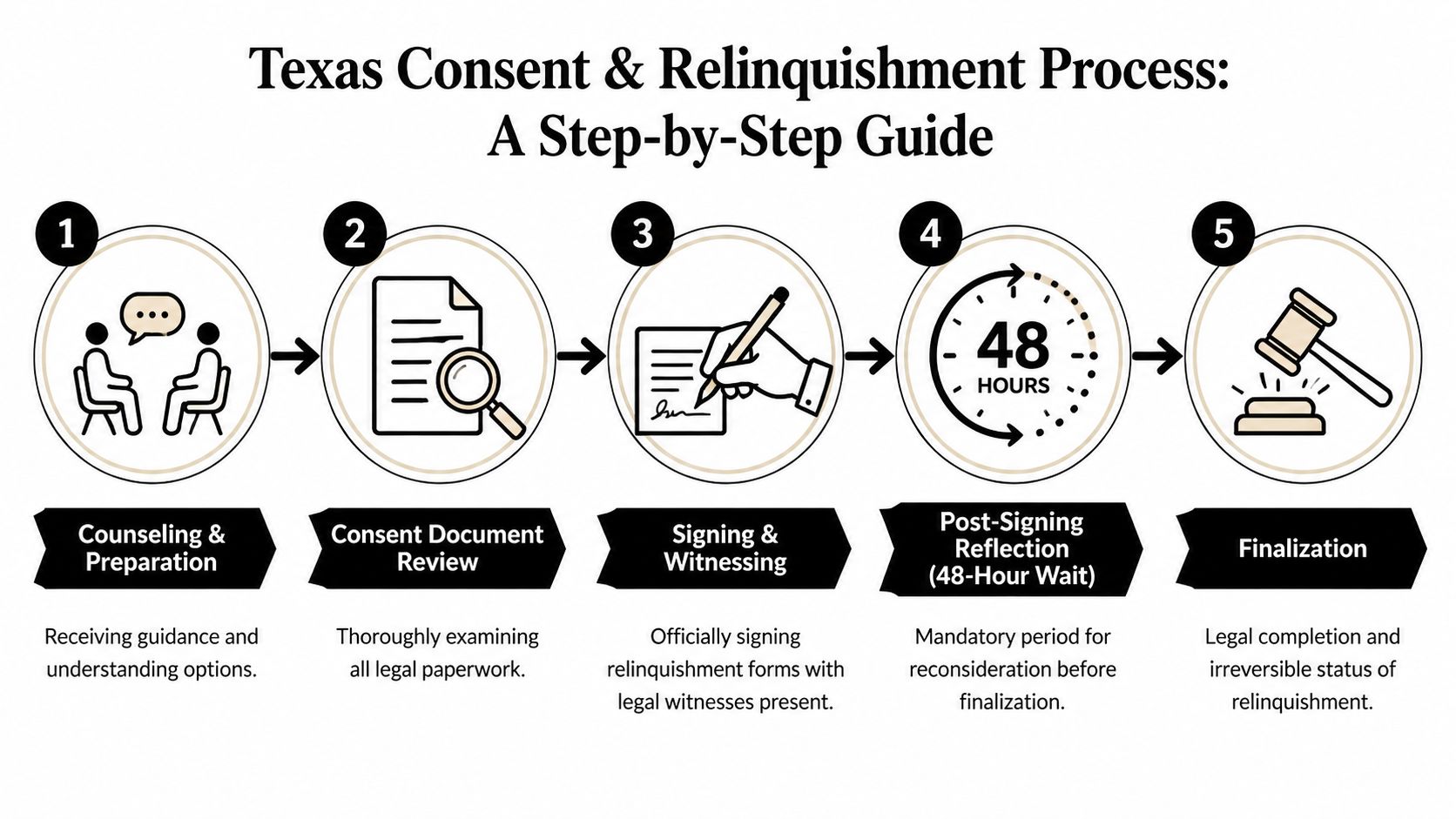
What signing usually looks like
Texas requires formalities designed to protect the process. The affidavit must be executed before two credible witnesses and verified by a person authorized to take oaths. That structure helps document that the decision was made knowingly and in the proper way.
Here is the process in plain language:
The birth occurs
No binding relinquishment can be signed before the child is born.The 48-hour period passes
During this time, the birth mother still has full parental rights.The documents are reviewed
She should understand what the affidavit says, what rights end, and what the consequences are.The affidavit is signed properly
Witnesses and oath verification are part of the legal requirements.The case moves toward termination and adoption finalization
The court process continues, with the child’s best interests remaining central.
If you want a closer look at the paperwork itself, this guide to Texas consent to adoption forms helps explain the documents families often encounter.
What irrevocable means in real life
“Irrevocable” is one of the hardest words in this process. It means a birth mother usually cannot change her mind later because the emotions became heavier than expected.
Texas is different from states that offer an automatic revocation window after signing. In Texas, challenges generally require court action and are typically limited to serious issues such as fraud, coercion, or failure to follow required legal procedures.
That does not mean birth mothers are unprotected. It means the law places heavy importance on making sure the decision is informed before the signature happens.
A simple example
Suppose a woman gives birth on Monday morning. She cannot sign a valid relinquishment that afternoon. She must wait until the legal timing requirement has passed. During that waiting period, she can still ask questions, talk with counsel, reconsider the plan, or request more explanation.
If she later signs a valid affidavit with a licensed agency after the waiting period and all legal requirements are met, she usually cannot undo that act by calling and stating she changed her mind. At that point, a court challenge would be required.
That is why careful review matters so much. In Texas adoption law, the moment before signing often carries the most legal importance for protecting the birth mother’s choice.
How the Birth Father's Role Affects Your Adoption Plan
A lot of anxiety in adoption cases comes from one question. What if the father is absent, unknown, uninvolved, or suddenly objects?
The answer depends on his legal status, not just his personal history with the mother. Texas law recognizes different categories of fathers, and each one can affect the process differently. A presumed father may have rights based on marriage. A man may also claim rights through paternity steps recognized under Texas law. In other situations, the adoption may move forward after diligent efforts to identify and notify him.
For unmarried mothers, who account for about 40% of births in the U.S., a father’s consent may not be required if he has not established paternity, but careful efforts to identify and notify a potential father are still critical to avoid later challenges, according to this discussion of adoption when the father is unknown.

When the father is married to the mother
If the mother is married at the time of birth, or if the marriage ended within the period recognized by Texas law for presumed paternity, the husband or former husband may be treated as a presumed father. That can give him legal rights that must be addressed before the adoption can proceed.
This surprises many people. Separation does not always answer the legal question. Marriage status can still matter.
When the father is unknown or uninvolved
This is a common real-life situation. A woman may know very little about the father’s location. She may have lost contact. She may not feel safe contacting him directly. Or she may know he has shown no interest in the pregnancy.
Texas law does not ignore that issue, but it does provide a path forward. Lawyers and agencies typically work through notice requirements and due diligence so the case can proceed lawfully.
Here are a few examples:
- Unknown location: The father’s identity may be known, but no one knows where he is.
- Little information: The mother may know only a first name or old contact detail.
- No involvement: The father knows about the pregnancy but takes no legal action to establish paternity.
- Contested situation: The father appears later and claims he should have been included.
Each of these situations requires careful handling. None automatically ends the adoption plan.
A father being absent does not mean the process becomes casual. It means the legal team must be careful.
Why notice matters so much
Courts want to avoid future disruption. If a father should have been notified and was not, that can create problems later. That is why Texas cases often involve diligent attempts to identify and notify possible fathers before termination and adoption move ahead.
Texas law also recognizes the role of paternity registration and proof. In practical terms, this means a legal record matters more than informal claims.
A simple scenario
Consider an unmarried woman who decides on adoption after birth. The father has not provided support, is not on the scene, and has not taken legal steps to establish paternity. Her case may still move forward, but only after proper legal review and required notice efforts.
Now compare that to a second woman whose husband is separated from her but still legally presumed to be the father. Her path may involve a different set of documents and court steps before the adoption can continue.
Those examples show why two cases that feel similar emotionally can look very different legally.
What birth mothers should take away
If the father’s role is unclear, don’t assume the case is impossible. Don’t assume the opposite either. This part of Texas adoption law is fact-specific.
The most helpful first step is to gather honest information. Who is the father, what is known about him, whether there was a marriage, and whether he has taken legal steps all matter. Clear facts help create a legal plan that protects the child, respects due process, and reduces the chance of future conflict.
Your Rights in Different Types of Texas Adoptions
Birth mother rights don’t look exactly the same in every adoption. The basic legal protections remain important, but the day-to-day experience can feel very different depending on whether the adoption is private, agency-based, or tied to the foster care system.
That difference matters because many families use the word “adoption” as if it describes one single process. It doesn’t.

Comparing the main pathways
| Adoption path | Birth mother involvement | Family selection | Contact expectations |
|---|---|---|---|
| Private adoption | Often more direct involvement before placement | Birth mother may have a significant role in choosing the adoptive family | Can range from open to closed |
| Agency adoption | Structured through a licensed agency | Profiles and matching may be guided by the agency | Often discussed in advance through agency planning |
| Foster care adoption | Usually arises in a different legal setting involving the state and court orders | Family choice may be more limited because the case is shaped by court and child welfare needs | Contact depends heavily on case history and court realities |
Private and agency adoptions often give a birth mother more opportunity to learn about a prospective family. Foster care cases can be more complicated because the state, prior court orders, and safety concerns may shape what options are realistic.
Open, semi-open, and closed adoption
Many readers focus on this question first. Will there be contact after the adoption?
An open adoption may include phone calls, emails, video chats, texts, or in-person visits. A semi-open adoption usually includes some updates, often with more boundaries. A closed adoption involves little or no direct ongoing contact.
Texas permits post-adoption contact agreements, but their legal force is limited. A birth mother’s legal rights to contact end when the adoption is finalized, which makes the early choice of adoptive family especially important, as explained in this article about open adoption agreements in Texas.
Some birth mothers hear “open adoption” and assume the court will enforce every future promise. In Texas, that assumption can lead to heartbreak.
What this means in practical terms
The relationship with the adoptive family matters. A written agreement is still valuable because it helps set expectations, but many post-finalization contact issues are handled more through trust, communication, and sometimes mediation than through strong court enforcement.
A birth mother who wants ongoing updates should think carefully about fit, not just paperwork.
Questions worth asking include:
- How do they handle conflict? A family that communicates respectfully before placement is often easier to work with later.
- Are their promises specific? “We’ll stay in touch” is vague. A clearer plan is easier to understand.
- Do they seem comfortable with your role? Some families welcome healthy ongoing connection. Others agree in theory but seem uneasy in practice.
Different adoptions can change the emotional experience
A woman in a private adoption may spend time getting to know the adoptive family and feel comfort in that connection. Another woman in a foster-related matter may feel like the process is more driven by court deadlines and caseworkers. Neither experience is simple.
The key is realistic expectations. Before finalization, a birth mother may still have meaningful choices depending on the case. After finalization, the law treats the adoption as complete, and her legal rights end.
For adoptive families, that reality matters too. If they want an open adoption to remain healthy, they should treat contact commitments as part of the child’s emotional well-being, not as optional niceties.
Navigating Real-World Challenges to Your Rights
A birth mother can have legal rights on paper and still struggle to use them in real life. That happens when distance, money, transportation, health care, or fear make it hard to slow down and make a clear decision.
One of the most overlooked examples in Texas is access to maternity care. About half of Texas counties are classified as maternity care deserts, meaning they lack hospitals with delivery units or obstetric providers. That lack of access can hit rural and minority women especially hard and may affect whether an adoption decision is voluntary, as discussed in this piece on Texas maternity care deserts and maternal access.
When access problems create pressure
A woman who has to travel long distances for prenatal care may feel pressure that has nothing to do with what she wants for her child. She may miss appointments because she can’t find transportation. She may have limited internet access for telehealth. She may not have a private place to talk through options.
Those are not just life problems. They can shape legal decision-making.
A voluntary choice works best when someone has time, information, and support. If basic care is hard to reach, it becomes harder to know whether a decision reflects true preference or immediate crisis.
Rights are strongest when a person has a real chance to use them.
Financial stress and fear can cloud judgment
Many women considering adoption are also trying to manage rent, food, work absences, or childcare for other children. That pressure can make every decision feel urgent.
Texas families should be careful here. Support during pregnancy needs to stay legal and ethical. No one should make a birth mother feel that help is conditional on signing away rights. If support is offered, it should be handled transparently and within Texas law.
This is one reason independent legal advice matters. It helps separate genuine support from unhealthy pressure.
Safe Haven is different from a planned adoption
Texas also has a Safe Haven option that allows anonymous infant surrender at designated safe sites such as hospitals and fire stations, with protection from prosecution when the infant is unharmed and surrendered within the legal time period. That option exists for crisis situations.
A planned adoption is different. Planned adoption usually involves informed consent, selection decisions, legal paperwork, and a structured court process. Safe Haven is not a substitute for careful adoption counseling. It is a last-resort safety option for a parent in crisis.
Real support can protect real choice
For many women, the most helpful support is practical:
- Transportation help: Getting to medical appointments and legal meetings matters.
- Private communication options: A safe phone or virtual meeting can make honest conversation easier.
- Clear document review: Understanding papers before signing protects everyone.
- Thoughtful counseling: Space to talk without pressure can reduce later regret and confusion.
When people talk about birth mother rights texas, they often focus only on signatures and court forms. The more complete picture includes the daily realities that shape whether a woman feels free to choose at all.
Why Partnering with a Texas Adoption Attorney Is Crucial
Agencies play an important role in many adoptions, but they do not replace independent legal advice. A birth mother, adoptive family, or relative caregiver may all need someone whose job is to focus on legal rights, valid procedure, and the child’s best interests.
That becomes especially important when the facts are messy. If the father is unknown, if there is a dispute about notice, if someone feels pressured, or if questions arise about contact agreements, legal guidance can prevent serious mistakes.
An attorney helps protect the process before problems grow
A Texas adoption attorney can help with issues like these:
- Consent review: Making sure the relinquishment documents are explained clearly and signed correctly.
- Paternity questions: Sorting out whether a father is presumed, acknowledged, alleged, or absent.
- Court compliance: Confirming that the required steps under Texas Family Code procedures are followed.
- Open adoption planning: Helping families put contact expectations in writing as clearly as possible.
- Relative and stepparent matters: Explaining how consent and termination issues work in family-based adoptions.
A helpful starting point for families comparing representation options is this guide to finding your adoption attorney in Texas.
Why this matters for birth mothers and adoptive families alike
For a birth mother, legal counsel can mean the difference between feeling informed and feeling cornered. For adoptive parents, it can mean the difference between a stable finalization and a preventable challenge later. For relatives, it can help preserve family relationships while still meeting legal requirements.
Texas adoption law puts the child’s best interests at the center. That standard is easier to honor when everyone understands their role and the process is handled carefully from the beginning.
A careful legal process doesn’t make adoption colder. It makes it safer, clearer, and more durable for the child.
Good legal advice also helps with the human side
People rarely come into adoption law at the easiest moment of their lives. They come in with grief, hope, confusion, and a lot of unanswered questions. A strong attorney does more than file documents. They help clients understand what is happening, what choices still exist, and what to expect next.
That kind of guidance can lower conflict, reduce fear, and help everyone move forward with more confidence.
Take the Next Step with Confidence and Support
A birth mother in Texas does not lose her voice because adoption is being considered. She has rights tied to privacy, medical choice, informed consent, and fair legal process. She also has a right to slow down, ask hard questions, and make decisions without coercion.
For adoptive parents and relatives, respecting those rights is part of building a strong adoption from the start. A child benefits when the adults involved choose honesty, patience, and clarity instead of shortcuts.
Some situations are straightforward. Others involve unknown fathers, limited health care access, complicated family relationships, or uncertainty about future contact. Those problems can feel overwhelming, but they can be addressed one step at a time.
The first step is understanding that you do not have to sort through this alone. Clear answers can make the road ahead feel much less frightening.
If you need guidance about adoption, parental rights, kinship options, or the legal process for a planned placement in Texas, the Law Office of Bryan Fagan, PLLC offers free consultations to help families and birth parents get answers in a confidential, compassionate setting. Whether you're exploring your options or ready to move forward, reaching out can help you protect your rights and make the best decision for your child and your future.
