
Some families reach a quiet turning point without realizing it at first.
A child comes into your home through CPS. At the beginning, you focus on the basics. School drop-offs. Bedtime routines. Doctor visits. Learning favorite foods. Earning trust. Then one day, the question changes from “How long will this placement last?” to “How do we make this child part of our family forever?”
If that’s where you are, you’re not alone.
Maybe you’re a foster parent who has cared for a child through hard visits, court dates, and uncertain updates. Maybe you’re a grandmother, aunt, uncle, or older sibling who stepped in when your family needed you most. Maybe you already feel like this child is your son or daughter in every way that matters, but the legal process still feels confusing, slow, and emotional.
That’s a normal place to be.
Adoption after cps placement texas is not just paperwork. It’s the legal path that can bring stability to a child who has already lived through too much change. It’s also a process with rules, waiting periods, training, court orders, and deadlines that can leave even loving caregivers overwhelmed.
The good news is that there is a path forward. Texas families complete this journey every year. From fiscal year 2010 to 2019, consummated adoptions from the Texas child welfare system increased by 27.2%, rising from 4,802 to 6,107 adoptions, according to the Texas Alliance of Child and Family Services post-adoption report.
This article is written for the family standing in the middle of that transition. You may already have the child in your home. You may already love them. What you need now is a clear, calm explanation of what happens between placement and adoption.
Your Journey to a Forever Family Starts Here
A child has been sleeping in your home for months. You know which nightlight helps them settle down. You know how they act before a hard school day. You know the sound of their footsteps in the hallway. Then a question starts to grow louder: are we still providing temporary care, or are we becoming this child’s permanent family?
That question often comes after the first crisis has passed.
For a foster parent, the change may happen slowly. At the start, you may guard your heart because reunification is still the goal. Then ordinary life begins to build a bond. The child learns where the cereal bowls are, asks for help with homework, and comes to you after a nightmare. What began as placement starts to feel like parenting.
That same shift happens in kinship homes. A grandmother, uncle, or older sibling may step in thinking the arrangement will last a few weeks. After school forms, doctor visits, counseling, and birthdays around the same table, the picture looks different. The child does not just need a safe place to stay. The child may need a permanent legal home.
That is why so many caregivers start looking for answers about adoption after cps placement texas.

This stage can feel confusing because love usually grows faster than the legal case. You may feel like a parent already, while the court still sees a temporary placement. You may hear terms like conservatorship, termination, permanency plan, and final decree and wonder how those pieces fit together.
A simple way to understand it is this. Caring for a child after CPS placement is the day-to-day job of parenting. Adoption is the legal step that changes your role from caregiver to parent in the eyes of the law.
Under Texas Family Code Chapters 162 through 166, adoption creates a legal parent-child relationship. After finalization, an adoptive parent has the same legal rights and duties as a birth parent. Before that can happen in a CPS case, the court must decide that adoption is the right permanent plan and that the child is legally free to be adopted.
Practical rule: If you are caring for a child through CPS, your bond with that child matters deeply, but the court still has to approve each legal step in order.
That may sound formal, yet there is a good reason for it. The court is checking whether the child will have a safe, stable, lasting home. In other words, the law is trying to catch up with the family life that may already be forming in your house.
For hopeful families, that structure can be reassuring. The process has stages. Each stage answers a different question. Is the placement safe? What permanent plan serves the child best? Have the legal rights of the child and the biological parents been addressed? Can the court now make this family permanent?
Those questions can feel heavy. They are also answerable, one step at a time.
Understanding Your Path to Adoption Through CPS
Not every CPS adoption case looks the same. Most families fit into one of two paths.
The first is foster-to-adopt. The second is kinship adoption, which usually involves relatives or people with a close family-like connection to the child.
Two common paths for Texas families
| Path | Who it usually involves | Common starting point |
|---|---|---|
| Foster-to-adopt | Licensed foster parents or approved caregivers | Child placed in home through CPS while the case is pending |
| Kinship adoption | Grandparents, aunts, uncles, adult siblings, or other relatives | Child placed with family during or after CPS removal |
Both paths matter in Texas. In 2021, adoption accounted for 26% of exits for children placed with relatives and 14% of exits for children in non-relative placements, according to the TexProtects State of the State report. That tells families something important. Relative adoption and foster-to-adopt are both real, established routes to permanency.
What Texas is trying to achieve
When CPS becomes involved, the first goal is often reunification if that can happen safely. If that doesn’t happen, the case shifts toward another permanent plan.
That permanent plan may be adoption, placement with relatives, or another long-term legal arrangement. Adoption is often the strongest legal form of permanence because it gives the child a clear, lasting parent-child relationship.
For a child, that can mean fewer question marks.
For a caregiver, it can mean full legal authority to make school, medical, and daily parenting decisions without the uncertainty of a temporary case.
Basic requirements in plain English
Texas law and CPS policy look at whether the adults seeking adoption can provide a safe and stable home. In plain terms, families are usually evaluated on things like these:
- Age and maturity: You need to show that you can responsibly parent a child through the long term.
- Safe home: The house does not need to be fancy. It needs to be safe, suitable, and appropriate for a child.
- Financial stability: CPS is not looking for wealth. It is looking for steady, workable support.
- Background screening: Adults in the home will usually go through criminal and child abuse background checks.
- Emotional readiness: This matters more than many families expect. Children in CPS cases often carry grief, trauma, divided loyalties, and fear of more loss.
Kinship and foster-to-adopt are emotionally different
A kinship caregiver may already have history with the child and the child’s parents. That can be a gift, but it can also create stress. You may feel pulled between protecting the child and preserving family relationships.
A foster parent may face a different challenge. You may have built a bond while knowing the case could still change. That uncertainty can make it hard to fully plan ahead.
Children don’t experience legal categories the way adults do. They experience consistency, safety, and who shows up for them every day.
That’s why the best-interest standard is so central. In Texas adoption cases, the court does not solely ask whether a caregiver wants to adopt. The court is asking whether adoption serves the child’s long-term welfare.
Where Chapters 162 to 166 fit in
You don’t need to memorize the Texas Family Code, but it helps to know the broad map:
- Chapter 162 covers the legal process for adoption.
- Related provisions in this part of the Code address records, procedures, and legal effects tied to adoption and parent-child relationships.
For most families, the practical takeaway is simple. Adoption is a court process, not just a CPS decision. CPS may support the plan, but a judge must approve it.
The Critical First Steps Home Study and Training
The home study worries many families more than any court hearing.
People clean baseboards, hide clutter, and panic about whether their home looks “good enough.” But the home study is not a white-glove inspection. It’s a closer look at whether your home life is safe, stable, and ready for a child who may have experienced fear, loss, and upheaval.

Texas CPS adoption preparation usually begins with required information sessions, an application, background screening, PRIDE training, and a home study. DFPS guidance describes PRIDE training as covering topics such as trauma and child development, followed by a home study that reviews home safety, financial stability, and emotional readiness, and the process can span several months before approval. That summary appears in this guide to CPS adoption services in Texas.
What a home study is really checking
A home study is part interview, part safety review, and part family assessment.
The social worker is usually trying to answer questions like these:
Is the home physically safe
Smoke detectors, sleeping arrangements, medication storage, and general child safety matter.Do the adults understand the child’s needs
A child coming from CPS care may need patience around food, routines, school behavior, or attachment.Can this family handle stress
Adoption is joyful, but it also brings grief, transition, and adjustment.Is everyone in the household on board
That includes spouses, partners, and often other children in the home.
If you want a practical starting point, this adoption home study checklist can help you organize documents and prepare your home.
What families often misunderstand
Many people think the home study is pass or fail based on appearances.
It’s more accurate to think of it as a preparation tool. The worker is looking for readiness, honesty, and safety. A small home can work. A busy home can work. A home that has lived-in furniture and toys on the floor can work.
What causes concern is usually not imperfection. It’s unaddressed risk, missing information, or adults who don’t yet understand the impact of trauma.
A calm, teachable family often presents better than a polished family that minimizes the child’s needs.
Why PRIDE training matters
PRIDE training can feel like one more requirement when you’re already tired from case meetings and paperwork. But this part often becomes one of the most useful pieces of the process.
Families learn how trauma can affect behavior. They learn why a child may reject affection one day and cling to it the next. They learn how grief can show up as anger, lying, withdrawal, or testing limits.
That doesn’t mean training gives you every answer. It gives you a better lens.
A child who hoards snacks may not be “being sneaky.” A child who melts down after a visit may not be “acting out for no reason.” The training helps adults respond with structure and compassion instead of punishment alone.
A simple preparation list
Before your home study meetings, it helps to gather and discuss these basics:
- Household documents: Identification, financial records, and requested forms.
- Safety items: Childproofing, locked storage if needed, and working alarms.
- Support system: Think through who helps you when school closes, work runs late, or emotions run high.
- Family conversations: Speak frankly about discipline, routines, privacy, and how you’ll support contact with important people when appropriate.
A short video can also make the process feel less abstract:
One everyday example
A relative caregiver may worry because her apartment is small and she shares space with two children already. She assumes CPS will see that as a problem.
What the worker may care about more is whether each child has a safe sleeping arrangement, whether the home is stable, and whether the caregiver understands how adoption will change her legal role.
The point is not perfection. The point is preparedness.
Navigating the Legal Heart of the Matter Terminating Parental Rights
For many families, this is the hardest part to talk about.
You may care about the child and still feel sadness for the birth parents. You may know adoption is the safest outcome and still grieve what the child has lost. Those feelings can exist together.
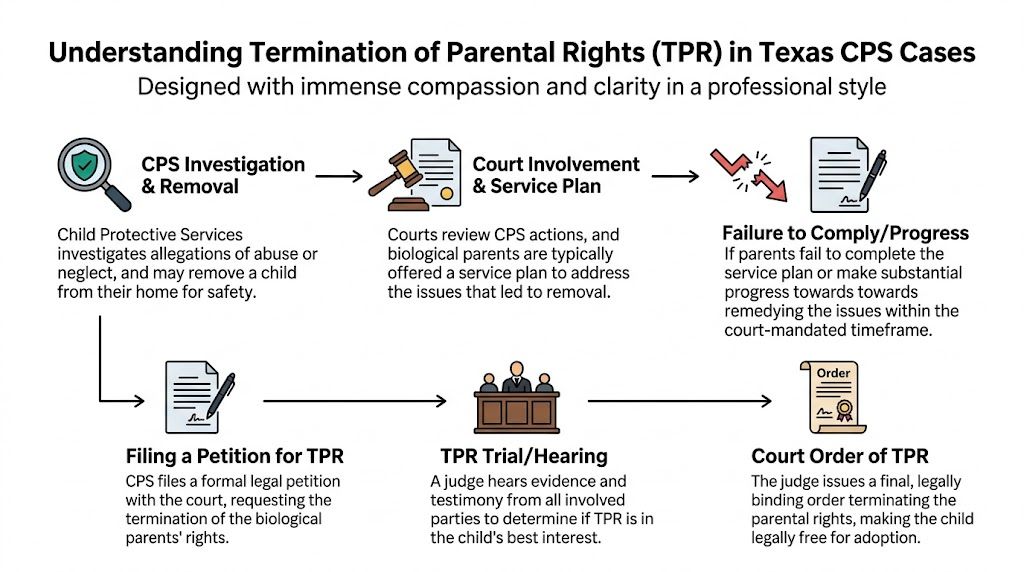
In legal terms, termination of parental rights, often called TPR, is the court process that ends the legal parent-child relationship between the child and the birth parent. In a CPS adoption case, that step is usually necessary before adoption can move forward.
Why TPR happens
Texas courts do not terminate parental rights lightly.
The court looks at the evidence, the family history, the parent’s progress or lack of progress, safety concerns, and whether termination is in the best interest of the child. In many CPS cases, parents are given a service plan and a chance to address the issues that led to removal.
If the legal standard is met, the court may sign an order terminating parental rights. That order is what makes the child legally free for adoption.
Voluntary and involuntary termination
These are the two broad ways TPR may happen:
Voluntary termination
A birth parent signs documents relinquishing parental rights. This can happen in some cases, though the court still reviews what is in the child’s best interests.Involuntary termination
A judge orders termination after a hearing or trial. This usually happens when the evidence shows serious concerns and the court finds that termination is legally justified and necessary for the child.
For caregivers, it helps to remember that TPR is not your decision to make. It is a judicial decision. Your role is to care for the child, document the child’s needs, and stay informed.
The best-interest standard in real life
“Best interest of the child” can sound vague. In practice, it means the court is asking where the child is most likely to be safe, stable, and able to thrive.
A judge may look at questions such as:
- Has the parent addressed the reasons for removal?
- Is the child bonded to the current caregiver?
- Can the caregiver meet the child’s medical, emotional, and educational needs?
- Would delaying permanence harm the child?
No single fact decides everything. The court looks at the whole picture.
Kinship caregivers need to know about the 90-day window
Relatives are in a unique legal position. Texas CPS policy states that after parental rights are terminated, there is a 90-day waiting period before an adoption can be consummated. That period gives certain relatives with legal standing time to intervene. The rule is explained in the DFPS handbook section on adoption consummation and relative intervention rights.
Standing is a legal word that means a person has the right to ask the court to hear their request.
For relatives, standing may depend on the facts. Prior caregiving, significant past contact, or a legal relationship to the child may matter. This is one reason kinship caregivers should not wait until the last minute to ask legal questions.
If you want a fuller explanation of the court side of this issue, this overview of terminating parental rights in Texas is a useful next read.
If you are a relative and you think you may need to intervene, timing matters as much as the facts.
What this stage feels like in a home
A foster parent may wonder whether it’s appropriate to decorate a room permanently while the TPR hearing is still pending.
A grandmother may worry that supporting adoption will damage her relationship with her adult child.
A child may ask, “Am I staying here forever?” before the court can definitively give that answer.
Those are not small moments. They’re the human side of TPR. A good legal process respects that this is not just a case file. It’s a child’s identity, a family’s grief, and a caregiver’s hope all at once.
From Placement to Petition The Foster-to-Adopt Transition
The phone has stopped ringing as often. Visits are over. The court has already changed the legal status of the case. Yet your daily life may look almost the same on the outside. You still pack lunches, help with homework, manage bedtime, and answer the same hard question from a child who wants certainty now.
That gap between placement and adoption petition is often the most confusing part of a Texas CPS case.
For many foster parents and kinship caregivers, this stage feels like standing in a doorway with a child in your arms. You are no longer just providing temporary care, but the law has not finished recognizing you as the child’s permanent parent. Emotionally, many families already feel like a forever family. Legally, a few more steps still have to happen.
What the supervision period is really for
Texas usually requires a post-placement supervision period before adoption can be finalized. A caseworker or another approved professional checks how the placement is going and reports back to the court.
That can feel personal.
It helps to view supervision as a safety check, much like the final inspection before a home sale closes. You may already be living in the house and caring for it every day, but the court still wants confirmation that the placement is stable, safe, and serving the child well.
During this period, professionals often focus on a few practical questions:
- Is the child settling in? They may look at behavior, attachment, routines, and whether the child seems more secure over time.
- Are daily needs being met? School attendance, medical care, therapy, and medication management often matter here.
- How is the household functioning? The court wants to know whether the adults can respond calmly and consistently when stress shows up.
- What does the child want? If the child is old enough, the child’s views may be part of the picture.
For kinship caregivers, this stage can be especially emotional. You may have loved this child long before CPS became involved. Even so, the court still has to shift your role from relative helper to legal parent. That is a real transition, and it deserves careful attention.
When care turns into a legal case for adoption
After placement has had time to stabilize, the case moves toward filing a petition to adopt.
A petition is the formal request asking the court to make the parent-child relationship permanent. It identifies the child, the proposed adoptive parent or parents, and the legal basis for the adoption. It also has to fit correctly with the CPS record and any earlier court orders.
Small paperwork problems can slow things down. A misspelled name, a missing exhibit, or an incomplete background document may lead to delay while the court asks for corrections.
Families who want a clearer sense of timing often find it helpful to review this step-by-step guide to foster-to-adopt in Texas. Some families also work with counsel, including the Law Office of Bryan Fagan, PLLC, to prepare filings and coordinate the court process in CPS-related adoptions.
What this stage can look like in real life
A foster mother may have cared for a seven-year-old for more than a year. By now, she knows which cereal the child will eat, which stuffed animal has to go to every therapy visit, and how long it takes to calm fears after a bad dream. In every practical sense, she is already parenting.
At the same time, she may still be waiting on updated paperwork, a report from the supervisor, or a court date to file or advance the petition. That waiting can feel strange because the relationship is already real, but the legal label has not caught up.
Children notice that tension too. A child may test limits more during this period, not because the placement is failing, but because permanence can feel scary as well as hopeful. Caregivers often need reassurance that mixed emotions are common.
Families with younger children sometimes find it useful to read outside adoption-specific materials on attachment, routines, and transitions, including guidance on what to expect in the first year with your new baby. The legal process is different, of course, but the day-to-day work of building trust, rhythm, and safety in a home often has some overlap.
Why families should not lose heart during this wait
This path is well established in Texas. From fiscal year 2010 to 2019, the number of consummated adoptions from the Texas child welfare system rose by 27.2%, reaching 6,107 in FY 2019, according to the Texas post-adoption report.
Those numbers do not make the waiting easy. They do offer something many families need at this point. Proof that other foster parents and relatives have made it through this middle stretch and reached permanent adoption.
If you are in this stage now, it helps to measure progress by lived reality as well as court dates. The child is learning your routines. You are learning how to parent this child, not just care for this child. That is the heart of the foster-to-adopt transition.

Finalization and Life After Adoption
The final hearing is often one of the most joyful days in family court.
A judge reviews the paperwork, confirms that the legal requirements are satisfied, and signs the final decree of adoption. That order changes the relationship permanently. From that point on, the adoptive parent is the child’s legal parent in every ordinary sense of the word.
Many families call this “adoption day.” Some courts take photos. Some judges speak directly to the child. Some families bring grandparents, siblings, or a stuffed animal that has been part of the journey from the start.
What finalization changes
After finalization, parents can usually move forward with practical next steps such as requesting an updated birth certificate and handling school, medical, and insurance records under the adoptive parent-child relationship.
Emotionally, finalization can bring relief. It can also bring up grief.
A child may feel happy and sad at the same time. A relative may celebrate the stability while mourning the circumstances that made adoption necessary. Parents should make room for both.
Adoption finalizes a legal relationship. It does not erase a child’s history.
Why support after adoption matters so much
Many families are caught off guard at this point. They expect the hardest part to end when the judge signs the decree. But children who have lived through trauma, removal, and uncertainty may still need strong support after adoption.
A major challenge in Texas is that funding for post-adoption services has not kept pace with demand, and many families adopting through the child welfare system do not receive state-contracted support in the same year their adoption is finalized, according to the Texas Alliance of Child and Family Services discussion of post-adoption service gaps.
That means families should think ahead, not wait for a crisis.
Good next steps after the hearing
- Ask for records: Keep copies of the final decree, medical records, school records, and any subsidy or assistance documents in one place.
- Build a support list: Identify therapists, pediatricians, school contacts, faith communities, respite options, and trusted relatives or friends.
- Watch transition behavior: Some children struggle more after permanence because they finally feel safe enough to show fear, grief, or anger.
- Use parenting resources thoughtfully: If you are welcoming a very young child and want practical help with early routines and development, a gentle guide on what to expect in the first year with your new baby can be useful alongside adoption-specific support.
Families do best when they stop viewing support as a backup plan. It’s part of the plan.
Common Questions in Texas CPS Adoptions
How long does adoption after CPS placement texas usually take
It depends on the case.
The timeline often turns on whether parental rights have already been terminated, whether any appeals or relative interventions are still possible, how quickly paperwork is completed, and when the court can schedule the final hearing. Some parts feel fast. Others feel painfully slow.
What if a birth parent appeals the TPR decision
An appeal can delay final adoption steps.
That does not automatically mean the placement will change, but it can mean the case remains legally unsettled for a period of time. Families should stay in close contact with the caseworker and their attorney so they understand what can move forward and what must wait.
Can I adopt a child placed from a different Texas county
Often, yes.
CPS cases can involve children, caregivers, and courts in different counties. The process may require coordination between offices and courts, but it is not unusual. The key issue is proper approval, proper filing, and clear communication among everyone handling the case.
Do relatives have to meet the same standards as foster parents
Relatives may have a different route into placement, but adoption still requires legal and practical review.
The court and CPS still need to know that the home is safe and that the caregiver can meet the child’s needs. Kinship caregivers should not assume that being family removes the need for documentation or court approval.
What if the child is scared about adoption
That’s common.
Children may worry that adoption means betraying their birth parents. They may worry about a name change, a new routine, or whether “forever” is real. The best response is usually calm honesty, consistency, and support from trusted adults and professionals.
If you're considering adoption after a CPS placement and want guidance that fits your family’s specific facts, Law Office of Bryan Fagan, PLLC offers free consultations for Texas families navigating kinship, foster-to-adopt, and other adoption matters. A clear legal plan can make this road feel far more manageable.
