
Terminating parental rights in Texas is one of the most serious and permanent actions a family law court can take. It’s a profound legal step that completely and forever severs the relationship between a parent and child, paving the way for adoption and giving a child a chance at a safe, stable future. This decision is never made lightly and is only granted when it serves the best interests of the child.
Understanding the Heart of Termination of Parental Rights

When we talk about terminating parental rights, we're discussing a foundational shift in a child's life. Think of it as clearing the legal ground so a new, stronger family structure can be built. This court order, often called a Termination of Parental Rights (TPR), isn't just paperwork—it’s a life-altering event for everyone involved, and we approach it with the sensitivity it deserves.
For a child, it can mean the promise of finally having a forever home. For a stepparent who has been raising a child as their own for years, it opens the door to legal adoption, solidifying a bond that already exists in their heart. For a birth parent facing impossible circumstances, it can be a deeply painful but selfless choice, made out of love to ensure their child gets the care they simply can't provide.
The Two Pillars of a Termination Case
At its core, any case to terminate parental rights in Texas must clear two very high bars in court. A judge must find "clear and convincing evidence" for both of these pillars:
- Grounds for Termination: The person asking for the termination must prove the parent committed at least one specific act listed in the Texas Family Code.
- Best Interest of the Child: The court must also conclude that ending the parent-child relationship is definitively in the child’s best interest.
This two-part test ensures the decision is made with the utmost care. The focus is always, always on creating a safe, stable, and nurturing environment where a child can finally put down roots and thrive.
A TPR order is irreversible. Once it's finalized, the parent-child relationship is legally severed forever. This ends all rights to inheritance, visitation, and decision-making, while also stopping any future child support obligations.
Sadly, this process has become more common. Nationally, the rate of parental rights termination for both parents doubled between 2000 and 2016, now affecting about 1 in every 100 children. The Texas Family Code lays out the specific grounds for termination in detail under §161.001, requiring an incredibly high standard of proof to protect every family member involved. You can explore more about these legal standards in this detailed research on parental rights.
Whether you're a hopeful adoptive parent, a concerned relative, or a birth parent exploring your options, understanding this process is the first step. It's a path that requires compassion, legal clarity, and experienced guidance.
Voluntary and Involuntary Termination Explained

In Texas, terminating parental rights isn't a single path—it's two very different journeys, each with its own legal and emotional terrain. Understanding the difference between voluntary and involuntary termination is the first step for anyone navigating this deeply personal process.
One path is chosen intentionally, often as part of a loving plan. The other is ordered by a court when a child’s safety is on the line. But no matter how a case begins, the final destination is always the same: ensuring the child has a safe, stable, and permanent home.
Let's break down these two routes with the clarity and compassion they deserve.
The Path of Choice: Voluntary Termination
Voluntary termination is exactly what it sounds like: a conscious, willing decision by a parent to legally relinquish their rights to a child. Far from being a punishment, this is most often a profound act of love, usually seen in private adoptions where a birth parent chooses an adoptive family to raise their child.
To make this official, the parent must sign a critical legal document called an Affidavit of Relinquishment of Parental Rights. This isn't just signing a form; it's a sworn statement, notarized, confirming the decision is being made freely, without any outside pressure or coercion.
There are a few key guardrails in place to protect everyone in this process:
- Willing Consent: The parent has to fully grasp the finality of their decision and agree to it without hesitation.
- Legal Safeguards: To ensure the parent isn't acting under duress, the affidavit cannot be signed until at least 48 hours after the child is born.
- Final Court Approval: Even with a signed affidavit, a judge must still review the case and issue a court order affirming that termination is truly in the child’s best interest.
This path gives a birth parent a voice in their child's future, often paving the way for open adoptions where some level of contact can be maintained. You can learn more about the specific paperwork by reading our guide on the release of parental rights form.
The Path of Necessity: Involuntary Termination
Involuntary termination is a much tougher road. This is when a court must step in to protect a child from a harmful or dangerous environment. Here, a parent’s rights are terminated against their will because their actions—or lack thereof—have put their child’s well-being at serious risk.
The State of Texas doesn't take this step lightly. A judge must find clear and convincing evidence that the parent has committed one of the specific acts listed in the Texas Family Code and that severing the parent-child relationship is necessary for the child’s safety and future.
Involuntary termination is not about punishing a parent; it's about protecting a child. The court's primary duty is to ensure every child has a chance to grow up in a safe and nurturing environment.
Grounds for taking this drastic measure can include severe issues like:
- Endangering the child's physical or emotional well-being
- Abandoning the child without providing any support or contact
- Failing to follow a court-ordered plan meant to create a safe home
- Committing a crime that results in imprisonment
This is often the last resort, taken only after all other attempts to reunite the family have failed, cementing the need for a new, permanent home through adoption.
Comparing Voluntary and Involuntary Termination in Texas
| Aspect | Voluntary Termination | Involuntary Termination |
|---|---|---|
| Initiation | Started by the parent's own choice. | Initiated by another party, like the other parent or DFPS. |
| Core Reason | Typically part of a planned adoption. | Based on endangerment, neglect, abandonment, or abuse. |
| Parental Consent | The parent willingly signs legal documents. | Happens against the parent's will. |
| Legal Standard | Court confirms it's in the child's best interest. | Requires "clear and convincing evidence" of statutory grounds. |
| Emotional Context | Often an act of love and sacrifice. | Usually follows a traumatic and contentious legal battle. |
While the circumstances are worlds apart, both paths lead to the same legal outcome: the permanent end of the parent-child relationship, which then opens the door for a child to be adopted into a new family.
Navigating the Legal Process Step by Step
The idea of heading to court can feel intimidating, but knowing the road ahead helps bring a sense of calm and control. When it comes to terminating parental rights, the legal system follows a very structured path with clear milestones. Each one is designed to protect the child and ensure the final decision is a just one. It’s a journey that demands careful preparation, but you don’t have to walk it alone.
The whole process kicks off when someone files a formal request with the court, known as a Petition for Termination. This single document sets the entire legal process in motion.
Who Can Start the Process?
Not just anyone can walk into a courthouse and ask to terminate parental rights. Texas law is very specific about who has the legal right—or "standing"—to file a petition. This group includes:
- One of the child's parents, which is common in cases where a stepparent wishes to adopt.
- A close relative, like a grandparent, aunt, or uncle, who is deeply concerned about the child's well-being.
- A legal guardian or another person who has had care of the child for at least six months.
- The Texas Department of Family and Protective Services (DFPS), especially when a child’s safety is believed to be at risk.
Whoever files the petition takes on the heavy burden of proving their case to the judge. This is a major legal hurdle, which we'll get into next.
Key Stages of a Termination Case
Once the petition is on file, the case progresses through several crucial stages. The process is methodical, built to ensure everyone’s rights are respected and, most importantly, that the child’s voice is heard.
- Serving Notice: The parent whose rights are on the line must be officially notified of the lawsuit. This is called "service of process," and it’s a fundamental right that gives them a fair chance to respond and show up in court.
- Appointing an Attorney for the Child: In contested cases, the judge will appoint a special attorney, known as an attorney ad litem. This lawyer has only one client: the child. Their job is to represent the child’s best interests by investigating the situation, speaking for the child, and making recommendations to the court.
- Gathering Evidence: This is the discovery phase. Think of it as the information-gathering stage where both sides collect everything they need to build their case. This might involve depositions from witnesses, collecting school and medical records, or uncovering other documents that help paint the full picture for the judge.
- The Final Hearing: This is the trial. Both sides present their evidence and arguments directly to the judge. There’s no jury in these cases; the judge alone listens to the facts and makes the final, life-altering decision.
As you move through the court system, presenting a clear and compelling case is critical. Honing skills in writing persuasive legal briefs can be a huge advantage, as it helps ensure your side of the story is communicated powerfully to the court.
The Clear and Convincing Evidence Standard
Texas courts do not treat the termination of parental rights lightly. The law sets an incredibly high bar for the level of proof required, known as "clear and convincing evidence." This is a much tougher standard to meet than the "preponderance of the evidence" standard used in most other civil cases, where you only have to prove something is more likely than not.
Clear and convincing evidence means the proof must be strong enough to create a firm belief or conviction in the judge's mind that the allegations are true. It’s a measure of certainty that leaves very little room for doubt.
The person asking the court to terminate rights must prove two things with this high level of certainty:
- That the parent engaged in at least one of the specific behaviors listed as grounds for termination in the Texas Family Code.
- That severing the parent-child relationship is genuinely in the child’s best interest.
This strict standard exists because ending a parent-child relationship is permanent and profound. Despite this, the state’s approach has made Texas the national leader in terminating parental rights, with a staggering 91,589 children impacted since 2006. This is partly driven by a DFPS policy of filing for termination at the beginning of most foster care cases—a practice some critics argue puts legal procedure ahead of potential family reunification. You can find more details on these state policies and their impact on Texas families.
In the end, every step of this process is designed to answer one fundamental question: What outcome will give this child the safest, most stable, and most loving permanent home?
How Termination Creates a Path for Adoption
Terminating parental rights can sound like the end of a story, but in the world of family law, it's often the legal beginning of a beautiful new chapter. Think of this court order not just as a conclusion, but as the essential key that unlocks the door to a child's permanent, loving future through adoption. It’s the moment legal uncertainty ends so a new family's journey can officially begin.
For so many Texas families, this process is what finally makes their bonds legally secure. It’s what transforms a house into a forever home and allows loving caregivers to finally become legal parents.
Solidifying Bonds Through Stepparent Adoption
Imagine a stepfather who has been a constant source of love and support for years. He’s the one at the school plays, the one coaching the soccer team, the one offering a shoulder to cry on. In his heart—and in the child's—he is already "Dad." But without a legal adoption, he lacks the authority to make critical medical or educational decisions for the child he raises.
When the other biological parent has been absent, uninvolved, or has endangered the child, terminating their parental rights clears the path for this devoted stepparent to adopt. The termination order legally recognizes a reality that has existed for years, allowing the stepfather to give the child the legal permanency and emotional security they deserve. This is one of the most common and heartfelt reasons for terminating parental rights in Texas.
An Order of Termination is the legal foundation upon which a new family is formally built. It extinguishes the rights of one parent, making it possible for another loving adult to step into that role legally and permanently.
Keeping Families Together with Kinship Adoption
Sometimes, the safest place for a child is with family they already know and trust. Kinship adoptions are a powerful way to maintain family connections when a child's parents are unable to provide a safe and stable home. This often involves grandparents, aunts, uncles, or even older siblings stepping up to raise a child.
In these situations, termination is a necessary step to give these relatives the full legal authority they need. It allows a grandmother to enroll her grandchild in school, make crucial medical decisions, and provide the stable environment the child needs to heal and thrive. This process ensures the child remains surrounded by family, preserving their sense of identity and belonging while securing their future.
The following graphic gives you a bird's-eye view of the core legal steps involved in the Texas Termination of Parental Rights (TPR) process.
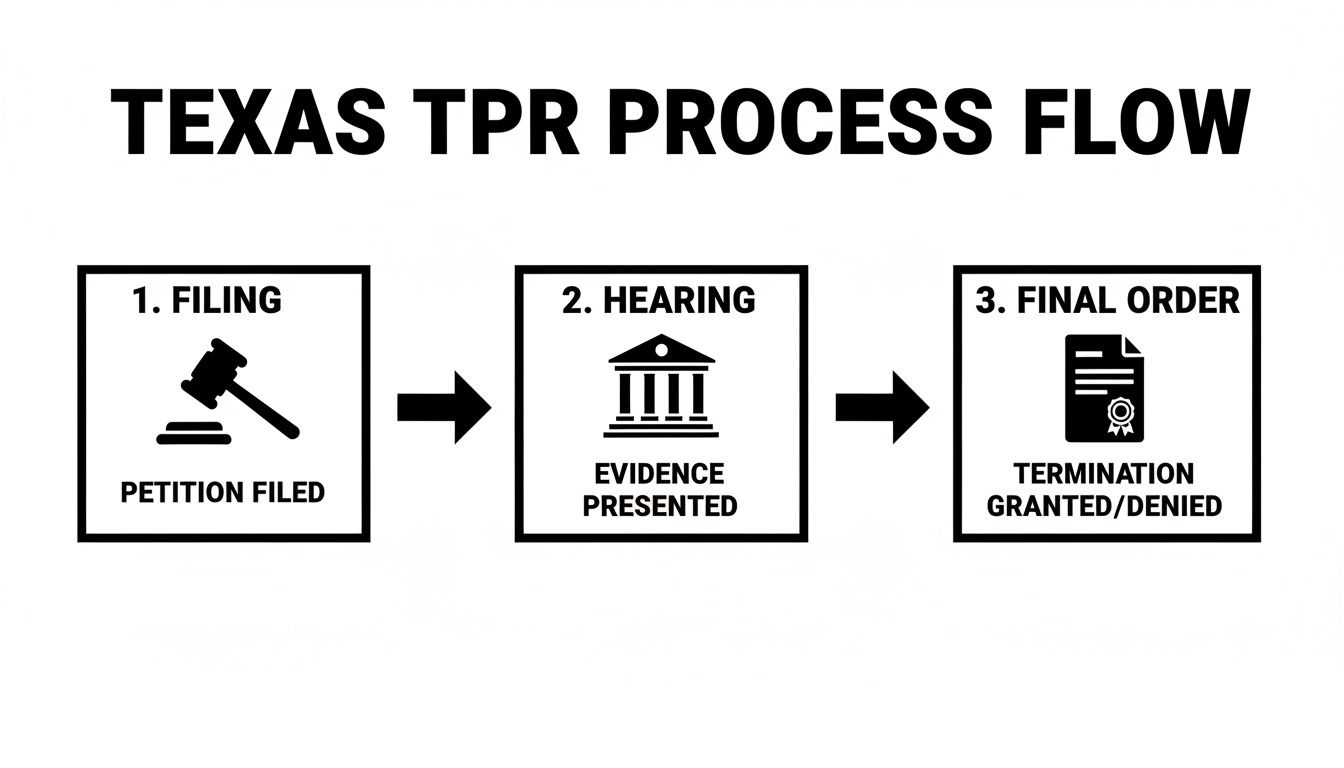
This visual makes it clear that every termination case, no matter the circumstances, must move through these formal court stages to reach a final, binding decision.
Paving the Way for Private Adoption
In private infant adoptions, a voluntary termination is an act of profound love and courage from a birth parent. By making the incredibly difficult decision to sign an Affidavit of Relinquishment, they are placing their child’s needs above their own and entrusting their future to a chosen adoptive family.
This voluntary act is the legal green light that allows the adoption to move forward. The termination order makes the child legally available for adoption, enabling the hopeful parents to finalize the process and finally welcome their child home forever. Each type of adoption has its own unique journey, and you can learn more by exploring the different Texas laws on adoption in our detailed guide.
Ultimately, whether through a stepparent, a relative, or a private agency, the termination of parental rights serves one primary purpose: to give a child the gift of a safe, stable, and legally permanent family.
Real-Life Scenarios Where Termination Is Necessary
The laws around terminating parental rights in Texas can feel a bit abstract, like something you'd only read about in a legal textbook. But for many families, these laws are a critical lifeline, offering a path to safety and stability for a child. These aren't just court cases; they're deeply personal journeys.
To give you a real sense of how this works, let's walk through a few common scenarios. We'll look at them with the empathy they deserve, always keeping the child's best interests front and center.
The Dedicated Stepparent Ready to Adopt
Picture this: Sarah and her son, Leo. Sarah remarried when Leo was just three. For the last six years, her husband, Mark, has been the only dad Leo has ever really known. He’s at every parent-teacher conference, he coaches Leo’s baseball team, and he’s the one Leo turns to for everything.
Leo’s biological father, on the other hand, has been a ghost. No calls, no visits, not a single child support payment in over four years. He has effectively abandoned his son. Sarah and Mark want to make their family official through a stepparent adoption, giving Leo the security and permanence of having Mark as his legal father.
In this situation, Sarah and Mark would petition the court for an involuntary termination of the biological father’s rights. They’d need to show clear and convincing evidence of his abandonment and failure to support Leo, as laid out in the Texas Family Code. Once his rights are terminated, the path is clear for Mark to legally adopt Leo, finally making the law reflect the reality of their family.
Grandparents Stepping Up in a Time of Crisis
Another all-too-common and heartbreaking scenario is when grandparents have to step in to protect their grandchildren. Think of David and Susan, whose daughter is battling a severe substance abuse problem. Her struggle has created an unsafe and chaotic environment for her young daughter, Emily.
Despite everyone's best efforts to help her, the situation hasn't improved, and Emily's well-being is at risk. David and Susan have been caring for Emily under a temporary order, giving her the stability she desperately needs. They’ve come to the painful realization that for Emily to have a real chance at a healthy childhood, they need to provide her with a permanent home.
In cases of endangerment, the court's primary duty is to protect the child. The goal is to move the child from a place of risk to one of permanent safety, even if it means making the incredibly tough decision to sever parental ties.
Here, the grandparents could file to terminate their daughter's parental rights on the grounds of endangerment—knowingly placing the child in conditions that threaten her well-being. This is an emotionally wrenching step, but it’s one they are taking out of profound love for their grandchild. A successful termination would allow David and Susan to pursue a kinship adoption, ensuring Emily can grow up in a safe, loving home while staying connected to her family roots.
A Birth Mother's Loving Adoption Plan
Not every termination is a contentious legal fight. Many begin as an act of selfless love. Imagine a young woman named Jessica who is pregnant and knows she isn't in a position to provide the life she dreams of for her baby. After a lot of soul-searching, she works with an adoption agency and chooses a hopeful couple, Michael and Ben, who she feels can give her child a wonderful future.
This is a voluntary termination scenario. Jessica is making a courageous, thoughtful plan for her child. After the baby is born, and after the legally required 48-hour waiting period, Jessica signs an Affidavit of Relinquishment of Parental Rights. This sworn document is her formal declaration that she is making this choice freely and understands it's permanent.
Her signature doesn’t finalize everything on the spot. A judge still has to review the case and issue an order confirming that termination is in the child's best interest. This compassionate legal step honors Jessica’s choice while formally opening the door for Michael and Ben to adopt the baby and start their life as a family.
Each of these stories, while different, shows how terminating parental rights in Texas is a crucial legal tool used to achieve one ultimate goal: securing a child's safe and permanent future.
Finding Compassionate Legal Support for Your Family
Navigating the termination of parental rights is a journey no one should ever have to walk alone. It's a life-altering decision, one that demands both legal precision and a deep well of empathy. We've walked through the what, why, and how of this complex process in Texas, but we know your family's story is entirely unique.
If you're even considering this path, you deserve guidance from someone who truly understands both the emotional weight and the legal intricacies involved. The emotional challenges can feel overwhelming, and it's okay to seek support. Exploring resources like therapy and support services for parents can be an incredible help during such a trying time. Finding the right legal partner is just as critical. Our team can help you make sense of your options and feel confident about what comes next. For more on this, check out our article on finding the best adoption attorneys near you.
Your family's future is far too important to leave to chance. Securing experienced, compassionate legal counsel is the single most important step you can take to protect a child's best interests.
We invite you to take that next step with confidence. Schedule a free, completely confidential consultation with The Law Office of Bryan Fagan, PLLC. Let our compassionate, knowledgeable team provide the steady legal support your family needs to secure a child's future.
Frequently Asked Questions About Terminating Parental Rights
The decision to terminate parental rights is heavy, packed with complex legal questions and powerful emotions. To help bring some clarity to this difficult process, we've put together straightforward answers to the questions Texas families ask us most often.
Can Parental Rights Be Reinstated After Termination in Texas?
Generally, an order from a Texas court terminating parental rights is final and permanent. This is one of the most serious and irreversible actions a family court can take. Think of it as a legal point of no return.
Is it ever possible to reverse it? Yes, but only in extremely rare and specific situations, like if a parent is later proven innocent of a serious crime that was the entire basis for the termination. Even exploring this remote possibility is an incredibly complex legal battle that requires an expert attorney. For almost everyone, the termination order is the final word.
Does Child Support Stop After Parental Rights Are Terminated?
Yes, once a judge signs the final order, the parent’s obligation to pay any future child support ends. The legal duty to financially support the child is completely severed, along with every other parental right and responsibility.
But—and this is a big but—termination doesn't wipe the slate clean. The parent is still on the hook for any unpaid child support (arrears) that piled up before the termination order was signed. The state can, and will, continue to collect that past-due amount.
An order terminating parental rights is forward-looking. It cuts off future obligations but does not wipe away any debts, including child support arrears, that were owed before the order was issued.
How Long Does the Termination Process Take in Texas?
There’s no one-size-fits-all answer here. The timeline for terminating parental rights in Texas can swing wildly depending on the specifics of the case. Every family's situation is different.
- Voluntary Termination: When a parent willingly signs an affidavit to relinquish their rights, usually as part of a planned adoption, the process is much faster. These cases can often wrap up in just a few months.
- Involuntary Termination: If a parent fights the termination in court, you’re looking at a much longer road. These contested legal battles can easily stretch from six months to well over a year, thanks to the time needed for gathering evidence, attending hearings, and dealing with potential appeals.
What if the Other Parent Cannot Be Found?
It’s a common and stressful problem: one parent is completely off the grid and can't be located. The good news is this doesn't have to stop the process of giving a child a secure future.
When a diligent, good-faith search turns up nothing, the court has a backup plan. It allows for other ways of giving legal notice, a method called substituted service. This might mean publishing a notice in a local newspaper or posting it at the courthouse. This legal workaround ensures the case can move forward, allowing a child to be adopted and find permanency even when one parent is unreachable. Handling this step correctly is critical, and it’s something you absolutely need an experienced attorney to manage.
Navigating the complexities of terminating parental rights in Texas requires compassionate, knowledgeable guidance. At The Law Office of Bryan Fagan, PLLC, we are here to answer all your questions and help you take the next step with confidence. Schedule a free, confidential consultation with us today to discuss your family’s unique situation by visiting https://texasfamilyadoption.com.
