
Deciding to grow your family through adoption in Texas is a profound moment, filled with hope, questions, and deep emotion. While the journey of a Texas infant adoption is guided by a specific legal process, it's a framework designed with one primary goal: creating secure, loving families by always putting the child’s best interests first. For many, the first step is simply understanding the path ahead.
Whether you are a hopeful adoptive parent, a birth parent considering an adoption plan, or a relative stepping in to care for a child, this guide is here to offer clarity and support. The path to adoption can feel immense, but breaking it down into manageable steps makes the journey approachable and empowering.
Starting Your Texas Infant Adoption Journey
Consider this your starting point—a compassionate guide to what it truly means to welcome a baby into your home through adoption in Texas. We understand that the process can seem overwhelming. From the initial paperwork to the final court hearing, our goal is to demystify each step so you can focus on what matters most: preparing to build your family.

Let's explore the main ways families are built through adoption and give you a clear view of the key milestones you can expect, from the home study to the day your family becomes legally and forever official.
Understanding the Emotional and Legal Path
Adoption is far more than a legal transaction; it's a deeply personal journey that brings families together in a powerful way. For hopeful adoptive parents, it demands preparation, patience, and vulnerability. For birth parents, it is an act of incredible love and courage—a decision requiring thoughtful consideration and a strong support system.
The legal framework, specifically Chapter 162 of the Texas Family Code, provides the structure that protects everyone involved.
At its core, adoption is about creating permanency for a child. The legal process is the structure that supports this beautiful, life-changing commitment, ensuring every child has a safe and nurturing forever home.
Key Milestones on Your Adoption Journey
While no two adoption stories are exactly alike, most follow a similar path. Understanding these stages can help you feel more prepared and in control from the start.
Here are the main milestones you'll encounter:
- Choosing Your Adoption Path: This is where you decide if you will work with a licensed agency, pursue a private adoption, or adopt a relative's child. Each has its own process.
- Completing the Home Study: This is a required assessment of your home and readiness to parent, conducted by a licensed social worker. It’s a foundational step in every Texas adoption.
- The Matching Process: For many, this is the heart of the journey—connecting with a birth mother who sees you as the right family for her child.
- Legal Finalization: This is the finish line. It involves court proceedings that legally terminate the birth parents' rights and grant you full, permanent parental rights, making your family official.
This guide will walk you through each of these phases in more detail. At the Law Office of Bryan Fagan, PLLC, we’re ready to offer the legal guidance and compassionate support you need to confidently take the next step.
Choosing Your Path to Infant Adoption in Texas
In Texas, adopting a baby isn't a one-size-fits-all journey. There are several paths you can take, and each one offers a different experience. Understanding the main routes for Texas infant adoptions is the first step toward finding the one that feels right for your family. This choice will shape your entire journey, from the support you receive to the connections you make along the way.
The three main pathways are agency adoption, private or independent adoption, and kinship adoption. Let's break down what each involves so you can choose the path that best aligns with your family’s hopes.
Agency Adoption: A Structured and Supportive Route
For many hopeful parents, agency adoption offers a welcome sense of security. A licensed Texas adoption agency acts as your guide, managing nearly every piece of the process. They handle matching with birth parents, provide counseling for everyone involved, and ensure every legal requirement is met.
Think of an agency as a dedicated, full-service team. They typically offer:
- Comprehensive Support: Agencies provide crucial services like birth parent counseling, home study coordination, and post-placement support. This built-in support system can be incredibly reassuring.
- Professional Matching: Agencies use detailed profiles to match you with expectant parents whose hopes and plans align with yours.
- Legal Assurance: They work with adoption attorneys to manage complex legal steps, ensuring the termination of parental rights and finalization are handled correctly.
This path is often a great fit for families who appreciate a clear, established process and a team of professionals to lean on.
Private Adoption: A More Direct Connection
Private adoption, sometimes called independent adoption, offers a more direct and often more personal journey. Here, hopeful adoptive parents and the birth mother usually connect on their own, whether through personal networks, online profiles, or with the help of an experienced adoption attorney.
While you won't have the full-service support of an agency, a private adoption gives you more control over the process. An attorney isn't just helpful on this path—they are essential. They will manage all legal filings, facilitate communication, and ensure the adoption is legally sound. To learn more, you can explore our guide on what is private adoption in Texas.
For example, a family might learn through a friend that a young woman is considering an adoption plan for her baby. With the help of attorneys for both sides, they can build a direct relationship and create an adoption plan together.
Kinship Adoption: Keeping Family Together
Kinship adoption is a beautiful way to provide a permanent, loving home for a child within your own family. This path is for relatives—like grandparents, aunts, uncles, or older siblings—who step in to adopt a child when their biological parents are unable to care for them.
The legal process for kinship adoptions is often more streamlined. Because the child remains in a familiar, loving environment, the emotional transition can be smoother for everyone.
Texas law prioritizes keeping children with family members whenever possible. A kinship adoption formalizes this bond, providing the child with legal permanency while preserving those vital family connections.
This path ensures the child maintains their sense of identity and belonging, surrounded by the family that already knows and loves them.
Comparing Your Options
Choosing between these paths is a significant decision, and there's no single "right" answer. This table compares the key features of each option to help you see the differences more clearly.
Comparing Infant Adoption Paths in Texas
This table compares the key features of agency, private, and kinship adoptions to help you choose the right path.
| Feature | Agency Adoption | Private/Independent Adoption | Kinship Adoption |
|---|---|---|---|
| Primary Support | Full-service agency staff and counselors | An adoption attorney | Family support and an attorney |
| Matching Process | Agency facilitates matching based on profiles | Direct connection between parties | Pre-existing family relationship |
| Level of Control | Less direct control; guided by agency process | High level of control and direct communication | High level of control within family dynamics |
| Typical Costs | Often the highest due to comprehensive services | Can be less expensive, mainly legal fees | Generally the least expensive option |
No matter which road you choose, the goal is the same: to create a secure and loving family. At The Law Office of Bryan Fagan, PLLC, we are here to provide the compassionate legal guidance you need to navigate any of these paths with confidence.
Navigating the Legal Steps of a Texas Adoption
The legal side of adoption builds the foundation that makes your family permanent and secure. While the process may seem complex, it's best to think of it as a well-planned journey. Each stage is designed to build a strong, legally recognized family, with the child’s best interests guiding every decision as required by the Texas Family Code.
Let's walk through this process step-by-step, from the first pieces of paperwork to that final, joyful day in court.
The Home Study and Adoptive Parent Profile
The first major milestone for any hopeful parent in Texas is the home study. This is not an inspection of your housekeeping skills but a collaborative process with a licensed social worker. Through interviews, background checks, and a home visit, you demonstrate your readiness to provide an infant a safe, stable, and loving home.
Around the same time, you’ll create your adoptive parent profile. This is a portfolio that tells your story to expectant parents considering an adoption plan. It's your chance to share your values, lifestyle, and the home you hope to build, helping a birth mother feel a personal connection to you.
This timeline gives you a bird's-eye view of how different infant adoption paths in Texas typically unfold, each with its own legal checkpoints.
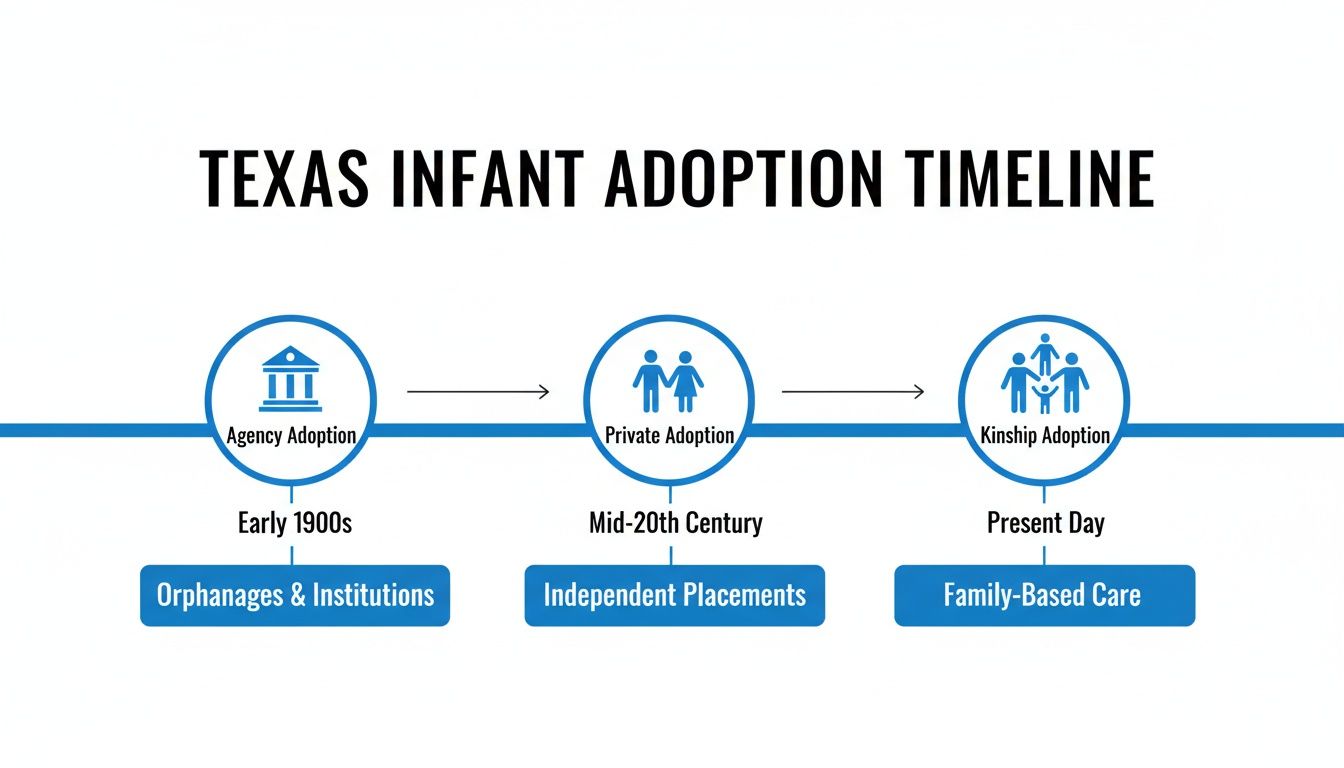
As you can see, agency, private, and kinship adoptions all share core legal requirements but can have different timelines and levels of support.
The Matching Process and Legal Consents
Once your home study is approved, the matching process begins. This is the moment an expectant mother reviews your profile and chooses you to be her child’s parents. It's a time filled with emotion, hope, and anticipation.
The wait for a match can vary. For domestic infant adoptions in Texas, hopeful parents can expect an average wait time of approximately 12 to 24 months from the start of the process to placement. Some families match more quickly, while others might wait longer.
After the baby is born, one of the most critical legal moments occurs. Texas law is very clear: a birth mother cannot sign any legal documents to relinquish her parental rights until at least 48 hours after the birth. This waiting period is a crucial safeguard, ensuring her decision is made with a clear head, free from the immediate stress of labor.
Once the birth mother signs the affidavit of relinquishment after this 48-hour window, her decision is irrevocable. This legal finality gives the adoptive family the security to move forward and fully bond with their new child.
Termination of Parental Rights and Finalization
The next legal phase is the Termination of Parental Rights (TPR). This is a formal court proceeding where a judge legally ends the rights of the birth parents, which makes the child legally available for adoption. Your attorney will file the correct petitions and manage this process with care and compassion. Understanding the legal paperwork, like the release of parental rights form, can help demystify this stage.
After the TPR is granted, a post-placement supervision period begins, which usually lasts for about six months. During this time, a social worker will visit your home a few times to see how everyone is adjusting and offer support. These visits result in positive reports sent to the court.
The final chapter is the adoption finalization hearing. This is a day of celebration. You'll appear in court, where a judge will review all documentation and sign the final decree of adoption. In that moment, your family is officially and forever recognized in the eyes of the law. This final step underscores why an experienced attorney is so essential—to manage every detail with precision.
Understanding the Financial Investment of Adoption
While building your family is a priceless journey, understanding the financial side of adoption is a necessary and practical step. For many hopeful parents considering Texas infant adoptions, the costs can feel like a hurdle, but they don't have to be a barrier. With solid planning and knowledge of available resources, you can approach this investment with confidence.
The expenses tied to adoption are not arbitrary figures. Every cost serves a crucial purpose—ensuring the process is handled ethically, legally, and with the utmost care for everyone involved, especially the child and the birth parents.
Breaking Down the Costs of a Texas Infant Adoption
The total cost of an infant adoption can range widely, often landing between $20,000 and $45,000 or more, depending on your chosen path. An agency adoption, for example, typically bundles a wide array of services into a comprehensive fee.
Here’s a look at the most common expenses:
- Agency or Professional Fees: This often represents the largest portion, covering services like matching, birth parent counseling and support, and overall case management.
- Legal Fees: You'll need an experienced adoption attorney to handle all legal paperwork, from the initial petition to the finalization hearing. You will also typically cover the birth mother’s legal fees for her own independent counsel.
- Home Study Costs: This fee pays for the licensed social worker who conducts the interviews, background checks, and prepares the final report required by the court.
- Birth Mother Expenses: Texas law allows adoptive parents to provide financial support for the birth mother’s reasonable living and medical expenses during her pregnancy. This is always managed through your agency or attorney to ensure compliance with state regulations.
Planning for these costs is an act of preparation, just like setting up a nursery. It’s a foundational step that helps create a stable, secure environment for your future child.
Financial Resources to Help You Grow Your Family
The good news is that you don't have to fund this journey alone. A wealth of resources exists specifically to help families manage the financial side of adoption, making it more accessible for loving, prepared parents.
For a more detailed look at managing these expenses, you can get the full picture by understanding the financial investment in adoption in our dedicated guide.
Be sure to explore these powerful financial tools:
- The Federal Adoption Tax Credit: This is a significant non-refundable tax credit designed to offset adoption expenses. For 2024, the credit can be worth over $16,000 per child, providing substantial financial relief.
- Employer-Provided Benefits: Many companies now offer adoption assistance in their benefits packages. Check with your HR department to see if your employer provides grants, reimbursement, or paid leave for adoption.
- Adoption Grants and Loans: Numerous non-profit organizations offer adoption grants that you don't have to repay. Additionally, some financial institutions offer low-interest loans created specifically for adopting families.
At The Law Office of Bryan Fagan, PLLC, we believe financial concerns should not prevent a loving family from coming together. We are here to provide the legal guidance and compassionate support you need to navigate every aspect of your adoption journey.
Welcoming All Families: Special Considerations in Texas
Every family’s journey to adoption is a unique story, and Texas law welcomes loving parents from all walks of life. The path to a Texas infant adoption is open to diverse families, and knowing the specific considerations for your situation can make the process feel more manageable and empowering.
At its core, adoption is about creating a stable, nurturing home. The law reflects this by focusing on a parent's ability to provide love and security—not on their marital status, sexual orientation, or family structure.
Whether you are part of a same-sex couple, a single person ready to become a parent, or a relative stepping up for a child you already cherish, there is a clear path forward for you.

LGBTQ+ and Single Parent Adoptions
In Texas, your right to adopt is not determined by who you love or whether you're married. LGBTQ+ individuals and couples have the same legal standing to adopt as anyone else.
Both joint and second-parent adoptions are fully recognized, giving your family the legal security it deserves. For example, a married same-sex couple can adopt jointly, or one partner can adopt their spouse's biological child through a stepparent-style adoption. The focus is always on your capacity to be a wonderful parent.
Likewise, single-parent adoptions are common and celebrated. A single individual who can provide a stable, loving home is fully eligible to adopt an infant in Texas. The process highlights your personal strengths, your support system, and your readiness to parent. The law knows that a loving home is built on commitment, not a specific family structure.
The Smoother Path of Kinship Adoptions
When a family member—like a grandparent, aunt, or uncle—adopts a child, it’s called a kinship adoption. This path is often more streamlined because it prioritizes keeping a child within their existing family circle, which is almost always seen as being in the child's best interest.
The home study process may be adjusted, and the emotional transition is usually smoother for the child, who is already surrounded by familiar faces and love.
Kinship adoptions are a cornerstone of the Texas family system. Relatives play a vital role in providing permanent homes for children. In fact, relatives account for more than half of all children and teens adopted from DFPS care in Texas, which shows just how crucial these family connections are.
When DFPS Is Involved in an Infant Adoption
Occasionally, an infant adoption may involve the Texas Department of Family and Protective Services (DFPS), often known as CPS. This typically happens when a newborn cannot safely go home from the hospital and is placed directly into foster care.
If the court ultimately terminates the biological parents' rights, the foster family who has been caring for the infant may then have the opportunity to adopt.
This "foster-to-adopt" path provides immediate stability for a newborn in crisis and is carefully guided by DFPS to ensure the child’s well-being is the top priority. While it involves different legal steps than a private adoption, the outcome is the same: creating a permanent, loving family. For families welcoming an infant, gaining a deeper knowledge of early childhood bonds can be incredibly valuable. You can learn more by understanding attachment theory and its impact.
Regardless of your background or family structure, the goal of adoption remains the same: to provide a child with a forever family. Texas law supports this goal by focusing on what truly matters—your ability to love, nurture, and provide a safe home.
Let Our Family Help You Build Yours
Deciding to grow your family through a Texas infant adoption is a beautiful commitment, filled with hope, questions, and emotion. It is a complex legal road, but it is not a road you have to walk alone. Having the right legal partner can turn confusing steps into a clear, manageable path toward the family you’re dreaming of.
Here at The Law Office of Bryan Fagan, PLLC, we do more than just file paperwork. We provide grounded, step-by-step guidance, from your first questions to the amazing day your adoption is finalized. Our goal is to empower you with straightforward answers and steady support, so you feel confident and cared for every step of the way.
Your Compassionate Legal Partner
Our firm was built on a simple idea: families helping families. We are fiercely committed to protecting your interests and, above all, the well-being of the child at the heart of this journey. We know the Texas Family Code, but we also understand the human side of adoption. We take the time to listen to your story, explain things in plain English, and build a legal strategy that fits your unique situation.
Building a family through adoption is one of life's most beautiful commitments. Our mission is to handle the legal complexities with precision and care, so you can focus on preparing your heart and home for your new arrival.
Whether you're just starting to think about adoption or you're ready to take the next step, our family is here to help yours. We believe every family deserves dedicated, empathetic legal support on this life-changing adventure.
If you're ready to move forward, we invite you to schedule a free, no-obligation consultation with our experienced adoption attorneys. Let's sit down together and talk about your dreams for the future.
Common Questions About Infant Adoption in Texas
Starting the infant adoption journey naturally brings up many questions. Getting clear, straightforward answers can provide peace of mind and help you feel more prepared for the road ahead. Here are some of the most common questions we hear from hopeful adoptive families.
What Are the Basic Requirements to Adopt an Infant in Texas?
To adopt a child in Texas, you must be at least 21 years old, be financially stable, and successfully complete an adoption home study. The home study is a supportive assessment of your home life, background, and readiness to parent, conducted by a licensed social worker.
You can be single, married, or in a long-term partnership. Texas law focuses on your ability to provide a safe, stable, and nurturing home for a child, not your marital status.
Can a Birth Mother Change Her Mind After the Adoption?
This is a common and understandable concern for adoptive families. Under the Texas Family Code, a birth mother cannot legally sign documents to relinquish her parental rights until at least 48 hours after the child's birth.
This mandatory waiting period is a critical safeguard, ensuring she makes this decision freely and without the immediate pressures of childbirth. Once she signs these documents, her decision is irrevocable—meaning it is permanent and cannot be reversed. This legal finality provides the security adoptive families need to bond with their new child.
What Is the Difference Between Open and Closed Adoptions?
The type of adoption is defined by the level of contact and communication between the adoptive family and the birth parents. Deciding what feels right for your family is a key part of the process.
- Open Adoption: This involves some form of ongoing contact, from sharing letters and photos to occasional visits. It allows the child to know their full story and maintain a connection with their birth family. For example, some families agree to an annual visit with the birth mother at a park.
- Closed Adoption: In this arrangement, no identifying information is shared between the birth parents and the adoptive family, and there is no contact after the adoption is finalized.
- Semi-Open Adoption: A popular middle ground, communication like photos or updates is often handled through a neutral third party, like an agency or attorney. This allows for connection while maintaining privacy.
As part of preparing for a new family member, many adoptive parents plan baby showers and look for meaningful baby shower gifts for expecting parents to celebrate this joyful new beginning.
The journey to building a family through adoption is deeply personal, and having the right support is essential. At The Law Office of Bryan Fagan, PLLC, our compassionate attorneys are here to answer all your questions and guide you through every step. Schedule your free, no-obligation consultation today by visiting us at https://texasfamilyadoption.com.
