
You may be sitting at your kitchen table talking about names. Or maybe you’re a stepparent who has packed lunches, helped with homework, and shown up for every doctor visit, and now you want the law to reflect what your heart already knows. Some families come to adoption after years of waiting. Others arrive because life changed quickly, and a child they already love needs permanence.
That mix of hope and uncertainty is normal.
Private adoption in Texas can feel personal because it often grows out of real relationships, real conversations, and a clear desire to create stability for a child. For one family, that means a newborn adoption arranged with the help of professionals. For another, it means a grandmother adopting a grandchild she’s already raising. For a third, it means a stepparent making a lifelong bond legally secure.
The legal process matters, but so does the human side. Birth parents need clarity. Adoptive parents need guidance. Children need safety, honesty, and a permanent home built around their best interests.
This guide walks through private adoption texas in plain language. It’s written for hopeful parents, relatives, and birth parents who want to understand what happens, why it happens, and how Texas law tries to protect everyone involved. If some parts of adoption seem overwhelming right now, that doesn’t mean the path is closed. It usually means you need a roadmap.
Your Journey to Building a Family Through Adoption
Anna had been “Mom” in every way except on paper. She had been in her stepson’s life for years. She knew his shoe size, his fears about thunderstorms, and how to calm him down before school pictures. What she wanted was simple. She wanted the law to recognize the family they were already living as.
Across town, another couple was waiting for a very different reason. They were preparing for a private infant adoption. Their nursery was only half done because they didn’t know when placement might happen. They were excited, but they were also nervous about paperwork, home studies, and whether they would make a mistake.
Both families were on the same road, even if they entered it at different points.
Private adoption gives Texas families a flexible path to permanency. It can work for stepparents, relatives, prospective parents pursuing an infant adoption, LGBTQIA+ families, and single parents. What ties these situations together is the same goal: creating a safe, loving, legally protected home for a child.
Some readers come to this process with a child already in their life. Others are just starting to explore their options. Either way, it helps to think of adoption as a series of manageable decisions instead of one giant leap.
Practical rule: Adoption works best when families prepare for both the legal steps and the emotional ones.
That means asking early questions. Who must consent? Is a home study required? Will the case involve another state? How will contact with birth family work after placement? Those details can feel technical, but they shape the security of the final adoption.
A private adoption is never just paperwork. It’s a legal process designed to support a lifelong relationship.
What Is Private Adoption in Texas
Private adoption in Texas is the legal path families use when an adoption happens outside the foster care system. The child is not being placed for adoption through CPS. Instead, the case usually begins through a private agreement, a licensed agency, or an existing relationship, such as a stepparent or relative caring for the child already.

Private adoption works like one legal framework with several entry points. A hopeful adoptive couple may begin with an agency or an independent match. A birth parent may choose an adoptive family directly. A stepparent may seek to secure the parent-child bond that already exists at home. A grandparent, aunt, or other relative may use the same court system to make a long-term caregiving role permanent.
That shared structure is what often surprises people. These cases can look very different on the surface, but Texas treats them as part of the same private adoption process. The details change from family to family. The core question stays the same. Will this adoption create a safe, lawful, permanent home for the child?
If you want the statutory background behind that process, this overview of Texas adoption laws explains the legal rules in more detail.
The main types of private adoption
Some families hear the phrase "private adoption" and picture only a newborn placement. Texas law is broader than that.
Private adoption often falls into these general categories:
- Independent adoption. The birth parents and adoptive parents make the match directly, and attorneys guide the legal steps.
- Agency-assisted adoption. A licensed private agency helps with screening, education, matching, and placement support.
- Stepparent adoption. A spouse adopts a child they are already raising, after the other parent's rights are addressed as required by law.
- Relative or kinship adoption. A family member adopts a child who is already in their care or with whom they have an established relationship.
These paths are different in practice, but they are connected. Each one requires attention to consent, parental rights, court approval, and the child's best interests.
Why private adoption feels more personal
Private adoption usually gives adults more direct involvement in the process. That may include choosing an agency, participating in a match, discussing future contact, or deciding how placement will happen. For many families, that level of involvement brings comfort because it allows more conversation and planning.
It can also raise hard questions.
A birth parent may want ongoing updates after placement. An adoptive parent may gladly agree in principle, then wonder what that means during holidays, school events, or major medical decisions. A stepparent may assume the case is simple because the child already lives in the home, then learn that the court still needs proper consent or a lawful termination of the other parent's rights. A relative caregiver may have done the day-to-day parenting for years, but legal adoption still requires formal steps to protect the child for the future.
Private adoption is personal. It is also a court process.
Who this path can serve
The phrase "private adoption Texas" covers more families than many people expect. It may apply to:
| Family situation | How private adoption may apply |
|---|---|
| Stepparent | A spouse adopts the child after the other parent's rights are addressed |
| Relative or kinship caregiver | A grandparent, aunt, uncle, or other relative adopts a child already in their care |
| Prospective infant adoptive parents | A private arrangement or licensed agency assists with placement |
| LGBTQIA+ couple or single parent | The same private legal framework can be used to pursue adoption |
The path may start in different places, but the goal is steady across all of them. Texas private adoption gives families a way to turn an important relationship into a permanent legal one, with the child's security at the center of every step.
The Legal Foundation of Your Texas Adoption
Adoption can feel emotional, but courts don’t finalize it on emotion alone. Texas uses a legal framework to make sure the adoption is safe, ethical, and permanent. Much of that framework appears in Texas Family Code Chapters 162 through 166, which govern adoption and related procedures.
If you want a fuller legal overview, this guide to Texas adoption laws is a helpful starting point.
Why the law is detailed
Families sometimes worry that legal requirements mean the system doesn’t trust them. Usually, the opposite is true. The law is trying to protect the child’s future.
A final adoption order changes legal parentage for life. Because of that, Texas courts want to know that the child’s placement is appropriate, that necessary consents were properly signed, and that no one was rushed or misled.
The court’s guiding standard is the best interest of the child. That phrase shows up often in family law because it matters. The judge’s duties involve more than checking boxes. The judge is asking whether this adoption creates a stable and lawful family relationship for the child.
The home study is preparation, not punishment
A home study is one of the first places people get anxious.
Many families hear “home study” and picture a harsh inspection. In reality, it’s better understood as a readiness review. A qualified professional looks at the household, background information, and the family’s ability to provide care. The process also gives adoptive parents a chance to ask questions and prepare for life after placement.
For many private adoption pathways, the home study is a central part of the case. It helps the court evaluate safety and suitability before finalization.
Parental rights must be addressed carefully
No adoption can be finalized unless the legal rights of the child’s existing parents are dealt with correctly. In some cases, a biological parent voluntarily signs documents consenting to termination and adoption. In others, the court must decide whether rights can be terminated under Texas law.
This is one of the most serious parts of any adoption case.
For a stepparent, this may involve the absent parent’s rights. For a relative caregiver, it may involve a painful family history. For a newborn placement, it means making sure consents are informed, valid, and properly handled.
A rushed or defective termination process can create future problems. That’s why careful legal work matters so much here.
Placement, supervision, and final approval
Texas courts usually want a period of post-placement evaluation before entering a final decree. This gives the court additional reassurance that the child is adjusting well and that the placement remains in the child’s best interests.
That period can feel long to adoptive parents, especially when the child is already home. Still, there is a purpose behind it. The law is not trying to keep families apart. It is trying to make the final order durable.
Interstate cases need special attention
If a private adoption involves families in different states, the case must follow the Interstate Compact on the Placement of Children, often called ICPC. Texas requires compliance with that process, and one detail causes avoidable delays if families miss it. Criminal background checks must be no more than 24 months old at the time of submission, as explained in the DFPS private interstate adoptions resource guide.
That matters because paperwork that seemed complete can become stale while families are waiting on other pieces of the case.
If your adoption crosses state lines, document timing matters almost as much as document content.
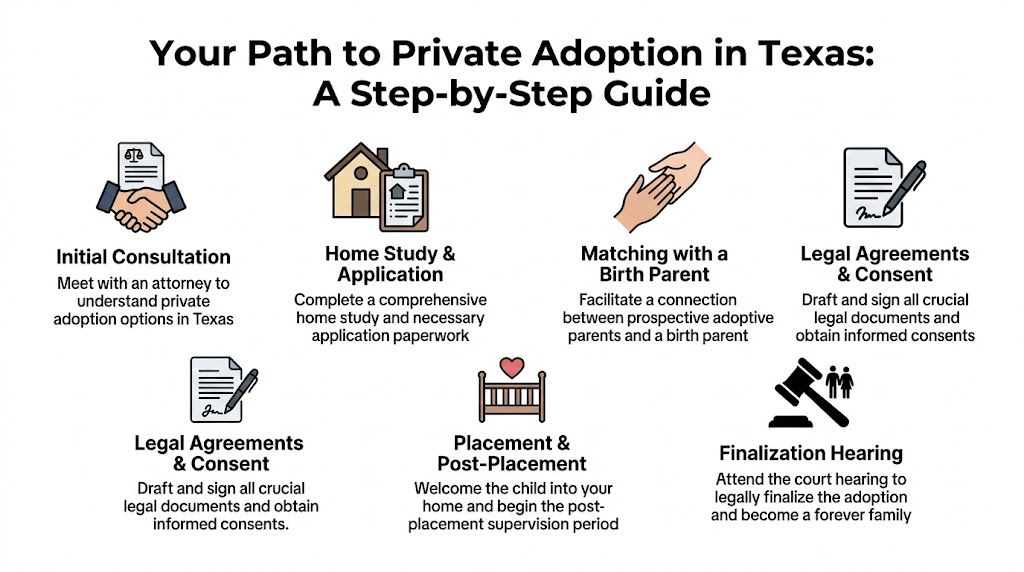
A Step-by-Step Guide to the Private Adoption Process
The private adoption process becomes less intimidating when you break it into stages. Families don’t complete everything at once. They move one step at a time, with each step building on the last.
If you’re comparing approaches, this overview of a private adoption agency in Texas can help you understand where an agency may fit into the process.
Step 1 Meet and plan early
The first step is usually a planning conversation with an adoption professional. For some families, that means an attorney. For others, it also includes a licensed agency, counselor, or home study provider.
This early stage is where you identify the type of adoption:
- Stepparent adoption
- Relative or kinship adoption
- Private infant adoption
- Adoption involving an out-of-state placement
That first planning step matters because the legal path changes depending on who the child is, whether the child is already known to you, and whether another parent’s rights must be terminated.
A stepparent case often starts with family history and paternity questions. A newborn private adoption may start with matching and hospital planning. A relative case may begin with figuring out who currently has legal authority over the child.
Step 2 Complete the home study and paperwork
Most private adoption paths require preparation before placement or finalization. The home study is a major part of that preparation.
The timeline can vary significantly. Kinship adoptions where the child is already known can move faster than the 9 to 18 month agency average, while private infant adoptions can take longer due to the matching process. All pathways require a 2 to 3 month preparation window for the home study, based on the Angela Adoption comparison of private and agency adoption in Texas.
During this phase, families often gather:
- Identity documents such as licenses and birth certificates
- Household records including financial and medical information
- Background materials required for screening
- Personal references requested by the evaluator
This step can feel paperwork-heavy, but it often gives families their first real sense that the process is moving.
Step 3 Match or confirm the family relationship
This stage looks very different depending on the case.
In a private infant adoption, this may involve being matched with an expectant or birth parent. Families usually prepare profiles, discuss values, and talk about expected contact after placement.
In a kinship or stepparent case, there may be no “matching” at all. The relationship already exists. The focus shifts to legal eligibility, consent, and the child’s long-term needs.
A simple example helps. If a child has lived with her aunt for some time, the emotional bond may already be strong. The legal work is about turning that lived reality into permanent legal parentage.
Step 4 Handle consent and legal placement
Once the case is ready, legal documents must be signed and filed correctly.
This can include consents, affidavits, termination documents, and the adoption petition. In some cases, hearings are needed before placement can become final. In others, placement occurs first and finalization happens later after supervision.
This is also the stage where mistakes can have long-term consequences. A missing signature, an invalid affidavit, or a filing in the wrong court can delay the process.
Key point: Adoption documents are not just forms. They create the legal foundation for your family.
Step 5 Welcome the child home and complete post-placement requirements
Placement is often the moment families have dreamed about, but it isn’t the last legal step.
After placement, Texas may require post-placement supervision or evaluation before the judge signs the final decree. Families sometimes feel surprised by this because daily life already feels permanent. Still, the court needs one last layer of confirmation.
During this period, the family may have visits with a social worker or evaluator. The purpose is to check adjustment, safety, and readiness for finalization.
Step 6 Attend the finalization hearing
Finalization day is the legal finish line.
The court reviews the case and, if all requirements are met, signs the order making the adoption permanent. For many families, this is one of the most joyful days they will ever spend in a courthouse.
Some hearings are brief. Some feel emotional from start to finish. A child may be dressed up. Relatives may attend. There are often photos afterward because this is more than a legal event. It is the day the law catches up with love.
Understanding the Costs and Timelines
A family may feel ready in their hearts and still need clear answers on paper. How much should we budget? How long should we expect this to take? Those are practical questions, and asking them early often makes the adoption process feel less overwhelming.
Costs and timing look different depending on which private adoption path fits your family. A stepparent adoption, a relative adoption, and a private infant adoption all travel under the same Texas legal framework, but they do not involve the same steps, professionals, or points of delay. It helps to view the process the way you would view a road trip. Everyone is driving toward permanence for a child, but the starting point, distance, and number of stops vary from one family to another.
Why costs can look so different from one case to another
Some families already know the child and are trying to make an existing parent-child bond legally permanent. Others are preparing for a match, placement, and possibly interstate coordination. That difference matters.
Common expenses may include:
- Attorney fees for legal advice, document preparation, court filings, hearings, and finalization
- Court costs charged by the county for filing and processing
- Home study fees if a home study is required in your case
- Post-placement supervision or reporting costs when the court requires follow-up before finalization
- Permitted birth-parent related expenses if Texas law allows them and they are handled correctly
A better question than “What is the average cost?” is “Which of these costs applies to our path?” That is usually where clarity begins. This article on how much private adoption costs in Texas gives a fuller breakdown of the expenses families often need to plan for.
Timelines usually turn on the slowest legal step
Families often want a single answer about timing, but Texas private adoption does not work on one universal clock. The timeline usually depends on the issue that takes the longest to resolve.
For example, a stepparent adoption may move more quickly if the family is stable and the consent or termination issues are straightforward. A relative adoption may begin with the child already living in the home, yet the court still needs the required paperwork, background review, and any needed findings before the case can be finalized. In a private infant adoption, the timing often depends on matching, placement, and whether more than one state’s rules apply.
A simple way to understand the timeline is to identify the step that can pause everything else.
| Adoption path | Timing issue that often controls the case |
|---|---|
| Stepparent adoption | Locating the other parent, obtaining consent, or addressing termination |
| Relative adoption | Converting an existing caregiving role into full legal authority |
| Private infant adoption | Matching, placement, and required legal consents |
| Interstate private adoption | Coordination between Texas requirements and the other state’s process |
Some cases move steadily. Some pause for reasons outside the family’s control.
Planning for placement costs in the real world
For families preparing for a newborn placement, medical expenses can be part of the larger planning conversation. Understanding the cost to have a baby in Texas can provide useful context when you are discussing legal planning, expected expenses, and what support may or may not be permitted under Texas law.
Good planning does not make the waiting easy. It does make the process easier to carry.
That is often the goal in this stage. Give your family a realistic budget, a realistic timeline, and enough room to make careful decisions without letting urgency drive the case.
Special Considerations for Your Unique Family
No two private adoption texas stories are the same. The law provides a structure, but every family walks into that structure with a different history, a different relationship to the child, and different hopes for the future.

When a stepparent wants the law to match daily life
A stepparent adoption often begins with a simple truth. The parent-child bond already exists.
A child may already call you Mom or Dad. You may already handle school forms, pickups, bedtime routines, and family holidays. Adoption gives legal weight to that relationship.
Still, these cases can carry emotional complexity. The other biological parent may be absent, uninvolved, or difficult to locate. Sometimes the child has questions about loyalty or identity. A careful legal process can create permanence without ignoring those feelings.
When relatives step in to keep family together
Kinship adoption often grows out of necessity.
A grandmother may be raising her grandchild because the child’s parents can’t safely do so. An uncle may become the stable adult in a child’s life during a family crisis. These adoptions can preserve family identity and continuity, which is very important to many children.
At the same time, relative adoptions can be emotionally layered. Holidays, sibling relationships, and extended family loyalties may all be affected. Families often need both legal clarity and honest conversations about roles.
When LGBTQIA+ families and single parents are building by choice
Many families come to adoption after deliberate, thoughtful planning. That includes LGBTQIA+ couples and single parents.
The private adoption framework can serve those families too. The legal questions are not about whether your family looks traditional. The pertinent questions are whether the adoption follows Texas law, whether the child’s interests are protected, and whether the placement is stable and appropriate.
For these families, support matters. So does working with professionals who understand the process and communicate clearly about documentation, home studies, and finalization.
Open and closed adoption are relationship choices
Families often ask whether an adoption should be open or closed. That question is less about labels and more about how people will relate to each other over time.
Some open adoptions involve letters and photos. Others include visits. Some begin with more contact and change as the child grows. According to this discussion of private adoptions in Texas and open adoption considerations, long-term boundaries are a common challenge, and families should create clear, enforceable communication protocols from the beginning.
That matters because life changes. People move. They remarry. A child’s needs evolve.
Here are practical issues families should discuss early:
- Communication method such as texts, email, letters, or scheduled calls
- Visit expectations including where, when, and how often contact may happen
- Privacy boundaries around social media and sharing photos
- Future review points so everyone knows the arrangement may need thoughtful updates
A healthy open adoption usually depends less on good intentions alone and more on clear expectations that adults can actually follow.
A short example
Consider a private infant adoption in which the birth mother wants ongoing photo updates and one yearly visit. That may sound simple on day one. Five years later, one family may have moved, a parent may have remarried, and the child may have strong feelings about contact.
The wiser approach is to plan for change from the start. Clear agreements reduce confusion later.
Navigating Common Challenges in Private Adoption
Private adoption can be beautiful and still be hard. Families deserve space for both truths.

When a match changes or falls through
Some families experience a disrupted match. That can happen when plans change before placement or when a case cannot legally move forward.
If that happens, grief is a normal response. Families often feel embarrassed talking about it, but they shouldn’t. Adoption involves real people making permanent decisions under emotional pressure.
Practical support helps here. So does legal guidance that keeps everyone from making rushed choices after a disappointment.
When legal details become emotional flashpoints
Termination of parental rights is often the point where legal complexity and family emotion collide.
A parent may be willing to consent but fearful of the finality. A relative may feel torn between protecting the child and preserving family peace. A stepparent may be surprised by how much old conflict returns once legal papers are filed.
That’s one reason some families work with an attorney alongside other professionals. The Law Office of Bryan Fagan, PLLC handles legal tasks such as adoption petitions, termination-related proceedings, court appearances, and finalization for Texas families pursuing private domestic adoption matters.
Post-adoption support matters more than many families expect
The legal case ends. Parenting doesn’t.
Texas families often need support after finalization, especially when questions of attachment, identity, grief, or behavior emerge later. The challenge is that Texas faces a significant shortage of adoption-competent mental health providers, and most families do not receive state-contracted post-adoption services in the year of finalization, according to the Texas Association of Child and Family Services post-adoption report.
That means families should build a support plan before a crisis happens.
Helpful planning steps include:
- Identify therapists early who understand adoption-specific needs
- Ask your pediatrician questions about trauma-informed referrals
- Create a support circle of trusted relatives, counselors, and parent mentors
- Keep records organized in case questions arise after finalization
A short video can also help families think through the emotional side of the journey.
The strongest adoption plans don’t stop at court. They prepare for family life after court.
Your Next Step Toward Building Your Family
A private adoption can begin with many different stories. A stepparent wanting legal security. A relative protecting a child’s future. A hopeful parent waiting for a placement. A birth parent trying to make a careful and loving plan.
The path has legal steps, emotional turning points, and important decisions. But it isn’t uncharted territory. With clear guidance, most families feel far less overwhelmed once they understand what happens first, what comes next, and what the court will require.
Adoption is about permanence, but it’s also about peace of mind. When the process is handled carefully, families can move forward knowing the child’s place in the family is protected.
If you’re ready to talk about your options, ask questions about your situation, or start planning for a private adoption in Texas, a one-on-one legal conversation can make the next step feel much more manageable.
If you’re considering adoption, guardianship, or a private placement, Law Office of Bryan Fagan, PLLC offers free consultations to help Texas families understand their options and move forward with clarity.
