
Some nights, the dream feels very simple. A quiet nursery. A folded blanket on the chair. A tiny pair of socks waiting in a drawer. Then the questions start. How does infant adoption Texas really work? Who can adopt? How long does it take? What happens if a match falls through? And if everyone agrees to an open adoption, is that agreement legally binding?
Those questions are normal. They don't mean you're unprepared. They mean you're taking a life-changing decision seriously.
For many Texas families, infant adoption begins with hope and uncertainty living side by side. One spouse may be ready to move fast while the other wants to understand every legal step first. A single parent may feel excited but worry about whether the process was designed with them in mind. A birth parent may want loving adoptive parents for their baby but still need honest answers about contact after placement.
Texas adoption law gives a framework for all of those situations. The details often come from Texas Family Code Chapters 162 through 166, which deal with adoption, consent, and related procedures. In plain English, those laws are built around one central idea: the best interests of the child.
Dreaming of Your Family The First Step in Texas Adoption
A hopeful parent often starts with ordinary moments. Standing in a doorway, looking at an empty room. Saving baby names in a phone note. Wondering whether this year will be the year everything changes.
That beginning matters. Adoption isn't just paperwork. It's also grief, excitement, waiting, trust, and careful legal planning.

A couple might spend months talking about whether to pursue a private adoption or work with an agency. A relative may step in when a newborn needs stability. A birth mother may want reassurance that her child will be safe and loved. Each story is different, but the first emotional hurdle is usually the same. People want clarity without losing hope.
A steady first step helps: adoption feels less overwhelming when you treat it as a sequence of manageable legal and practical tasks, not one giant leap.
If you're at the very start, a practical overview of how to start the adoption process in Texas can help you organize your next move. Most families feel calmer once they understand the basic path from eligibility and home study to placement and court finalization.
Texas law doesn't expect perfection. It asks whether a child will enter a safe, stable, and lawful home. That difference matters. Many loving parents fear they'll be judged at every turn. In reality, the process is designed to protect children and prepare adults for the realities of parenting through adoption.
Your First Steps on the Texas Adoption Journey
A hopeful parent often reaches this stage with a notebook full of questions. Can I adopt in Texas. Who decides if I qualify. What happens if a match falls through after I have already opened my heart to a child.
Those questions belong here. Early planning in an infant adoption is not only about forms and deadlines. It is also about preparing for the emotional realities of the process, including the possibility of a disrupted placement and the limits of post-placement contact agreements under Texas law.
Who can pursue infant adoption in Texas
Texas starts with a straightforward question. Can this adult provide a safe, stable, lawful home for a child.
For many families, the answer is yes. Texas law generally requires a prospective adoptive parent to be an adult who can show stability, complete background checks, and participate in the screening process. The Texas Department of Family and Protective Services explains the general approval process for adoptive families, including background checks, references, training, and home study review, in its overview of becoming an adoptive parent in Texas.
That standard can feel intimidating at first, but it helps to view it the way a judge or evaluator does. They are not asking whether your family looks perfect in a photograph. They are asking whether a child can live safely in your home and whether you understand the responsibilities adoption brings.
A practical starter list usually includes:
- Basic legal eligibility: You must be an adult and able to adopt under Texas law.
- Background screening: Adults in the household are reviewed for criminal history and child abuse concerns.
- Financial stability: Texas does not require wealth. It does require evidence that you can meet a child's day-to-day needs.
- Personal records and references: Agencies, attorneys, and evaluators often ask for documents early so the process can begin in an orderly way.
Choosing the path that fits your family
The path matters because it shapes how decisions get made, who supports you, and what risks you may face if a placement changes course.
Some families work with a licensed agency. Others pursue a private adoption with attorney guidance. Others come to adoption through foster care after court proceedings involving a child and the state. If your goal is a newborn placement, this guide on adopting a newborn in Texas can help you compare your options before you commit.
Here is a plain-language comparison:
| Factor | Private Adoption | Agency Adoption | Foster Care (CPS) Adoption |
|---|---|---|---|
| How the match happens | Often through attorney-guided outreach, networking, or private arrangements | Through a licensed agency's matching process | Through the child welfare system after CPS involvement |
| Birth parent contact | Can be flexible, but expectations should be discussed carefully and documented clearly | Often shaped by agency practice and counseling support | Depends on the case history, safety concerns, and court orders |
| Home study required | Yes | Yes | Yes |
| Timing | Can move quickly or involve long periods of waiting | Depends on agency procedures and match opportunities | Often depends on the child's legal status and court rulings |
| Cost structure | Legal fees and approved adoption-related expenses usually drive cost | Agency fees plus legal expenses | Different fee structure, sometimes with support related to the child's needs |
| Disruption risk | Can feel more personal and sudden if a match changes before placement | Agency support may help families prepare for uncertainty | The uncertainty often centers on the child's legal case rather than a voluntary newborn plan |
That last row deserves attention. A disrupted adoption does not mean anyone acted in bad faith. Sometimes an expectant mother changes her mind before signing a valid relinquishment. Sometimes hospital plans shift. Sometimes legal concerns surface that make placement impossible or unwise. Preparing for that possibility early is like building guardrails on a bridge. You hope never to test them, but you are safer because they are there.
What to expect from a home study
The home study worries many hopeful parents because it feels personal.
A home study is better understood as a structured review of whether your household is ready for adoption. It usually includes interviews, document review, background checks, references, and a look at home safety. The State Bar of Texas explains that a pre-adoptive social study helps the court evaluate the proposed placement and the child's best interests in its family law guide on adoption and termination of parental rights.
In real life, the questions are often practical. How will you handle childcare. Who can help after placement. What is your plan for talking with a child about adoption in age-appropriate ways. If you already have children at home, how will you help them adjust.
A home study works a lot like a careful inspection before a house sale. The goal is not to shame the owner. The goal is to identify whether the structure is sound, what needs attention, and whether everyone understands what comes next.
Expect topics such as:
- Why adoption is part of your family plan
- How your work schedule supports parenting
- What support system you can rely on
- How you will speak openly about adoption
- Whether your home is physically safe for a child
Honesty helps more than polished answers. Evaluators usually recognize the difference between a family that has prepared thoughtfully and a family that is trying to say the "right" thing.
Early conversations that protect families later
This is also the right stage to talk openly about post-placement contact.
Many prospective adoptive parents hear the phrase "open adoption" and assume every promise about visits, photos, or updates will be enforceable in court. In Texas, that is not a safe assumption. Expectations about future contact should be discussed with your attorney in specific terms before placement so you understand what is legally binding, what is based on trust, and how misunderstandings can create pain later.
That conversation matters for another reason. Families often recover from hard moments better when they entered the process with realistic expectations. If a match disrupts, or if contact after placement becomes more complicated than expected, you will be in a stronger position if your paperwork, counseling support, and legal advice were clear from the beginning.
A practical first-action checklist
Before you focus on matching, it helps to get your foundation in order:
- Gather documents: Identification, financial records, medical information, and household details often come up early.
- Choose your professional support: That may include an agency, an attorney, or both.
- Discuss openness in concrete terms: Talk about letters, photos, calls, and visits, not just broad intentions.
- Prepare your household: Safety, space, and support planning should begin now.
- Ask disruption questions early: Find out what financial risk, counseling support, and legal steps apply if a placement does not proceed.
Families usually feel steadier once the process has names, stages, and realistic expectations. The early work may look quiet from the outside, but it is the part that often protects your family best later.
The Heart of the Process Matching and Placement
A phone call comes in. An expectant mother has reviewed your profile and wants to talk. In one moment, the process can feel more real than it ever has before. Families often describe this stage as the point where paperwork turns into relationship, and where hope starts sharing space with vulnerability.

Creating a profile that feels real
Your adoptive family profile introduces you before you ever speak. It should sound like you, not like a brochure.
An expectant parent is usually trying to answer very human questions. What would my child's everyday life feel like in this home? How do these adults handle stress, family traditions, and conflict? Will they speak about me with respect? Can they offer steadiness if plans change or emotions run high?
Details matter. A short note about bedtime routines, Sunday dinners with grandparents, or the way you support each other during hard weeks often says more than polished promises ever could. The goal is not perfection. The goal is clarity and sincerity.
Families comparing professionals often start with practical guidance on how to choose an adoption agency. The right fit can shape how matching conversations are handled, how hospital planning is explained, and what support is available if a match changes course before placement.
Openness in Texas means two different things at once
Openness has both an emotional side and a legal side. Those are related, but they are not the same.
In everyday terms, open adoption usually means direct contact or ongoing communication between birth parents and adoptive parents. Semi-open adoption often means updates are shared through an agency, email account, or another buffer that protects privacy. Closed adoption usually means there is little or no continuing identifying contact.
That part is simple.
The harder part is understanding what happens if expectations shift later. Texas families need to know that post-adoption contact plans are often built more like a carefully discussed family understanding than a court order you can easily enforce after finalization. A promise to send photos, schedule calls, or consider visits may carry real emotional weight, but legal enforceability is limited. That is why specific conversations before placement matter so much.
A good comparison is a detailed map versus a locked gate. A map helps everyone travel in the same direction. It does not guarantee every road will stay open forever.
Why clarity protects everyone
Vague expectations create many of the conflicts families later describe as betrayal, even when no one meant harm.
If one side says "we want visits," that can mean very different things. One family may picture one visit a year if everyone feels comfortable. A birth parent may hear quarterly in-person time and regular calls. Both may believe they agreed, yet both may leave the conversation with different pictures in mind.
Clear terms reduce that risk. Talk about frequency, method, holidays, photos, travel, who initiates contact, and what happens if someone needs a pause for emotional or safety reasons. If your attorney or agency helps you put those expectations into writing, treat that document as a guide for communication and trust-building, while understanding its legal limits in Texas.
This becomes even more important if a placement disrupts.
A disrupted match can feel like grief mixed with confusion. Some families also wonder whether updates, expenses, or future contact will continue in any form. Those questions are easier to handle when expectations were discussed precisely at the start and when your professional team explains what is legally required, what is discretionary, and what support is available after a disruption.
Placement day and hospital planning
Hospital time is often tender, emotional, and less predictable than families expect. Even well-made plans may need to change in the moment.
Common questions include:
- Who is at the hospital: The expectant mother's wishes, the hospital's rules, and prior planning usually guide this.
- Who cares for the baby before discharge: That may vary depending on the hospital, the birth mother's preferences, and the legal status of the placement.
- Who signs what and when: Consent documents must follow Texas law and proper timing requirements.
- When the baby goes home: Discharge, legal documentation, and agency or attorney coordination all affect timing.
Parents usually feel steadier when they treat the hospital plan like a draft with structure, not a script that every person must follow word for word. Flexibility is not failure. It is often part of treating everyone involved with dignity during an emotional day.
Families often benefit from hearing this process discussed in a straightforward way:
If the birth happens outside Texas
An out-of-state birth adds another layer of approval before you can travel home with the child. The Interstate Compact on the Placement of Children, or ICPC, is the agreement between states that reviews and approves that placement.
For waiting parents, ICPC often feels like standing in a doorway with your bags packed while paperwork moves from one office to another. You may already be caring for a newborn, but you still need formal clearance before leaving the birth state. The wait can last several business days, and families should plan for temporary lodging, time away from work, infant supplies, and emotional fatigue.
This is one more place where good preparation helps. Ask early who will submit documents, how updates will be communicated, what delays are common, and who to call if questions come up while you are out of state.
Navigating the Texas Legal System for Your Adoption
You may be holding a baby, choosing a pediatrician, and learning feeding schedules while also hearing words like relinquishment, termination, and prove-up hearing from your agency or attorney. That contrast can feel jarring. The emotional reality says, "This child is already in my heart." Texas law still requires the court file to catch up.
Texas Family Code Chapters 162 through 166 set out much of the legal framework for adoption. Through every document and hearing, the court keeps returning to one question. Is this adoption in the child's best interest?
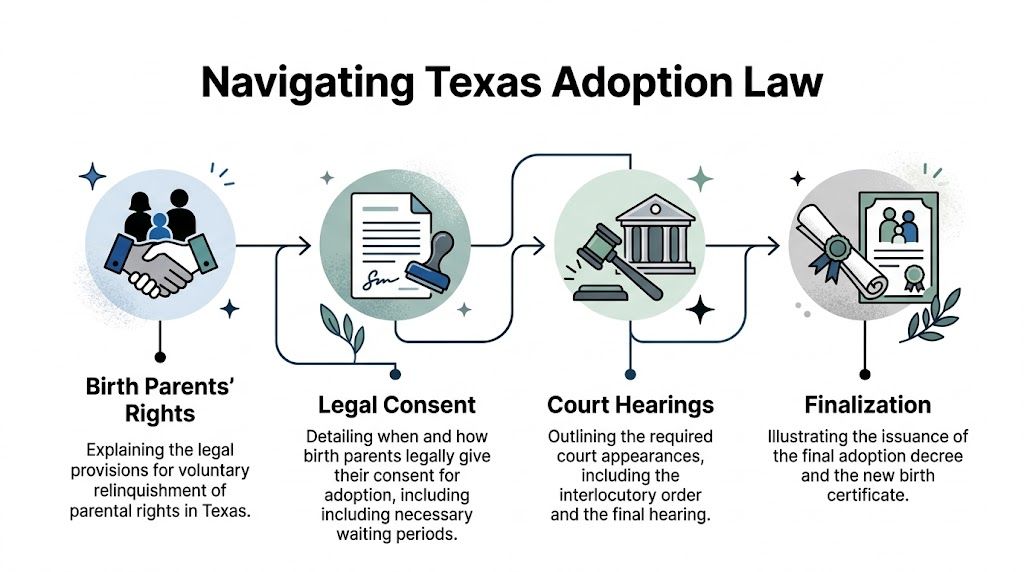
Birth parents' rights come first
Before an adoption can be finalized, the court must resolve the legal rights of the child's current parents. In a voluntary infant adoption, that usually means a birth parent signs legally valid documents relinquishing parental rights. In other cases, the court may be asked to terminate parental rights without consent if Texas law allows it.
This part often feels slow for a reason. Courts are careful here because adoption creates a new legal family by first ending an existing legal relationship. In foster care cases especially, judges must consider safety, reunification efforts, notice requirements, and whether every legal step was handled correctly before a child is legally free for adoption.
For hopeful parents, it helps to treat this stage like title work before buying a house. Everyone may agree on the goal, but the legal ownership issue still has to be cleared before the transfer is secure.
Consent is more than a signature
Families often assume that once paperwork is signed, the adoption cannot be disrupted. Texas law is more exact than that.
Consent must be signed in the form the law requires, at the proper time, and with the right formalities. A document handled incorrectly can create delays or, in rare cases, a serious challenge. That is one reason experienced legal guidance matters so much in infant adoption cases.
A few practical points make this easier to understand:
- Legal validity matters. Verbal plans, text messages, and informal promises do not replace proper consent documents.
- Timing matters. Texas has rules about when certain affidavits may be signed.
- Records matter. Judges want a clean file showing that every required step was completed properly.
Contested cases are uncommon in many private infant adoptions, but families should still prepare emotionally for uncertainty before finalization. Adoption disruptions do happen. Sometimes a match ends before placement. Sometimes a parent reconsiders before rights are terminated. Hopeful parents are not doing anything wrong when they ask direct questions about these possibilities. They are preparing wisely.
Texas courts finalize adoptions based on a complete legal record, not on good intentions alone.
Filing the adoption petition
After placement and after parental rights have been addressed, the adoptive parent or parents usually file an adoption petition asking the court to make the child their legal child.
The petition package often includes the following materials:
| Filing item | Why it matters |
|---|---|
| Home study | Shows the court that the home was evaluated for safety and suitability |
| Background materials | Confirms required screenings were completed |
| Consent or TPR records | Shows that the prior parental rights issue was resolved legally |
| Post-placement reports | Helps the court assess how the child is doing in the home |
County practice can shape how smooth this stage feels. One court may want documents organized a certain way. Another may have a crowded docket and limited hearing dates. Small filing mistakes can delay a final hearing by weeks, even when everyone agrees the adoption should proceed.
Law Office of Bryan Fagan, PLLC can assist with preparing petitions, reviewing consent or TPR records, and coordinating the court steps required for finalization.
Post-placement supervision is still part of the case
Many families are surprised to learn that bringing a baby home does not end the legal process. Texas commonly requires a period of post-placement supervision before finalization. During that time, an agency or evaluator checks on the child's adjustment and prepares reports for the court.
This period serves two purposes at once. It gives the court updated information, and it gives parents time to settle into daily life with support. Feeding issues, sleep deprivation, bonding concerns, and ordinary new-parent anxiety can all surface here. That does not mean something is wrong. It means you are living real family life while the legal process continues in the background.
This stage can also raise questions about openness after placement. Texas families should understand a hard truth early. Open adoption agreements may carry strong emotional meaning, but their enforceability depends on the type of case and the legal structure behind the agreement. In many private infant adoptions, ongoing contact plans are better understood as good-faith commitments unless they are tied to a legally enforceable framework. Families should ask their attorney to explain what is legally binding, what is aspirational, and how to reduce confusion before finalization.
That conversation matters because post-placement strain is not always about court paperwork. It can also involve changed expectations about updates, visits, photos, and boundaries. Clear expectations protect relationships.
The prove-up hearing usually feels joyful and formal at the same time
Texas adoptions often end with an Adoption Prove-Up Hearing. The term sounds technical, but the hearing itself is often brief. The judge reviews the file, confirms that legal requirements were met, and signs the order finalizing the adoption.
A simple outline looks like this:
- The case is called
- The judge reviews the paperwork
- The judge or attorneys ask a few questions
- The final decree is signed
Parents often expect something tense and trial-like. In many cases, the hearing feels more like a formal blessing on a family that has already been forming day by day.
Once the decree is signed, the child becomes your legal child for all purposes under Texas law. That includes parental authority, inheritance rights, and the ability to obtain a new birth certificate through the proper records process. For many parents, that final signature brings relief as much as joy. After months of paperwork, waiting, and emotional risk, the law finally says what your heart has been saying. This is your child.
Adoption Timelines Costs and Common Challenges
You may have a nursery half planned, a folder full of paperwork, and a calendar marked with hopeful guesses. Then someone asks, "So when will the baby be home?" In Texas infant adoption, that question is often impossible to answer with precision. Parts of the process run on dates and deadlines. Other parts depend on human decisions, legal consent rules, and circumstances no family can control.

What families should expect on timing
A Texas infant adoption usually moves in stages, not in one straight line. Home study preparation, training, profile creation, matching, placement, post-placement supervision, and finalization each have their own pace. One stage may move quickly while the next takes far longer than expected.
The Texas Department of Family and Protective Services explains the basic legal framework for adoption in Texas, including the court approval and post-placement steps that must happen before an adoption is finalized, at Texas DFPS adoption information. In practical terms, families should expect waiting at more than one point in the process, not just before a match.
That distinction helps. Waiting to be chosen is one kind of stress. Waiting after placement, while required supervision and legal filings continue, is a different kind. Parents often feel relieved and anxious at the same time because the child is home, but the case is not yet fully final.
Costs work the same way. They come in layers. Agency fees, home study costs, legal fees, travel, counseling-related expenses, and post-placement requirements may arise at different points rather than all at once. Two Texas families pursuing infant adoption can spend very different amounts because their paths are different, even if both begin with the same goal.
Delays are frustrating, but they are not always a warning sign
A longer timeline does not automatically mean something is wrong. It may reflect your matching preferences, the need to gather records, scheduling with evaluators, interstate paperwork if the child is born outside Texas, or a legal issue that needs to be cleaned up before the court can finalize the case.
Court procedure often works like building a house inspection. You may feel ready to move in, but the inspector still has to confirm that each required step was completed. That review can feel slow. It also protects the final adoption from avoidable legal problems later.
The difference between a disruption and a dissolution
These terms are often blurred together, and that causes needless panic.
A disruption usually means the adoption stops before finalization, after a match has been made or after placement has begun. A dissolution is different. It refers to the legal ending of an adoption after finalization. For hopeful parents pursuing infant adoption in Texas, the more immediate concern is usually disruption, not dissolution.
That difference matters emotionally and legally. A disrupted adoption can involve grief, financial questions, and uncertainty about what happens next. A dissolution raises a very different set of legal and family issues because the adoptive relationship was already finalized.
The Child Welfare Information Gateway discusses disruption and dissolution as separate events with different causes and consequences in its adoption support materials at Child Welfare Information Gateway adoption disruption and dissolution resources.
If a match falls through
A failed match can feel like a sudden silence after months of planning. Families may have told relatives, arranged leave from work, bought baby supplies, or started picturing daily life with a child who never comes home. That grief is real.
A careful response usually includes:
- Pause before making major changes: Shock can push parents to switch professionals or change adoption preferences before they understand what happened.
- Review the fee agreement line by line: Ask what is refundable, what may be credited to a future match, and what new expenses could arise if you continue.
- Get legal clarity quickly: If living expenses, medical expenses, or consent documents were involved, your attorney should explain what Texas law allows and where your obligations stop.
- Make room for grief: Counseling, support groups, faith community support, or a few honest conversations with trusted people can help more than forcing yourself to "stay positive."
A disrupted match does not erase your hope to become a parent. It means this adoption plan did not lead to finalization.
Open adoption after placement
Many hopeful parents focus so hard on getting to placement that they do not spend enough time asking what happens after the child comes home. That can create pain later.
In Texas, open adoption agreements may reflect sincere promises about updates, photos, calls, or visits. But families should understand the legal difference between a moral commitment and a court-enforceable one. Some post-adoption contact expectations are built on trust and communication rather than on a remedy a judge will actively police. The Texas Family Code is the controlling law on adoption and termination issues, and reviewing the statute with counsel helps families understand what a court can enforce and what depends on ongoing cooperation, at Texas Family Code, Title 5.
That does not make openness unimportant. It makes clarity important. A written contact plan works like a map. It cannot force every road to stay open forever, but it helps everyone start with the same directions. Families are often better prepared for post-placement stress when they discuss practical details early, such as how often updates will be sent, who initiates contact, what happens if someone moves, and how boundaries will be handled if expectations change.
Honest preparation makes the hard parts easier to carry
Hope is stronger when it is informed.
Families cope better when they understand the difference between a match, a placement, and a final decree. They also make steadier choices when they budget for delays, ask direct questions about disruptions, and talk plainly about what openness may look like after finalization. In infant adoption Texas families often need both things at once. A clear view of the legal process and compassion for the emotional weight of the wait.
Special Considerations for Your Unique Family
A family can begin in more than one way. In Texas, the court looks at whether the adoption serves the child’s best interests and whether the legal requirements are met. That gives many families room to move forward with confidence, even if their path looks different from someone else’s.
LGBTQIA+ parents and single parents
If you are a single parent or part of an LGBTQIA+ couple, you may carry an extra layer of worry into the process. That feeling is understandable. Many hopeful parents are not just asking, “What does the law require?” They are also asking, “Will people treat us fairly?”
The strongest answer is preparation. Home studies and placement decisions usually focus on the same core questions for every adoptive parent. Can you provide a safe home? Do you have stable income or a workable financial plan? Who is in your support system? How will you care for a baby during work hours, illness, or emergencies?
A single parent often benefits from showing the court and the agency a clear backup plan. An LGBTQIA+ couple often benefits from presenting a steady, honest picture of family life and discussing how they will talk with a child about identity and origin over time. Those conversations matter because adoption is not only a legal event. It is a lifelong family story.
That story can become more complicated if a placement changes course. A disrupted match can hit unique-family households especially hard when they have already spent months explaining themselves, preparing their home, and answering personal questions. If that happens, treat the disruption like a legal and emotional injury that needs care on both fronts. Ask what fees can be credited, what records you should keep, and what support you need before accepting another opportunity.
Stepparent and relative adoptions
Some infant adoptions start with an existing bond. A stepparent may already be parenting the child day to day. A grandparent, aunt, uncle, or other relative may already be providing a stable home.
That can shorten part of the process because there may be no matching stage. The case can still turn on serious legal questions, especially consent and the termination of another parent’s rights. A relative adoption can feel simple because everyone knows one another. Legally, it is still like building a house on a foundation. If one required step is skipped, the structure is less secure.
These cases also carry emotional pressure that families do not always expect. A relative may hope adoption will solve years of conflict. Sometimes it helps. Sometimes it brings old disagreements into sharper focus, especially around future contact, holidays, and decision-making. Clear expectations help here, too.
If your relative adoption will continue some contact with a birth parent after finalization, ask direct questions early about what is legally enforceable in Texas and what depends on ongoing cooperation. Families often feel calmer when they know the difference before emotions rise.
Foster and kinship considerations
For some families, infant adoption Texas overlaps with CPS or kinship care. In those situations, adoption may come after a period of temporary caregiving, court review, and uncertainty about whether reunification will remain the goal.
That history matters.
Kinship caregivers often step in fast, with very little time to prepare. They may need to shift from “I’m helping for now” to “I may become this child’s permanent parent.” That emotional change can be harder than people expect. It is one thing to love a child and keep them safe. It is another to accept the weight of a permanent legal role while family relationships are under strain.
Practical preparation helps steady the ground. If you are caring for an infant during that transition, a list of essential baby items can help you cover daily needs while the legal questions are still unfolding.
Kinship and foster-related adoptions also raise post-placement concerns that deserve attention. A child may have ongoing relationships with siblings, grandparents, or a parent whose rights were terminated. Some contact plans work well because the adults communicate consistently and keep the child’s needs first. Others break down when grief, conflict, or safety concerns change the picture. In Texas, that is why families should ask not only, “What do we hope will happen?” but also, “What can a court enforce if contact stops or becomes harmful?”
Your family may be unique. The need for clarity is not. A careful legal plan, honest expectations about disruption risk, and a realistic view of post-adoption contact can make this path feel more manageable and much less lonely.
From Hopeful Parent to a Family Forever
A Texas adoption doesn't become meaningful only when the judge signs the final order. It becomes meaningful much earlier. In the home study conversations. In the waiting. In the hard talks about openness, boundaries, and what it means to place a child's needs first.
After placement, many families spend the supervision period learning ordinary routines. Feeding schedules, doctor visits, nighttime wakeups, and the first sense that this child is settling into the home. Around that time, practical preparation matters too. If you're getting ready for those early weeks, a simple checklist of essential baby items can help you focus on what you need.
The legal work in Chapters 162 through 166 exists to protect everyone involved, especially the child. When the process is handled carefully, finalization isn't just the end of a case. It's the court's recognition of a family that has been built with intention, patience, and love.
If you're considering infant adoption, facing a failed match, wondering about open adoption contact, or preparing for finalization, compassionate legal guidance can make the path feel much more manageable.
If you'd like legal guidance suited to your adoption path, schedule a free consultation with Law Office of Bryan Fagan, PLLC. A thoughtful conversation can help you understand your options, protect your rights, and move forward with clarity.
