
If you're searching for newborn adoption texas, there's a good chance you're holding two emotions at once. Hope, because you're thinking about welcoming a baby into your family. Fear, because the process can feel very personal and legally complicated at the same time.
That mix is normal.
A newborn adoption in Texas isn't one single form or court hearing. It's a series of decisions, relationships, and legal steps that all need careful attention. Some families are just starting to ask whether they qualify. Others are already speaking with an agency, an attorney, or an expectant mother. Some birth parents are trying to understand what their choices really mean. Wherever you are, clear information helps.
Texas law focuses on the best interests of the child. That idea runs through the Texas Family Code, especially Chapters 162 through 166, which govern adoption, consent, records, and related procedures. In practical terms, that means the court wants to see that the placement is safe, lawful, and stable, and that every parent's rights have been handled correctly before an adoption is finalized.
Adoption is also far from unusual. Nationally, one in 35 children in the United States is adopted, and at least 85% of these children are described by their adoptive families as being in "excellent" or "very good" health, according to the National Survey of Adoptive Parents, as summarized by Angela Adoption's adoption statistics overview. For many families, adoption becomes a healthy, joyful way to build a permanent home.
Your First Steps on the Texas Adoption Path
Most hopeful parents want to know one thing first. Can we adopt?
In Texas, the starting requirements for a private newborn adoption are straightforward in plain English. You must be at least 21, financially stable, and prepared to complete background and child abuse checks. The state also requires a home study, which is a formal review of your household and readiness to parent.

Texas law doesn't limit adoption only to one type of family. Married couples, single adults, relatives, and many other family structures may pursue adoption if they meet the legal standards and the court finds the placement serves the child well. In many cases, the issue isn't fitting a narrow mold. It's showing that your home is safe, stable, and ready.
What Texas Family Code means in daily life
Chapter 162 is the heart of Texas adoption law. It covers who may adopt, what must be filed, and what the court must decide before finalization. It also ties adoption to the legal termination of prior parental rights, which becomes especially important in newborn placements.
Chapter 161 often comes up alongside these rules because it addresses termination of parental rights. In a newborn adoption, the court can't grant the adoption until the child's legal status is clear. That's why families often hear about relinquishment documents, affidavits, and court orders early in the process.
Practical rule: Adoption isn't only about bringing a baby home. It's about making sure every legal step is done in the right order so your child's status is secure.
Agency adoption or private adoption
One of the first major decisions is whether you'll work through a licensed agency or pursue a private adoption with attorney guidance.
A licensed agency often provides structure. It may help with screening, education, matching, communication plans, and post-placement coordination. That can feel reassuring for families who want a guided process from beginning to end.
A private adoption can feel more direct. In some situations, an expectant mother already knows the family, or she may prefer a more personal connection outside a larger agency system. Private adoption can also give families more flexibility in how communication and planning unfold, but it still requires strict legal compliance.
A simple comparison helps:
| Path | Often feels like | Common benefit | Common challenge |
|---|---|---|---|
| Agency adoption | Structured and guided | More built-in support | Less direct control over some parts of the match process |
| Private adoption | Personal and relationship-driven | More direct communication in some cases | Requires close legal oversight from the start |
Consider two examples.
A couple in Houston may choose an agency because they want education classes, matching help, and support at the hospital. A single hopeful parent in Austin may pursue a private adoption because a family friend has approached her directly about adopting a baby. Both paths can be valid. The right choice depends on how the connection began, how much support you want, and whether everyone has independent legal guidance.
Why a lawyer matters early
In newborn adoption texas cases, timing matters. Consent documents, notice to a possible birth father, hospital planning, interstate issues, and final court filings can all affect whether the process moves smoothly. A lawyer helps you spot problems before they turn into delays.
That doesn't mean a lawyer replaces an agency or counselor. It means someone is watching the legal framework while you focus on the human side of the adoption.
Here are the first steps many families take:
- Choose your path: Decide whether you're exploring agency adoption, private adoption, or a relative placement.
- Gather basic records: Identification, financial documents, health information, and household details often come up early.
- Schedule legal guidance: An adoption attorney can explain likely timelines, required filings, and any issues specific to your family.
- Prepare for the home study: Even loving, capable parents usually feel nervous about it. That's normal.
- Learn the emotional side too: Newborn adoption involves birth parents, hospital planning, and expectations about future contact.
If you're still at the starting line, a focused guide on how to start the adoption process in Texas can help you organize those first decisions.
The families who feel most steady aren't always the ones with the easiest path. They're often the ones who asked clear questions early and built the right support around them.
The Home Study and Finding Your Match
You have filled out forms, gathered records, and told a few trusted people about your plan. Then a social worker is scheduled to come to your home. For many hopeful Texas parents, that is the moment the process stops feeling abstract and becomes concrete. The questions get more personal. The timeline feels less theoretical. It is also the stage where many families worry about the wrong things.

A home study works like a licensing review for a future adoptive home. Under Texas law, a social study is part of the adoption process because the court needs a clearer picture of the home, the adults, and the support around the child. The goal is practical. Is the home safe? Are the caregivers honest and prepared? Is this placement likely to serve the child's best interest?
The review usually includes interviews, background information, financial and health records, and a visit to the home. Texas courts and practitioners often treat this as a full-family assessment, not a paperwork exercise. The Texas adoption information published by Texas Law Help explains the legal framework in plain language, including the court's role and the need for a social study in many cases.
A point that surprises parents is that the evaluator is not only sizing up the adults. The evaluator is trying to understand the daily life of the household. If you already have children at home, their routines, adjustment, and understanding of adoption may come up too. That can feel intrusive at first. In practice, it usually feels more like a careful conversation than an interrogation.
Consider a common example. A Texas couple pursuing newborn adoption may spend days worrying about scuffed baseboards, an unfinished nursery, or whether they gave the "right" answer about discipline. Then the meeting happens. The social worker asks about work schedules, childcare plans, marriage or relationship history, extended family support, medical issues, and what the couple understands about open adoption. She checks smoke detectors, sleeping arrangements, and general safety. She is trying to see whether real life in this home can hold a child well.
That difference matters.
Families often assume the home study rewards polish. It rewards candor and preparation. A parent who says, "We are still learning how much openness may be best, and we want guidance on that," often presents better than a parent who tries to sound flawless. Judges and evaluators know that adoption involves adjustment. They want to see that you can ask questions, accept guidance, and put a child's needs ahead of appearances.
A few misunderstandings cause unnecessary stress:
- "The house must look perfect." The standard is safety and suitability, not showroom quality.
- "We need every baby item in place." A reasonable plan matters more than a fully decorated nursery.
- "Nervousness means we are doing badly." Anxiety is common, especially for first-time adoptive parents.
- "The evaluator is trying to catch us in a mistake." The questions are meant to assess stability, parenting approach, and support.
Many families feel calmer after reviewing a practical adoption home study checklist for Texas families before the first visit.
The home study asks a simple legal question in a very human setting. Can this home provide safety, stability, and care for a child?
After approval, the process shifts from evaluation to waiting for a match. That wait can feel strange because nothing may appear to be happening on the outside while a great deal is changing underneath. Your profile may be circulating through an agency. An attorney may be fielding possible situations. An expectant mother may be reading about your family while making one of the hardest decisions of her life.
The waiting period is not just administrative. It is emotional triage. Some situations move quickly and then stop. Some never become a fit. Some lead to long conversations about hoped-for contact after birth, medical history, or how the hospital plan may work. If you are in a private adoption, those early communications need extra care. Warmth matters, but so do boundaries and honesty. Promises made in hope can become painful later if they are vague or unrealistic.
Here is a short video many families use to get a better feel for the process:
Your adoptive parent profile often plays a large role in this stage. The strongest profiles sound grounded and specific. They show daily life clearly. What does a weekend look like in your home? Who will help in the first few months? How do you talk about adoption? What kind of ongoing contact are you open to, if that becomes part of the plan? Those details help an expectant mother picture a real future, not a polished slogan.
A good match usually develops the same way trust develops in any important relationship. Slowly, openly, and with room for hard questions. Excitement has a place. So does patience.
Navigating Critical Legal Milestones
You may be standing in a hospital room with a diaper bag by your feet and legal questions running through your mind. That is a very normal place to be in a Texas newborn adoption. Families often feel joy, fear, gratitude, and caution all at once.
The legal process has an order to it. That order matters because each step builds the foundation for the next one, much like framing a house before the roof goes on.

Texas handles a large number of adoptions each year. Private newborn adoption is a recognized path here, but recognized does not mean simple. The details still matter in every case, especially around consent, parental rights, and final court approval.
Consent after birth
One rule surprises many hopeful parents. In Texas, a birth mother cannot sign an affidavit of relinquishment until at least 48 hours after the baby is born.
That short waiting period serves a real purpose. Childbirth is physically exhausting and emotionally intense. Texas law creates a pause so consent is not taken in the immediate rush of delivery and recovery.
For adoptive parents, this often helps to reframe those first two days. You may be caring for the baby and talking through hospital plans, but the legal consent timeline is separate from the emotional experience. Placement and consent are related, but they are not the same thing.
For a birth parent, this rule is a protection. It gives space to understand what is being signed and what the decision means.
Termination of parental rights
Before a Texas court can approve an adoption under Chapter 162 of the Texas Family Code, the child must be legally free for adoption. In plain terms, the rights of each legal parent must be addressed first.
Termination of parental rights works like the legal handoff that makes adoption possible. If that handoff is incomplete, finalization cannot happen, no matter how ready everyone feels.
Sometimes the process is voluntary. A parent signs the required documents after the law allows it. In other cases, things become more complicated. A father may be known but uninvolved. He may be difficult to locate. There may be disagreement about notice, identity, or intent to assert parental rights. Those facts change the legal work that has to be done.
If you want a clearer explanation of one part of this process, this guide to voluntary termination of parental rights in Texas explains how consent and court approval fit together.
A practical point matters here. Courts do not fill in missing pieces because a family has bonded with the baby. Judges look for proper notice, correct documents, and proof that Texas requirements were followed.
Revocation concerns and why precision matters
This is often the most emotionally charged part of the process. Adoptive parents may ask, "Can a birth parent change their mind?" Birth parents may ask, "What exactly am I agreeing to, and can it be undone?"
The answer depends on the document itself, the wording, the timing, and whether the signing process complied with Texas law. Small mistakes can create large problems later. A missing form, a signature taken too early, or incomplete notice to a father can delay the case or open the door to litigation.
That is why careful legal drafting matters so much in newborn adoptions. Good legal work is not cold or technical for its own sake. It protects everyone involved by making the record clear, complete, and defensible.
Post-placement supervision and finalization
After placement, Texas law requires post-placement supervision before the adoption can be finalized. For many families, this part feels emotionally odd. Day to day, you are feeding the baby at 3 a.m., learning cries, and settling into parenthood. Legally, though, the court still has one more stage to review.
Under the Texas Family Code, a court generally may not grant an adoption until the child has lived with the petitioner for at least six months, unless a statutory exception applies. During that period, a professional involved in the case checks on the child and the home and prepares information for the court. You can review the statute itself in the Texas Family Code, Section 162.009.
This period is less about testing whether you love your child and more about giving the court a documented picture of how the placement is going. In real life, that usually means home visits, reports, and updated paperwork.
What finalization feels like
Finalization hearings are often short. Their emotional weight is much bigger.
Many families bring grandparents, dress the baby for photos, and walk into court carrying both relief and memory. The judge reviews the file, confirms that the legal steps were completed, and signs the adoption order. At that point, the adoptive parent or parents become the child's legal parents in every sense Texas law recognizes.
Families often tell me the hearing feels less like a dramatic ending and more like a quiet exhale. The hard waiting, careful paperwork, and uncertainty finally give way to legal permanence. That does not erase the complexity of the child's story. It gives that story a stable legal home.
Understanding Timelines Costs and Modern Family Paths
You may be holding a nursery checklist in one hand and a legal pad in the other, wondering how these pieces fit together. That tension is normal. Newborn adoption in Texas asks families to prepare for a baby while also preparing for paperwork, waiting, and decisions that can feel very personal.
A good way to approach this stage is to separate three questions. How long might this take. What expenses may come up. How will Texas law apply to your family.
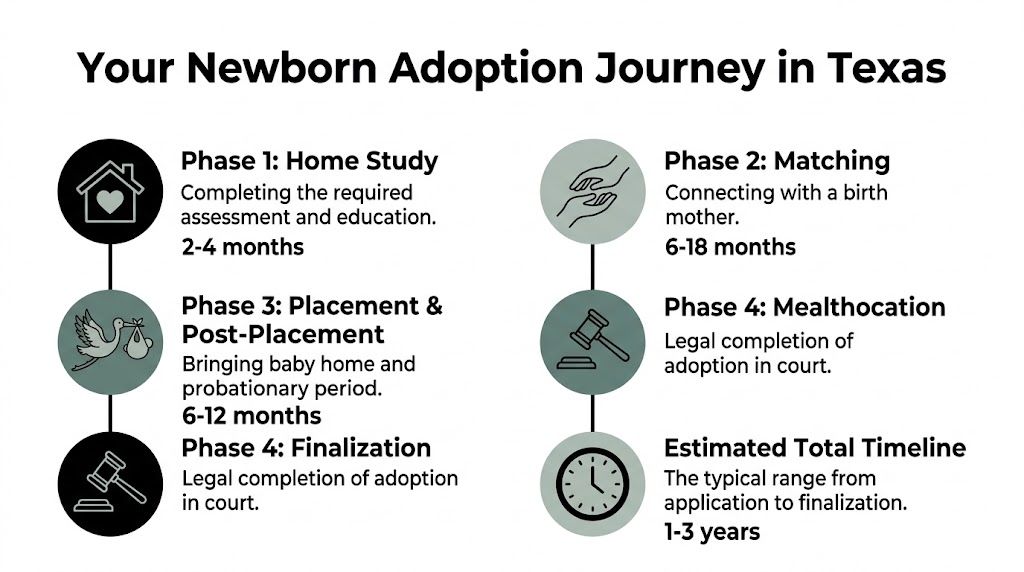
The timeline image above is a planning tool, not a promise. Adoption often works like air travel with a baby on board. You may have a clear itinerary, then a delay, a gate change, or an unexpected wait. The destination can still be the same, but your calendar may not unfold in a straight line.
What costs usually include
Private newborn adoption usually involves several separate expenses instead of one all-inclusive price. Families often pay for legal services, the home study, agency work if an agency is involved, document preparation, court filings, and post-placement supervision. In some cases, there may also be approved adoption-related expenses connected to the expectant parent's pregnancy or recovery, depending on what the law allows and how the case is structured.
Because fee arrangements vary, ask each professional for a written breakdown early. That one step can prevent a great deal of stress later. It helps you see which charges are flat fees, which depend on how the case develops, and which costs might arise only if there is an interstate issue or a delay.
| Category | What it may cover |
|---|---|
| Legal fees | Petitions, consents, court filings, termination-related work, finalization |
| Home study | Evaluation, interviews, updates if needed |
| Agency services | Matching support, counseling coordination, profile presentation |
| Adoption-related expenses | Certain approved expenses connected to the adoption process |
| Post-placement work | Supervisory visits and reports before finalization |
One practical tip that gets overlooked is to budget for ordinary newborn life at the same time you budget for the adoption itself. Formula, diapers, missed work, travel, and a short notice hotel stay can affect the first weeks home just as much as legal invoices. For day-to-day baby planning, some families also find it helpful to review resources on understanding newborn feeding schedules.
How long the process may take
There is no single Texas timeline that fits every private newborn adoption. Some families are matched quickly after the home study is approved. Others wait much longer because the match takes time, an expectant parent's plan changes, interstate approval is required, or a birth father issue needs to be addressed carefully.
The Texas Department of Family and Protective Services explains the adoption process in broad terms, including evaluation, placement, supervision, and court approval, in its adoption materials at Texas DFPS. For private newborn cases, the lived experience is often less like checking off boxes and more like managing phases that overlap. Paperwork may be complete while matching is still open. A baby may be born before every practical detail is settled. Interstate clearance may keep you away from home during days when you expected to be introducing your child to family.
That is why I encourage parents to plan in layers. Have a legal timeline, a work-leave timeline, and a real-life timeline for travel, childcare for other children, and lodging if the birth happens out of state. When those layers are in place, delays feel less like chaos and more like something you prepared to handle.
LGBTQ+ couples and single parents in Texas
Many hopeful parents privately ask a harder question underneath the legal one. Will the system see us as a real family.
Texas courts focus on the child's best interests and whether the legal requirements have been met. The practical concerns are straightforward. Is the home study complete. Is the placement legally supported. Are the necessary consents and court filings in order. Can this home provide safety, stability, and care for the child.
That does not mean every family has the same experience. LGBTQ+ couples and single parents often feel more at ease working with professionals who regularly serve a wide range of family structures and can help with profile language, hospital planning, and court preparation in a respectful way. The Law Office of Bryan Fagan, PLLC handles adoption matters in Texas, including family structures such as single-parent and LGBTQIA+ adoptions, along with the legal filings and court process that go with them.
If this is your path, ask direct questions before you hire anyone. Have you handled cases like mine. How do you prepare families for hospital contact. How do you address concerns if a birth parent or provider is unfamiliar with our family structure. Clear answers matter.
Open and closed adoption
Families also spend a lot of time thinking about contact after placement. The words sound simple, but the decision rarely feels simple.
An open adoption usually means some level of ongoing contact or information sharing between adoptive and birth families. A closed adoption means little or no direct contact. Between those two points is a wide middle ground. Some families exchange letters and photos through an agency or attorney. Some agree to periodic updates. Some build a more direct relationship over time.
The legal part is only one piece. The emotional part matters just as much. A contact plan works best when everyone understands what is being offered, what is realistic, and what serves the child over time. A promise made in a hospital room may feel comforting in the moment, but if it is vague, people can remember it differently later.
Careful conversations help. So does leaving room for the fact that feelings may change as the child grows. The healthiest plan is usually the one that is honest at the start, respectful in practice, and centered on the child's long-term well-being.
Life After Finalization and Your Questions Answered
Finalization is a joyful legal milestone. It isn't the end of the adjustment.
Many families find themselves surprised. The paperwork is done, relatives are celebrating, and everyone expects life to feel settled right away. But newborn adoption creates new routines, new emotions, and sometimes new questions about identity, bonding, and contact with birth family members. Parents may also be physically exhausted, especially in the first weeks home.
One issue doesn't get enough attention in private adoptions. A significant gap exists in post-adoption support for private adoptions, and many Texas families are unaware of or hesitant to use state-contracted services after finalization because of information gaps and fear of government involvement, even though resources like subsidies and Medicaid may be available, as discussed by American Adoptions in its Texas adoption resource. That matters because families often need support after the court date, not just before it.
Why post-adoption support matters
Support doesn't mean something has gone wrong. It means your family is adjusting to a major life change.
Some parents need help navigating sleep deprivation, feeding concerns, or return-to-work planning. Others need guidance on how to talk about adoption from the beginning in age-appropriate ways. Birth parents may also need ongoing counseling and respectful communication structures, especially in open adoption situations.
For daily newborn care, practical tools can make the first weeks less overwhelming. Families sometimes benefit from outside resources on basics like understanding newborn feeding schedules because adoption doesn't change the reality that a new baby brings round-the-clock needs.
The healthiest adoptive families often ask for help early, before stress turns into isolation.
Questions families ask after placement and finalization
What if we live in Texas but the birth mother is in another state
That usually means the Interstate Compact on the Placement of Children, often called ICPC, may apply. In simple terms, both states must approve the placement before the child can be taken across state lines.
That can affect travel, hotel stays, and time away from work. Families should plan carefully and avoid making assumptions about when they can return home. The legal team usually coordinates documents, but the emotional part still falls on the family. You're caring for a newborn in an unfamiliar place while waiting for permission to travel.
What if the birth father is unknown or won't cooperate
Texas courts still require this issue to be addressed. The exact approach depends on the facts. The court may need evidence about identity, notice efforts, registration issues, or whether legal grounds exist to terminate rights.
This is one area where families get into trouble by relying on guesswork. A statement like "he isn't involved" may describe the relationship, but it doesn't automatically resolve the legal issue. The court needs proper procedure, not assumptions.
Are open adoption agreements enforceable in Texas
Families often use the phrase Post-Adoption Contact Agreement to describe expectations about photos, updates, or visits after finalization. In practical life, these agreements can be meaningful and helpful when everyone enters them with good faith.
The legal enforceability question is more nuanced and depends on the type of case and how the agreement is structured. Because expectations about contact can affect trust long after finalization, families should put those discussions in writing where appropriate and get legal advice before relying on any promise as binding.
What if we're struggling to bond right away
That can happen, and it doesn't mean you aren't meant to be a parent.
Some adoptive parents feel immediate attachment. Others feel protective but emotionally numb at first because the process has been stressful, uncertain, or exhausting. Bonding often grows through ordinary care. Feeding, rocking, diaper changes, medical appointments, and the rhythm of showing up day after day.
Should we tell our child about the adoption early
Most professionals and experienced adoptive families encourage talking about adoption early and naturally. The goal isn't one big reveal later. It's building a family story your child grows up knowing.
That usually sounds simple at first. "We were so happy when you joined our family." Over time, the language becomes more detailed and age-appropriate. Honesty, kindness, and consistency matter more than having perfect words.
A steady way forward
The legal process matters because it gives your family security. The emotional process matters because it gives your child roots.
If you're considering newborn adoption texas, try not to measure your progress only by dates on a calendar. Measure it by whether you're building a lawful, honest, supported path for the child at the center of the case. That is what Texas courts care about. It's also what helps families remain steady after the excitement of finalization fades and everyday parenting begins.
If you're thinking about adoption, or you're already in the middle of a match, hospital plan, consent question, or finalization process, legal guidance can bring calm to a very emotional time. The Law Office of Bryan Fagan, PLLC helps Texas families understand adoption law, prepare required filings, and move through each step with clarity and compassion. You can schedule a free consultation to talk through your situation and get practical guidance for the road ahead.
