
If you're reading this, you may already be doing what many hopeful parents do late at night. Searching terms like how to adopt a baby in texas, opening ten tabs, and trying to turn a highly emotional dream into a clear legal plan.
That mix of hope and uncertainty is normal.
Some families are hoping to adopt a newborn. Some are relatives already caring for a baby and wanting to make that bond permanent. Some are foster parents wondering whether the child in their home may become their son or daughter in every legal sense. Others are birth parents looking for a safe, loving plan and wanting to understand what Texas law requires.
Texas adoption law gives families several paths forward, but the process can feel heavy at first because every step is designed around one central question. What is in the child's best interest? That principle runs through the Texas Family Code, especially Chapters 162 through 166, and it affects everything from home studies to consent forms to the final court hearing.
A good adoption plan isn't just about paperwork. It's about timing, trust, informed consent, and building a stable home for a child. When families understand the legal milestones in plain English, the process becomes much easier to carry.
Choosing Your Adoption Path in Texas
Most families begin with one practical question. Which kind of adoption fits our situation? In Texas, that answer usually falls into three paths for families hoping to welcome a baby or young child into their home.
Some parents work through a licensed agency. Others complete an independent or private adoption with legal help from attorneys and professionals. Others come to adoption through the foster care system, often after caring for a child who needs permanency.
Each path can lead to the same final result. A court order that creates a permanent legal parent-child relationship. But the road to get there looks different.
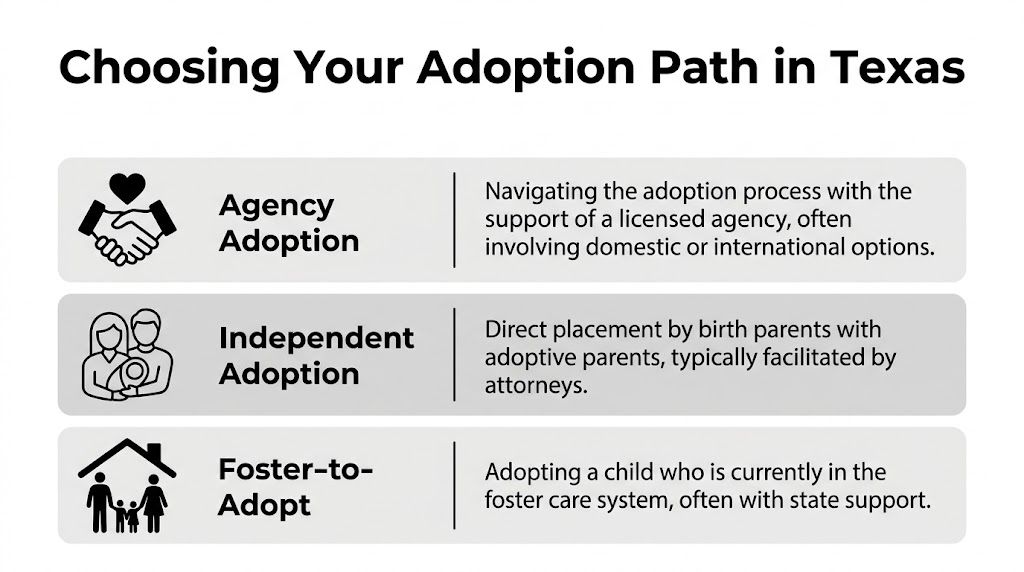
Three paths that families often compare
Agency adoption usually offers more structure. A licensed agency often helps with screening, education, matching, counseling, placement support, and post-placement supervision. This can feel reassuring for families who want a team helping them through each phase.
Private attorney adoption is often more direct. In many cases, birth parents and adoptive parents connect through personal networks, professionals, or adoption outreach, and attorneys handle the legal side. This route can provide more flexibility, but it also requires careful attention to compliance with Texas law.
Foster-to-adopt works differently from infant adoption planning. The child is already in state care, and the legal system first prioritizes safety, reunification when appropriate, and then permanency. Some babies do enter foster care, but families should understand that foster care is not a newborn matching program. It is a child welfare system.
Practical rule: Choose the path that fits your family's emotional readiness, not just the path that sounds fastest.
Texas families often ask whether foster care adoption is common. It is an important part of adoption in this state. In fiscal year 2021, 4,586 children were adopted through DFPS, and relatives adopted more than half of these children according to Texas adoption statistics and requirements. That matters because many adoptions in Texas grow out of existing family relationships, not only traditional infant matches.
Texas infant adoption pathways at a glance
| Factor | Private Attorney Adoption | Licensed Agency Adoption | Foster Care (DFPS) Adoption |
|---|---|---|---|
| How the process starts | Usually through a private match or planned placement | Application with a licensed agency | Orientation and state or agency approval process |
| Who helps manage the case | Attorneys and other required professionals | Agency staff, social workers, and attorneys | DFPS, approved agencies, caseworkers, and attorneys |
| Birth parent contact | Can vary from limited to ongoing, depending on the plan | Can vary from closed to open, depending on the plan | Usually depends on the child’s case history and court orders |
| Best fit for | Families wanting a direct, customized legal path | Families wanting more structure and support | Families open to children in care and the realities of the child welfare system |
| Main emotional challenge | Uncertainty around matching and consent | Waiting and matching decisions within agency systems | Living with the uncertainty of reunification and court timelines |
| Common legal focus | Consent, paperwork, placement, and court approval | Agency compliance, placement, supervision, and finalization | CPS history, termination of rights, placement stability, and finalization |
A private adoption and an agency adoption can both involve a newborn. The biggest difference is often who is coordinating the relationship and the steps. In either path, Texas law still requires the legal pieces to be done carefully.
Open, semi-open, and more private arrangements
Families also get confused about communication after placement. Texas law allows different levels of openness, but the practical details depend on the people involved and the professionals guiding the case.
A family working with an agency may exchange updates, letters, and photos through the agency. In a more open private adoption, birth parents and adoptive parents may talk directly before and after birth. In other cases, contact is limited.
There isn't one emotionally correct model for everyone. What matters is that expectations are discussed early, respectfully, and openly.
A simple way to decide
If you're still unsure which route to take, think about these questions:
- Do you want structured support: A licensed agency may feel steadier if you want education, matching help, and social work oversight in one place.
- Do you already know the birth parent or a possible placement: A private adoption may be the more natural legal path.
- Are you already caring for a child in your family or through foster care: Kinship or foster-related adoption may be the most direct route to permanency.
- How much uncertainty can your household manage: Every adoption has unknowns, but each path carries different emotional pressure points.
Families comparing these options often find it helpful to review the broader types of adoption in Texas before deciding.
The Texas Adoption Journey Step by Step
Once a family chooses a path, the process starts to feel more real. You stop asking, "Could we adopt?" and start asking, "What happens first?"
For many people, the first big hurdle is the home study. It sounds intimidating, but it isn't a test that expects perfection. It's an evaluation meant to help professionals and the court decide whether your home is safe, stable, and ready for a child.

The home study
In plain language, a home study is a closer look at your family life. A licensed professional gathers background information, interviews household members, checks the home environment, and prepares a report for the court or agency.
For private domestic infant adoptions in Texas, that process often includes criminal background checks, child abuse clearances, home safety review, interviews with adults in the home, references, medical information, and financial documentation. Texas families are often relieved to learn that the goal is not wealth. The goal is stability and honesty.
Over 90% of qualified families who complete the home study successfully achieve placement, and Texas law also requires a 48-hour waiting period after birth before a birth mother can sign relinquishment papers, followed by a six-month post-placement supervision period before finalization, according to this Texas adoption process overview.
Here are the parts of a home study that often worry families most:
- Background checks: Adults in the household should expect criminal and abuse history screening.
- Home safety review: The professional isn't looking for a magazine-perfect house. They are checking for safety, sleeping arrangements, and general stability.
- Interviews: Expect questions about your childhood, marriage or relationship history, discipline views, support system, and reasons for adopting.
- Paperwork: Delays often happen here, not because a family is unfit, but because documents are missing or outdated.
A home study is less about judging you and more about documenting that a child will have a safe, prepared home.
Consent and termination of parental rights
This is the legal heart of adoption. Before an adoption can be finalized, the court must have lawful consent or a proper court order terminating parental rights.
For a newborn adoption, birth parent consent must follow Texas rules. The waiting period after birth is important because it protects against rushed decisions during an emotional and physically demanding time. In attorney and agency cases, the legal forms must be handled carefully, with proper timing and proper filing.
In other adoptions, such as stepparent, kinship, or CPS cases, the issue may be whether one or both biological parents agree, cannot be found, or must have their rights terminated by court order. This is one reason Chapter 161 and the adoption chapters of the Texas Family Code matter so much in practice. Adoption does more than create a new legal relationship. It usually requires the court to clearly resolve the old one first.
Placement and supervision
After placement, many families assume the final court date comes right away. In Texas, it usually doesn't.
The court generally wants to see that the child is adjusting well in the home and that the placement is stable. That is why post-placement supervision exists. During this period, a social worker or agency representative may visit, ask questions, and prepare reports.
Some parents feel nervous about these visits, but they are usually much calmer than expected. The worker may ask about feeding, sleeping, bonding, medical care, and how everyone in the home is adjusting to the new routine.
A short video can help make that legal process feel more concrete:
Finalization in court
Finalization day is often one of the happiest days in family court. This is when the judge reviews the case, confirms that the legal requirements have been met, and signs the adoption decree.
At that moment, the adoptive parent becomes the child's legal parent under Texas law, with the same rights and responsibilities as any other parent. That includes decision-making, inheritance rights, and the full legal recognition of the parent-child relationship.
A typical finalization process includes:
- Filing the petition with the correct Texas court.
- Submitting supporting documents such as the home study, consents, termination orders, and post-placement materials.
- Attending the court hearing where the judge reviews whether the adoption is in the child's best interest.
- Receiving the signed decree that finalizes the adoption.
Families wanting a fuller legal roadmap often review the Texas adoption process step by step before starting.
Understanding Adoption Timelines and Financial Costs
Two questions tend to sit in the background of every adoption conversation. How long will this take? And, what are we really going to spend?
The honest answer is that timelines and costs depend heavily on the path you choose. A private infant adoption, a licensed agency case, a kinship placement, and a CPS-related adoption can all look very different. The legal steps may overlap, but the waiting points don't.
Why timelines vary so much
In a private domestic infant adoption, one family may move quickly from home study to match and placement. Another may wait much longer for the right situation. In foster care, the wait is shaped by court proceedings, the child's case status, and whether reunification remains the goal.
The six-month post-placement period is one reason finalization doesn't happen immediately, even after a baby is placed in your home. Families sometimes think placement means the case is nearly over. Legally, it means you have entered the next phase.
One issue many families don't expect is interstate delay. If a child is born in Texas and the adoptive parents live in another state, the placement usually must comply with the Interstate Compact on the Placement of Children, often called ICPC.
The ICPC delay many families don't plan for
Standard guidance often mentions a short ICPC wait. But recent delay issues have made this part of the process harder for some out-of-state families. While standard guides cite a 7 to 10 day ICPC clearance, 2025 data states that Texas DFPS processing slowed to 14 to 21 days, and that can add $5,000 to $15,000 in unexpected travel and living costs for out-of-state families waiting to take their baby home, according to this discussion of the Texas adoption process and ICPC delays.
That doesn't mean out-of-state adoptions are impossible. It means families should plan for a longer stay in Texas if the child is born here.
Planning note: If your adoption may cross state lines, budget for extra lodging, meals, missed work, and newborn care during the ICPC waiting period.
What costs usually include
Even without listing exact fees, it helps to know the categories that often shape an adoption budget:
- Legal fees: Drafting documents, handling consent issues, filing court pleadings, and appearing at finalization.
- Agency fees: In agency cases, these may cover matching services, education, counseling, and supervision.
- Home study costs: A licensed professional must complete and approve the study.
- Court costs: Filing and final decree expenses may apply.
- Travel and lodging: Especially important in interstate placements.
- Birth-parent-related lawful expenses: In some situations, Texas law allows certain support expenses if handled correctly and transparently.
The right budget isn't just financial. It's emotional. Waiting costs something too. So does uncertainty. Families do better when they leave room for both.
A realistic way to prepare
A useful starting point is to build a written plan with three columns: likely costs, possible delays, and support resources. That support may include savings, employer adoption benefits, tax planning, extended family help, or grants offered by private organizations.
The families who feel steadier during adoption aren't always the families with the biggest budget. They're often the families who prepared for the process to change shape.
If timing is your biggest concern, review how long adoption can take in Texas and compare it with your family's work schedule, child care plans, and leave options.
Adoption for Every Texas Family
Texas families don't all arrive at adoption in the same way. One child may already call you Mom. Another may be your grandson, niece, or younger sibling in every practical sense except on paper. Another child may come into your home through foster care, where love grows while the court process is still unfolding.
The law has room for these different stories.

When a stepparent wants to make it official
A common Texas scenario looks like this. A child has lived for years with a parent and stepparent. The stepparent handles school pickup, bedtime, doctor visits, and the thousand ordinary acts that make a family. At some point, the question becomes legal as well as emotional. Should the stepparent adopt?
In many stepparent adoptions, one biological parent remains the legal parent and the other parent's rights must be addressed before the adoption can proceed. If the absent parent agrees, the process may be simpler. If not, the court may need evidence and a hearing before rights can be terminated.
These cases are often very personal. The legal paperwork matters, but so does the child's sense of identity and stability.
Kinship adoption and relative caregivers
Another common story starts in a family crisis. A grandmother begins caring for a baby after a difficult period in the parents' lives. An aunt takes in her nephew. An older sibling steps into a caregiving role. At first, everyone says the arrangement is temporary. Over time, it becomes clear that the child needs permanence.
Texas strongly reflects the importance of kinship care. For CPS-related adoption paths, Texas requires 20 to 40 hours of trauma-informed training, the wait can be 2 to 5 years due to reunification priorities, 70 to 80% of foster placements with families who want to adopt are eventually finalized, and kinship adoptions often proceed 85% faster, according to this guide to the adoption process in Texas.
That last point matters. Relative adoptions can sometimes move more smoothly because the child already knows the caregiver, and the court can see an existing bond.
When a child is already safe with a grandparent, aunt, uncle, or other relative, the law often focuses on turning an informal caregiving relationship into a permanent legal one.
LGBTQ+ parents and single parents
Many hopeful parents ask a version of the same question. "Will Texas law let me adopt if I'm single?" "Can we adopt as a same-sex couple?" In practice, Texas families come in many forms, and the legal process is about fitness, compliance, and the child's best interests.
Single adults may adopt. Couples may adopt if they meet the legal requirements of their case. What often matters most is being organized, transparent, and ready to show the court a stable home.
A same-sex couple in Houston may pursue a private infant adoption through an agency or attorney-guided process. A single woman in Dallas may adopt a relative's child after stepping into a caregiving role. A married couple in San Antonio may finalize the adoption of a foster child after months of supervision and hearings. These are different stories, but the legal framework is built around the same core values of safety, permanence, and best interest.
Foster parents who hope to adopt
Foster care adoption carries a unique emotional weight because the child is already part of your daily life while the legal future is still uncertain. Reunification is often the first goal in CPS cases, and that can be hard for foster parents who have bonded with a child.
Still, some placements do become forever families. Families navigating that path often work with caseworkers, child-placing agencies, and legal counsel to understand timing, parental rights, and court filings. One available resource for legal guidance on this is the Law Office of Bryan Fagan, PLLC, which assists Texas families with adoption filings, home study preparation, and court proceedings in domestic, kinship, and CPS-related cases.
Common Adoption Pitfalls and How to Prepare
The families who handle adoption stress best usually aren't the ones with a perfect process. They're the ones who expected a few bumps and prepared for them early.
One source of frustration is paperwork. Home studies, court filings, references, and background materials all depend on complete, current documents. If even one item is missing, your case may slow down for reasons that feel small but matter legally.
What delays cases most often
A simple document checklist can save weeks of stress:
- Identification documents: Keep copies of driver's licenses, marriage records, divorce decrees, and any prior court orders in one folder.
- Financial records: Gather pay stubs, tax returns, and proof of regular income so your home study provider sees a clear picture.
- Medical forms: Complete physicals and any required health statements quickly so they don't become the last missing item.
- References: Ask trusted people early, because letters often take longer than families expect.
Another common pitfall is misunderstanding what the home study is looking for. Some parents think they need to impress the evaluator. That usually backfires. The better approach is calm honesty. A stable home matters more than a polished performance.
Nearly 118,000 U.S. children were awaiting adoption from foster care in 2016, with 41% concentrated in six states including Texas, according to these foster care adoption statistics. That scale helps explain why the screening process is thorough. Courts and professionals are trying to create permanent, secure homes for vulnerable children.
Emotional setbacks need preparation too
Not every pitfall is legal. Some are emotional.
A birth parent may reconsider an adoption plan. A match may not move forward. A family may complete a home study and then wait longer than expected. Foster parents may care greatly for a child while knowing the case could still change direction.
That doesn't mean the process failed. It means adoption involves real people making life-changing decisions under pressure.
Steady advice: Build your support system before the hard moment arrives. Choose one or two trusted friends, a counselor, clergy member, or support group who can carry some of the emotional weight with you.
Red flags families can address early
Some issues don't block adoption, but they need explanation. High debt, recent instability, major relationship stress, or an unclear caregiving plan can raise questions in a home study. The answer usually isn't to hide the issue. It's to explain it clearly and show how your household manages it responsibly.
Families often benefit from early legal review because an attorney can spot avoidable problems before they grow. That may include filing errors, consent issues, missing records, or misunderstandings about notice requirements under Texas law.
Your Next Steps to Building Your Family
No two adoption stories are identical, but the first steps are often the same. Slow down, get clear on your path, and start gathering the information that turns hope into action.
For some families, that means deciding between agency, private, or foster-related adoption. For others, it means recognizing that a child already in their care needs something more permanent than an informal arrangement. Either way, the process becomes less overwhelming when you focus on one decision at a time.

A simple checklist you can start today
- Choose your likely adoption path. Write down whether you're exploring agency, private, kinship, stepparent, or foster-related adoption.
- Make a document folder. Start collecting identification, financial records, household information, and health paperwork.
- Talk as a household. Discuss openness, waiting, travel, child care, and how you want to handle uncertainty together.
- Learn the legal sequence. Home study, consent or termination, placement, supervision, and finalization all matter.
- Build emotional support. Adoption is legal, but it's also very personal. Give yourself people to lean on.
Some families also like to prepare for the emotional side of welcoming a child into their home. If you have friends or relatives supporting you through the process, a gentle resource on thoughtful gifts for expecting parents can help them show care in practical ways during waiting, placement, or those first early weeks.
A few questions families often still have
You don't need to have every answer before you ask for legal help. You just need a clear starting point.
Can we adopt if our life isn't perfect?
Yes. The law doesn't require perfection. It requires safety, stability, honesty, and a home that serves the child's best interests.
Will we have to go to court?
In most Texas adoptions, yes. The final hearing is the step where the judge signs the decree.
What if we're relatives already caring for the child?
That may open a different and sometimes more direct path, depending on the facts of your case.
What if we're overwhelmed?
That's common. Adoption involves legal rules, emotional decisions, and practical planning all at once.
If you're ready for guidance that fits your family's specific situation, schedule a free consultation with Law Office of Bryan Fagan, PLLC. Our team helps Texas families understand adoption law in plain English, prepare for home studies and court, and take the next step toward building a permanent family.
