
A birth parent may be sitting in a quiet room, staring at papers that were signed only hours or days ago, and feeling a wave of panic. The decision may have felt clear in the hospital, at an agency office, or during a hard season of life. Then the silence sets in, and the question comes fast: “Can I challenge this?”
At the same time, hopeful adoptive parents may be setting up a nursery, sharing the news with family, and letting themselves feel joy for the first time in months or years. Then a phone call changes everything. They hear that consent may be questioned, and that joy turns into fear.
Both reactions are deeply human. Adoption sits at the intersection of love, grief, hope, and law. When consent is challenged, people often feel lost because the emotional truth and the legal truth don't always move in the same direction. A person may feel regret, confusion, pressure, or heartbreak. But the court asks a different question. It asks whether the consent was legally valid.
That's why understanding your rights matters so much. If you're asking, Can Consent to Adoption Be Challenged in Court?, the short answer is yes, but only in limited situations and often under strict deadlines. Texas law places enormous value on stability for children, so the legal path is narrow. Still, narrow is not the same as nonexistent.
The Moment of Doubt After Signing Adoption Papers
One common scene starts with a birth mother who signed an affidavit and believed she was doing what was best for her child. Later, she begins replaying every conversation in her mind. Did someone rush her? Did she fully understand what “permanent” meant? Was she promised contact that now feels uncertain?

Another common scene starts with adoptive parents who have already bonded with the child. They may have gone through interviews, paperwork, home studies, and the emotional weight that comes with waiting. If they hear that the consent may be challenged, their first fear is often simple and immediate: “Could we lose this child?”
Why this moment feels so overwhelming
Adoption consent isn't just another form. It can lead to the ending of one legal parent-child relationship and the creation of another. That's why people often feel the weight of it only after the papers are signed.
For birth parents, the shock can feel like stepping off a path and realizing the bridge behind you may not be easy to cross again. For adoptive parents, it can feel like building a home while the ground underneath suddenly seems less steady.
The fear on both sides is real, even when the legal answer is uncertain.
The confusion people often have
Many people assume that if they signed while emotional, the consent can automatically be undone. Others assume that once a signature is on paper, no challenge is possible at all. Neither belief is fully accurate.
Courts look closely at how the consent was obtained, whether legal rules were followed, and when any challenge is raised. They don't treat every doubt the same way. Regret alone usually won't be enough, but fraud, duress, or serious procedural problems may open the door to a court challenge.
If you're in this situation, the most helpful first step is to slow down and separate emotion from legal grounds. Both matter. But only one decides what a judge can do.
Understanding the Power of Adoption Consent in Texas
In Texas, adoption consent carries unusual legal weight because the law is trying to protect a child's need for permanence. A child cannot thrive if every placement stays uncertain. So the law treats consent as something much more serious than a routine agreement.
What consent really means
In many cases, a birth parent signs an Affidavit of Relinquishment of Parental Rights. In plain language, that document tells the court that the parent is giving up legal parental rights so the adoption process can move forward.
Imagine a door with a lock. Before the affidavit is signed, the door may still be open. After a valid affidavit is signed, the law may treat that door as locked. In some situations, the key is gone immediately. In others, the document itself may describe whether any revocation period exists.
If you want a clearer look at what informed decision-making should look like before signing, this guide on informed consent in a Texas adoption case can help.
Why Texas courts treat finality so seriously
Texas courts don't make it easy to undo a finalized adoption. According to this discussion of contesting adoption in Texas, challenging a finalized adoption decree is exceptionally rare, Texas Family Code §162.012 generally requires challenges to be filed within six months of the decree's entry, and successful post-finalization reversals occur in fewer than 1% of cases nationwide. The same source explains that birth parents face an extremely high burden of proof.
That rule exists for a reason. Once a child has settled into a family, formed attachments, and started to rely on that home as permanent, courts become very cautious about disrupting that bond.
What this means in real life
For birth parents, this means the law won't usually revisit a valid consent just because the decision became painful later. For adoptive parents, it means the law is designed to protect permanence, but only if the process was handled correctly from the start.
A few practical points help make this clearer:
- Consent is powerful: It can set the foundation for termination of parental rights and adoption.
- Words matter: The exact language in the signed affidavit can control whether it is revocable or irrevocable.
- Procedure matters too: Even strong intentions can be undermined if the legal steps were mishandled.
Practical rule: In adoption cases, courts care deeply about both substance and process. A heartfelt decision still has to be legally valid.
Valid Legal Grounds for Challenging Consent
A court doesn't ask whether a person feels sad, conflicted, or uncertain after signing. It asks whether the consent was legally defective. That distinction can feel harsh, but it helps explain why some challenges move forward and many do not.
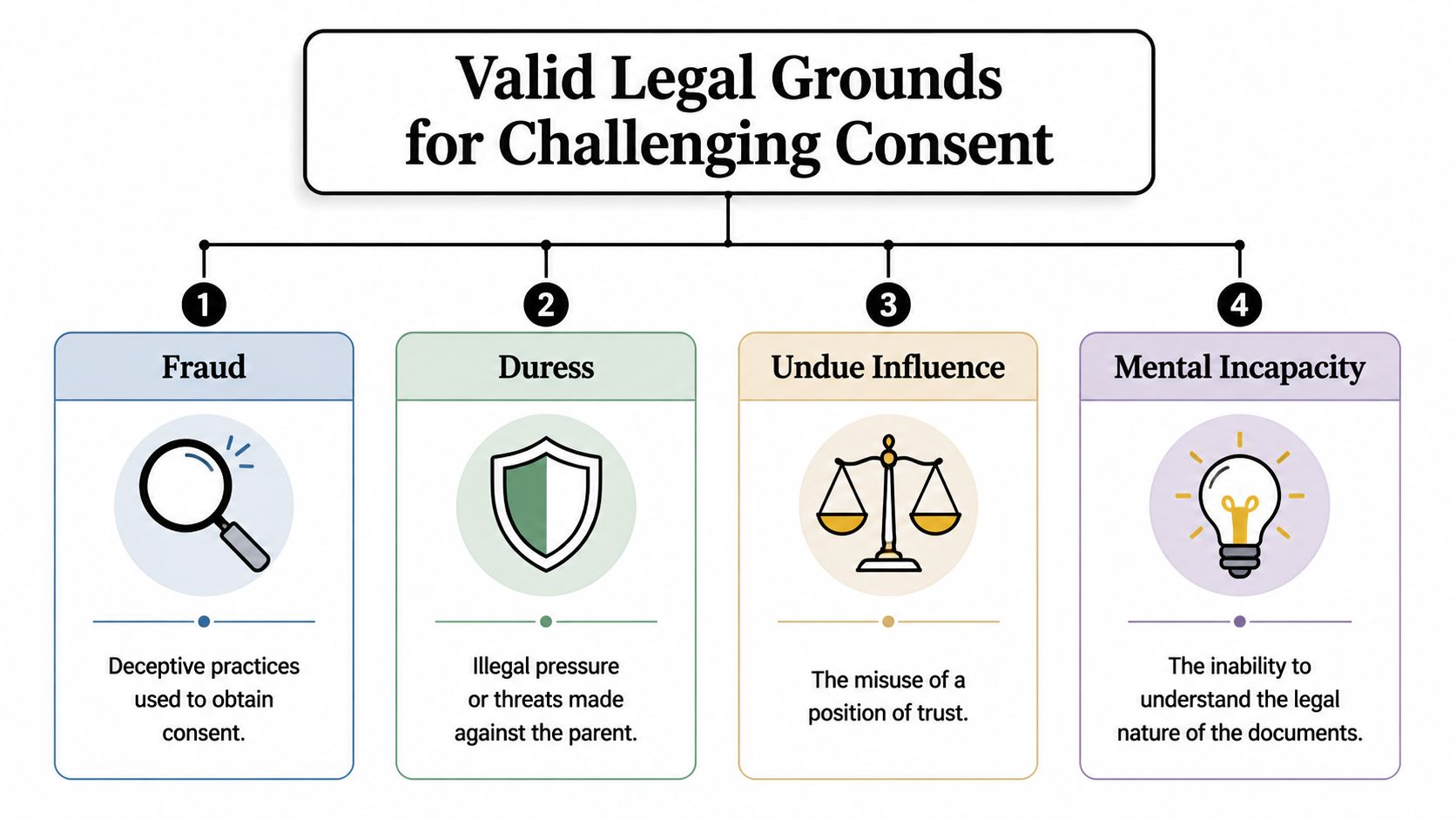
Fraud
Fraud means someone used deception to get the parent to sign. The lie has to be important, not minor.
For example, a birth parent may be told something false about what the papers mean, or may be misled about a key fact that directly influenced the decision. If that falsehood caused the consent, the court may examine whether the consent was valid.
Fraud is not the same as disappointment. If someone hoped for a certain future relationship but never had a legally enforceable promise, that may be painful without amounting to fraud.
Duress and undue pressure
Duress is stronger than ordinary pressure. Adoption decisions are emotional by nature, and nearly everyone feels pressure of some kind. The legal question is whether the pressure was so serious that it overpowered free choice.
A simple way to think about duress is this: if a person signs because they feel sad, scared, or overwhelmed, that may not be enough. If they sign because someone used threats, intimidation, or extreme coercion, that may be very different.
Examples may include:
- Threat-based pressure: Someone threatens harm or severe consequences unless the papers are signed.
- Control over access: A parent is blocked from seeing the child unless they agree.
- Power imbalance abuse: A person in authority uses that position to push the parent into signing.
Mental incapacity
A valid consent requires understanding. If a parent could not understand the nature and effect of the documents at the time of signing, the consent may be challenged.
That doesn't mean every emotional crisis creates incapacity. It usually means the parent lacked the ability to understand what they were doing in a legally meaningful way.
Procedural defects
Sometimes the problem isn't what someone said. It's how the consent was executed.
According to this analysis of defective adoption consent execution, material execution defects such as failing to follow required form content, witnessing rules, or signing procedures can invalidate consent, and procedural errors alone account for 20-30% of successful adoption contests in major U.S. jurisdictions. The same discussion highlights the need for strict compliance with Texas Family Code §162.008.
That matters because people often assume a paperwork mistake is “just technical.” In adoption law, some technical steps are the legal safeguards that protect everyone involved.
What is not enough
A change of heart, by itself, usually isn't a legal ground.
That can be one of the hardest truths in these cases. A parent may love the child, regret signing, and wish to reverse course. But unless the law recognizes a defect such as fraud, duress, incapacity, or a serious procedural error, the court may not undo the consent.
The legal system doesn't measure the depth of regret. It measures the validity of consent.
Strict Timelines for Revoking or Contesting an Adoption
When people ask whether consent can be challenged, timing often becomes the deciding factor. The clock starts running early, and in some cases it moves faster than families expect.
Why timing changes everything
A useful way to think about this is a ticking clock. The law may allow action, but only inside a narrow window. Once that window closes, even a serious concern can become much harder to raise.
Texas adoption paperwork can differ, especially on whether an affidavit is revocable or irrevocable by its own terms. Some challenges involve the consent itself before finalization. Others involve the final adoption decree after the court has entered it.
If you need a practical overview of this issue, review how long a birth parent has to revoke consent in Texas.
Texas adoption consent timelines
| Action Type | Time Limit | Is it Revocable? | Relevant Texas Family Code Section (Simplified) |
|---|---|---|---|
| Birth mother signing voluntary relinquishment after birth | At least 48 hours after birth | Depends on the affidavit's terms | Chapter 161 requirements tied to relinquishment timing |
| Challenge to a finalized adoption decree | Generally within six months of the decree's entry | Not a standard revocation. This is a court challenge | §162.012 |
| Consent document with stated revocation language | Varies by the document | Depends on what the affidavit says | Chapter 161 and the affidavit terms |
Where readers get tripped up
People often confuse three different ideas:
- Waiting to sign
- Revoking a consent if the document allows it
- Challenging a final decree in court
Those are not the same thing. A parent may have had to wait before signing. The affidavit may or may not allow revocation. And after finalization, the court challenge rules become much stricter.
A few practical reminders help:
- Read the exact document: The affidavit's wording matters.
- Save every paper you signed: Dates, notarization, and witness information can become important.
- Act immediately if you have concerns: Delay can close legal options quickly.
What to Expect in a Contested Adoption Hearing
A contested adoption hearing can feel intimidating, but the process becomes easier to manage when you understand the sequence. The court isn't there to punish either side. The court is there to decide whether legal requirements were met and what outcome serves the child's best interest.

The case usually starts with a filing
A birth parent or other party raises a legal objection through the court. That filing must identify the reason the consent or adoption is being challenged. The court then sets hearings and deadlines.
For the birth parent, this stage often feels urgent and emotional. For the adoptive parent, it often feels like life has been put on pause. Both sides usually need records, witnesses, and legal arguments rather than assumptions.
Evidence becomes the center of the case
After the challenge is filed, the case may involve document gathering, witness statements, and testimony about what happened before the papers were signed. If the dispute concerns consent, the court may look at the affidavit itself, the circumstances of signing, and whether every statutory step was followed.
In contested adoptions, consent remains a central issue because Texas Family Code §162.001 requires consent unless parental rights were terminated on legal grounds such as abandonment. According to this discussion of contested adoption and consent, when a biological father contests, they prevail in about 40% of cases by proving pre-birth involvement and rebutting legal presumptions against them.
That point matters because not every contest looks the same. A mother challenging her own consent raises one set of issues. A father asserting that he should have been included raises another.
The judge focuses on the child
Even when adults are in conflict, the court keeps returning to the child's stability, safety, and long-term welfare. In some cases, the court may appoint an attorney ad litem or another representative to focus on the child's interests.
What judges want most: credible evidence, clear timelines, and a child-centered solution.
This video offers a general look at how adoption hearings can feel and why preparation matters.
What families often experience in court
A contested hearing often includes:
- Testimony about consent: Who explained the document, who was present, and what was said.
- Questions about notice: Whether every required parent or interested party received proper legal notice.
- Best interest analysis: Whether the child's current and future well-being support the requested outcome.
For adoptive parents, the process can feel like every choice is under a microscope. For birth parents, it can feel like the most painful decision of their life is being replayed in public. Both experiences are difficult. Knowing the process ahead of time can reduce some of that fear.
Special Rights for Fathers and Relatives in Adoption Challenges
Some of the most misunderstood adoption cases involve fathers and relatives. These cases often turn on notice, timing, and whether a person acted quickly enough to protect legal rights.
Fathers who were not fully included
An alleged or unknown father may assume he has no rights if he wasn't married to the mother or didn't know about the pregnancy right away. That assumption can be dangerous.
According to this overview of contested adoption issues involving fathers, Texas courts hold best interest hearings, and fathers who file to intervene within 30 days of receiving notice have a 40% success rate. The same source explains that rights can be extinguished quickly without timely action or registration on the putative father registry.
For many fathers, the first legal question isn't “Can I stop the adoption?” It's “Do I still have standing to be heard at all?”
If this issue affects you, review what rights a birth father has in Texas adoption cases.
Why relatives face different practical issues
In kinship and stepparent adoptions, family history changes the emotional dynamics. A grandparent, aunt, stepparent, or other relative may already have a close bond with the child. That existing bond can make disagreements sharper because the adults often know each other well and carry years of shared history into court.
A few examples show how these cases can differ:
- Stepparent adoptions: A noncustodial parent may object, forcing the court to examine consent, notice, or prior parental involvement.
- Relative adoptions: The family may agree the child needs stability but disagree about who should provide it.
- Unknown father issues: A relative placement may look settled until a father appears and seeks to intervene.
Fast action matters most in father-rights cases. Waiting can shrink legal options before the court ever reaches the emotional merits.
When You Must Contact an Adoption Attorney
You should contact an adoption attorney the moment you think consent may be invalid, or the moment someone tells you a challenge has been filed. This isn't a paperwork issue to “sort out later.” In adoption cases, later is often too late.
A lawyer can help you identify the actual issue quickly. Is this a case of regret with no legal remedy? A procedural defect? A notice problem involving a father or relative? A finalized decree with a narrow challenge window? Those questions sound similar to families in crisis, but legally they are very different.
Signs you should seek help right away
- You signed but now believe you were misled
- You think someone pressured you into signing
- You weren't given proper notice of an adoption case
- You are an adoptive parent who just learned consent may be contested
- You are a father or relative trying to intervene before your rights disappear

Why legal guidance matters so much
Adoption cases ask families to make permanent decisions during some of the most emotional moments of their lives. The law requires precision at exactly the moment people are least likely to feel calm and clear. That's why experienced legal guidance isn't a luxury here. It's protection.
Whether you're a hopeful adoptive parent, a birth parent, a grandparent, or a father trying to understand your place in the process, clarity can bring peace even when the path ahead is hard. Good legal advice helps you protect your rights while keeping the child's best interest at the center.
If you need guidance about a contested adoption, consent issue, stepparent adoption, kinship placement, or finalization in Texas, the Law Office of Bryan Fagan, PLLC offers compassionate support for families in Houston, Dallas, Austin, San Antonio, and surrounding communities. A free consultation can help you understand where you stand, what deadlines may apply, and what next step best protects you and the child involved.
