 Skip to content
If you're reading this, you're probably carrying a lot of worry. You may be a father who just learned a child may be placed for adoption. You may be an expectant mother trying to understand whose consent matters. Or you may be an adoptive family asking a hard but fair question: What rights does a birth father have in Texas adoption cases?
The short answer is that a birth father's rights in Texas depend on legal status, timing, and action. Biology matters, but in adoption cases, legal paternity is what usually opens the courthouse door. That can feel harsh, especially when real life is messy and people don't always get notice early enough to act.
Texas adoption law is built around both procedure and the child's best interests. Chapters 162 through 166 of the Texas Family Code govern much of the adoption process, including consent, termination of parental rights, and finalization. In practical terms, families usually move through home studies, background checks, consent or termination issues, placement, and then a court hearing to finalize the adoption. Where the birth father fits into that path depends on whether he is legally recognized and whether he acted in time.
The Foundation of a Father's Rights Establishing Paternity
A lot of confusion starts here. People often assume that if a man is the biological father, he automatically has full legal rights in an adoption case. In Texas, that isn't always true. A father's rights are closely tied to whether he has established paternity.
Texas recognizes different ways a man can become the child's legal father. This is similar to needing the right key for the right lock. A biological connection may be important, but the court still looks for a legal key that proves fatherhood in a recognized way.
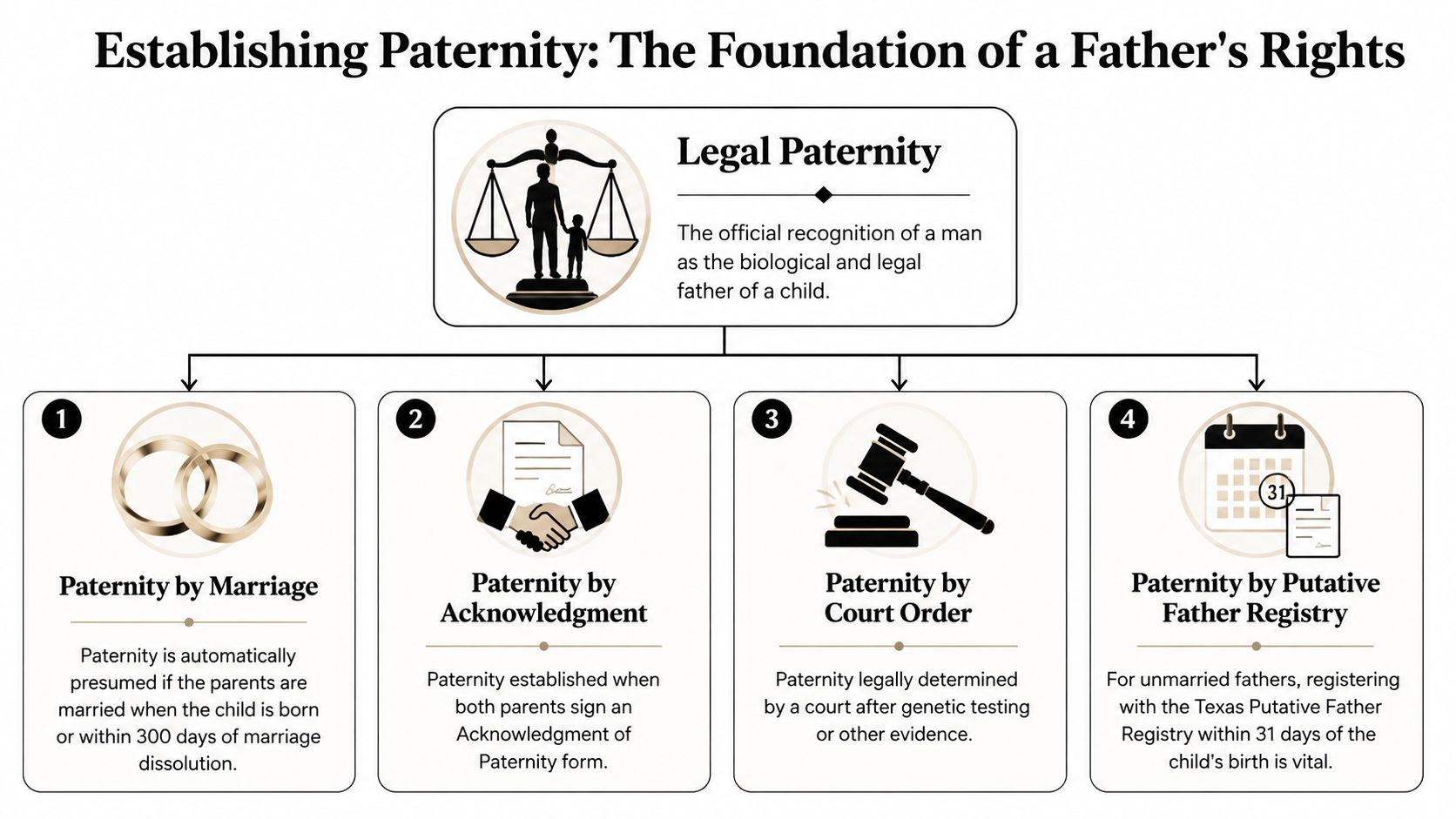
Three common legal paths
Presumed father. This usually applies when the man is married to the child's mother at the relevant time under Texas law. The law starts from the assumption that he is the father, which gives him a stronger legal position at the beginning of an adoption case.
Acknowledged father. This happens when the parents sign an Acknowledgment of Paternity, often called an AOP. It is a formal legal document, not just an informal statement. If you're trying to understand how that form works, this guide on Texas acknowledgment of paternity is a helpful starting point.
Adjudicated father. This means a court has decided paternity, often after a legal case that may involve genetic testing or other evidence. Once a court enters that order, the father has a much clearer legal identity in the adoption process.
Why this matters so much
From 2000 through 2010, Texas Vital Statistics data showed roughly 50,000 to 70,000 paternity acknowledgments were filed annually, showing how often Texas relies on the AOP process to sort out fatherhood early in a child's life, as explained in this discussion of the Texas putative father registry and paternity acknowledgment practice.
That number matters because it shows how often legal fatherhood is created by paperwork and timing, not by assumption.
Practical rule: If you're a father who wants a voice in an adoption case, don't assume the court will treat biology alone as enough. Ask what legal step has already been taken, and what step still needs to happen.
A simple example
Suppose Mark and Elena were never married. Mark is sure he is the father, but he never signed an AOP and never went to court. If an adoption case begins, Mark may feel blindsided when he learns that his legal footing is weaker than he expected.
By contrast, if Mark had signed the AOP or obtained a court order, the adoption process would usually have to deal with his rights more directly.
This is why early action matters. In many Texas adoption cases, the first question is not "Who is the father biologically?" The first question is, "Who is the father legally?"
The Critical 31-Day Window Texas's Putative Father Registry
For unmarried fathers, one of the most important and least understood protections is the Putative Father Registry. This is a state registry where a man can register his possible paternity to preserve his right to receive notice of an adoption proceeding.
That sounds simple on paper. In real life, it often isn't.

Why this deadline catches people off guard
Texas law requires an unmarried father to register within 31 days of the child's birth to preserve certain notice rights in adoption cases. But many fathers don't even know the baby has been born, don't know an adoption is planned, or don't know the registry exists.
That gap is real. As noted in this article about whether a birth father can block an adoption in Texas, many fathers learn about an adoption plan only after the 31-day window has already closed, which can leave them with very limited options.
What registration does and does not do
Registration is important, but it does not automatically make someone the legal father.
Here's the simpler version:
- It can preserve notice rights. A registered man may have the right to be informed about an adoption case.
- It does not by itself establish paternity. He may still need to sign an AOP or file a paternity case.
- It does not guarantee he can stop the adoption. It gives him a chance to appear and be heard.
A lot of fathers miss this distinction. The registry is more like raising your hand and saying, "I may be the father, and I want notice." It is not the same thing as winning the case.
What if the deadline was missed
Missing the registry deadline can be serious. In many private infant adoption cases, a court may move forward without the father's consent if he did not register on time and does not otherwise have protected legal status.
That doesn't mean every late case is hopeless. It does mean the facts matter a great deal. A father may need immediate advice if he believes notice procedures were defective, if fraud occurred, or if other legal steps had already established his rights.
This short video gives a helpful overview of consent issues that often connect with registry problems:
If you're dealing with signatures, notice, or deadlines, this guide on Texas consent to adoption forms can help you understand what paperwork usually appears in these cases.
When fathers call after the deadline has passed, the first question usually isn't "Can I still object?" It's "What happened procedurally, and was every required step actually followed?"
For adoptive parents, the registry matters too. A proper registry search helps protect the finality of the adoption and reduces the risk of a later challenge.
The Power of Consent and When It Can Be Bypassed
If a father has established legal rights, his consent often matters in adoption. But consent is not the whole story. Texas courts can terminate parental rights in some situations and allow the adoption to proceed without the father's approval.
That part of the law can feel upsetting to read, especially if you're a parent trying to stay involved. But it also helps explain why two cases that look similar on the surface can turn out very differently.
When consent usually matters
A legally recognized father often must either consent to the adoption or have his rights terminated before the adoption can be finalized. In plain English, the court usually cannot just ignore him because he disagrees.
This is especially important in private infant adoptions and stepparent adoptions, where the question often becomes whether the father is participating, absent, or contesting the case.
A clear example of involuntary termination
Texas law establishes non-payment of child support for one year as a ground for terminating a birth father's parental rights without his consent. A documented child support arrearage of 12 months or more can serve as prima facie evidence for a termination petition, although the father can still respond by showing inability to pay rather than willful non-support, as discussed in this explanation of termination issues in Texas stepparent adoption cases.
That legal rule matters because it gives courts an objective marker. The court isn't just asking whether the relationship feels distant. It is looking at conduct that can be documented.
Why courts still look at the full picture
Even with a measurable ground like support arrears, these cases are not automatic. A father may argue that he was unable to pay because of unemployment, illness, or another serious barrier. The court has to sort out whether the failure was willful.
A helpful way to think about it is this:
| Situation | What the court may ask |
|---|---|
| Father paid support and stayed involved | Is his consent required? |
| Father fell behind but has a credible reason | Was non-support willful or unavoidable? |
| Father stopped supporting and disappeared | Are grounds for termination present? |
If you're trying to understand how a court may proceed without a father's signature, this article on adoption without father consent in Texas gives a useful overview.
A father's rights are strong when he acts like a parent in both legal and practical ways. Courts tend to focus on both.
For birth mothers and adoptive parents, this is often where legal strategy becomes very case-specific. For fathers, it's a reminder that silence, delay, and lack of support can affect rights long before the final hearing.
How Rights Differ in Stepparent Private and CPS Adoptions
The same father may have different practical influence depending on the type of adoption. A stepparent case is not handled the same way as a private infant case. A CPS case brings in another layer of court oversight, safety concerns, and prior proceedings.

Stepparent adoptions
In a stepparent adoption, the child usually already lives in a stable household with one biological parent and a stepparent who wants full legal rights. The birth father's role often depends on whether he is known, legally recognized, and involved.
If the father agrees, the process may be more straightforward. He can sign the needed consent or relinquishment documents, and the court can move toward termination and adoption with less conflict.
If he doesn't agree, the case often turns to whether legal grounds exist to terminate his rights. In these cases, judges pay close attention to the child's daily reality. Who has been parenting? Who has been supporting the child? Who has maintained contact?
Private infant adoptions
Private infant adoptions usually create the most anxiety around notice and timing. The child's placement may happen very early, and the legal work around consent, paternity, and notice often starts immediately.
For an unmarried father, the practical questions are sharp:
- Has he established legal paternity?
- Did he register in time if the registry applies?
- Has he taken real steps to claim responsibility for the child?
If the answer to those questions is no, the father may have a much harder time stopping the adoption.
CPS and foster care adoptions
When a child is in the CPS system, the case often includes earlier findings about safety, neglect, abandonment, or other serious concerns. By the time adoption is discussed, there may already have been litigation over parental rights.
That changes the posture of the case. The father may still have rights to notice and participation if his rights have not yet been terminated, but the issues often go beyond consent alone.
A side-by-side view
| Adoption type | Common issue involving father |
|---|---|
| Stepparent | Whether the father will consent or whether termination grounds exist |
| Private infant | Whether paternity and notice rights were preserved in time |
| CPS | Whether prior court findings have already limited or ended rights |
Families often feel guilty for asking these questions. They shouldn't. The child needs legal clarity, and every adult involved needs to know where they stand.
Asserting Your Rights or Contesting an Adoption
A common crisis point looks like this. A father learns, days or weeks later, that an adoption may already be underway. He is unsure whether he signed the right papers, unsure whether he had to register, and afraid that one missed deadline ended everything.
That fear is understandable. It is also not a reason to stay still.

Contesting an adoption usually turns on proof and timing. A court will want to see what legal steps the father took, when he took them, and whether he acted like a parent in real life rather than only objecting after the adoption process had advanced. A missed Putative Father Registry deadline can be a serious obstacle, but it does not answer every question by itself. Cases can still depend on paternity, notice, prior filings, and the exact posture of the adoption.
If you're a birth father
Start by treating the case like a clock that is already running. Waiting for a call from the mother, agency, or court can cost valuable time.
A practical checklist helps:
Learn what has already happened. Find out whether the child has been born, whether an adoption petition or termination case has been filed, and whether any hearing dates are already set.
Ask a lawyer to map out your legal status. The first question is not just "Am I the father?" It is "What can I prove right now, and what legal step comes next?"
Address the 31-day registry issue directly. If you registered on time, bring proof. If you did not, say that clearly to your lawyer so the analysis can shift to any other rights or arguments that may still exist.
Gather a paper trail. Save texts, emails, payment records, travel receipts, screenshots, and messages showing attempts to stay involved or learn about the child.
Be ready to act in court, not only in conversation. Objections usually carry more weight when they are backed by prompt filings, requests for testing if needed, and a record of support.
The registry works a little like a deadline for checking in before a door closes. Missing it can narrow the path sharply. But fathers are often confused about whether the registry applied, whether another paternity step already mattered, or whether they were denied information about the birth. Those details can change the legal analysis, which is why late cases still need immediate review instead of surrender.
If you missed the 31-day deadline
This is the question many fathers are afraid to ask, and it deserves a direct answer. Missing the deadline may weaken your ability to object, but you should still have a lawyer examine the timeline carefully.
For example, a father may believe he "missed everything" when the actual issue is more specific. Was paternity already acknowledged another way? Was there already a court case involving the child? Did he receive proper notice? Did he make prompt efforts to claim responsibility but lack accurate information about the birth? Those are not magic fixes, and they do not guarantee a result. They are the kinds of facts lawyers look at because adoption cases are decided on the record, not on assumptions.
If you're a prospective adoptive parent
Prospective adoptive parents usually want the same thing the court wants. Stability for the child and a process that will hold up later.
That means slowing down enough to confirm the paperwork was handled correctly. Keep notice records, affidavits, search results, consents, and court orders in one place. Family law offices also need reliable intake because urgent calls often come in at the worst possible moment. Some practices use tools such as Recepta.ai's virtual reception services so deadline-sensitive messages about hearings, service, or disputed parental rights are less likely to be missed.
Care matters because old procedural problems do not always stay buried. As noted earlier, later access to adoption-related records can bring notice or consent issues back into view years after the placement. A careful file today can prevent a painful dispute later.
One practical option for legal guidance
Families dealing with adoption filings, consent disputes, termination issues, or contested birth father claims sometimes consult the Law Office of Bryan Fagan, PLLC as one Texas adoption counsel among other available legal resources.
Frequently Asked Questions About Birth Father Rights
What if the birth mother won't tell me when the baby is born
That concern is very common, and it's one reason these cases feel so unfair to fathers. If you think you may be the father, don't wait for perfect information before speaking with a lawyer. A father often needs to act based on what he knows now, not what he hopes to learn later.
Can I stop an adoption if I'm not on the birth certificate
Sometimes, but not automatically. Being left off the birth certificate does not always end the matter. The stronger question is whether you have legal paternity or another protected legal status. If you don't, the path gets harder, and speed becomes critical.
Does paying the mother's medical bills give me rights
Paying expenses may show support and responsibility, and that can matter factually. But payment alone usually doesn't create legal fatherhood. Think of it as helpful evidence, not a substitute for legal action.
I signed something at the hospital. Does that mean I consented to adoption
Maybe, maybe not. Hospital paperwork can include several different forms, and people often sign documents while stressed or exhausted. A lawyer needs to look at the exact form, not just the memory of signing it.
If I missed the registry deadline, is there anything I can still do
Possibly, but those details matter most. A late case may still raise questions about notice, prior paternity steps, or whether required procedures were followed. Don't assume the answer is no without getting legal advice quickly.
I'm an adoptive parent. Should I be worried if the father might appear later
Worried may be too strong a word, but careful is the right word. If the legal process was handled correctly, the adoption is in a stronger position. If paperwork, notice, or timing were sloppy, that can create stress later that could have been avoided.
Some questions need general education. Others need immediate legal strategy. Birth father rights sit right at that line.
If you have questions about consent, paternity, the Putative Father Registry, home studies, termination of parental rights, or the final steps required under Texas adoption law, a personalized legal review can bring a lot of peace of mind. The adoption process should protect the child, respect valid parental rights, and help families move forward with confidence. To talk through your situation with a Texas adoption attorney, schedule a free consultation with Law Office of Bryan Fagan, PLLC.

