 Skip to content
You may already be living like a parent in every way that matters. You pack lunches, help with homework, sit through doctor visits, and calm the hard nights. But when school forms, medical decisions, or long-term security come up, the law may still treat you like an outsider because the child’s biological father is absent, unknown, or refusing to cooperate.
That gap can feel unfair. It’s even harder when the child already sees you as family and you’re only trying to give them stability.
Texas law does allow adoption without father consent texas in some situations. The path depends on which kind of “absent father” issue you’re facing. Sometimes the father is unknown. Sometimes he can be located but has never stepped into the child’s life. Sometimes he appears only after an adoption case begins. Each situation calls for different proof, different court steps, and careful attention to the child’s best interests.
A stepparent may be trying to adopt the child they’ve raised for years. A grandparent may be the one providing a safe home. A relative caregiver, foster parent, LGBTQIA+ parent, or single parent may be trying to turn daily love and responsibility into legal permanence. If that sounds like your family, you’re not alone.
The law in this area can feel heavy, but it isn’t random. Texas courts look for facts, documents, timelines, and credible evidence. They also look closely at whether the adoption will protect the child and create a more secure future.
Your Dream of Family and the Challenge of an Absent Father
Maria had been the one signing permission slips for years, even when the school still listed someone else as the child’s legal father. Her husband’s son called her “Mom” at home, but when a medical emergency came up, she learned how fragile that title could feel without legal recognition.
That’s the place many Texas families start from. Love is already there. The routine is already there. The child already knows where home is. But a missing, uninvolved, or uncooperative father can stand between the family you live every day and the family the law will formally protect.

For many people, this isn’t about excluding someone out of anger. It’s about giving a child security. You may want the right to make school decisions, access medical records, or know that if something happens to your spouse, the child won’t face another legal crisis. Those are practical concerns, but they’re also emotional ones.
The families who face this most often
This issue comes up in several kinds of homes:
- Stepparent households where the biological father hasn’t been involved for a long time
- Relative care situations involving grandparents, aunts, uncles, or adult siblings
- Private infant adoptions where the father’s identity is uncertain or he never established legal rights
- CPS and foster care cases where the father is absent, hard to locate, or has serious legal barriers
In all of these situations, the question is not merely, “Can we adopt?” The question is usually, “What will the court need to see before it can move forward without his consent?”
The court doesn’t grant an adoption just because a father has been disappointing. The court looks for legally recognized grounds and proof that adoption serves the child’s best interests.
That distinction matters. It helps explain why some families move forward smoothly, while others run into delays. The difference is often evidence, procedure, and timing, not the sincerity of the family’s love.
Why clarity matters early
People often wait too long to gather records because they assume the father’s silence speaks for itself. In court, silence usually needs documentation. Missed support payments, no-contact periods, registry searches, returned mail, service efforts, and school or medical records can all matter.
If you’re trying to understand where your family fits, start with this simple idea: Texas may allow adoption without a father’s consent, but the path depends on whether he is unknown, uninvolved, unresponsive, or actively contesting the case.
When Texas Law Says a Father's Consent Is Not Required
Before any adoption can move forward without a father’s agreement, the court usually has to deal with his parental rights. In plain English, that means the court must determine whether his consent is unnecessary because the law allows termination of those rights or because he never took the legal steps needed to protect them.
In a stepparent case, Texas law allows the adoption to proceed without terminating the rights of the spouse who remains the parent, but the other biological parent’s rights still must be terminated. That rule appears in Texas Family Code §162.001(b)(2), as discussed in this explanation of Texas consent rules in stepparent adoption cases.
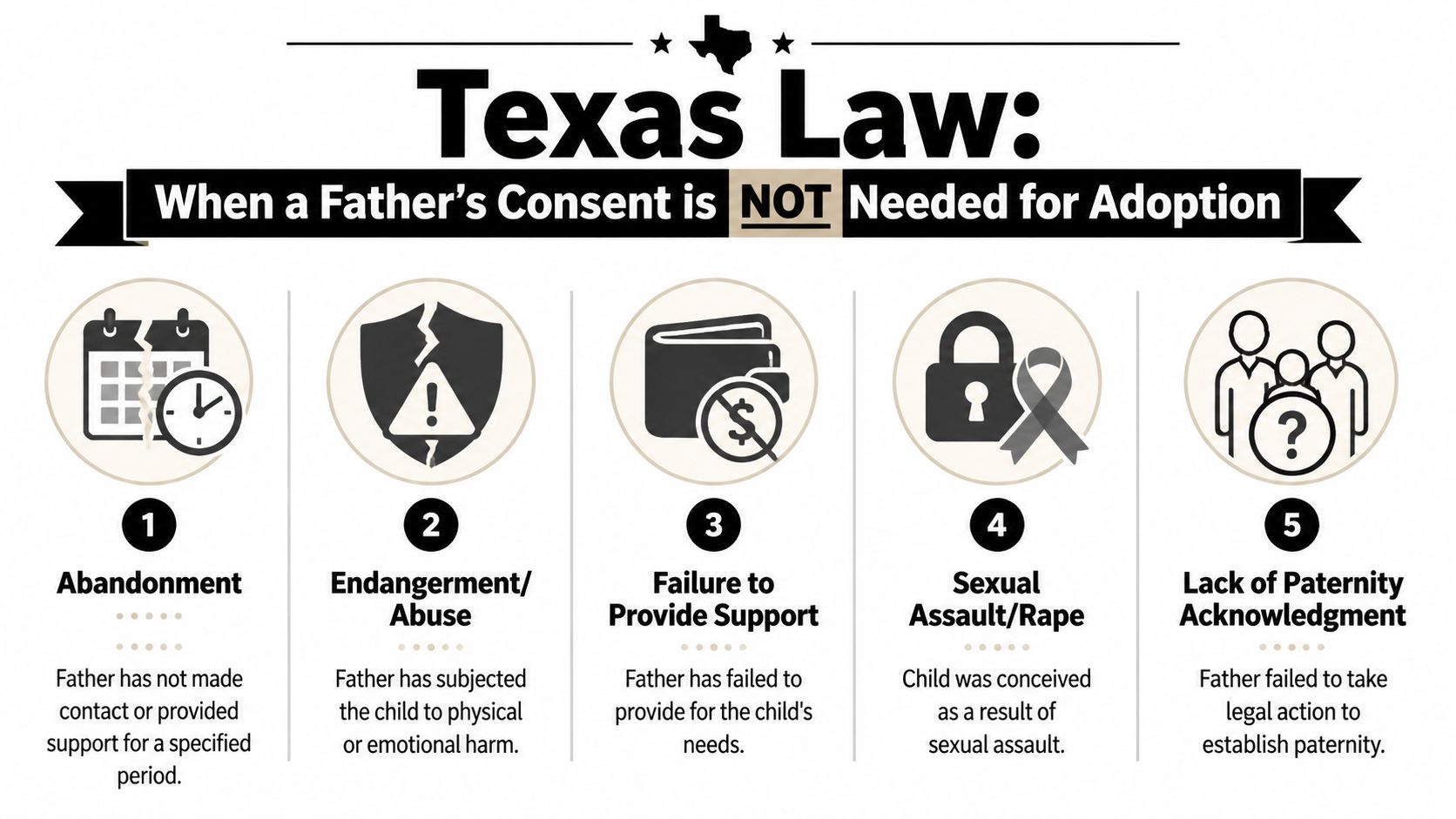
Texas courts don’t remove parental rights lightly. Judges treat those rights as important, so they expect clear evidence and a careful process. One of the most common grounds is abandonment. In Texas, stepparent adoption without the biological father’s consent is legally possible when the father has abandoned the child by having no contact or providing no support for at least six months, and Texas data discussed in this overview of stepparent adoption without consent states that in fiscal year 2022, over 60% of Texas foster care adoptions involved involuntary termination of parental rights due to factors like abandonment or non-support.
The best interest standard still controls
Even when a legal ground exists, that alone usually isn’t enough. The judge still asks whether the termination and adoption are in the best interest of the child. That means the court looks at stability, safety, emotional ties, daily care, and whether the proposed adoption creates a healthier long-term home.
A common misunderstanding is that a father loses rights automatically just because he hasn’t been around. That’s not how courts approach these cases. Judges want facts they can verify.
Common grounds in plain English
Below is a simple comparison of the main issues families often raise when trying to adopt without a father’s consent.
| Grounds | What It Means in Plain English | Common Evidence Required |
|---|---|---|
| Abandonment | He has had no meaningful contact and provided no support for at least six months | Visitation logs, text records, call history, child support records, testimony from caregivers |
| Failure to support | He had the ability to help support the child but did not do so | Payment history, court support records, bank records, employment information if available |
| Endangerment or abuse | His conduct put the child’s physical or emotional well-being at risk | Police reports, medical records, protective orders, witness statements |
| Long-term incarceration or serious criminal issues | His circumstances prevent him from parenting safely or consistently | Criminal case records, sentencing records, related court documents |
| Prior voluntary relinquishment or lack of legal paternity steps | He already gave up rights, or never properly established them | Signed relinquishment papers, paternity records, registry results, court filings |
Three absent father scenarios that matter
The legal path often turns on which of these real-life patterns fits your case.
Unknown father
This is common in some private infant adoptions. If the father’s identity is uncertain, the court usually wants proof that reasonable efforts were made to identify or locate him. In some situations, a registry search becomes a major part of the case.
Uncooperative but known father
This is the father who can be found, has been notified, but won’t sign. In that situation, the case often becomes a contested termination and adoption matter. The focus shifts from “Can we find him?” to “Can we prove legal grounds to terminate his rights?”
Father who drifted out of the child’s life
This is often the stepparent adoption case. He may have been involved once, then disappeared, stopped paying support, and stopped visiting. These cases rise or fall on records. Courts look carefully at whether the gap in contact was real, substantial, and voluntary.
Practical rule: If you’re asking a court to proceed without a father’s consent, start collecting documents before you file. Judges trust organized proof more than emotional summaries.
Why this area feels confusing
People often hear broad statements like “if he’s not around, you can adopt.” The truth is narrower. Texas courts separate disappointment from legal grounds. A father may be inconsistent, selfish, or difficult and still retain rights unless the evidence satisfies the statute and the child’s best interest supports termination.
That’s why evidence-focused planning matters so much in adoption without father consent texas cases. The law offers a path, but it asks families to prove why that path is justified.
The Role of the Texas Putative Father Registry
Some fathers are legally recognized from the beginning. Others are not. The Texas Putative Father Registry exists for men who may believe they are the father of a child but have not yet become a legal father through marriage, court order, or acknowledgment of paternity.
The registry matters most when the parents were not married and the father did not take formal steps to establish his rights. In those situations, the court wants to know whether he preserved his ability to receive notice and assert a parental claim.
Texas created this registry in the 1990s, and it plays a major role in adoptions that move forward without paternal consent. According to this discussion of Texas adoptions involving uninvolved fathers and registry issues, a father’s failure to register can lead to waiver of consent, and 2023 data from Texas adoption agencies shows the registry mechanism is crucial in over 70% of private adoptions involving unknown or uninvolved fathers.
What a putative father is
A putative father is an alleged biological father who may claim paternity but hasn’t yet secured full legal father status. That category matters because Texas doesn’t treat every biological possibility the same way. The law gives rights stronger protection when the father has taken recognized legal action.
If you’re dealing with a private adoption or a case involving disputed paternity, it helps to understand how acknowledgment issues fit into the larger picture. This guide on Texas acknowledgment of paternity and related adoption questions can help clarify where legal fatherhood begins.
When failure to register changes the case
A common point of confusion is whether being the biological father is enough by itself. In some cases, it isn’t. If a man doesn’t register and doesn’t otherwise establish his legal connection to the child, the court may allow the adoption to proceed without requiring his consent.
That does not mean petitioners can skip due diligence. Courts still expect serious efforts to identify the father when possible and to follow notice rules carefully. But the registry can sharply change the legal situation when the father stayed passive.
How this usually plays out in real life
Consider three examples:
Private infant adoption with uncertain paternity
The mother is not married, and more than one man could be the father. The legal team investigates, checks the registry, and documents efforts to identify possible fathers.Mother knows the father’s name but has had no meaningful contact
A registry search may still matter, but so do search efforts, notice, and the father’s own actions or inaction.Father appears late and claims he objected all along
The court will likely look closely at whether he registered, whether he supported the child or mother when relevant, and whether he acted promptly to establish paternity.
A late objection often turns on whether the father protected his rights when Texas law gave him the chance.
Why families should take this seriously
The registry is not just a technical box to check. It can determine whether a father’s consent is required at all. It also affects strategy. A case involving a true unknown father is built differently from a case involving a known father who ignored every legal step available to him.
Families sometimes assume this issue only matters in agency adoptions. It can matter in private placements, kinship matters, and some contested cases as well. The earlier it’s reviewed, the fewer surprises tend to emerge later.
Questions to ask early
If the father is not on the birth certificate or has never gone to court, ask:
- Has anyone confirmed whether he is a presumed, acknowledged, or adjudicated father?
- Was a registry search completed where required?
- Have search efforts been documented?
- Is there any support, communication, or paternity filing that could change his status?
The answers shape everything that follows. In many adoption without father consent texas cases, the registry is the dividing line between a straightforward legal route and a much more contested proceeding.
What to Expect in the Texas Adoption and Termination Process
After you determine which legal path applies, the next question is practical. What happens in court?
The process usually moves in stages. Texas stepparent adoption cases commonly begin with filing, then addressing the noncustodial parent’s rights, then completing required checks or evaluations, then attending a final hearing. A child who is 12 or older must provide written consent to the adoption unless the court waives that requirement in the child’s best interest, and judges have broad discretion throughout the process, as described in this summary of the Texas stepparent adoption process.

Filing the case
The case usually begins with an Original Petition. In many stepparent cases, families file for termination of the other parent’s rights and the adoption in the same overall proceeding. The petition includes basic details about the child, the parents, and the legal reasons the adoption should be approved.
Accuracy matters here. If names, dates, status details, or notice information are wrong, the case can slow down or create avoidable problems.
Serving notice and locating the father
If the father is known, he must usually be served properly. If his location is unknown, the court expects diligent efforts to find him. That may include address searches, contact attempts, and documentation of what was tried.
When readers ask why these steps matter so much, the answer is due process. Courts want to protect the child’s stability, but they also must protect against cutting off a parent’s rights without fair notice.
Appointment of attorneys or other court protections
In some contested cases, the court may appoint an attorney ad litem for the nonconsenting parent. That can add time and complexity, but it exists to make sure the process is fair.
The child may also have their interests separately considered, depending on the case. This is one reason contested matters often feel slower than families expect.
Court delay doesn’t always mean something is wrong with your case. Sometimes it means the judge is being careful, which is exactly what appellate courts expect in termination cases.
Evaluations, checks, and paperwork
Some cases require an adoption evaluation, background checks, or both. In uncontested matters, courts may waive parts of the evaluation process after reviewing criminal background checks, but that depends on the circumstances.
You may also need affidavits and other supporting documents. If the child is older, written consent issues must be handled carefully. If the child’s name will change and the child is old enough for separate written consent to that change, that piece needs attention too.
For families trying to prepare for disagreement from the other parent, this resource on contested adoption issues in Texas gives a useful overview of what can make the process more demanding.
What the hearing often feels like
Many parents picture a dramatic courtroom battle. Sometimes the final hearing is much calmer than they expect. Other times, especially when the father contests, there may be testimony, evidence, and witness questions.
Judges usually focus on a few core questions:
- Were legal notice requirements followed
- Has the petitioner proven valid grounds for termination, if needed
- Does the evidence support the adoption
- Is the adoption in the child’s best interest
- Has the child’s required consent been obtained, if applicable
Here is a short video that helps some families feel more grounded about the legal process before they step into court:
After the judge signs
If the court grants the adoption, the child becomes the legal child of the adoptive parent. In a stepparent case, that means the stepparent gains full legal parental status. A new birth certificate may then be issued to reflect the adoption.
That moment is powerful, but it usually follows a lot of paperwork and patience. Families often feel relief more than celebration at first. Relief that school forms make sense now. Relief that medical care won’t require extra legal explanations. Relief that the child’s day-to-day family has legal permanence.
A practical checklist before filing
- Collect identity documents such as birth certificates, marriage records, and prior court orders
- Organize your evidence so contact history, support history, and service efforts are easy to follow
- Check child consent issues early if the child is older
- Prepare for delays if the father may contest or if the court appoints counsel
- Review every filing carefully because procedural mistakes can create setbacks even in strong cases
Building a Strong Case for the Best Interest of the Child
A strong case is not built on anger. It’s built on records.
Texas courts look closely at proof, especially in contested matters. They distinguish between abandonment and failure to support, and the court trends discussed in this Texas Law Library stepparent adoption FAQ emphasize that judges want specific evidence such as financial records and visitation logs, particularly where a father may try to protect or revive his rights late in the process.

What judges usually find persuasive
Think in categories, not feelings. If you say, “He disappeared,” the judge will want to know when, how often, and what documents support that statement.
The most useful proof often includes:
- Contact records such as texts, emails, missed call logs, social media messages, or returned mail
- Support records including payment histories, child support orders, bank records, and receipts showing who paid for the child’s needs
- Caregiving records like school forms, medical records, therapy records, and emergency contact documents showing who has been acting as the parent
- Witness testimony from teachers, counselors, relatives, coaches, or childcare providers who have personal knowledge of the child’s life
- Safety evidence such as police reports, protective orders, or criminal records when abuse or endangerment is part of the case
How to document abandonment
Abandonment cases often become timeline cases. You are trying to show a meaningful pattern of no contact and no support.
A helpful approach is to build a month-by-month record. Note attempted visits, failed visits, canceled calls, birthdays missed, and any support that was not provided. Keep the timeline factual.
Keep this mindset: your notes should read like a calendar, not a diary.
For example, instead of writing, “He never cared about our child,” write, “No visits from January through July, no birthday call, no school contact, and no support payment received during that period.”
How to document failure to support
Support claims often get messy because informal help can become a disputed issue. One parent says, “I gave cash.” The other says, “No, you didn’t.” Judges prefer records they can verify.
If support is part of your case, gather:
- Court-ordered child support records, if any
- Bank statements showing regular or missing transfers
- Receipts for major child expenses
- Proof of who paid rent, school costs, insurance, or medical bills for the child
- Any messages where the father admits he did not help
When a father suddenly becomes active
This happens more often than families expect. A father may ignore the child for a long time, then react strongly once he receives court papers.
That does not automatically defeat the case. But it does mean the court will look more closely at the full history. Judges often ask whether the new interest is genuine and sustained or whether it began only after legal action started.
Practical help with organizing evidence
You don’t need fancy software. A clear binder or digital folder system is often enough if it’s organized well.
Try this structure:
- Section one for court orders and legal documents
- Section two for support records
- Section three for communication logs
- Section four for school and medical records
- Section five for witness names and short summaries of what each person knows
If you work with counsel, organized records save time and reduce the risk that key evidence gets overlooked. The Law Office of Bryan Fagan, PLLC helps Texas families prepare and present adoption and termination filings, including stepparent and kinship matters where proof of noninvolvement and best-interest factors must be clearly documented.
Common Questions About Adoptions Without a Father's Consent
What if the father suddenly contests the adoption
That usually turns the matter into a contested case, not an automatic loss. The court will examine whether he has legal standing, whether he preserved his rights, whether valid grounds for termination exist, and whether the adoption serves the child’s best interests.
If he appears late, the history of the case matters. So do service records, support history, and any registry or paternity issues.
What if we truly don’t know who the father is
That does happen. In those cases, the court usually expects careful efforts to identify and locate any possible father. The exact steps depend on the facts, but the key idea is diligence. Families must be able to show they didn't skip over the issue because it was inconvenient.
Unknown-father cases often involve more procedural work than people expect. That’s because the court wants to protect the final adoption from future legal attack.
Is being off the birth certificate enough to remove his rights
No. A birth certificate issue alone usually doesn’t answer the legal question. Texas law looks at a broader set of facts, including marriage, acknowledgment of paternity, court orders, and in some situations the putative father registry.
A man who is not listed may still have a claim. A man who is listed may still fail to preserve rights depending on the case posture. That’s why status has to be analyzed carefully.
How are CPS and foster care cases different
CPS matters often involve more agency records, court history, and statutory timelines than private or stepparent adoptions. The legal standards remain serious, but the case file is usually much larger.
For CPS-related and foster-to-adopt cases, recent Texas legislative changes have made termination more efficient for fathers absent for over 12 months, and this discussion of Texas adoption consent laws and CPS scenarios notes that registry searches and exceptions involving criminal histories such as family violence can be especially important as courts increasingly waive consent based on best interests to avoid placement delays.
Can a stepparent file if the child already calls them Mom or Dad
Yes, emotional family bonds matter, but affection alone doesn’t replace the legal requirements. The court still needs the proper petition, notice, and proof supporting termination or waiver of consent.
That said, the child’s day-to-day reality often matters in the best-interest analysis. Teachers, doctors, and relatives may help show who has been parenting.
Does the child get a say
Sometimes, very much so. In Texas, a child who is old enough under the statute may need to provide written consent unless the court waives it. Even younger children may influence how a judge views the family dynamic, stability, and emotional well-being.
How long will this take
There isn’t one universal answer. An uncontested case may move much more smoothly than a contested one. Problems with service, missing paperwork, registry questions, or appointment of counsel can all extend the process.
The healthier expectation is this: some adoption cases feel administrative, while others feel like litigation. If a father’s rights are being challenged, the court will move carefully.
What if the father has a criminal history
That can be very relevant, especially if the conduct relates to family violence, abuse, or child safety. But criminal history should be documented properly and connected to the legal ground being asserted. Courts still require proof, not assumption.
Is mediation ever useful
Sometimes, yes. In some families, a father who won’t initially sign may become more cooperative once the legal issues are explained clearly and respectfully. Not every case should settle, but not every case needs a courtroom fight either.
Taking the Next Step to Build Your Family
Families often come to this process carrying equal parts hope and worry. That’s normal. Adoption without a father’s consent in Texas can be legally complex, but it is not impossible, and it is not reserved for only one kind of family.
The key is matching the facts to the right legal path. An unknown father case is different from an abandonment case. A late contest is different from a father who never established rights. The more clearly those differences are understood, the more confidently a family can move forward.
At its heart, this process is about permanence for a child. Courts want stability, safety, and honesty. When families prepare carefully and present credible evidence, they give the judge something solid to act on.
If you’re considering adoption without father consent texas, you deserve answers that fit your family’s real circumstances, not a generic checklist.
If you’re ready to talk through your options, schedule a free consultation with the Law Office of Bryan Fagan, PLLC. A confidential conversation can help you understand which legal path may apply, what proof you’ll need, and how to move toward a more secure future for your child.

