
Some families arrive at this issue slowly. A grandmother starts by helping for a few weeks, then a few months, and before long she’s the one handling school pickup, doctor visits, bedtime, and every hard day in between. A stepparent may realize the same thing in a different way. They’re the parent doing the daily work, but the law still doesn’t fully recognize that bond.
That’s where termination of parental rights texas cases often enter the conversation. The phrase sounds harsh, and for many families it feels frightening at first. But in real life, this legal step is often tied to a child’s need for safety, consistency, and a permanent home.
For birth parents, it can involve grief and love at the same time. For relatives, it can feel like stepping into a role they never expected to hold. For hopeful adoptive parents, it can be the legal step that allows a child’s life to become more stable and secure.
A Difficult Decision for a Child’s Future
Maria had been raising her grandson for so long that everyone in the family already saw her as his main parent. She enrolled him in school, took him to the dentist, and sat with him when he had nightmares. But each time a medical form asked who had legal authority, she froze. Love was there. Legal protection was not.
That’s the moment many Texas families reach. They realize that an informal arrangement, even one built on deep commitment, may not be enough for the child’s future. A child may need more than a safe couch and a familiar bedtime routine. The child may need legal permanency.

In simple terms, termination of parental rights means a court ends the legal parent-child relationship. After that, the parent no longer has the legal rights and duties that come with being a parent. In many cases, this is the legal step that must happen before an adoption can move forward under the Texas Family Code, including the adoption procedures families often encounter in Chapters 162 through 166.
Why this matters so much in Texas
Texas families need clear guidance because these cases are not rare here. In Texas, approximately 30% of children in out-of-home care experience termination of parental rights, a rate nearly double the nationwide average, according to state-by-state termination data discussed here.
That number doesn’t tell you what any one family should do. It does show that Texas courts deal with these cases often, and that families need to understand the process before making decisions.
Practical rule: Termination is not a casual paperwork step. It’s one of the most serious orders a family court can sign.
Families who are comparing how different states handle these issues sometimes also look at guides from elsewhere, such as this overview of Florida parental rights termination, to see how Texas fits into the bigger picture. But Texas law has its own rules, procedures, and timing, so local legal advice matters.
Voluntary Relinquishment vs Involuntary Termination
Texas law recognizes two very different paths. They may lead to the same legal result, but they begin from very different places emotionally and legally.
One path begins with a parent’s choice. The other begins with a court case brought by someone else.
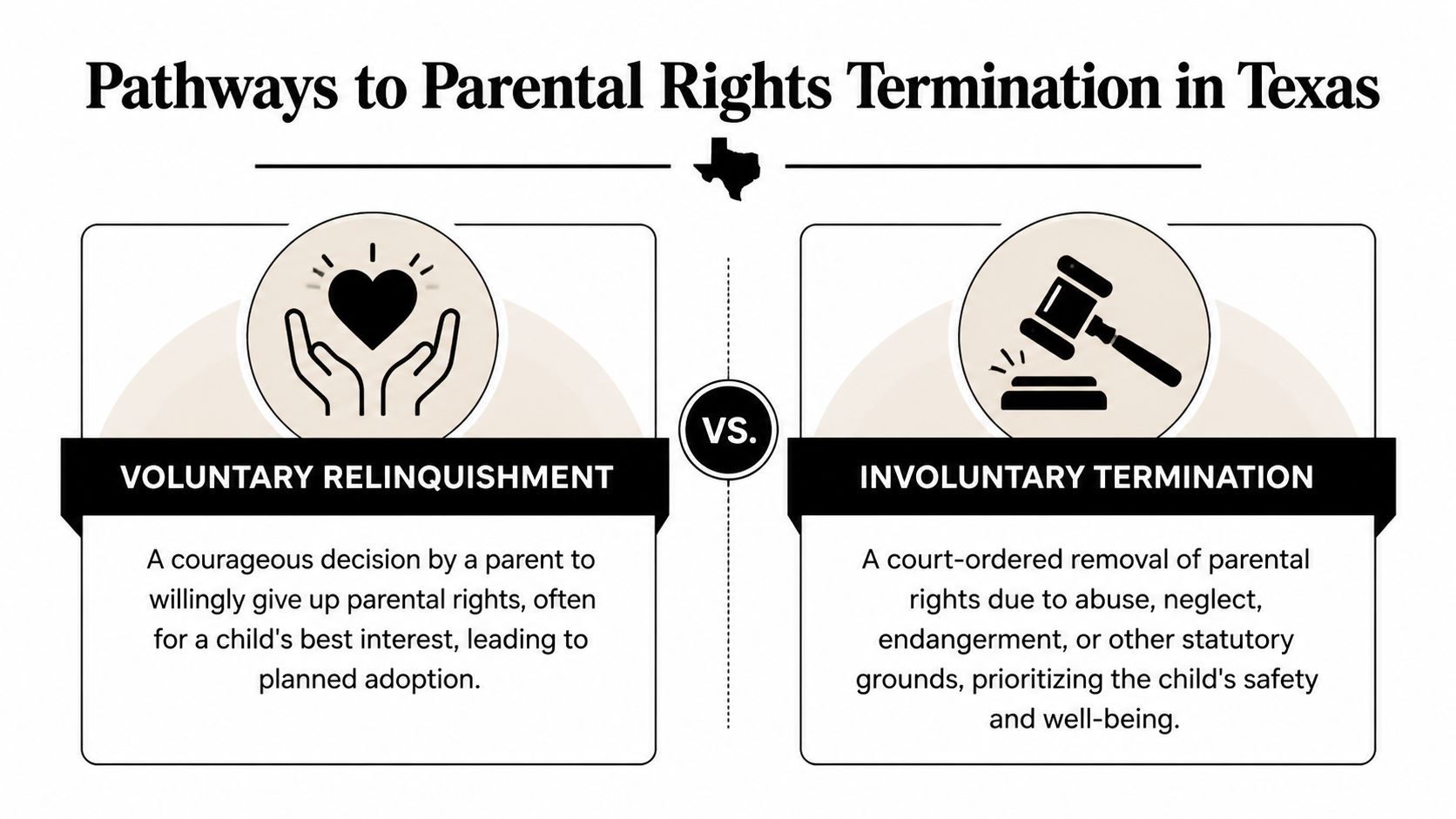
How voluntary relinquishment works
Voluntary relinquishment usually comes up when a birth parent decides that someone else should become the child’s legal parent. This often happens in private adoption, kinship adoption, or stepparent adoption cases.
Texas doesn’t allow this to happen casually or in the heat of the moment. For a voluntary termination to be valid, a birth parent must sign an Affidavit of Voluntary Relinquishment. That affidavit can only be signed at least 48 hours after the child’s birth, and it is revocable for 10 days after it’s signed, as explained in this guide on voluntary termination of parental rights in Texas and the underlying legal discussion at Frankfurt Law’s Texas guide.
Those safeguards matter. They exist because the law recognizes how emotional these decisions can be.
A simple way to think about it is this:
| Path | Who starts it | Why it happens |
|---|---|---|
| Voluntary relinquishment | The parent | The parent believes this is best for the child |
| Involuntary termination | Another party, often through court action | The child’s safety, welfare, or legal stability is at issue |
What involuntary termination means
Involuntary termination happens when a court is asked to end parental rights without the parent agreeing. This may happen in CPS cases, but it can also arise in private family cases involving a relative, stepparent, or another person with legal standing.
This path is not about punishing a parent for being imperfect. Family courts know that parents can struggle, recover, and change. Involuntary termination is reserved for cases where the legal standard is met and the court believes the child’s long-term well-being requires it.
A parent can love a child and still be in a legal case where the court is asked to decide whether the relationship should continue.
Why families often get confused
Many people assume that signing a document ends rights immediately. It doesn’t. Even in a voluntary case, court involvement still matters.
Others assume that if a parent hasn’t been around, termination is automatic. It isn’t. Texas courts require proof, procedure, and a separate best-interest finding.
Three points usually help families understand the difference:
- Choice matters: In a voluntary case, the parent is choosing to relinquish rights through a formal legal process.
- Proof matters: In an involuntary case, the person asking for termination has to prove legal grounds.
- Court approval matters: In either path, the judge still has to decide whether the result serves the child’s best interest.
Understanding Involuntary Termination Grounds in Texas
The law lists many possible grounds for involuntary termination, but most families understand them better when they’re grouped into everyday themes. The key point is that a judge can’t terminate rights just because a situation is messy or painful.
In Texas, a court must find clear and convincing evidence of at least one of the specific grounds listed in Texas Family Code §161.001, such as endangerment, abandonment, or substance abuse, and must also find that termination is in the child’s best interest, as summarized by Child Welfare Information Gateway’s Texas grounds overview.
Abandonment and long absence
One common category involves abandonment. In plain language, this means a parent has left the child without meaningful support, care, or a real plan to return.
A familiar example is a child who has been living with an aunt for many months while the parent has little contact, sends no support, and makes no real effort to resume parenting. Families often think the passage of time alone decides the case. It doesn’t. The court looks at conduct, intent, and the child’s situation.
Endangerment and unsafe environments
Another major category is endangerment. This does not require proof that a child was physically injured. It often focuses on whether a parent placed the child in dangerous conditions or engaged in conduct that endangered the child’s physical or emotional well-being.
That can include repeated exposure to drug use, severe instability, violent relationships, or other unsafe living conditions. Courts often look for a pattern, not just one bad day.
If a case involves addiction treatment or a court order to complete rehab, families may find it helpful to understand the legal side of treatment through resources like Tru Dallas Detox on court-ordered rehab. A treatment history can matter, but judges usually focus on whether the parent created a stable and safe environment for the child.
The court asks a hard question. Did the parent’s conduct put the child’s well-being at risk?
Failure to support or comply
Some cases focus less on dramatic danger and more on a parent’s ongoing failure to meet basic responsibilities. Texas law can allow termination when a parent fails to support a child despite having the ability to do so.
Another common issue appears in cases where a parent was given a court-ordered service plan and did not complete it. That may involve parenting classes, counseling, substance abuse treatment, or other steps ordered during a CPS case.
Here’s how these themes often look in real life:
- Support problem: A parent has income but provides no meaningful financial support for the child over an extended period.
- Service-plan problem: A parent starts services, misses visits, skips treatment, and doesn’t finish required tasks.
- Contact problem: A parent disappears from the child’s life and leaves others to carry all parenting duties.
Criminal conduct and other serious grounds
Texas law also includes grounds tied to certain criminal convictions and conduct that makes parenting impossible or unsafe. Some grounds are highly specific. Others overlap with the broader endangerment analysis.
Families don’t need to memorize every subsection of the statute to understand what matters most. The court is looking for legally recognized conduct, solid evidence, and a direct connection to the child’s welfare.
A short example helps. If a father is incarcerated, the case does not turn on incarceration alone. The court looks at the full picture, including the child’s needs, the parent’s ability to provide care, and the statutory ground being alleged.
Why the legal standard is so high
“Clear and convincing evidence” is a higher standard than simple suspicion or family frustration. It means the judge needs evidence strong enough to produce a firm belief or conviction that the legal ground is true.
That’s why these cases often rely on detailed records instead of broad accusations.
- Documents: medical records, school records, court orders, service plans
- Communications: text messages, emails, call logs, written warnings
- Witnesses: relatives, teachers, counselors, social workers, supervisors of visits
A parent who is defending against termination may respond with evidence of sobriety, stable housing, treatment completion, regular contact, or improved parenting. The case is rarely won by one emotional moment in court. It is usually shaped by the pattern the evidence shows over time.
Navigating the Texas Court Process Step by Step
A grandmother may have been getting a child to school every morning for months. A stepparent may already be doing the daily work of parenting. A birth parent may be scared that one missed hearing or one bad period in life will define the whole case. The court process exists to sort through those fears carefully, one step at a time.

Texas courts do not reach termination in one leap. The case usually moves like a set of gates. One gate has to open before the next one matters. That structure can feel slow, but it protects everyone involved, especially the child.
Step one starts with standing
The first question is simple: who is legally allowed to bring the case?
This is called standing. It does not ask who loves the child most. It asks who has the legal right to ask the judge for action. For relatives and stepparents, that distinction can be frustrating at first. A person may be significantly involved in a child’s life and still need to meet specific legal rules before the court can hear the request.
Private cases often turn on facts such as how long the person has cared for the child and what role they have played in daily life. A relative, for example, may need to show actual care, control, and possession of the child for a required period before filing, as discussed in this explanation of the legal process to terminate parental rights in Texas and the standing overview from Family Lawyer Katy.
For a kinship caregiver, standing is the courthouse door. If that door does not open, the judge cannot decide whether termination would otherwise be appropriate.
What usually happens after the case is filed
Once the right person files, the case follows a predictable path.
A petition is filed
This document tells the court what is being requested, which legal grounds are alleged, and what facts the filing party plans to prove.The other parent is formally served
Service is official notice. It is the legal system’s way of saying, "You have the right to know this case exists and the chance to respond."The court sets early hearings and ground rules
Some hearings deal with scheduling, temporary issues, or who will speak for the child’s interests. In some cases, the court appoints an attorney ad litem or another representative for the child.Both sides gather information
This stage often includes records, witness interviews, requests for documents, and preparation for testimony. Families sometimes compare this part to assembling a puzzle. One piece rarely shows the full picture. The court wants to see how the pieces fit together over time.The judge holds the final hearing or trial
The court listens to testimony, reviews exhibits, and decides whether the law and the evidence justify termination.
A short video can help make the process feel more familiar before you ever walk into court:
How adoption changes the picture
When termination is connected to adoption, the court is often looking at more than the end of one legal relationship. It is also looking at the start of a new permanent one.
Texas Family Code Chapters 162 through 166 cover the legal requirements for adoption, including who may adopt, consent issues, evaluation and home study questions in applicable cases, placement concerns, and final court approval. In practical terms, termination can be the legal doorway to a more stable future.
A stepparent adoption is a common example. The child may already live in a stable home with the stepparent acting as a daily parent. Termination clears the legal path for that family relationship to become permanent. In a kinship case, an aunt or grandparent may seek the same kind of legal security so the child is not left in limbo.
For birth parents, this stage can feel painful because the case is no longer only about past conduct. It is also about where the child will belong legally and permanently. For caregivers and hopeful adoptive parents, the process may bring relief and guilt at the same time. That mix of emotions is common.
Court procedure can feel cold on paper, but each step has a purpose. Notice protects rights. Careful review of evidence protects fairness. Final orders protect children.
Practical preparation for families
Families usually benefit from treating the case like a long record-building process, not a single dramatic day in court.
- Organize records early: Keep school papers, medical records, calendars, and communication logs together.
- Choose witnesses with firsthand knowledge: A teacher, counselor, caregiver, or supervisor who directly observed events usually helps more than someone repeating family stories.
- Understand your legal role: A grandparent, stepparent, foster parent, and birth parent may face very different legal questions in the same case.
- Match the court strategy to the permanency plan: If adoption is the goal, the legal steps should support that goal from the beginning.
This process is hard due to its profound impact on all involved. It also has structure, and structure can help families breathe, prepare, and make clearer decisions for a child’s future.
Presenting Your Case and Defending Your Rights
By the time a termination case reaches a final hearing, the judge is not looking for polished speeches. The judge is looking for reliable evidence. That’s what turns family conflict into a legal decision.
What evidence usually matters most
A termination case often includes several kinds of proof working together. One text message rarely decides everything. A pattern across many sources is more persuasive.

Common examples include:
- Witness testimony: relatives, teachers, counselors, caseworkers, doctors, or supervisors who personally observed the parent or child
- Written records: attendance reports, medical notes, police reports, counseling records, and prior court orders
- Digital evidence: texts, emails, social media posts, call logs, and photos
- Compliance evidence: proof that a parent did or did not complete services, visits, treatment, or testing
A grandparent might testify that she became the child’s daily caregiver after the parent disappeared. A teacher might describe chronic absences or behavior changes. A parent defending the case might show treatment completion, stable employment, and regular efforts to reconnect.
What clear and convincing means in real life
People hear “clear and convincing evidence” and wonder what that looks like outside a law book. It means more than suspicion, gossip, or fear. It means the proof must be strong enough that the judge forms a firm belief about the facts.
That’s why detail matters. Dates matter. Records matter. A parent who says, “I’m doing better now,” will usually need documents and witness support to make that claim persuasive.
Best interest of the child
Even if a legal ground is proven, the court still has to decide whether termination serves the best interest of the child. The human aspect of the case then comes prominently into focus.
Judges often consider factors commonly associated with the Holley analysis, including:
| Question the court considers | Why it matters |
|---|---|
| What does the child need emotionally and physically? | The court wants to know who can meet daily needs consistently |
| Is the proposed home stable? | Children usually do better with predictability and safety |
| What are the parenting abilities of the adults involved? | The judge compares real caregiving capacity, not promises alone |
| Is there a healthy bond with the parent or caregiver? | Relationships matter, especially when the child is attached |
| Have the adults shown good judgment over time? | Courts often focus on conduct patterns, not isolated claims |
A useful way to think about best interest: The judge is asking which outcome gives this child the safest and most stable future, not which adult has the strongest feelings.
How parents defend against termination
Parents are not powerless in these cases. A defense may focus on the facts, the legal ground, the child’s best interest, or all three.
A parent may argue that the alleged danger was temporary, that they have corrected the conditions, that they maintained meaningful contact, or that termination would harm the child more than help. Sometimes the strongest defense is evidence of consistent change over time, not a last-minute promise to improve.
For relatives and adoptive families, this means patience matters. For parents facing termination, it means early action matters.
Life After Termination From Rights to Adoption
A termination order ends one legal relationship, but in many families it also opens the door to a new legal beginning. That’s why this stage is often closely tied to adoption.
For a stepparent, termination may allow the person who has already been parenting every day to become the child’s legal parent. For a grandparent or other relative, it can create the foundation for a kinship adoption that protects the child from future uncertainty. For foster or prospective adoptive families, it can mean the child is legally free for adoption.
How adoption becomes possible
Texas adoption law, especially Chapters 162 through 166 of the Texas Family Code, governs the legal steps that follow. Depending on the type of adoption, families may deal with consent requirements, background checks, a home study or evaluation, placement rules, and a final court hearing.
In a stepparent case, the path is often more straightforward because the child is already living in the home. In a relative or CPS-related case, there may be added paperwork and court review before finalization.
Families considering this route after state involvement often look for practical guidance on adoption after CPS placement in Texas, because the transition from foster or conservatorship status to adoption can feel like a major shift.
What changes after adoption
Once an adoption is finalized, the adoptive parent gains full legal parental rights and duties. That means the authority to make decisions for the child, the legal security to enroll the child in school and obtain care, and the permanence many children need to feel rooted.
Practical changes can include:
- A new legal parent-child relationship
- Possible name changes
- Updated legal records
- A more secure future for school, healthcare, and inheritance issues
This is why many families stop thinking of termination as only a loss. In an adoption setting, it can also be the legal step that gives a child permanence.
Children usually feel the difference between a temporary arrangement and a permanent home. The law can help close that gap.
Not every case ends in adoption, and some families pursue conservatorship or guardianship-related solutions instead. But when adoption is the goal, termination is often the foundation that makes the next chapter legally possible.
Your Next Steps on the Path to Permanency
Families usually feel calmer when they know what to do next. The right first step depends on where you stand in the child’s life.
If you are a birth parent
- Pause before signing anything: If voluntary relinquishment is being discussed, make sure you understand exactly what rights you may be giving up.
- Talk with a counselor or trusted support person: Emotional pressure can cloud judgment, especially right after childbirth or during a crisis.
- Get independent legal advice: You need someone to explain the paperwork, the timing, and the long-term effect on your rights.
- Think about the child’s future structure: If adoption is being planned, ask how contact, stability, and decision-making will work afterward.
If you are a stepparent or relative
- Gather proof of your caregiving role: Keep school records, medical forms, calendars, and anything showing the child has been in your care.
- Check standing early: Many families lose time because they assume love alone gives them the right to file.
- Match the legal case to the family goal: If you want adoption, the termination strategy should support that outcome.
- Prepare for both legal and emotional resistance: Even when the facts are strong, these cases can still be painful for everyone involved.
If you are a foster or hopeful adoptive parent
- Ask where the child is in the permanency process: Not every placement is ready for adoption at the same time.
- Complete required adoption steps: Depending on the case, this may include a home study, training, or updated evaluations.
- Understand legal risk: A placement may feel permanent emotionally before it becomes permanent legally.
- Keep the child’s needs at the center: Court timelines matter, but so do attachment, routine, and trauma-informed care.
No family should have to guess through a process this serious. Clear advice can help you protect the child, respect everyone’s rights, and move toward a more stable future.
Frequently Asked Questions About Parental Rights Termination
Does termination end child support forever
It can end future parental obligations after the court order, but it does not automatically erase past-due support. Arrears usually remain an enforceable issue. Families are often surprised by this, especially in private cases.
Can a parent get rights back later
Termination is meant to be permanent. Courts treat it as one of the most serious orders in family law. That’s why judges require strict proof and careful procedure before signing it.
Can someone terminate rights just because a parent is absent
Not automatically. Absence may be important evidence, but the court still needs a valid legal ground and a best-interest finding. The case depends on the full facts, not a label.
Does a stepparent automatically have the right to file
No. A stepparent may need to meet standing rules or proceed in a related family law action before the court can decide the termination request. This is one of the most common misunderstandings in private family cases.
What if the other parent will agree
Agreement can help, but it doesn’t replace court approval. A signed affidavit or other consent-related document must still meet Texas legal requirements, and the judge still has to decide whether the result serves the child’s best interest.
What happens if the parent cannot be found
That issue usually affects notice and service. The court still requires legally proper efforts to notify the parent before moving forward. Families shouldn’t guess on this part because mistakes here can create serious problems later.
Does termination always lead to adoption
No. Sometimes termination is followed by adoption. Other times the child may remain with a conservator or another caregiver under a different legal arrangement. Adoption is common, but it is not automatic.
How do unknown father issues affect private adoption
They can complicate the process. In some cases, questions about paternity, notice, registry issues, or identity must be resolved before adoption can move forward safely. This is an area where careful legal planning matters a lot.
If your family is facing questions about termination, adoption, kinship care, or a stepparent case, a clear legal plan can make a painful process feel more manageable. The attorneys at Law Office of Bryan Fagan, PLLC help Texas families understand their options and move toward permanency with compassion and practical guidance. You can schedule a free consultation to talk through your situation in a private, supportive setting.
