
Sarah had tucked her stepson into bed for years. She knew which stuffed animal had to be on the pillow, which homework battles needed patience, and which quiet look meant he was worried about school. When she and her husband finally decided to make their bond legal through adoption, they thought the hardest part would be paperwork. Then a legal notice arrived. The adoption would be challenged.
That moment is common in contested adoption texas cases. A stepparent, grandparent, aunt, uncle, or foster parent may already be doing the daily work of parenting, only to learn that someone with legal rights plans to fight the case. It can feel personal, even when the court process is really about legal standards, evidence, and the child’s long-term stability.
If you're in that position, your fear makes sense. So does your determination.
A contested adoption means the path forward has changed, not that hope is gone. Courts in Texas take these cases seriously because adoption creates a permanent legal family relationship. That can make the process slower and more emotionally heavy, but it also means the judge is looking carefully at what serves the child best.
Stress can make even simple tasks feel harder. Some families find it helpful to pair legal guidance with practical coping tools, such as Ben's guide on managing anxiety, especially during the waiting periods between hearings.
When Your Adoption Dream Faces a Hurdle

A contested adoption often starts with a very ordinary family scene. A grandfather is packing school lunches because his granddaughter has lived with him for a long time. A stepparent is taking a child to the doctor, helping with spelling words, and showing up for every school program. Life already feels like family life. Then the legal process catches up, and someone objects.
That objection can come with a rush of questions. Can the other parent stop everything? Will the child have to testify? Did we miss some step? Are we about to lose the child we’ve been caring for?
Those questions don't mean you're weak. They mean the situation matters.
What a contest usually feels like
Most families don't walk into a contested adoption calm and organized. They often feel split in two. One part wants to protect the child and move quickly. The other part is stunned by the conflict and worried about making a mistake.
That emotional split is especially common when the person contesting the adoption is someone the child knows. A child may love a stepparent and still have mixed feelings about a biological parent. A grandparent caregiver may believe adoption brings safety, while another relative sees the case as a painful loss. The law doesn't erase those emotions. It asks the court to sort through them carefully.
The strongest cases often begin with a family taking one deep breath and choosing steady, thoughtful action over panic.
What the court sees
The court won't treat your case as a family argument to "win." It will treat it as a decision about a child's legal future. That shift is important. Your hurt feelings matter, but what matters most in court is what you can prove, how you behave during the process, and whether the adoption supports the child's well-being.
For many families, that is the first turning point. Once you stop asking, "Why is this happening to us?" and start asking, "What does the court need to see?" the process becomes more manageable.
What Legally Defines a Contested Adoption in Texas
A contested adoption in Texas usually involves two legal questions. First, the court must decide whether the rights of the objecting parent should be terminated, if those rights haven't already ended. Second, the court must decide whether the adoption should be approved under the Texas Family Code, especially Chapters 162 through 166.

In plain English, a contested adoption means someone with legal standing has asked the court to delay or deny the adoption. In many stepparent cases, that person is the non-custodial parent. In other situations, it may involve a legal father, an alleged father with rights to be heard, or another party recognized by law.
Why termination matters first
Adoption is permanent. Because of that, Texas courts don't skip over parental rights. In a stepparent adoption, the court generally can't grant the adoption unless the other legal parent's rights are voluntarily relinquished or involuntarily terminated.
Texas law treats that step as serious constitutional ground. As noted in TexasLawHelp's explanation of stepparent adoption questions, in contested stepparent adoptions, Texas law requires termination of the non-custodial parent's rights as a prerequisite, using a "clear and convincing evidence" standard, and contested cases can have significantly lower success rates than uncontested cases, at about 40 to 50 percent.
That phrase, clear and convincing evidence, confuses many families. It doesn't mean "maybe" or "probably." It means the proof must be strong, credible, and persuasive. Think of it this way. If ordinary family disagreement is fog, clear and convincing evidence is a windshield that lets the judge see the facts with confidence.
What counts as the child's best interest
Even when one parent has made serious mistakes, the court still asks a separate question. Is adoption by this petitioner in the best interest of the child?
That standard is the heart of these cases. Judges look at stability, safety, the child’s needs, the existing bond with the adult seeking adoption, and the long-term effect of granting or denying the petition. The court is not handing out rewards to the better adult. The court is making a child-centered decision.
Here’s where people often get confused. A parent can object to an adoption and still lose the case if the legal grounds support termination and the evidence shows adoption serves the child’s best interest. On the other hand, loving a child intensely is not enough by itself if the legal requirements haven’t been met.
Common situations that lead to a contest
The details vary, but many contested cases grow out of a few recurring problems:
- A stepparent adoption dispute where the other parent refuses consent
- A claim that notice was improper and the objecting party says they weren't fairly informed
- A consent dispute where someone argues the consent was invalid, pressured, or withdrawn
- A paternity-based challenge when a father comes forward and asks to be heard
- A relative care conflict where family members disagree about who should become the child’s permanent legal parent
You don't need to memorize legal labels to understand what matters. The court wants to know whether the process was lawful, whether parental rights can legally end, and whether the child will be better protected by the adoption.
A short overview can help before you meet with counsel:
The practical takeaway
If your adoption is contested, the case is no longer just about forms or a happy final hearing. It becomes an evidence-driven family law case. That means dates matter, records matter, witness credibility matters, and your day-to-day conduct matters.
Practical rule: Don't assume the judge sees what your family lives every day. Your job is to help the court see it through lawful, organized proof.
Your First Actions When Facing a Contested Adoption
The first days after learning about a contest are often the hardest. People either freeze or react. Neither helps much. A better approach is to slow the moment down and start building a clean record.
What to do first
Start with documents. Gather every court paper, prior orders, text messages, emails, school records, medical records, calendars, and notes that may help show the child’s living situation, your caregiving role, and the history of the relationship at issue.
Then separate facts from feelings. Make a simple timeline. Include major events such as when the child began living with you, periods of support or lack of support, important school or medical issues, and any contact attempts by the person contesting the adoption. Judges and lawyers work better with timelines than with emotion-heavy summaries.
A consent issue can change the course of a case. If that is part of your situation, this guide on revoking adoption consent in Texas can help you understand the kinds of questions that may come up.
Your actions now will build the foundation of your case later.
What not to do
Don't argue with the other party through text or social media. Don't post about the case. Don't pressure the child to "choose sides." Don't coach the child on what to say to a therapist, evaluator, or attorney ad litem.
Families sometimes believe they need to defend themselves in every conversation. Usually, they don't. They need to preserve evidence and avoid creating new problems.
A few common missteps deserve special attention:
- Emotional texting: Angry messages often become exhibits.
- Selective deletion: Deleting communications can look worse than the message itself.
- Informal side deals: Verbal promises made in stress often create confusion later.
- Talking through the child: That can increase emotional harm and hurt your credibility.
Build a case file at home
You don't need a law office filing room to get organized. A simple binder or secure digital folder works. Create sections for court papers, communications, school information, medical records, and photos that show ordinary family life. Label everything by date.
That matters because contested adoption texas cases often turn on patterns, not single moments. The court may need to see consistency over time. Who took the child to appointments? Who helped with school? Who provided a stable routine? Who stayed involved?
Protect the child while the adults fight
Children notice more than adults think. Even when nobody explains the legal details, they can feel tension in the room. Keep routines steady. Keep bedtime, school attendance, activities, and supportive adults consistent if possible.
If the child asks direct questions, answer clearly and truthfully at an age-appropriate level. "The adults are working through a court process, and you're loved and safe" is often better than a long legal explanation.
Here is a useful first-week checklist:
- Read every paper carefully and note deadlines.
- Preserve communications without editing or deleting.
- Write a factual timeline while memories are fresh.
- List possible witnesses such as teachers, counselors, relatives, or caregivers with direct knowledge.
- Keep the child out of adult conflict as much as possible.
- Speak with an experienced Texas adoption attorney quickly so your next steps fit the posture of your case.
A simple example
Take a stepparent who has raised a child for years while the other parent has sporadic contact. If a contest is filed, the stepparent may feel tempted to send a long message listing every missed birthday and every broken promise. That message usually won't help. A dated calendar, school emergency contact records, and documented communication history usually help more.
Careful action doesn't feel dramatic. It feels slow. But in court, slow and careful often wins trust.
Navigating the Contested Adoption Court Process
Once the case begins moving, many families feel lost because the court process doesn't move in a straight emotional line. One week may bring urgent filings. The next may feel silent. That doesn't mean nothing is happening. It means different legal steps are unfolding behind the scenes.
The basic court path
Most contested adoption cases move through a sequence that looks something like this:
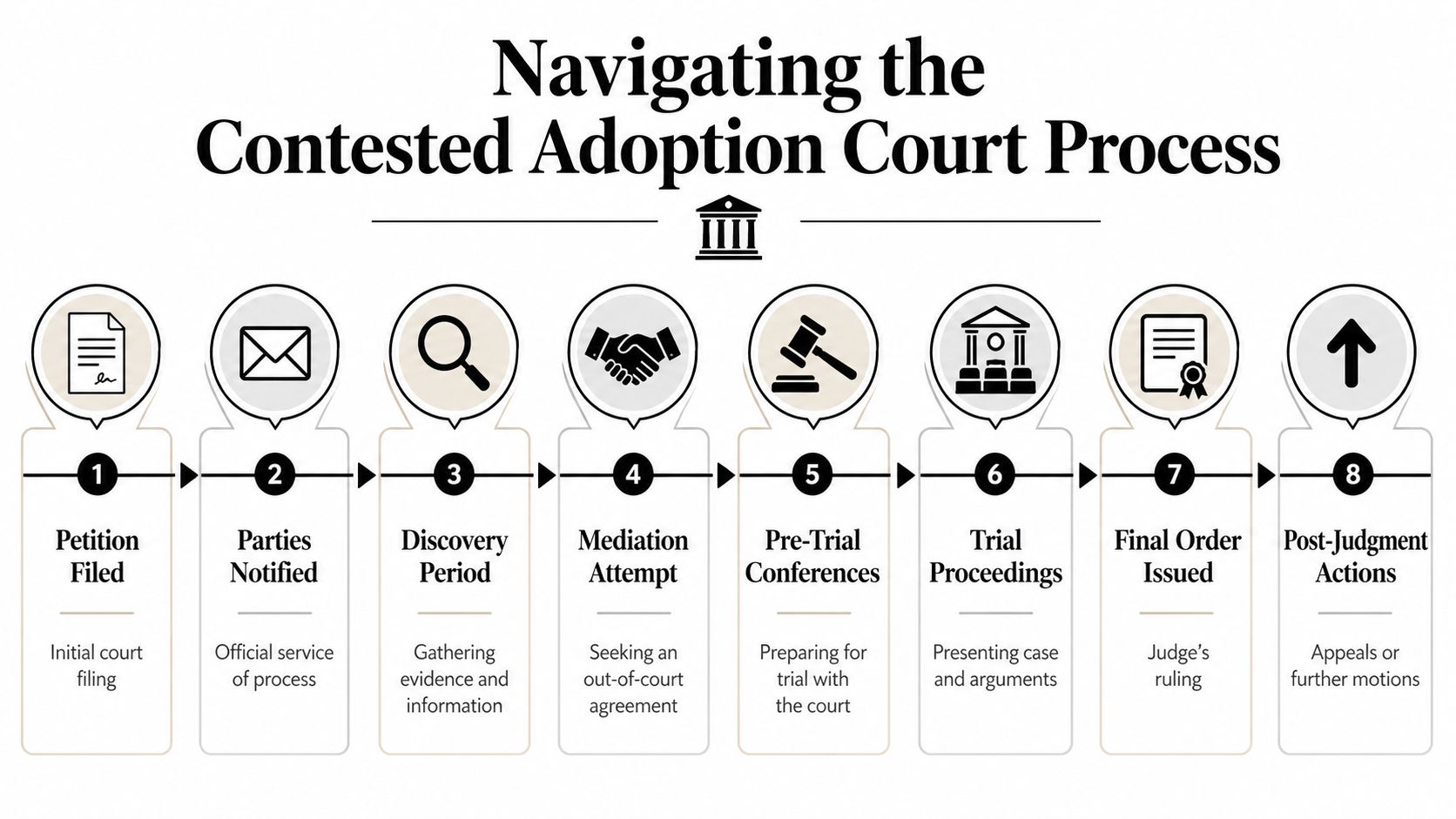
The process often starts with a petition, followed by formal notice, information gathering, negotiations, hearings, and eventually a final ruling. In some cases, the court also appoints professionals to help assess the child’s needs and best interests.
If the case involves termination issues, families often benefit from understanding the legal framework behind Texas termination of parental rights, because adoption and termination are often tightly connected in a contested case.
Phase one with filing and notice
The case begins when the proper petition is filed. Then the other interested parties must receive legal notice. This is not a courtesy email. It is formal service that tells the court everyone had a fair chance to respond.
Improper notice can create major problems. Even a strong case can get delayed if service was incomplete or challenged. That is one reason contested adoptions demand detail-oriented work from the start.
Phase two with investigation and evaluation
After filing, the court may require or review a home study or adoption evaluation, depending on the type of adoption and whether any exception applies. In contested stepparent matters, the court may also appoint an evaluator and may involve an amicus attorney or attorney ad litem to focus on the child's interests.
That professional is not there to cheer for either side. Their job is to gather information, observe, interview, and report concerns relevant to the child. Families often find this unnerving because it can feel like being judged in your own home. A better way to view it is this: the evaluator is helping the court understand the child’s daily world.
The evaluator may look at issues such as:
- Home stability and whether the child’s routine is safe and consistent
- Bonding between the child and the proposed adoptive parent
- Background checks and any history that raises concern
- Household functioning including discipline, communication, and support systems
A home study is not a contest for the "perfect" family. It is a review of whether this home can safely and permanently meet this child’s needs.
Phase three with discovery
Discovery is the formal exchange of information. This can include requests for documents, written questions, subpoenas, and depositions. It sounds technical, but the idea is simple. Each side gets access to evidence before trial.
Your earlier organization proves valuable. Records that seemed small at home can become important in discovery. School attendance logs, medical appointment records, communication history, and evidence of the child’s daily care often gain legal significance here.
Here are examples of what lawyers may seek:
| Court process stage | What families often need to provide |
|---|---|
| Filing and notice | Existing orders, names, addresses, legal relationships |
| Evaluation or home study | Household information, references, background details |
| Discovery | Texts, emails, calendars, records, photos, witness lists |
| Final hearing | Clear testimony and organized exhibits |
Phase four with mediation and pretrial work
Many cases do not go straight from discovery to trial. Courts often encourage mediation or settlement discussions. There may also be pretrial conferences where the judge sets deadlines, narrows disputed issues, and addresses evidentiary problems.
This can feel frustrating because families often want one big day where everything gets decided. In reality, contested cases are built step by step. The court wants a manageable record, not chaos.
Phase five with trial
At trial, the judge hears evidence and testimony. Depending on the case, witnesses may include the parties, caregivers, teachers, professionals, and others with direct knowledge. The judge decides whether legal grounds for termination exist, if required, and whether the adoption is in the child’s best interest.
Anonymous examples help make this concrete:
- A stepparent case may center on whether the objecting parent maintained a meaningful relationship and whether legal grounds exist to end that parent’s rights.
- A kinship case may focus on long-term stability, safety concerns, and who has provided day-to-day care.
- A CPS-related case may involve a more structured placement process after parental rights have already been terminated.
In CPS-involved adoptions, the process is especially structured. The DFPS Adoption Resource Guide states that caseworkers typically screen 3 to 5 potential homes, about 60 percent are eliminated because of mismatches, and the process from placement to finalization averages 24 months, though a contested case can extend that timeline, as described in the DFPS Adoption Resource Guide.
Who each person is in the courtroom
Families do better when they know the roles:
- Judge decides the legal issues and the child’s best interest
- Petitioner’s attorney presents the adoption and, when needed, the termination case
- Opposing party or attorney challenges the petition
- Attorney ad litem or amicus attorney focuses on the child’s interests
- Evaluator or social worker provides assessment information
- Witnesses bring facts, not rumors
Knowing these roles lowers anxiety because it helps you see that the courtroom is structured, even when emotions are high.
Strategic Crossroads Mediation, Settlement, or Trial
Most families enter a contested case thinking trial is the main event. Sometimes it is. But many of the most important choices happen before trial, when the adults have to decide whether to negotiate, compromise, or ask the judge to decide everything.
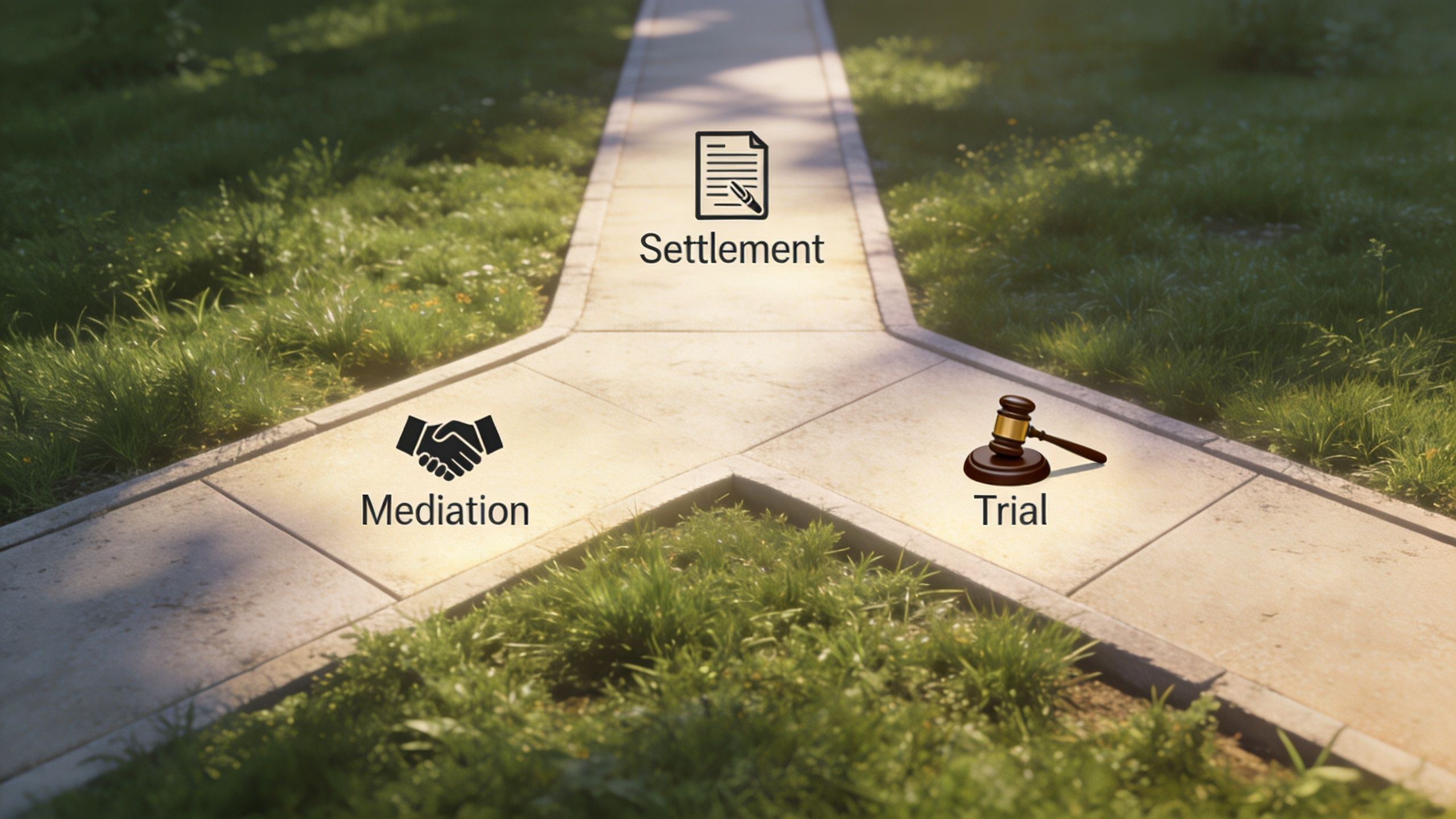
Mediation
Mediation is a private settlement process where a neutral mediator helps the parties talk through options. It does not mean you are giving up. It means you are testing whether a safer, less painful agreement is possible.
In family law matters, including adoptions, mediation can be powerful when both sides are willing to participate in good faith. As noted earlier in the legal framework discussion, documented communication and good-faith negotiation can make mediated resolutions highly effective. That practical reality is one reason many families consult a skilled Texas adoption attorney before deciding whether to mediate, settle, or prepare fully for trial.
Mediation may help when the disagreement is partly about fear, communication, or future contact rather than a full denial of the child’s current reality.
Settlement
Settlement is broader than mediation. It means the parties reach some agreement without a full trial. In some cases, a settlement may involve consent to adoption after certain concerns are addressed. In others, the conflict may narrow even if the entire case does not resolve.
A settlement can sometimes preserve dignity in a situation where everyone has already suffered. For example, a biological parent may have great concern but still be unable to offer a stable home. A negotiated outcome may reduce conflict and help the child avoid prolonged uncertainty.
Trial
Trial gives the judge the final say. That can be necessary when the facts are strongly disputed, when one side refuses any reasonable resolution, or when the child’s safety requires a clear court ruling.
Trial also has costs that are not just legal. Testimony can be stressful. Cross-examination can feel personal. Delays are common. The result is binding, but it is no longer in the parties’ control.
A side-by-side look
| Path | What families often gain | What families often give up |
|---|---|---|
| Mediation | Privacy, flexibility, a chance to reduce conflict | Full control if no agreement is reached |
| Settlement | A tailored outcome and less courtroom strain | The chance to have a judge decide every issue |
| Trial | A definitive ruling based on evidence | Time, emotional energy, and predictability |
When each path makes sense
Consider mediation when communication is strained but not hopeless.
Consider settlement when the core facts are clear and the disagreement may be narrowed by practical terms.
Prepare for trial when major legal rights are disputed and no safe agreement is possible.
Some of the strongest families choose mediation first, not because their case is weak, but because the child needs less conflict if a lawful agreement can be reached.
This matters in contested adoption texas cases because the process itself affects the child. Even when adults are respectful, prolonged conflict can strain routines, relationships, and emotional security. A strategic decision is not just about legal advantage. It is about what road causes the least harm while still protecting the child’s future.
Conclusion Building Your Family's Future with Confidence
A contested adoption can shake a family’s sense of stability. It can turn a moment that should feel hopeful into one that feels uncertain and heavy. But uncertainty isn't the end of the story.
The path is still there. It requires more care, stronger evidence, and patient legal guidance.
The families who move through these cases well are not always the loudest or the most emotionally certain. They are often the ones who stay child-focused, document carefully, follow the court’s process, and resist the urge to let conflict define the case. That is what helps judges see the difference between adult disagreement and a child’s real need for permanency.
Texas continues to have a deep need for stable adoptive homes. In 2020, 5,249 Texas children were adopted through the child welfare system while 12,319 remained waiting to be adopted, according to the Texas fact sheet published by the Child Welfare League of America. Behind those numbers are children who need safety, routine, belonging, and legal permanency.
If you're facing a contest, don't measure your progress only by how fast the case moves. Measure it by whether each step protects the child and strengthens the legal foundation for the future.
You don’t have to sort through that future alone. Clear answers, careful planning, and a calm strategy can make this process feel far less overwhelming.
Frequently Asked Questions About Contested Adoptions in Texas
Some questions come up again and again, especially late at night when families are trying to understand what tomorrow may bring. These direct answers can help.
| Question | Answer |
|---|---|
| Can a biological parent stop an adoption just by objecting? | Not automatically. An objection can delay finalization and require the court to address parental rights and the child’s best interest, but the court still decides the case based on the law and the evidence. |
| Will the child have to testify in court? | Not always. Courts try to protect children from unnecessary stress. Depending on the child’s age, maturity, and the issues in dispute, the judge may rely more heavily on professionals, records, or testimony from adults. |
| Does a contested adoption always go to trial? | No. Some cases resolve through mediation, negotiation, or narrowing the issues before a final hearing. Others require trial because the facts or legal rights are sharply disputed. |
| What if the other party suddenly starts contacting the child more often after the case is filed? | That can happen. The court will usually look at the full history, not just last-minute changes. Keep a calm, accurate record of contact, follow existing orders, and avoid turning the child into a messenger. |
A few practical clarifications
People also ask whether a contested case means they did something wrong. Usually, it doesn’t. It often means adoption has moved from a cooperative process into a disputed legal one. The legal standard changes. Your need for precision increases.
Another common question is whether kindness hurts your case. It doesn’t. You can be calm, respectful, and child-focused while still setting boundaries and presenting strong evidence. In fact, judges often notice the adults who manage conflict without escalating it.
When in doubt, choose the response you would be comfortable seeing read aloud in a courtroom.
Some relatives wonder whether guardianship would be easier than adoption. Sometimes it may be a separate option worth discussing, but it does not provide the same permanence as adoption. The right path depends on your facts, the child’s needs, and whether long-term legal stability is the goal.
If your situation involves a stepparent, relative caregiver, foster child, or consent dispute, individualized advice matters. Small procedural differences can change the entire case.
If you're facing a contested adoption and need steady, compassionate legal guidance, the Law Office of Bryan Fagan, PLLC is here to help. Our team works with Texas families at every stage of the adoption process, including stepparent, kinship, CPS, and other complex cases. Schedule a free consultation to talk through your situation, understand your options, and take the next step toward clarity and stability for your family.
