
The courthouse doors close behind you. Your child may be holding a small stuffed animal, clutching your hand, or smiling because everyone in the hallway just said “congratulations.” You feel relief, joy, and maybe a little disbelief that this long process is finally over.
Then a quieter question often shows up on the drive home. What does this mean legally now? Not just in a ceremonial sense, but in daily life. Can you sign school papers? Make medical decisions? Will your child have the same inheritance rights as any other child in the family? And what changes later, when that child becomes an adult?
Those questions are normal. They matter because adoption isn't only about love and commitment. It's also about giving a child a secure legal place in a family. When people ask, what rights do adopted children have in Texas, they're usually asking something deeper: will this child be protected, recognized, and fully part of the family in every way that counts?
Texas law gives strong answers, but the rules can still feel overwhelming at first. The good news is that the big picture is clear. Once an adoption is finalized, Texas treats that child as a full legal child of the adoptive parent. From there, the details become easier to understand step by step.
The Moment After Finalization Your New Family's Legal Reality
A lot of families expect the final hearing to feel like the end of the story. In one sense, it is. The court signs the order, pictures are taken, and everyone breathes a little easier. But emotionally, many parents and relatives feel a new responsibility settle in right away. They want to know what has changed, what still needs attention, and how to protect the child moving forward.

One simple way to think about finalization is this. Before the hearing, the family may already live like a family. After the hearing, Texas law recognizes that family relationship as permanent. That legal recognition affects school records, medical decisions, inheritance, and the child's place in the family going forward.
For many families, it also brings peace. The uncertainty of “Will we be allowed to?” starts to fade. If you want a fuller look at what changes once the judge signs the order, this guide on what happens after an adoption is final in Texas helps explain the next practical steps.
Adoption finalization doesn't just confirm who loves the child. It confirms who the law recognizes as the child's parent.
That difference matters to hopeful adoptive parents, birth parents, and relatives alike. It helps everyone understand where rights begin, where prior rights end, and why Texas courts spend so much care on the process. The law is trying to create stability, not confusion. For a child, that stability can mean something very personal: a safer sense of where they belong.
The Cornerstone of Adoption Equal Legal Standing in Texas
The most important right is also the simplest to say. Once an adoption is finalized in Texas, the adopted child has the same legal and inheritance rights as a biological child. The Texas Department of Family and Protective Services puts it plainly: “Once adopted, a child has the same legal and inheritance rights as naturally born children.” Texas has applied that rule on a large scale. The agency states that 53,412 children had been legally adopted in the period it reviewed, and annual adoptions increased 27.2%, from 4,802 in fiscal year 2010 to 6,108 in fiscal year 2019, according to Texas DFPS adoption information.
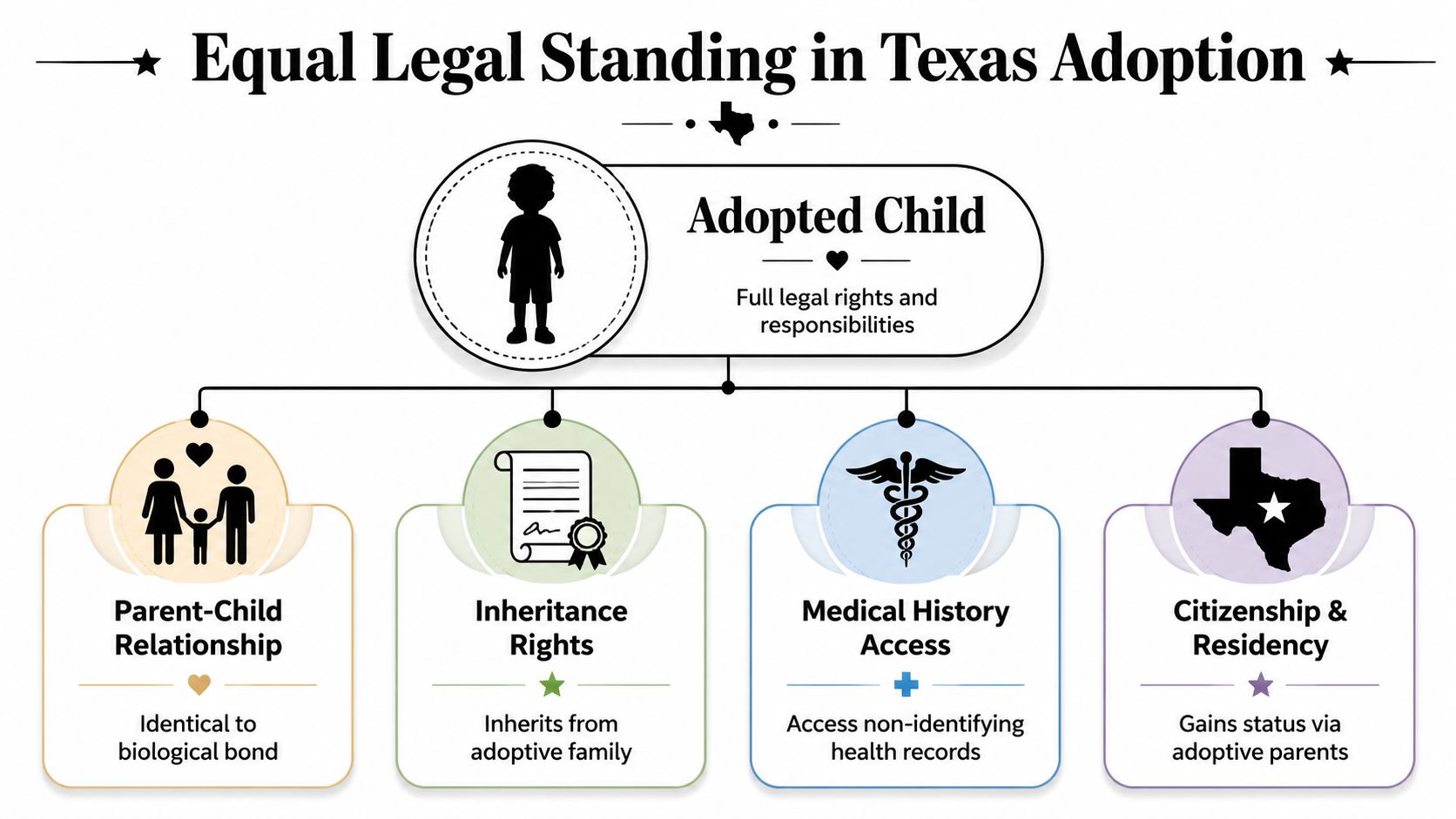
What equal legal standing really means
In plain English, equal standing means the law doesn't treat adoption like a second-tier relationship. After finalization, the child is not “almost” your child or your child “for some purposes.” The child is your legal child.
That affects everyday life in ways families feel immediately:
- Family identity: The child becomes part of the adoptive family's legal structure.
- Parental authority: The adoptive parent can act as the child's legal parent.
- Inheritance status: The child stands in the same line as a biological child when inheritance questions come up.
- Long-term security: Other institutions, like schools and medical providers, can rely on the legal parent-child relationship.
A house-building comparison helps here. Before you can build, you have to clear the old legal framework that conflicts with the new one. In many Texas adoption cases, that means the biological parents' parental rights must be permanently terminated before the adoptive parent becomes the child's legal parent. Then the adoption decree becomes the new foundation.
Why termination matters before adoption
This is one of the hardest parts for families to talk about because it carries so much emotion. But legally, it's critical. Texas adoption law is designed to create one clear, permanent parent-child relationship through the adoption order.
If you're trying to understand who gains rights and who loses them in that process, this resource on the rights of adoptive parents gives a useful companion overview.
Some families face voluntary termination. Others face contested cases and court hearings. In either situation, the legal purpose is the same. The court is making sure the child's status is stable and not divided by overlapping parental claims.
A short explanation of the hearing itself can help too. Finalizing a Texas Adoption: The Final Hearing describes what happens at the hearing that makes the adoption legal.
Later in the process, many families find it helpful to hear a visual explanation of how Texas courts approach adoption rights and finalization.
Practical rule: If the adoption has been finalized, Texas law treats the child as a full legal child of the adoptive parent, not as a lesser category of family member.
Key Rights and Responsibilities During Childhood
The clearest test of adoption often comes on an ordinary Tuesday.
A child wakes up with an earache. School calls about a field trip form. The pediatrician's office needs consent for treatment. In those everyday moments, a finalized adoption gives the child something deeper than paperwork. It gives the family a stable legal center. The adoptive parent is the person the law recognizes to protect, decide, and show up.
For children, that daily clarity can feel like security. For parents, it brings both authority and duty.
Daily parenting decisions
During childhood, legal parenthood shows up in practical ways over and over again. A parent can enroll the child in school, speak with teachers, review records, consent to medical care, add the child to insurance where eligible, and make the kinds of routine decisions every family has to make.
That may sound basic, but basic is often where security lives. A child should not have to wonder who can pick them up, sign the form, approve counseling, or speak to the doctor. Adoption turns those questions into settled answers.
Here are a few of the areas where that legal relationship matters most:
- Medical care: A parent can consent to treatment and coordinate with doctors about the child's health.
- Education: A parent can handle enrollment, school communication, records, and planning for the child's needs.
- Benefits and coverage: A parent can address insurance and other family-based eligibility issues.
- Daily upbringing: A parent can make decisions about routines, activities, discipline, and support at home.
The law is doing something quiet but powerful here. It is helping family life function without constant uncertainty.
The child's own voice in the process
Texas also gives many older children a meaningful role in the adoption itself. A child who is 12 or older generally must consent to the adoption unless a court waives that requirement in the child's best interest, as noted earlier in the article's discussion of Texas adoption procedure.
That rule is significant because adoption is not just something adults arrange around a child. In many cases, Texas asks the child to say yes to the new legal relationship.
For a stepparent adoption, this can be especially emotional. A child may feel happy that the law is catching up with real life. The same child may also feel uneasy, guilty, or confused about what that choice says about a biological parent. Those mixed feelings are common. They do not mean the adoption is wrong. They usually mean the child understands that family bonds carry history as well as hope.
Some children feel relief when they are given a voice. Others feel pressure. A calm explanation and room for honest questions usually help more than reassurance that everything is "fine."
Children often want concrete answers. Will my last name change? Will I still see certain relatives? What happens at court? Do I have to talk? Adults sometimes rush past those questions because they seem small. To a child, they are the map.
Time, transition, and support
Texas generally requires a child to live with the petitioner for a period before an adoption can be completed unless the court waives that requirement. Families sometimes experience that wait as frustrating, especially when everyone already feels committed. But the purpose is straightforward. The court is looking for stability, fit, and the child's best interest over time, not just on one good day.
Some children also need support after finalization. That is particularly true for children coming from foster care, kinship care, or a history of trauma, loss, or interrupted attachments. Legal security helps, but it does not erase grief overnight. Families may still need counseling, medical care, school services, or post-adoption assistance as they settle into a new normal.
A child's rights during these years are tied closely to the parent's responsibilities. The parent is not only allowed to make decisions. The parent is expected to keep showing up for the hard ones.
| Situation | Why the right matters |
|---|---|
| A child needs counseling | The family may need continued behavioral health support after adoption |
| A child has ongoing medical needs | Coverage can help maintain consistent care |
| A family is adjusting after foster care or kinship placement | Post-adoption services can support stability and transition |
A full legal role means full parental responsibility
Adoption gives a parent the same legal role any parent has during childhood. That includes attending school meetings, consenting to treatment, advocating for special services, setting boundaries, and helping the child work through fear, grief, and change.
In that sense, a child's rights and a parent's duties fit together like the frame of a house and the walls built onto it. One gives shape. The other gives shelter.
Families who are also thinking ahead to long-term financial security often ask how these childhood rights connect to inheritance questions later on. Our article on whether an adopted child can inherit from biological parents in Texas explains one of the areas that can surprise parents and adult adoptees alike.
Children do not just gain a new legal status through adoption. They gain the right to be cared for by a parent whose role is clear, recognized, and fully binding under Texas law.
Understanding Inheritance and Estate Planning
Inheritance is one of the most emotional legal questions in adoption because it touches belonging, fairness, and long-term family security. Many parents ask it privately. If something happens to me, will my adopted child be treated the same as my biological child?
In Texas, the general answer is yes. Once the adoption is finalized, an adopted child stands in the position of a legal child for inheritance purposes. That matters especially when someone dies without a will and the estate passes under intestacy rules.

The default rule most families rely on
If an adoptive parent dies without a will, the adopted child generally inherits as that parent's child. That is one of the strongest signs that Texas treats adoption as a real and complete parent-child relationship, not a symbolic one.
For families, this means adoption affects more than custody and caregiving. It also protects the child's place in the family across time, including during probate and estate administration.
The rare exception involving biological-family inheritance
Texas law has an important wrinkle that families sometimes miss. Texas Estates Code § 201.054 may allow an adopted child to still inherit from and through a biological parent if the right was not specifically eliminated in the termination order, as summarized by this discussion of adopted child inheritance rights in Texas.
That exception doesn't apply in every case. But it matters enough that families and lawyers should pay attention to the wording of court orders.
Here's why the details matter:
- Termination language counts: Probate outcomes can turn on what the order says.
- Assumptions can create conflict: Relatives may assume all biological inheritance rights ended automatically.
- Estate planning still matters: A clear will can reduce confusion and prevent painful family disputes.
If you want a deeper look at that narrow issue, this article on whether an adopted child can inherit from biological parents in Texas explores the problem in more detail.
A well-drafted will doesn't replace adoption rights. It makes family intent clearer when grief and legal questions arrive at the same time.
For many families, the best approach is simple. Trust the security adoption creates, then strengthen that security with updated estate planning. That combination gives children more than legal rights on paper. It gives them fewer questions later.
How Rights Are Established in Special Adoption Scenarios
The legal rights of the child are the same after finalization, but the road to get there can look very different depending on the family. A stepparent adoption doesn't raise the same questions as a foster care adoption. A kinship case often begins with an existing bond. An LGBTQ+ adoption may involve concerns about documentation, parental recognition, or matching the legal process to the family's lived reality.
That's why families often feel less anxious once they identify which path they're on.
Comparing the most common paths
| Adoption path | Main legal focus | How the child's rights are secured |
|---|---|---|
| Stepparent adoption | Terminating the other parent's rights when required | The child gains a legally recognized parent already acting in that role |
| Kinship or relative adoption | Converting an existing caregiving relationship into permanent legal parenthood | The child's day-to-day family bond becomes legally permanent |
| CPS or foster care adoption | Moving from temporary state involvement to permanency | The child gains a permanent family after court review |
| LGBTQ+ adoption | Completing the same legal process with clear parental recognition | The child receives full legal ties to the adoptive parent or parents |
| International adoption | Aligning foreign and Texas legal documentation | The child's legal family status is secured in Texas records and orders |
Stepparent and kinship cases
Stepparent adoption often feels emotionally straightforward because the child may already see the stepparent as “Mom” or “Dad.” Legally, though, the major issue is usually the termination of the other biological parent's rights before the new legal relationship can be created.
Kinship adoption has a different emotional tone. A grandparent, aunt, uncle, or older sibling may already be doing the daily work of parenting. Adoption in that setting often brings legal stability to a bond the child already depends on. It can also simplify school, medical, and long-term planning questions.
Foster care, LGBTQ+ adoption, and other family structures
Foster care adoption usually carries a strong permanency focus. The child may have already lived through uncertainty, court oversight, and changing placements. Finalization turns that temporary arrangement into a permanent family relationship, which can be profoundly stabilizing.
LGBTQ+ families often share the same core goal as any other family. They want the law to match the family the child already knows. The legal rights created by adoption are not different because of the parents' identity. What may differ is the paperwork, the route to parentage recognition, or the facts that bring the family into court.
Some families want practical legal guidance from a firm that handles adoption and guardianship matters across Texas. The Law Office of Bryan Fagan, PLLC provides information and representation for stepparent, kinship, foster care, LGBTQIA+ adoptions, and related family law matters.
The process under Texas Family Code Chapters 162 to 166
Even when the family story differs, the legal framework still centers on the same ideas found in Texas adoption law, especially the chapters that govern adoption procedure, consent, records, and related protections.
Families usually move through a process like this:
- Preparing the case: Gathering records, evaluating whether a home study or related review is needed, and making sure the filing matches the child's situation.
- Addressing parental rights: Determining whether someone must consent, relinquish rights, or be part of a termination proceeding.
- Placement and review: Giving the court enough information to decide whether the adoption serves the child's best interest.
- Final hearing: Asking the judge to create the permanent legal parent-child relationship.
The rights at the end are the same. The steps to get there depend on the family's circumstances.
Rights After Age 18 The Adult Adoptee's Journey
A young adult adoptee turns 18 and starts asking different questions than they did as a child. The focus often shifts from school forms and custody to identity, family history, medical information, and access to records. For many Texas families, this stage feels less like the end of the adoption story and more like a new chapter.
That shift can stir up strong emotions. An adult adoptee may feel secure and connected to their adoptive family while also wanting to understand where they came from. Those two experiences can exist together. In healthy families, they often do.
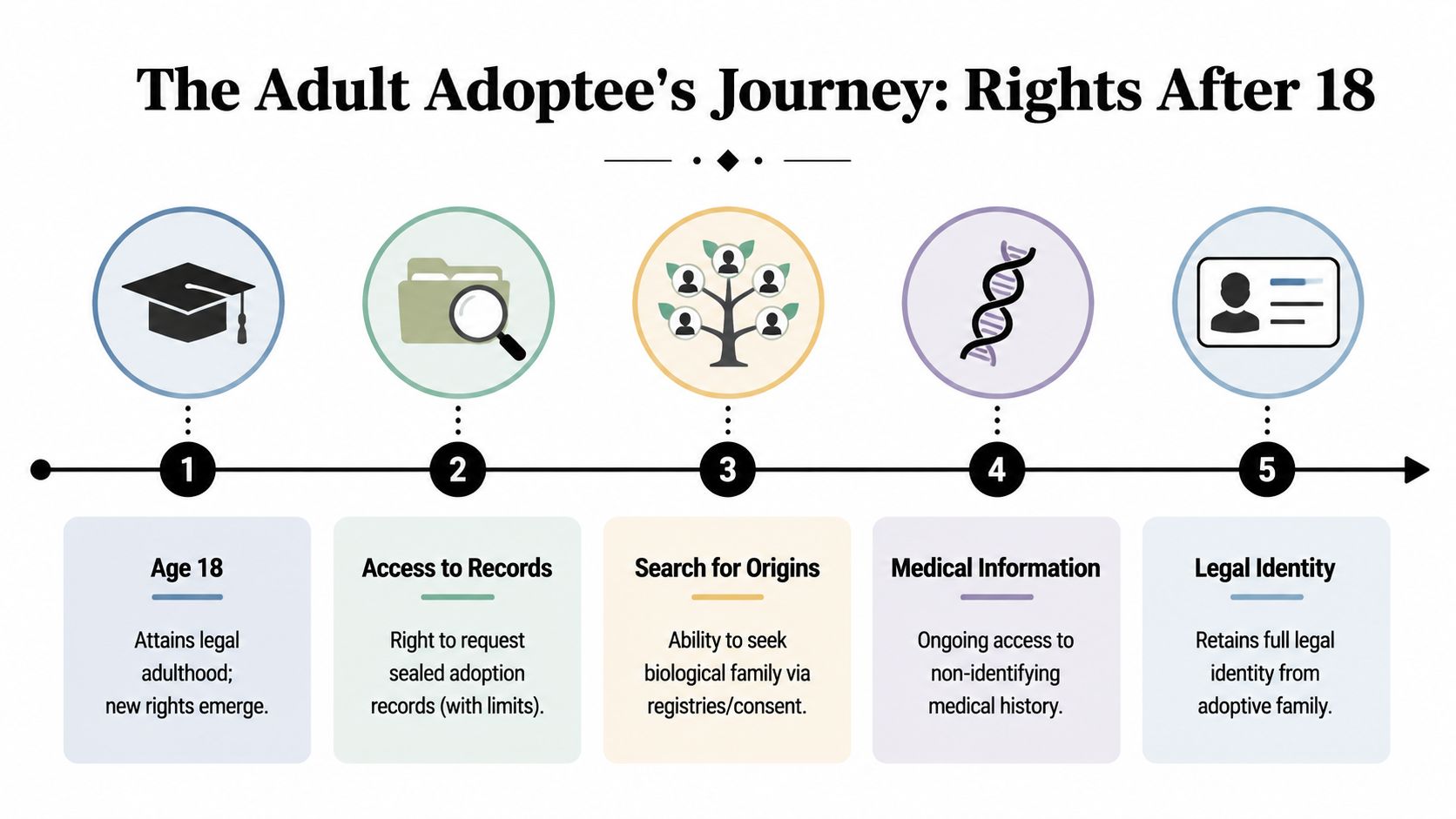
Access to records in Texas
Texas gives adult adoptees some ability to seek records, but the rules are still limited and can be confusing. As noted earlier, Texas law changed to allow some adult adoptees to apply for a noncertified copy of an original birth certificate in certain circumstances. Even so, access is not automatic in every case, and some records may still require court involvement.
The Adoptee Rights Law Center's Texas summary describes Texas as a “compromised state” for record access. That description fits the experience many adoptees have. The door is not fully closed, but it is not fully open either.
A simple way to understand it is this. Finalization creates a permanent legal family. Record access is a separate issue. One gives security inside the family. The other affects how easily an adult adoptee can learn about the past.
Why adult adoptees often seek records
For some people, record access is about genealogy. For others, it is about medical history, cultural roots, or wanting the facts of their own story to fit together in a clearer way.
Common reasons include:
- Medical information: Family health history can affect screening, treatment, and long-term planning.
- Identity and ancestry: Names, ethnic background, and early-life details can carry real personal meaning.
- Possible family contact: Some adult adoptees want to learn whether biological relatives are open to communication.
- Planning for the next generation: Adult adoptees may want accurate history for their own children.
Legal adulthood gives adoptees more independence. It does not guarantee full access to every document they hope to see.
That gap can be hard on everyone involved. Some adoptive parents worry that questions about birth family history signal distance or rejection. In many cases, the opposite is true. A secure family gives a person room to ask honest questions without fearing that love or belonging will be taken away.
The often-overlooked issue for adult adoptees with children
This point deserves more attention. Once an adoptee becomes a parent, record access stops being only a personal issue. It can affect their children too.
Available guidance indicates that descendants in Texas do not have a specific right to request the original birth certificate. In practical terms, that can leave families with missing medical background, gaps in genealogy, and unanswered questions that become harder to solve over time.
That is why careful family recordkeeping can be so helpful. Non-identifying background information, medical notes, court papers, and any history shared during the adoption process can become part of the foundation an adult adoptee uses later in life. Like a family photo album, those records may seem ordinary at first. Years later, they can provide reassurance, context, and answers when they are needed most.
Building Your Family with Confidence and Legal Clarity
Texas adoption law is built around a powerful idea. A child who is adopted becomes a real, permanent, legally protected member of the adoptive family. That security shows up in daily parenting, long-term inheritance rights, and the child's place in the family story.
If you've been asking what rights adopted children have in Texas, the answer is reassuring. The law is designed to create belonging, stability, and clarity. When questions come up about your specific situation, personal guidance can make the next step feel much easier.
If you're exploring adoption, finalization, stepparent adoption, kinship care, or questions about an adopted child's rights, the attorneys at Law Office of Bryan Fagan, PLLC invite you to schedule a free consultation. A compassionate conversation can help you understand your options, protect your child's future, and move forward with greater confidence.
