
Reversing an adoption in Texas is legally possible, but it is exceptionally rare and difficult. A birth parent may have only 10 days to withdraw consent in some situations, and after a final adoption decree, a challenge may be barred after six months if the adoption was properly completed.
You may be reading this after a sleepless night, with one painful question circling in your mind. Can this be undone? Maybe you're a birth parent who feels pressured by how fast everything happened. Maybe you're an adoptive parent facing facts you didn't expect. Maybe you're a grandparent or relative trying to understand whether a finalized adoption can be challenged at all.
Texas law approaches this question with one guiding priority. Children need stability. That idea shapes adoption law from the beginning of the case through finalization, and it explains why courts are so cautious about reversing an adoption once it becomes final.
The Question Haunting Many Families
Many families ask this question.
An adoptive parent may wonder what happens if a placement has turned into a crisis. A birth parent may look back and feel panic, grief, or confusion after signing paperwork. A relative may suspect something went wrong and ask whether the court can step back in. Different stories lead to the same question, and the emotional weight is heavy in every version.

The short answer is yes, but only in rare situations. Texas courts don't treat adoption like a casual agreement that can be canceled after someone changes their mind. They treat it like the creation of a permanent family bond, and judges are very careful about disturbing that bond.
Why this question feels so urgent
For many people, the legal question is really tied to an emotional one.
- Birth parents may be asking whether regret means the consent can be taken back.
- Adoptive parents may be asking whether serious undisclosed problems matter legally.
- Relatives may be asking whether they can protect a child if they believe the process was flawed.
Those are human questions, not selfish ones. When families are under stress, they often need both legal clarity and emotional support. If your household is already under strain, resources on managing child well-being during divorce can also help you think about how children process uncertainty, separation, and change.
Practical rule: In Texas adoption cases, the court's first question usually isn't "What do the adults want now?" It's "What protects this child's stability and well-being?"
A hard truth that can also be reassuring
That answer can feel harsh if you're in pain. It can also be reassuring if you're an adoptive parent worried that a finalized adoption could be reopened easily.
Texas courts know that children form attachments. They settle into routines, schools, medical care, and daily family life. The law tries to protect that sense of belonging, which is why successful reversal cases are uncommon and usually involve serious legal problems, not second thoughts alone.
Why Texas Law Views Adoption as Permanent
Texas adoption law is built around permanency. Under the Texas Family Code, especially the chapters that govern adoption procedure and related family law issues, the court doesn't view adoption as a trial run. It views adoption as the legal creation of a parent-child relationship that should be secure and lasting.
Just as pouring the foundation of a house allows for adjustments before the concrete sets, the initial stages of adoption leave room for change. However, once it hardens and the house is built on top of it, tearing it up affects everything resting above it. A final adoption decree works in a similar way. Once the court signs it, the law treats that parent-child bond as something meant to endure.
What finalization really means
When an adoption is finalized, the adoptive parent becomes the child's legal parent in a full and meaningful sense. This is why the process before finalization is so careful. Courts often look at a range of issues that support family stability, such as:
- Home study review to understand the proposed home environment
- Termination or relinquishment issues involving the biological parents' legal rights
- Placement history and how the child is adjusting
- Court approval to make sure legal requirements were met
For hopeful adoptive parents, that can feel slow. For a judge, it's how the law protects children before making a permanent decision.
Chapters 162 through 166 in plain English
These Family Code chapters cover much of the legal framework around adoption and related family issues in Texas. In practical terms, families usually experience them through the steps of the case rather than through section numbers.
A simplified path often looks like this:
Preparation
Families gather records, complete screenings, and prepare for a home study when one is required.Consent and termination issues
The court must be satisfied that the legal rights of existing parents have been properly addressed.Placement and adjustment
The child's day-to-day care, safety, and connection with the proposed family matter.Final hearing
A judge reviews the file and decides whether adoption is in the child's best interests.
Adoption law isn't designed to create easy exits after finalization. It's designed to make sure the court gets the decision right before finalization.
That framework helps explain why asking Can an Adoption Be Reversed in Texas? is really asking whether something serious happened that justifies disrupting a permanent legal family relationship.
Strict Timelines for Challenging an Adoption
Timing matters in adoption cases more than many families realize.
Texas law doesn't leave the door open indefinitely for someone to revisit a completed adoption. The law moves quickly because delay creates uncertainty, and uncertainty can be painful for a child who needs to know where home is.
Before finalization and after finalization are different
One of the biggest points of confusion is this. Stopping an adoption before it becomes final is not the same as reversing it afterward. Those are very different situations.
According to Texas family-law commentary, a birth parent may have a 10-day window to withdraw consent after it is given, and once a final adoption decree is entered, a challenge may become barred after six months if the adoption was properly completed, as explained in this discussion of how long a birth parent has to revoke consent in Texas and the related legal overview at Rodriguez Family Lawyer on whether an adoption can be overturned.
That doesn't mean every case is simple or automatic. It means the law strongly favors quick finality.
Why the deadlines are so short
Courts don't want children living in legal limbo.
If a parent signs consent and later wants to challenge that decision, the law expects that challenge to happen fast. If a court has already signed the final decree, the legal system becomes even more protective of the adoption. At that point, later challenges usually require something more serious than regret or a change of heart.
A useful way to think about it is this:
| Stage of case | What the law tends to allow |
|---|---|
| Before final decree | There may be a narrow chance to contest or withdraw consent |
| After final decree | The path gets much narrower and usually requires major legal proof |
What families often misunderstand
People sometimes assume they can "go back to court later" if they feel the adoption wasn't the right choice. In Texas, that assumption can be dangerous.
- Delay can close the door: Waiting too long can eliminate options that might have existed earlier.
- Finalization changes everything: Once the decree is signed, the legal status of the child and parent changes in a deep way.
- Urgency matters: If fraud, coercion, or a serious defect is suspected, early legal review is critical.
When families ask about reversal, the date paperwork was signed and the date the decree was entered often matter almost as much as the facts themselves.
If you're unsure whether your case is still in the placement stage or already finalized, that distinction needs to be sorted out immediately. The answer can change the entire legal path.
The Extremely Limited Grounds for Reversal
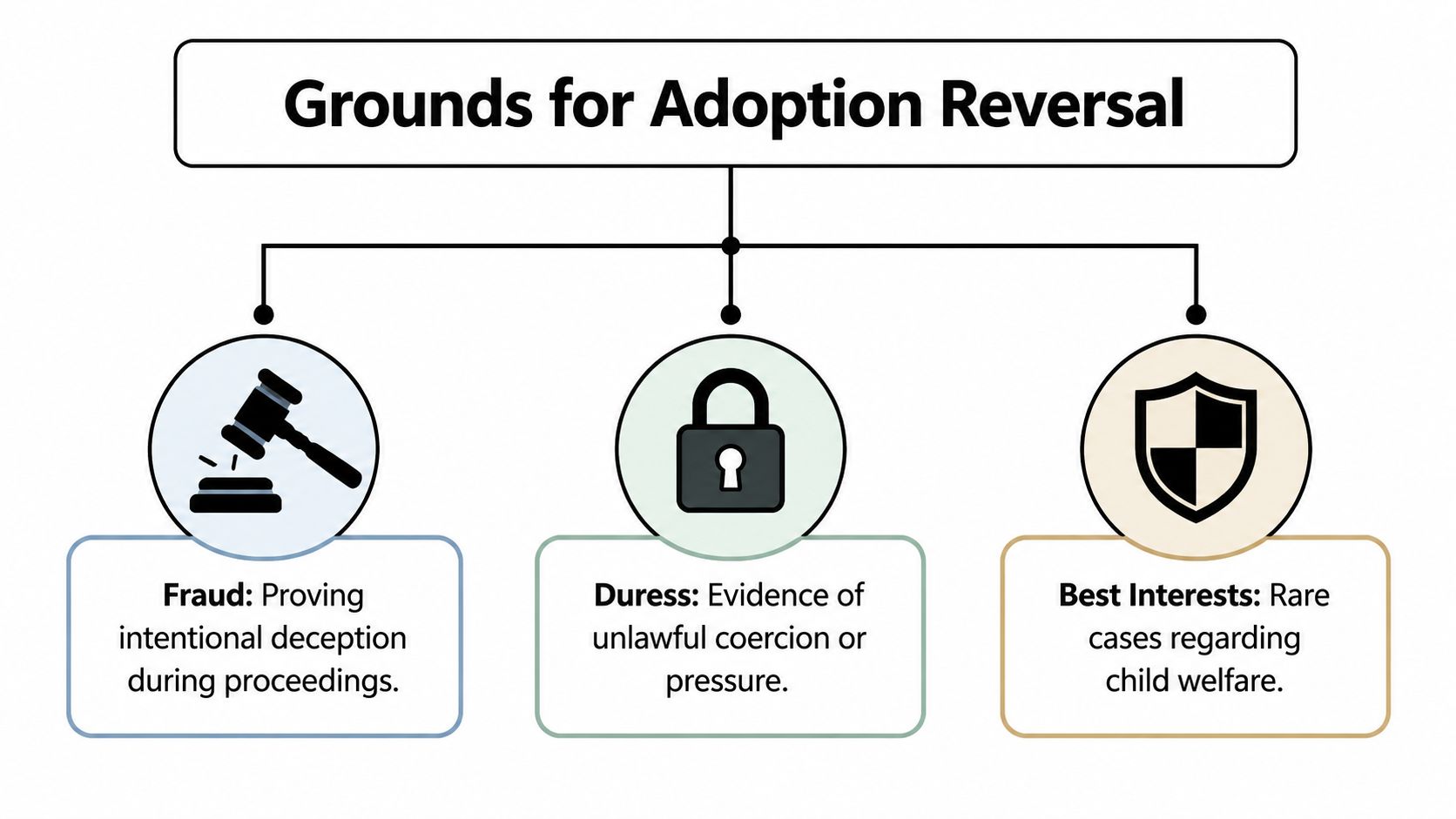
After a Texas adoption is finalized, courts usually treat it as a stable legal parent-child relationship. Reversal is described as rare because the court must find either a compelling procedural defect or conclude that reversal is in the child's best interests. In practice, a person alleging fraud or duress must provide clear, convincing proof of hidden facts, coercion, or another serious legal error, while the court also looks closely at the child's attachment, safety, and placement stability, as explained by Eddington Worley on reverse adoption in Houston Texas.
Fraud means more than feeling misled
Fraud usually means someone intentionally hid or lied about an important fact during the adoption process.
For example, a person might claim that a signature was obtained through deliberate deception about what document was being signed. Or a party might say critical facts were intentionally concealed in a way that affected consent. This is a high bar. Courts usually want hard proof, not suspicion.
If you're trying to understand this issue better, this guide on what makes an adoption consent invalid in Texas gives helpful background on when consent may not hold up.
Duress and coercion are not the same as emotional pressure
Every adoption decision carries emotion. That alone does not make the consent invalid.
Duress usually means unlawful pressure or force. Coercion often involves pressure so serious that it overcomes a person's free choice. A birth parent who felt heartbroken, rushed, or conflicted may still have given legally valid consent. But if someone threatened them, trapped them, or manipulated them in a way that destroyed meaningful choice, that moves into a different category.
Here are simple examples:
Likely not enough by itself
A parent later says, "I was devastated and regretted signing."Potentially serious
A parent claims, "I was threatened with consequences if I didn't sign immediately."
The court will want evidence that separates normal emotional difficulty from unlawful pressure.
Serious legal defects can matter
Some cases focus less on what people said and more on whether the process itself was legally broken.
That might involve a major notice problem, a defective filing, or another procedural failure that goes to the validity of the adoption. These arguments can be technical, but the idea is simple. If the legal road was badly damaged, the court may examine whether the final result can stand.
The child's best interests remain the center of the case
Even if someone raises a serious legal issue, the court still has to think about the child living inside the legal file.
Is the child safe? Attached? Settled? Thriving in the adoptive home? A judge doesn't evaluate reversal in a vacuum. The court asks what this change would do to the child's life.
A reversal request may focus on adult conduct, but the court still measures the likely impact on the child.
That is why many reversal attempts fail. Even when an adult points to a real problem, the judge may decide that undoing the adoption would create greater harm for the child than leaving it in place.
Reversing Child Adoptions Versus Adult Adoptions
Many readers don't realize there are two very different conversations hidden inside this topic.
Reversing the adoption of a minor child usually raises deep questions about safety, attachment, and long-term stability. Reversing an adult adoption is often more about the wishes of the adults involved and the legal relationship they want the court to recognize or undo.
That difference matters because the court's focus changes.
A side-by-side comparison
| Factor | Child Adoption Reversal | Adult Adoption Reversal |
|---|---|---|
| Main concern | Child's welfare and stability | Consent and legal wishes of adults |
| Court focus | Best interests of the child | Agreement, legal validity, and procedural issues |
| Emotional impact reviewed by court | Attachment, home life, safety, continuity | Usually less centered on child welfare concerns |
| Difficulty level | Typically very high | Often more straightforward if the adults agree |
| Common context | Disputes over consent, alleged coercion, serious legal defects | Inheritance planning changes, relationship breakdowns, or mutual change of plans |
Why child cases are harder
A child adoption case affects someone who may have no voice in the courtroom but will live with the outcome every day. That is why judges move cautiously.
A child may know only one bedtime routine, one school pickup line, one set of parents. If a court breaks that legal bond, it can shake the child's entire world. The law takes that seriously.
Adult adoption cases usually involve a different analysis
Adult adoptions often formalize an existing parent-like relationship or serve estate and inheritance goals. If the adoptive parent and adopted adult both want to revisit the arrangement, the case may be less tangled because the court isn't trying to protect a minor's daily sense of safety and belonging.
Readers who are asking about that separate topic may find this guide on adopting an adult in Texas useful.
Not every adoption reversal question is really about a child. When the adopted person is an adult, the legal analysis can look very different.
What Kind of Evidence a Court Requires
A court does not treat an adoption challenge like a family disagreement that can be sorted out by telling each side's story. The judge is being asked to disturb a legal parent-child relationship. Because of that, the proof usually needs to be specific, consistent, and tied to a recognized legal problem.
Feelings still matter. They help explain why someone is coming forward. But a court usually needs facts it can verify.

What persuasive evidence often looks like
The right evidence depends on the legal ground being raised. A fraud claim calls for different proof than a claim about duress or a serious defect in the court process. Still, judges often look for the same basic qualities. Was the evidence created close to the events? Does it match other records? Does it explain how the alleged problem affected the adoption itself?
That can include:
- Texts, emails, letters, or signed documents showing deception, threats, pressure, or key facts being concealed
- Witness testimony from people who directly saw conversations, conduct, or signing circumstances
- Court filings, hearing transcripts, or service records that point to a major procedural defect
- Medical, counseling, or agency records if they directly relate to capacity, coercion, or another issue before the court
A judge will usually want more than a statement such as, "I did not understand what I was signing." The court often asks what caused that confusion, what evidence supports it, and whether the paperwork or surrounding events tell a different story.
Judges test the details, not just the accusation
One way to understand this is to picture the court building a timeline brick by brick. If one brick does not fit, the judge looks closer. If someone attended hearings, signed papers, accepted the adoption for a period of time, and only later objected, the court will examine those facts carefully.
That does not mean a claim fails just because time passed. It means the explanation has to hold together under pressure.
Courts also pay attention to whether the evidence points to a problem serious enough to justify disrupting the child's legal home. That is the emotional center of these cases. The question is not only whether an adult feels wronged. The question is whether the proof shows a legal defect so significant that the court should reconsider a relationship the law is designed to keep permanent for a child.
Here's a helpful overview for families who want a plain-language discussion of how courts evaluate evidence and procedure in adoption-related disputes.
Legal help usually matters early
These cases can be hard to assess from memory alone. Records may need to be gathered quickly. Witness accounts may need to be compared against filings and hearing dates. A small procedural detail can matter a great deal.
Law Office of Bryan Fagan, PLLC handles Texas adoption and guardianship matters, including questions about whether an adoption challenge may involve fraud, coercion, duress, or procedural error.
Focusing on Family Stability and Finding Your Path Forward
A family can reach this point carrying grief, anger, regret, or real fear for a child. The law does not ignore those feelings. It asks a harder question alongside them. What result gives this child the most stable and secure home now?
That focus can feel frustrating to adults who want a clear yes or no. But it helps to view adoption like the legal foundation of a house. Courts are very reluctant to pull up that foundation once a child is living safely inside it, unless there is a serious legal reason to do so. The goal is permanence, not repeated disruption.
Sometimes the better question is what helps now
In some situations, reversal is not the step that best protects the child. The better answer may involve counseling, clearer family boundaries, better communication, or a workable plan for contact if the facts and the law support it.
Those choices do not erase hurt. They can, however, address the core problem without tearing apart a legal relationship the court was meant to make permanent.

Some families begin with the goal of undoing an adoption. After a close review of the facts, the more helpful goal becomes protecting the child while solving a different legal or emotional problem.
A careful legal review can bring order to a very emotional situation. The timing, the final decree, the records, and the child's present home life all shape what is possible. It also helps answer an important question many people miss at first. Is this a rare challenge to a final adoption, or is it a different family problem that needs a different solution?
For those trying to answer, "Can an Adoption Be Reversed in Texas?", clear advice about your specific facts is usually the most useful next step. Law Office of Bryan Fagan, PLLC handles Texas adoption and guardianship matters and can help families understand what the law allows, what the court is likely to focus on, and what path may best protect the child at the center of the case. A confidential consultation can help you sort through the facts with compassion and honesty.
