
The phone rings. Then an email arrives from a lawyer. Then panic sets in.
Your adoption was already finalized. You stood in court, heard the judge sign the decree, and started building ordinary family life around a promise of permanence. So when someone later challenges that adoption, it can feel like the floor drops out from under you.
If you're in that position, take a breath. A finalized adoption carries real legal force. Courts don't treat it like a simple disagreement over parenting. They treat it as a challenge to an existing legal parent-child relationship. Historical federal information shows that post-finalization dissolution is uncommon, with one federal summary noting that roughly 1% of finalized adoptions failed relatively soon after finalization in the data it discussed, which reinforces how much permanence finalization creates for families in the federal summary on adoption disruptions and dissolutions.
That doesn't mean families should ignore a challenge. It means you should understand what kind of fight this is. In Texas, the question usually isn't, "Who wants the child now?" The question is whether there was a serious legal defect in the original adoption process, and while that issue is being sorted out, what arrangement best protects the child's day-to-day stability.
Many parents get stuck on the same fear: Will my child be taken from me while the case is pending? Sometimes people assume a filed challenge automatically changes custody. It usually doesn't work that way. Courts typically move carefully, and they focus on stability while legal issues are reviewed.
Your Adoption Is Finalized But Now It Is Being Challenged
A family in this situation often says the same thing first: "I thought this was over."
That reaction makes sense. Finalization is supposed to mark the end of the legal process and the beginning of normal life. In Texas, adoption under the Family Code, including the chapters that govern adoption procedure and related child protection matters, is built around permanence for the child. Once the court signs a final decree, the adoptive parent-child relationship becomes legally recognized, not temporary, not experimental.

Why the notice feels so frightening
Most families don't know what a post-finalization challenge means. They picture a birth parent changing their mind, or a relative suddenly appearing and asking the court to undo everything. In plain English, that's usually not enough.
A finalized adoption challenge is a legal attack on the decree itself. The person bringing the case usually has to claim something serious, such as fraud, coercion, or another major flaw in the original process. Courts are not starting from zero. They are weighing a completed legal status.
A challenge after finalization is serious, but it is not the same thing as an open door back into the case.
What families need most in the first few days
You need two kinds of clarity right away.
First, you need to know whether the challenge was filed on time and under a valid procedure. Second, you need to know what the court is likely to do about the child's placement while the case moves forward.
That second question matters because children still need breakfast, school pickups, bedtime routines, counseling appointments, and ordinary reassurance. The law may be sorting out technical issues, but the child is still living real life every day. Texas courts know that. In most contested situations, the child's immediate stability becomes a practical priority from day one.
The Legal Strength of a Finalized Adoption in Texas
Before finalization, an adoption is still a pending case. After finalization, it is a signed court judgment that creates a legal parent-child relationship.
That change is hard to overstate.
Under Texas Family Code Chapters 162 through 166, the court does not finalize an adoption until it has reviewed the legal path that brought the child to this point. Depending on the case, that review can include consent, termination of parental rights, notice, background checks, home study requirements, and the child's placement before the final hearing. Once the judge signs the decree, the court is no longer deciding whether the adoption might happen. It has already ruled that it did happen.
Finalization works much like closing on a house after inspection, financing, and signed documents. Before closing, problems can still stop the deal. After closing, ownership has legally changed hands, and undoing that result requires far more than second thoughts or family conflict. In adoption, the decree carries that same weight. It tells the court, schools, doctors, and everyone else that this child is legally your child unless a serious legal defect is proved.
That legal strength becomes especially important during the in-between period of a challenge. While the case is being argued, the court does not usually treat the child as if nothing was finalized. The existing decree remains the starting point. In practical terms, that often means the child stays with the adoptive parents unless a judge enters a temporary order for a specific reason tied to the child's safety or welfare.
What finalization means in practical Texas terms
For adoptive parents, finalization usually means:
- You are the child's legal parent with the rights and duties that come with parenthood.
- The adoption has already been approved by a court after review of the required legal process.
- A later challenge faces a high barrier because it is attacking an existing judgment, not asking the court to make a first-time placement decision.
If you want more detail about how Texas treats finality after entry of the decree, this explanation of whether an adoption can be reversed in Texas adds useful background.
Why families draw real protection from the decree
The emotional weight of this legal finality is significant. Adoptive parents often worry that a challenge means the adoption was never completely secure.
That is usually not the case.
Practical rule: Finalization does not make a court challenge impossible. It does mean your family begins from a legally recognized status that courts are generally reluctant to disturb without proof of a serious problem.
For a family in crisis, that point is more than legal theory. It often affects where the child sleeps, who takes the child to school, whether routines stay intact, and how much disruption enters daily life while the case is pending.
Valid Legal Grounds for Contesting an Adoption
A challenge after finalization can't rest on sadness, regret, or a changed opinion about adoption. The law usually requires a legally recognized defect in how the adoption happened.
Courts treat these cases as attacks on an existing legal status. That means the challenger generally must prove something like fraud in obtaining consent, coercion, lack of proper notice to a biological father, or a faulty termination of parental rights. Just as important, the proof usually needs to be documentary and procedural, not merely an emotional account of what went wrong as explained in this discussion of common legal challenges in adoption.
What these legal grounds mean in plain English
The terms can sound abstract, so it helps to translate them.
| Legal Ground | Plain-English Explanation | Example |
|---|---|---|
| Fraud | Someone was intentionally misled about an important fact that affected consent or the court process | A parent claims they signed because they were given false information about the legal effect of the papers |
| Coercion or duress | A person says they were pressured, threatened, or forced into signing | A birth parent alleges they were pushed into consent through intimidation |
| Lack of proper notice | A person entitled to legal notice says they were never properly told about the case | An alleged father argues he should have received notice before rights were terminated |
| Faulty termination of parental rights | The underlying court process ending a parent's rights had a serious legal problem | The challenge claims the termination order was defective under required procedure |
Why ordinary regret isn't enough
Many readers ask a hard question: "What if someone just says they made a mistake?"
Courts understand that adoption decisions can involve grief and second thoughts. But final decrees would mean very little if they could be undone every time an adult later felt differently. That is why the law usually limits these challenges to defects that call the integrity of the process into question.
A simple change of heart is not the same as fraud.
A painful emotional response is not automatically duress.
A family conflict after placement is not, by itself, proof the decree was invalid.
The documents often matter more than memories
In these cases, paper trails usually matter more than broad accusations.
The court may closely review:
- Signed consent forms
- Service records and returns
- Termination orders
- Court transcripts
- Home study records
- Any filings tied to notice and jurisdiction
If you're trying to understand whether consent problems could affect the case, this article on what makes an adoption consent invalid in Texas gives useful background.
The strongest post-finalization challenges usually point to a defect in the legal machinery of the adoption, not to disappointment with the outcome.
A quick example
Suppose a birth father was legally entitled to notice and claims he never received it. That doesn't automatically mean the adoption gets undone. But it does present a procedural issue the court has to examine carefully.
By contrast, if a relative says, "I would have raised the child differently," that usually does not attack the decree itself. It may be emotionally charged, but it is not the kind of defect courts usually look for in a post-finalization challenge.
What to Expect During the Legal Challenge Process
When families ask, "What happens if an adoption is challenged after finalization?" they usually aren't asking for a law school answer. They're asking: What happens next week? Where does my child sleep? Who makes decisions while this is pending?
That is the right question.
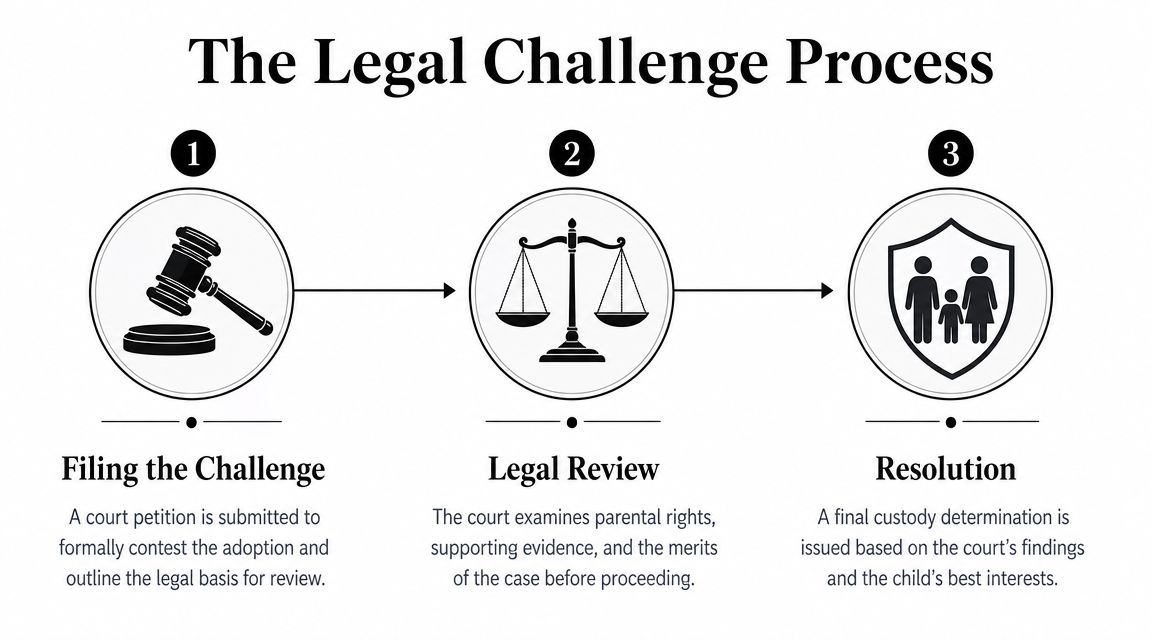
Step one is checking whether the case is even timely
After finalization, the legal posture changes. The challenge becomes a post-judgment attack on the adoption decree. In many places, that means a narrow filing window applies. One example from another state is Florida, where an action to vacate or set aside an adoption judgment must be filed within one year. The larger point is that these cases are time-sensitive, and the first question is often procedural viability, not emotional fairness in this explanation of adoption disruptions and post-finalization timing.
In Texas, your lawyer will usually start by reviewing dates, filings, notice, consent documents, and the final decree itself.
What usually happens with the child's placement
A filed challenge does not automatically mean immediate removal from the adoptive home.
Courts generally try to avoid unnecessary disruption while the legal issue is sorted out. If the child is doing well in the adoptive home, attending school, seeing familiar doctors, and bonded to the family, stability usually matters. Judges can issue temporary orders while the case proceeds.
Temporary orders can address things like:
- Where the child lives during the case
- Who can make medical and school decisions
- Whether any contact or visitation occurs
- Whether evaluations or supervised exchanges are needed
The in-between period often looks quieter than families fear
The legal paperwork may be intense, but the day-to-day routine often continues while the court gathers information.
That can mean the child remains with the adoptive parents while lawyers argue over notice, consent, or procedure. It can also mean temporary restrictions on contact if the court believes conflict would unsettle the child. In some cases, the court may order professional evaluations or appoint someone to help assess the child's needs.
What this means for daily life: Keep records, keep routines, and don't make sudden changes unless the court orders them.
A simple timeline
- A petition or motion is filed challenging the finalized adoption.
- Your attorney reviews the procedural issues such as deadlines, notice, consent, and jurisdiction.
- The court may hold an early hearing to decide temporary arrangements.
- Evidence is gathered, often focused on documents and prior court procedure.
- The court decides whether the challenge can move forward and, if so, what final relief is legally available.
Families often expect a dramatic, instant outcome. Most of the time, the process is slower and more document-driven than that. The courtroom question may sound technical, but the practical goal during the case is usually straightforward: protect the child's stability while the court decides whether the challenge has legal merit.
Defending Your Family Your Rights as Adoptive Parents
A post-finalization challenge can make loving, capable parents feel as if the ground just shifted under the house. That feeling is real. The law, however, does not reset your family to day one.
You are starting from an existing court order and an established parent-child relationship. In practical terms, your job is to protect the child's daily stability while your attorney challenges the legal basis of the case.

Your defense begins at home, not just in the courtroom
Families often expect this stage to revolve around a hearing date. Often, the more important work happens in binders, email folders, school pickup lines, counseling appointments, and the ordinary routines that show a child is safe and settled.
Start by gathering the full adoption record. Pull together the final decree, pleadings, service records, consent documents, termination orders, agency communications, home study materials, and any orders entered before finalization. Then build a second file for the child's current life. Include school records, medical records, therapy attendance, medication information, extracurricular schedules, and a simple calendar showing where the child sleeps, learns, and receives care.
That second file matters in the in-between period. If the court has to decide temporary questions about custody, contact, or exchanges while the challenge is pending, judges look for a clear picture of the child's real world, not just the adults' accusations.
Steps that protect your position and your child's routine
- Get legal counsel quickly. A lawyer can assess deadlines, notice issues, consent challenges, and procedural defects before the case turns into a series of emotional reactions.
- Do not make side agreements. Informal promises about visitation, placement changes, or letting someone take the child for a few days can create confusion and may undercut your legal position.
- Save every communication. Keep texts, emails, letters, social media messages, and voicemails related to the dispute.
- Keep the child's schedule steady. Continue school attendance, medical care, therapy, and family routines unless the court orders a change.
- Keep the child out of the conflict. Do not ask the child to report on another adult, repeat allegations, or choose sides.
For practical preparation, this guide on how to win a contested adoption case in Texas explains the kind of evidence and strategy these cases often require.
One available option for families seeking counsel in this area is the Law Office of Bryan Fagan, PLLC, which handles Texas family law matters including adoption and guardianship issues.
A short video can also help some families process the legal and emotional side of contested adoption matters.
What your lawyer is really trying to protect
Your attorney is usually building two parts of the defense at the same time.
The first is procedural. The court may need to decide whether notice was proper, whether consent was valid, whether required steps were followed, and whether the challenge was filed within the time the law allows.
The second is practical and child-centered. If the case reaches questions about temporary possession, contact, or disruption to the home, your lawyer will want evidence showing what the child's life looks like right now. A finalized adoption challenge is rarely only a dispute about hurt feelings. It often begins with technical legal claims, but during the case, the court still has to consider what will keep the child's life as steady and safe as possible.
That is why calm documentation is so powerful. A judge may hear competing stories from adults. Records showing consistent school attendance, regular medical care, therapy participation, and a stable home give the court something concrete to rely on while the case is pending.
How Texas Courts Protect the Child's Best Interests
Even in a very technical dispute, the child is not a piece of evidence. The child is the center of the case.
One of the biggest gaps in public explanations is the part families care about most: custody and contact during the lawsuit. Even while a challenge is pending, courts stay focused on the child's best interests. That can include temporary orders keeping the child with the adoptive parents for stability, appointing experts to evaluate the situation, and shaping later decisions around the child's welfare rather than the adults' competing claims in this discussion of what may happen when an adoption fails.
What best interests usually looks like in real life
In a courtroom, "best interests" isn't just a slogan. Judges look at lived conditions.
They may ask:
- Is the child safe where they are now
- How strong is the child's bond with the adoptive family
- Would a sudden move cause emotional harm
- What school, medical, counseling, and family routines are already in place
- Does the child need a neutral voice in the case
In some cases, the court may appoint an attorney ad litem or another professional to focus on the child's interests. That person does not represent either side's hurt feelings. Their job is to help the court understand what protects the child.
Stability often carries real weight
A child who has settled into a home, formed attachments, and built a routine is not living in a legal theory. That child is living in a family system.
Courts may need to examine old paperwork, but they usually make temporary and final decisions with one eye on the child's present world.
That doesn't mean legal defects don't matter. They do. But Texas courts often try to avoid turning a child's life upside down while adults litigate what happened in the past.
Immediate Steps to Take When Your Adoption Is Challenged
The first few days matter. Panic can lead families to make avoidable mistakes.
Start with calm, concrete action.

Do these things right away
- Read every page carefully. Find out what was filed, who filed it, and whether there is a hearing date.
- Collect your full adoption file. Include court orders, consents, proof of service, agency records, and placement paperwork.
- Write down a timeline. List major dates from placement through finalization and anything that happened after.
- Keep the child's routine steady. School, meals, therapy, and normal family habits matter.
- Talk to an adoption attorney quickly. Time issues can shape the entire case.
Avoid these common mistakes
Don't contact the challenging party to argue facts. Don't post online about the case. Don't promise visits or handoffs outside a court order. And don't pull the child into adult conflict by asking questions they shouldn't have to answer.
If your child is old enough to notice stress, keep your explanation simple and reassuring. They need to hear that the adults are handling it and that they are safe right now.
One last point families need to hear
A legal challenge is frightening. It is not the same thing as losing your child.
Most families need a clear plan, a careful review of the original case, and a strong focus on preserving the child's stability while the court addresses the legal issue.
If your finalized adoption is being challenged, legal advice can bring structure to a frightening situation. The Law Office of Bryan Fagan, PLLC helps Texas families understand adoption procedure, review decrees and consent records, and respond to post-finalization disputes with the child's stability at the center. If you need guidance, schedule a free consultation to talk through your options and next steps.
