
A CPS call can turn a hopeful adoption plan upside down in a single afternoon.
Maybe you're an adoptive couple who had already picked out a crib, and now the expectant mother tells you Child Protective Services is asking questions. Maybe you're a grandmother who just got a call asking whether your grandchild can stay with you tonight. Maybe you're a birth parent who wants adoption, but you're terrified that CPS got involved before you could make a plan.
If that's where you are, the first thing to know is this. CPS involvement doesn't always end an adoption path. It does, however, change who is making decisions, what paperwork matters, and what options are still available.
That's why the most important question in a CPS-related adoption case is often not “Can this adoption still happen?” It's “Who is in control right now?” The answer to that one question shapes almost everything that follows.
Texas families usually fall into one of three lanes. A private adoption where CPS suddenly appears. A foster care adoption where CPS is part of the process from the start. Or a kinship or relative case where a grandparent, aunt, uncle, or stepparent is trying to protect an existing bond with the child.
When you understand which lane you're in, the situation gets less foggy. You can stop reacting to every phone call and start making informed decisions.
When a Knock on the Door Changes Your Adoption Journey
Sarah and Miguel had already been matched with an expectant mother. They had spoken about names, hospital plans, and the kind of contact everyone hoped to keep after birth. Then came the call. CPS had opened an investigation.
Across town, Denise, a grandmother, got a different kind of call. Her daughter's children had been removed, and CPS wanted to know whether Denise could take them in. She wasn't thinking about “adoption law.” She was thinking about pajamas, school pickups, and whether the children would be scared.

These families are in very different situations, but they share the same first feeling. Panic. People often assume CPS means the door has slammed shut. In reality, CPS usually means the legal path has changed shape.
Why the path changes
In a standard private adoption, the adults involved usually make most of the early decisions. In a CPS case, the state may step in to evaluate safety, placement, and whether the child should return home. That shift can affect a birth parent's choices, an adoptive family's expectations, and a relative's rights.
The confusion comes from the fact that people use the word “adoption” to describe very different legal routes. In Texas, those routes can involve voluntary consent, court review, home studies, background checks, termination of parental rights, and a final court order under the adoption provisions families usually encounter in Texas Family Code Chapters 162 through 166.
A CPS case feels personal because it affects your family. But it also becomes procedural very quickly. That's why clear legal guidance matters early.
The first calming thought to hold onto
If CPS is involved in your adoption case, you still have options. They may not be the same options you had a week ago, but they matter. A private placement may still move forward if the child remains with the parent. A foster-to-adopt path may open if the state takes custody. A grandparent or other relative may be able to seek placement, conservatorship, or adoption.
The key is to stop guessing which rules apply. Your next step depends on who currently has legal authority over the child.
Understanding the Shift in Legal Authority
Think of adoption like traffic at a busy intersection. Before CPS gets involved, the birth parent and the prospective adoptive family are often directing most of the movement. Once CPS enters the picture, a new traffic controller steps into the middle of the road. That controller is the state, acting through CPS and the court.

When that happens, people don't get to keep driving as if the light is still green. The rules change because the state's first job is child safety.
Four terms that matter right away
Here are the words that usually cause the most fear, in plain English:
- Investigation means CPS is looking into a report and gathering facts.
- Removal means the child is taken out of the home.
- Conservatorship means a person or agency has legal authority to make decisions for the child. If CPS has managing conservatorship, the state has major decision-making power.
- Termination of parental rights, often called TPR, means the legal parent-child relationship is ended by court order. If you want a plain-English overview, this guide on termination of parental rights in Texas helps explain the concept.
Why the state's role feels so powerful
It is powerful. Once a child has been removed and placed in state custody, the parent usually can't independently place that child through a private adoption agency. At that point, the case is moving through a court-driven permanency system. Reunification may be considered first. If that fails, the state may move toward another permanent plan, including adoption.
This isn't rare. A peer-reviewed study published through the National Library of Medicine states that by age 18, about 1 in 3 U.S. children will have experienced a CPS investigation, 12.5% will have had a substantiated investigation, and 6% will have spent time in foster care.
Where readers usually get confused
Many people hear “open CPS case” and assume that means the parent has already lost all control. That's not always true.
A case can exist at different stages, and those stages matter:
| Case status | Who likely controls major placement decisions | What it often means |
|---|---|---|
| Investigation only | Parent still has legal custody | A private adoption plan may still be possible |
| Child removed | CPS and the court | The case usually shifts away from private placement control |
| State managing conservatorship | CPS under court oversight | Permanency planning follows the child welfare process |
| After TPR | Court and authorized placement process | Adoption becomes legally possible, but not automatic |
Practical rule: Ask one direct question early. “Is this case still pre-removal, or is the child already in state custody?” That answer changes almost every legal option on the table.
Under Texas law, adoption itself still requires a separate court process. Families usually move through screening, required reports, consent or termination issues, and finalization before a judge. But when CPS is involved, those adoption steps sit inside a larger child protection case, and that larger case controls the pace.
What Happens to a Private Adoption Plan
A private adoption can feel stable until CPS enters the room. Then the whole arrangement can become what lawyers often call a legal-risk situation. That phrase doesn't mean anyone did anything wrong. It means the legal authority behind the plan may change before the adoption can be completed.
Two very different outcomes
Sometimes CPS investigates, gathers information, and closes the matter without removing the child. In that situation, the parent may still have the ability to move forward with a voluntary adoption plan, including choosing an adoptive family and discussing future contact, depending on the facts and timing.
Other times, CPS substantiates concerns and removes the child. Once that happens, the case usually leaves the private lane and enters the state system. The matched adoptive family may no longer be the family who receives the child, even if everyone previously agreed.
Why agency conflict creates delays
Private adoption agencies and CPS are not doing the same job. A private agency focuses on consent, matching, and placement support. CPS focuses on safety, investigation, and statutory permanency planning. When both are involved, the risk isn't just duplicate paperwork. As noted by A Family for Every Child, there can be conflicting jurisdictional objectives and confidentiality constraints that delay consent, home study approval, and the creation of required child history documentation.
That is one reason families feel stuck. They may have done everything asked of them and still be told to wait.
What this means in real life
If you're the prospective adoptive family, try to separate emotional commitment from legal position. You may love this child already. But until the legal authority is clear, you may not control the outcome.
If you're the expectant or birth parent, timing matters. Before removal, you may still have meaningful choices. After removal, those choices usually narrow sharply.
The hard truth is simple. A private adoption plan can survive CPS involvement, but only if the parent still has the legal authority to make that plan.
Texas families also need to remember that adoption finalization has its own court requirements. Even in private cases, courts look for proper consents, required filings, and the child's best interests. If CPS has opened a parallel case, every step should be reviewed with extra care so one track doesn't undermine the other.
The Path to Adoption Through Foster Care
For some families, CPS isn't an interruption. It's the starting point. That's the foster-to-adopt path.
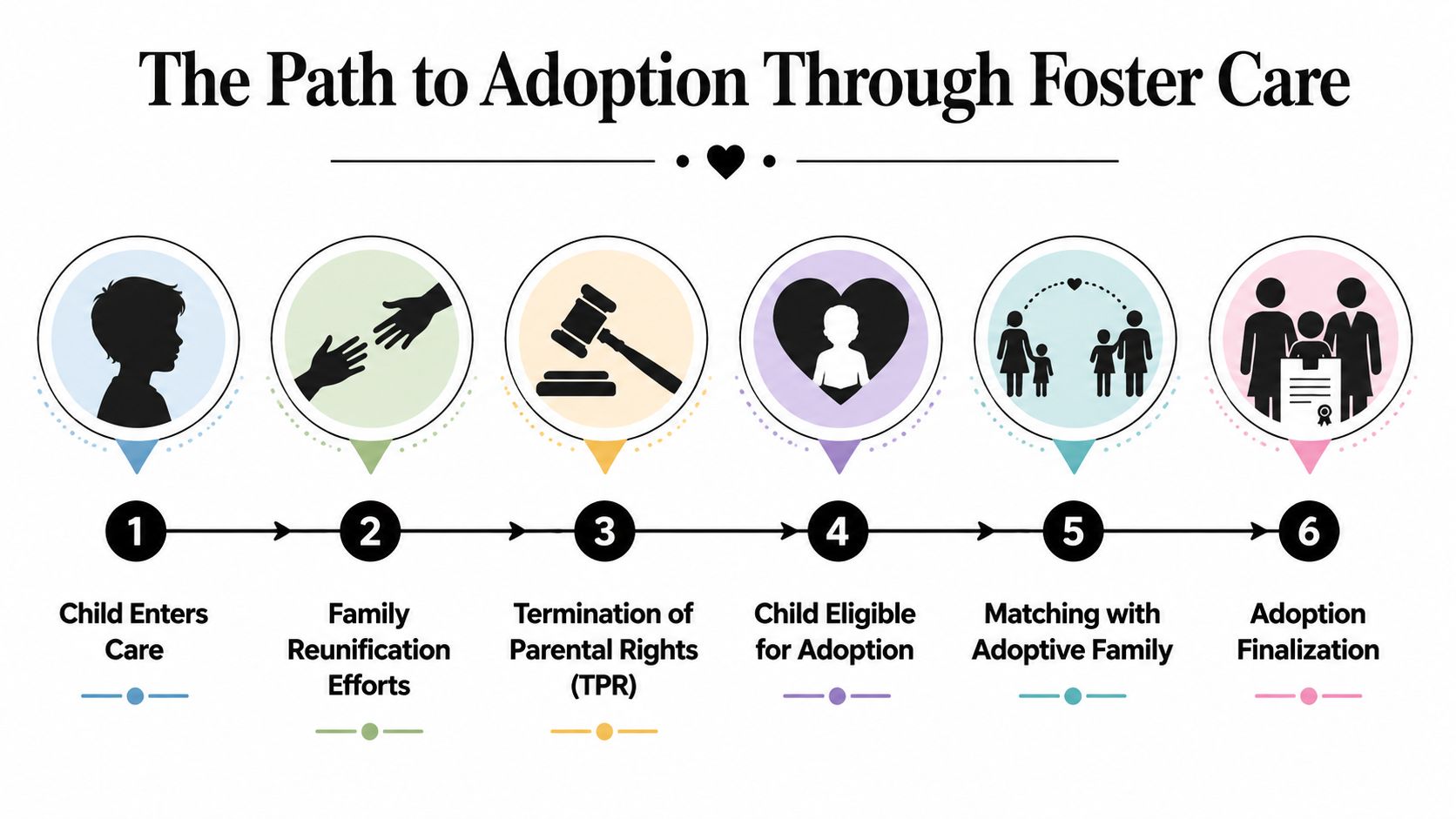
If that's your route, it helps to know that adoption does not begin the moment a child enters care. The case usually starts with safety concerns and a court case focused on whether the child can safely return home.
The basic sequence
Most foster-to-adopt cases follow a pattern like this:
- The child enters care. CPS places the child somewhere safe.
- Reunification efforts begin. The court often gives parents services and a path to regain custody.
- The court reviews progress. Hearings continue while the judge monitors safety and compliance.
- Parental rights may be terminated. If the legal grounds are met and the court finds it proper, TPR can occur.
- The child becomes eligible for adoption. Then the matching and adoptive placement process can move forward.
- The adoption is finalized in court. Texas law requires a separate adoption case and final order.
For a closer look at this route, families often find this page on adoption after CPS placement in Texas useful.
The need is real, and the process can still move slowly
Nationally, the scale is large. The National Council For Adoption foster care statistics update reports that in FY 2024, 46,935 children were adopted from foster care, while 328,947 children were still in foster care. The same update says 34,817 children remained in care even though they were legally free for adoption.
Those numbers help explain a painful truth. A child can be ready for permanency on paper, and the system can still take time to carry that out.
Here is a short video that helps many families understand the foster care adoption process in practical terms.
What Texas families should expect
Texas foster and adoptive families usually go through screening, training, a home study, and placement review before finalization. If a child is already placed with you, the emotional challenge is often the waiting. You care for the child every day, but the law still requires the court to work through the parent's case before adoption can proceed.
That waiting period can be heavy. It doesn't mean the process is failing. It means the court is balancing child safety, parental rights, and permanency.
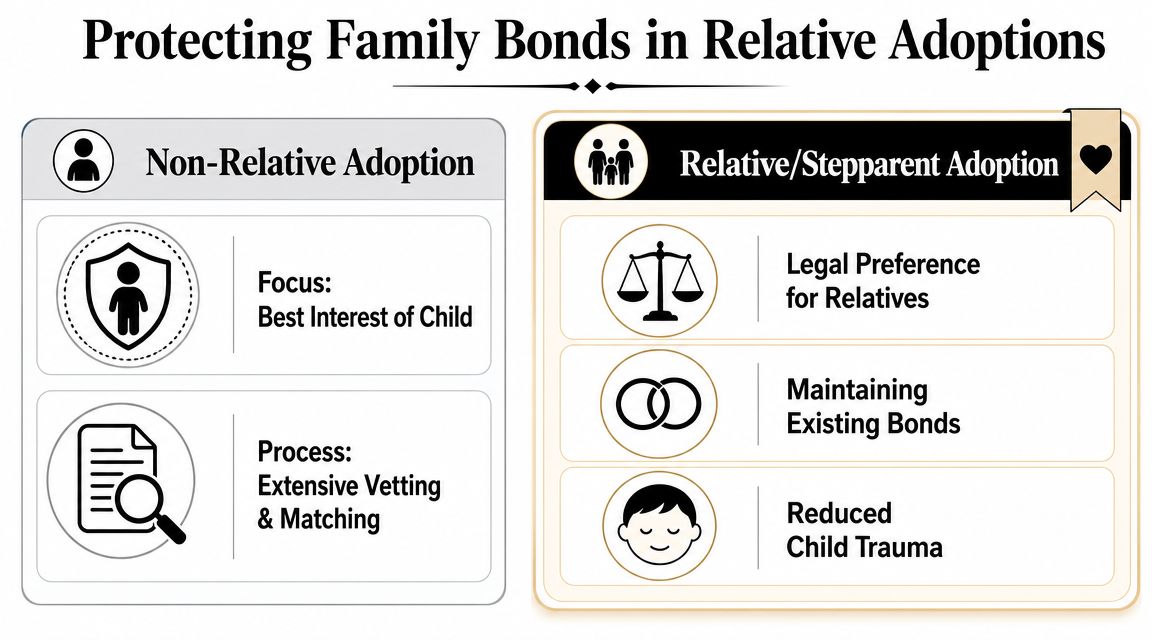
Protecting Family Bonds in Relative Adoptions
When CPS removes a child, relatives often step in first. A grandmother offers a bedroom. An aunt rearranges work. A stepparent asks whether years of daily parenting finally count in court. In these moments, family bonds matter, and the law may treat relatives differently from strangers.
Adoption and guardianship are not the same
One of the biggest misunderstandings in kinship cases is the idea that any long-term placement is basically adoption. It isn't.
When CPS is involved, relatives may sometimes be steered toward guardianship instead of adoption. As explained by the ACLU of Southern California's child welfare guidance, these paths carry different legal consequences. Adoption creates full, permanent parental rights, while guardianship can be temporary and does not sever the biological parents' rights in the same way.
That difference matters when you're deciding how much stability the child needs, what future court involvement might continue, and whether reunification is still being considered.
A side-by-side way to think about your options
| Option | Parental rights of birth parents | Stability level | When families consider it |
|---|---|---|---|
| Adoption | Usually ended through consent or court order before finalization | Highest permanence | When the goal is a permanent legal family |
| Guardianship or similar arrangement | Often still exists in some form | Can be stable, but less final | When reunification is still possible or adoption is not yet available |
| Conservatorship | Varies by court order | Can give major decision-making power | When a relative needs legal authority without full adoption yet |
For many families, the right choice depends on timing. A grandparent may accept placement now, conservatorship later, and adoption only after the court resolves the parents' rights.
Stepparent cases have their own twist
Stepparent adoption in Texas still requires dealing with the other legal parent's rights. If CPS has an active case involving that parent, the evidence developed in the CPS matter may affect whether a voluntary or involuntary termination is possible. That does not mean adoption is automatic. It means the stepparent's case may be shaped by what happens in the CPS court file.
Relatives who want to stay connected to the process should learn the difference between informal caregiving and a formal legal role. Information on relative adoption in Texas can help families compare those paths.
Children usually do better when the adults around them stop treating “placement” and “permanency” as the same thing. A child may be safe with you today and still need a more permanent legal plan tomorrow.
Under Texas Family Code Chapters 162 through 166, adoption is the act that creates the new permanent legal parent-child relationship. Guardianship and conservatorship can be powerful tools, but they don't always do the same job. For that reason, relatives should ask not only “Can the child live with me?” but also “What legal status will protect this child six months from now, and six years from now?”
Your Immediate Action Plan
The first day after CPS becomes involved often feels like trying to read a map in heavy rain. Calls start coming in. New terms appear. People ask for signatures, meetings, and records. Your first job is to slow the moment down enough to answer one question: who is in control right now?
That answer shapes almost every next step. In a private adoption, the parent may still be making decisions. In a CPS case, the court and the state may control placement. In a relative case, family members may need to act quickly to be considered and heard.
1. Identify which legal track you are actually in
Start by getting four facts clear, preferably in writing:
- Is CPS only investigating, or has a case been filed in court?
- Is the child still with a parent, or has the child been removed?
- Who has conservatorship right now?
- Is there a cause number, hearing date, or signed court order?
These facts work like road signs. If the child remains in a parent's legal custody, a private adoption plan may still be possible. If the child is in state custody, placement decisions usually shift to CPS and the judge. If you are a grandparent, aunt, uncle, or adult sibling, you may need to ask for placement right away instead of waiting for someone to contact you.
2. Put every contact and document in one place
Fear scatters information. A simple record brings it back together.
Use a notebook, folder, app, or email folder. The format matters less than consistency. Save texts, emails, business cards, court notices, service plans, and anything you are asked to sign.
A basic log can include:
- Date and time
- Person involved
- What was said
- What was requested
- Deadline or next court date
If a case changes direction later, this record can help your lawyer see the sequence clearly. It also helps you catch missed deadlines before they become bigger problems.
3. Respond carefully, not casually
You can be cooperative and still be careful. That balance matters.
If a caseworker asks for a meeting, document, or signature, pause long enough to understand what the request means. Some requests are routine. Others can affect placement, visitation, services, or your legal position in the case.
A calm response can sound like this:
“I want to cooperate, and I want to understand the legal effect of this request before I agree.”
That keeps the conversation respectful while protecting your ability to make informed decisions.
4. Get legal advice before the case chooses a direction for you
Early advice is often the difference between reacting late and acting on time. A lawyer can help you sort out whether this is still a private adoption matter, a CPS lawsuit, or a family placement case that needs fast court action.
That matters because each path has different pressure points. A birth parent may need advice about whether any voluntary plan is still available. A prospective adoptive parent may need to know whether the match is still parent-controlled or has shifted to state control. A relative may need to ask about intervention, placement requests, or temporary orders before the case moves ahead without them.
Options may include legal aid, appointed counsel in qualifying cases, or private family law counsel. The Law Office of Bryan Fagan, PLLC is one Texas option for families dealing with adoption, guardianship, and CPS-related family law issues.
5. Choose the next move that fits your role
Do not copy someone else's strategy. The right first step depends on where you stand in the case.
- Birth parent: Ask whether the child is still in your legal custody and whether you are being asked to sign anything that changes your rights.
- Prospective adoptive parent in a private match: Confirm whether the adoption plan is still parent-directed or whether CPS and the court now control placement.
- Relative or kinship caregiver: Tell CPS in clear terms that you want placement considered now, and ask what paperwork or court filing is needed for the judge to hear from you.
- Foster parent: Check the current permanency goal in the court orders and ask where the case stands on reunification, termination, and placement review.
Small steps count here. Clear facts, careful records, and early legal advice can turn a frightening situation into a set of decisions you are able to make.
Answering Your Top Questions
Can a birth mother still choose the adoptive family if CPS has an open case
Sometimes yes, sometimes no. If CPS is investigating but the child is still in the parent's legal custody, the parent may still have meaningful input into a private adoption plan. Once the child is in state custody, placement decisions usually move to CPS and the court. The parent's wishes may still matter as part of the broader picture, but they usually do not control the final placement decision.
If I'm a foster parent, am I guaranteed to adopt the child in my care
No. Foster care and adoption are related, but they are not the same legal stage. The court often begins with reunification as the primary goal. If reunification fails and parental rights are terminated, the foster parent may become a strong adoptive option, but there is no automatic guarantee.
How long does a CPS-involved adoption take in Texas
It varies a great deal. The answer depends on whether the case is private or state-managed, whether parental rights are contested, whether relatives come forward, whether the child is already placed in the intended home, and how quickly required reports and hearings move through court. Some cases move steadily. Others take much longer because the court must resolve safety findings, services, and permanency before adoption can be finalized.
What does it mean to intervene in a CPS case
To intervene means asking the court for permission to become a formal party in the case. Relatives, caregivers, or others with a strong connection to the child sometimes use intervention so they can present evidence, receive notice, and ask the court for specific relief. It is a strategic move, not a form letter. Whether intervention makes sense depends on your relationship to the child, your goals, and the procedural posture of the case.
If you're asking whether to intervene, the better question is often this. “What do I want the court to let me do that I can't do as a bystander?”
Texas adoption law under Chapters 162 through 166 still controls the final step of creating the legal parent-child relationship. But when CPS is already involved, your success often depends on understanding the earlier court fight over custody, conservatorship, and parental rights. That is why clear advice at the beginning can save months of confusion later.
If CPS has entered your adoption story, you don't have to sort out the next move alone. The Law Office of Bryan Fagan, PLLC helps Texas birth parents, adoptive parents, foster families, grandparents, and other relatives understand who is in control, what legal path applies, and what steps can protect the child's future. If you need guidance on a private adoption disrupted by CPS, a kinship placement, a stepparent adoption, or a foster care finalization, schedule a free consultation to talk through your options with a Texas family law attorney.
