
You're filling out an adoption application after weeks, maybe months, of hope. Then you reach the criminal history question.
Your stomach drops.
Maybe it's an old DWI from a difficult season. Maybe it's a misdemeanor from your early twenties. Maybe it isn't your record at all, but your spouse's. Many Texas families hit that moment and wonder the same thing: Can a Criminal Record Prevent You from Adopting in Texas?
Sometimes the answer is yes. Sometimes the answer is not necessarily. That uncertainty is what makes this part of the process so stressful.
The good news is that Texas doesn't treat every criminal record the same way. The law looks closely at what happened, how long ago it happened, whether it falls into a permanently disqualifying category, and whether there is evidence of rehabilitation. For some families, a past conviction is a hard stop. For others, it's a serious issue that still may be reviewed in context.
That distinction matters. It can mean the difference between giving up too soon and taking the right next step with care and honesty.
Adoption in Texas is governed largely by the Texas Family Code, including Chapters 162 through 166, along with agency rules, home study requirements, and court procedures. Those rules are designed to protect children while also giving courts and professionals a framework for evaluating families fairly. If you're pursuing a stepparent adoption, kinship adoption, foster-to-adopt case, or private adoption, the criminal history review can affect both the home study process and the final court approval.
This guide walks through the issue in plain English. It focuses on the human side as much as the legal side, because hopeful parents need both clarity and compassion.
Your Adoption Dream and The Criminal History Question
Some families come to this issue with joy and momentum. They've talked through names, bedrooms, school zones, and what kind of family life they want to build. Then one line on a form brings everything to a halt.

A common example is a stepparent who has raised a child for years and is finally ready to make that relationship legal. The child already calls them Mom or Dad. The home is stable. Everyone is emotionally ready. Then they remember a long-ago conviction and worry it could undo everything.
Another family may be grandparents stepping in for a grandchild. They aren't trying to create a perfect record on paper. They're trying to keep a child connected to family. A dated offense from many years ago can suddenly feel like a threat hanging over an already emotional process.
Why this question feels so personal
The criminal history question doesn't just ask about your record. It can feel like it asks whether your past defines you forever.
That's why so many people freeze. They aren't only asking whether the state will see a charge or conviction. They're asking whether the law will recognize growth, treatment, stability, and the life they've built since then.
A past mistake can be legally important without being the whole story of who you are.
Texas adoption law can be strict, especially when child safety is involved. But strict doesn't always mean simple. Some offenses create permanent barriers. Others trigger waiting periods or a closer review. In many cases, the answer depends on details.
What families usually need most
Most worried parents don't need vague reassurance. They need a realistic understanding of three things:
- Whether the offense is an absolute bar: Some crimes stop the process regardless of how much time has passed.
- Whether time matters: Other offenses may carry a waiting period before an application can move forward.
- Whether rehabilitation can be shown: Agencies and home study professionals may consider the offense, the outcome, and the changes that followed.
Under Texas Family Code adoption procedures, the path to adoption usually involves a petition, background screening, a home study in many cases, and a final court order under Chapter 162. In stepparent and relative cases, families are often surprised that the legal process still requires careful screening even when the child already knows and trusts the household.
That can feel frustrating. It can also be manageable when you understand the rules early.
The Guiding Principle Best Interest of the Child
Texas adoption law starts from one central idea: the best interest of the child. That phrase shows up often in family law because it guides what courts, agencies, and evaluators are trying to protect.
Background checks are part of that protection. They are not supposed to be a moral test or a way to relive your worst day. They are meant to help decision-makers determine whether a child will enter a safe, stable, and nurturing home.
Why the law looks closely at criminal history
When Texas courts review an adoption under the Family Code, including the procedures in Chapter 162, the judge isn't only deciding whether adults want the adoption. The court is deciding whether the placement serves the child's welfare.
That's why screening can be detailed. It may include criminal history, abuse and neglect registry checks, the home environment, and the adults living in the home. In practical terms, the law asks: is this child likely to be safe here, and is this family prepared for the responsibility of adoption?
Federal law influences that question too. The national benchmark is the Adoption and Safe Families Act of 1997, which bars adoptive placements when a prospective parent has felony convictions for child abuse or neglect, spousal abuse, or violent crimes such as homicide, as described by this adoption law overview of criminal background checks.
Protection, not punishment
Families often get discouraged because screening can feel unforgiving. But it helps to reframe the process.
A child entering adoption may already have experienced instability, trauma, loss, or disrupted attachment. Texas law tries to reduce future risk by requiring careful review before parental rights are created through adoption.
That doesn't mean every criminal record proves a person is unsafe. It means the law takes certain categories of harm very seriously, especially where children, family violence, sexual offenses, or severe violence are involved.
Practical rule: If a criminal history issue exists, the question usually isn't just “Did something happen?” It's “What happened, how serious was it, and what does it mean for this child now?”
How this affects different adoption paths
The best-interest standard applies across adoption types, but it can feel different depending on the case:
- Stepparent adoption: The child may already live with you, but the court still has to decide whether legal adoption is in that child's best interest.
- Kinship adoption: Relatives often have strong emotional ties with the child, yet the state still reviews safety concerns carefully.
- Private or agency adoption: Screening often happens before a child is placed, so criminal history concerns may surface early.
- Foster or CPS adoption: Child safety review is especially central because the state is already involved in placement decisions.
In each setting, the same principle stays in the foreground. The law is trying to protect children, not to classify adults.
That may not erase the stress. But it does help explain why Texas treats criminal history as a serious part of the adoption process.
How Texas Screens Adoptive Parents The Background Check Process
Texas uses more than one kind of screening. That catches many families off guard.
A lot of people assume there's one background check and then they're done. In reality, adoption cases can involve multiple layers of review, and each one serves a different purpose.
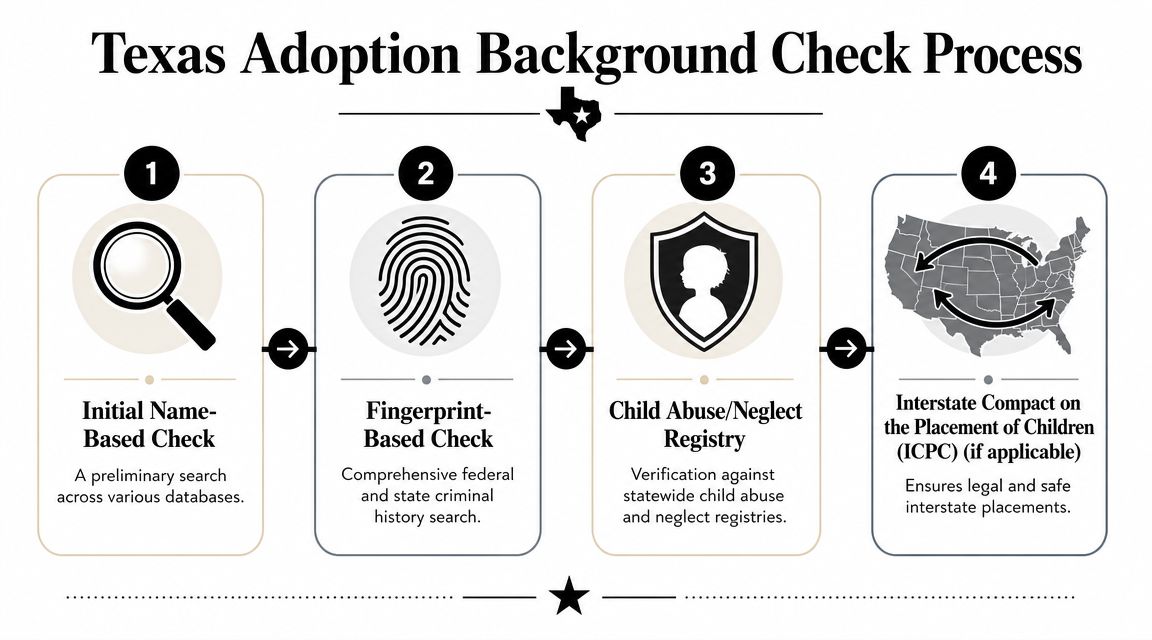
The main parts of the screening process
According to Texas guidance on background checks for prospective foster, adoptive, and kinship caregivers, the review can include name-based checks, fingerprint-based checks, and DFPS registry screening. In plain language, that means the state is not relying on a single database.
Here's what that often looks like:
Name-based criminal history review
This is often an early screening step. It helps identify records tied to a person's identifying information.Fingerprint-based criminal history check
Fingerprints allow a broader search, including state and federal criminal history records.DFPS or child abuse and neglect registry review
This looks for history involving abuse or neglect findings, which can be highly important in an adoption case.Case-specific review for the type of adoption
A stepparent case may move differently than a foster or interstate placement, but screening still matters.
If you want a fuller picture of what may appear in different kinds of screenings, Brian Hansford on background check issues offers a useful plain-language discussion of how background checks can raise questions about arrests, records, and what may show up.
Screening happens before and after you feel ready
One reason families get frustrated is that criminal history can become an issue at more than one stage.
The first point is often the home study or agency review. If the evaluator sees a disqualifying offense or needs more explanation, the case can slow down before it ever reaches a judge. Families preparing for that stage often benefit from understanding Texas adoption home study requirements early so they can gather records and explanations before the evaluator asks.
The second point is the court stage. Texas adoption practice doesn't end with a favorable home study. The judge still needs the required documents, and the paperwork has to be current.
Courts in Texas must accept a criminal history record only if it was obtained within one year before the court ordered the record obtained, according to the Texas Children's Commission benchbook discussion of adoption records.
A simple paperwork problem can cause a real delay
Families sometimes focus only on whether the record itself is disqualifying. But stale paperwork can also interrupt an adoption.
That matters in private, kinship, and stepparent adoptions too. Even when everyone agrees the adoption should happen, the court still expects the legal file to be complete and current.
A careful lawyer, agency, or home study professional will usually track those dates closely. If your case involves an older conviction, it's especially important to stay organized so the legal discussion stays focused on the substance of your case instead of avoidable administrative issues.
Understanding Disqualifying Offenses Absolute Bars vs Timed Restrictions
Texas law now becomes more specific.
A criminal record does not automatically block every adoption. But Texas does use a structured framework. Some offenses are treated as permanent barriers. Others can trigger a waiting period and later review.
The difference between a hard stop and a reviewable issue
The most important distinction is between an absolute bar and a timed restriction.
A hard stop means the offense falls into a category that can permanently disqualify an applicant. A reviewable issue means the offense is still serious, but the law may allow consideration after time has passed and the applicant is otherwise suitable.
According to this Texas adoption discussion of felony convictions, Texas uses a structured criminal-screening framework in which offenses like criminal solicitation of a minor can create a permanent bar, while offenses such as a first-time DWI may trigger a five-year bar followed by possible risk evaluation.
Texas Adoption Criminal History Review Categories
| Category | Description | Common Examples |
|---|---|---|
| Permanent bar | Offenses that can permanently disqualify a prospective adoptive parent | Criminal solicitation of a minor, online solicitation of a minor, aggravated kidnapping, continuous violence against the family |
| Timed restriction | Offenses that may trigger a waiting period before the case can be considered further | First-time DWI, certain drug-related offenses |
| Review after waiting period | Cases that may still require a risk evaluation even after the waiting period has ended | Older non-violent offenses where the state wants more context |
| Case-specific concern | Records that may not fit an automatic disqualifier but still raise questions in the home study or court process | Lower-level or dated convictions, depending on facts and surrounding history |
Texas guidance also identifies certain convictions that can lead to permanent disqualification, including sexual assault, trafficking or smuggling of persons, online solicitation of a minor, continuous violence against the family, and sale or purchase of a child. That broader discussion appears in this Texas child welfare background-check resource.
Where readers often get confused
Many people hear “felony” and assume all felonies are treated the same. They aren't. Others hear “misdemeanor” and assume misdemeanors never matter. That isn't safe either.
The legal significance usually turns on:
- The type of offense
- How recent it was
- Whether it falls into a permanently disqualifying category
- Whether the case may be reviewed after a waiting period
Some records create a legal wall. Others create a legal question.
That distinction is why two families with criminal records may face very different outcomes. One applicant may be disqualified immediately. Another may need to explain the offense, provide records, and show years of stability.
The right analysis depends on the exact offense, not just the label “criminal record.”
Paths to Redemption Overcoming a Past Mistake
A past mistake does not always end an adoption case. For many families, the main question is whether Texas will see the whole story, not just the old charge on a background report.
That process often feels personal because it is personal. A criminal record can reduce years of growth to a few lines on paper. Your job, and your lawyer's job, is to give those lines context so the agency, home study provider, or judge can see the parent you are today and the home you can offer a child.

As noted earlier, Texas decision-makers may look beyond the existence of a conviction and examine the surrounding facts. For a reviewable issue, the focus often shifts to time passed, patterns of behavior, treatment, stability, and honesty. That difference matters. A hard stop leaves no room for argument. A reviewable issue gives you a chance to show rehabilitation in a concrete, credible way.
What rehabilitation looks like to a reviewer
Rehabilitation works a lot like rebuilding trust after a broken promise. Words help, but steady proof carries more weight.
A strong file often includes:
- Certified court records: These confirm the exact offense, the outcome, and whether all court requirements were completed.
- Treatment, counseling, or program records: If the offense involved alcohol, drugs, anger, or family conflict, completion records help show you addressed the cause, not just the charge.
- Reference letters: Letters from employers, counselors, clergy, sponsors, or longtime community members can describe your present-day character and consistency.
- A personal statement: A clear, respectful explanation can show accountability, insight, and the changes you made after the offense.
- Evidence of stability: Steady work history, safe housing, community involvement, and a healthy family routine can support the picture of a secure home.
One document rarely carries the case by itself. Reviewers usually look for a pattern. If your records, references, and personal explanation all point in the same direction, your case becomes easier to understand.
What can weaken an otherwise good case
Families under stress sometimes make avoidable mistakes. The problem is rarely that they have a past. The problem is that the explanation feels incomplete, inconsistent, or defensive.
Watch for these issues:
- Partial disclosure: If an application asks about arrests or convictions, answer directly and completely.
- Minimizing the conduct: Saying an offense was "no big deal" can raise concern about judgment and accountability.
- Guessing about old records: Sealed, dismissed, or restricted records can still raise legal questions in adoption screening, so confirm the facts before filing.
- Last-minute preparation: A rushed response can make a stable, well-rehabilitated life look thin on paper.
Substance-related histories often bring extra anxiety. If alcohol or drug issues are part of your background, it helps to understand how screening may work in practice, including whether agencies may request testing. This guide on drug testing in Texas adoption cases explains that part of the process.
Legal cleanup can help, but it does not erase every concern
Some families ask whether expunction or nondisclosure will solve the problem. Sometimes those tools help. They may affect how a record appears or how your attorney presents your history. They do not erase a permanent statutory bar, and they do not guarantee approval.
That point often causes confusion. Clearing a record is about visibility. Rehabilitation evidence is about trust. Adoption decision-makers may care about both.
Law Office of Bryan Fagan, PLLC handles Texas adoption matters, including cases where a family needs help preparing for home studies, court filings, and questions about prior legal issues.
The strongest redemption cases are usually the ones that stay grounded in the child's best interests. They show a safe home, a stable routine, honest answers, and a parent who did the work to change. For a family in a reviewable category, that is the path.
Real-Life Scenarios How Records Affect Different Adoptions
Legal rules make more sense when you see how they might apply to real families. These examples are fictional, but they reflect the kinds of situations that often worry people.
A stepparent with an old misdemeanor
Maria has helped raise her husband's son since preschool. The child's other parent's rights have already been addressed, and the family is ready to move forward with a stepparent adoption under Texas Family Code procedures.
Maria also has an old misdemeanor from years ago. It wasn't violent, it hasn't happened again, and she has a stable home and work history. In a case like this, the record may still come up in screening, but the issue may be treated as a reviewable concern rather than an automatic end to the case.
A relative caregiver with a dated DWI
A grandfather has been caring for his granddaughter after a family crisis. He wants legal permanence so he can make decisions for school and health care without constant uncertainty.
He has a past DWI conviction. That doesn't mean the case will be simple, and it doesn't mean approval is guaranteed. But because Texas distinguishes between permanent bars and certain offenses that may involve a waiting period and later review, the case may depend heavily on timing, sobriety history, and evidence of stability.
In kinship cases, judges often see both sides at once. The need for family continuity, and the need for child safety.
A private adoption applicant with a recent non-violent felony
A married couple begins a private adoption journey. One spouse has a more recent non-violent felony conviction related to a difficult chapter in life.
This kind of case often brings uncertainty because “non-violent” doesn't automatically mean “no problem.” An agency or evaluator may look closely at the offense, how recent it was, treatment or rehabilitation efforts, and whether the law imposes a waiting period or other barrier. The same record can feel much more serious when it is recent than when many stable years have passed.
Why individualized review matters
These scenarios show why broad internet answers can be misleading. “You can adopt with a record” is too simple. “You can't adopt with a record” is too simple too.
Texas adoption cases often turn on details like the kind of adoption, the exact offense, the passage of time, and the quality of the family's documentation. In a foster, private, stepparent, or kinship case, the law still comes back to the same question: will this adoption serve the child's best interests?
That's why specific legal advice matters so much. The facts of your family, not someone else's online story, are what count.
Your Questions Answered and Taking the Next Step
If you're still worried, that's normal. Families often need direct answers to the practical questions they don't want to ask out loud.
Frequently Asked Questions
| Question | Answer |
|---|---|
| Does a misdemeanor automatically prevent adoption in Texas? | Not always. The outcome depends on the offense, how serious it was, and how long ago it occurred. |
| What if my spouse has the record, not me? | That can still matter. Adoption screening often looks at the adults in the home, not only the person filing the petition. |
| Do sealed or old records still matter? | They can. Don't assume an older or restricted record won't come up. Get legal advice based on your specific history. |
| Can a stepparent adoption still require background review? | Yes. Even when the child already lives with the family, the legal process can still require screening and court approval. |
| If my offense isn't a permanent bar, am I guaranteed approval? | No. A reviewable issue is not the same as a guaranteed yes. Agencies, evaluators, and courts may still look closely at safety and stability. |
| Should I explain the record before anyone asks? | Usually, honest and well-prepared disclosure is better than letting reviewers discover missing information on their own. |
The next step is usually simpler than people think
Start by gathering your records. Make a timeline. Be honest about what happened and what has changed. If you already know the offense may be an issue, don't wait for a home study interview or court deadline to begin preparing.
Texas adoption law can be demanding, especially under the procedures that govern petitions, investigations, and finalization in Chapters 162 through 166. But many families find that once they understand whether they're facing a hard stop or a reviewable issue, the path becomes clearer.
If you're asking, “Can a Criminal Record Prevent You from Adopting in Texas?” the most accurate answer is this: sometimes, but not always. The right legal analysis can help you tell the difference before you invest more time, money, and emotion in the process.
If you're worried that an old conviction, a recent charge, or your spouse's record could affect your adoption, a confidential conversation can bring clarity quickly. The Law Office of Bryan Fagan, PLLC helps Texas families understand adoption screening, home studies, petitions, and finalization with a focus on the child's best interests and the realities of each family's situation. If you'd like guidance specific to your case, schedule a free consultation and take the next step with clearer answers and a plan.
