 Skip to content
A hopeful adoptive couple sits across from an expectant mother at a coffee shop. They aren't talking about paperwork yet. They're talking about birthdays, photos, whether the child might someday want answers, and how everyone can protect that connection without creating more pain. One person wants reassurance. Another wants stability. All of them care about the same child.
That is usually where the question begins. What is a post-adoption contact agreement in Texas? People often assume it works like a standard contract. In Texas, it usually doesn't. That misunderstanding causes a lot of fear, and sometimes heartbreak, for birth parents, adoptive parents, and relatives trying to do the right thing.
Texas adoption law gives families a way to plan for contact after adoption in some situations, but the strength of that plan depends heavily on how the adoption happens. A private adoption and a CPS adoption do not operate the same way. That difference matters more than most families realize.
If you're feeling overwhelmed, you're not behind. You're asking the right questions. Adoption under Texas Family Code Chapters 162 through 166 can involve home studies, termination of parental rights, consent issues, court review, and finalization. When contact after adoption is part of the conversation, families also need to think carefully about how openness will work in daily life, not just on paper.
Your Compassionate Guide to Post-Adoption Contact
Maria is considering adoption for her baby. She has found an adoptive family she trusts, and the conversations have been kind and respectful. She wants to know whether she can still receive photos, maybe letters, and perhaps a visit once in a while as the child grows. The adoptive parents want to honor that bond, but they also want to understand what Texas law will and won't require later.
That moment carries a lot of emotion. No one is thinking only like a legal client. They are thinking like parents, or future parents, or family members trying to protect a child from confusion and loss.

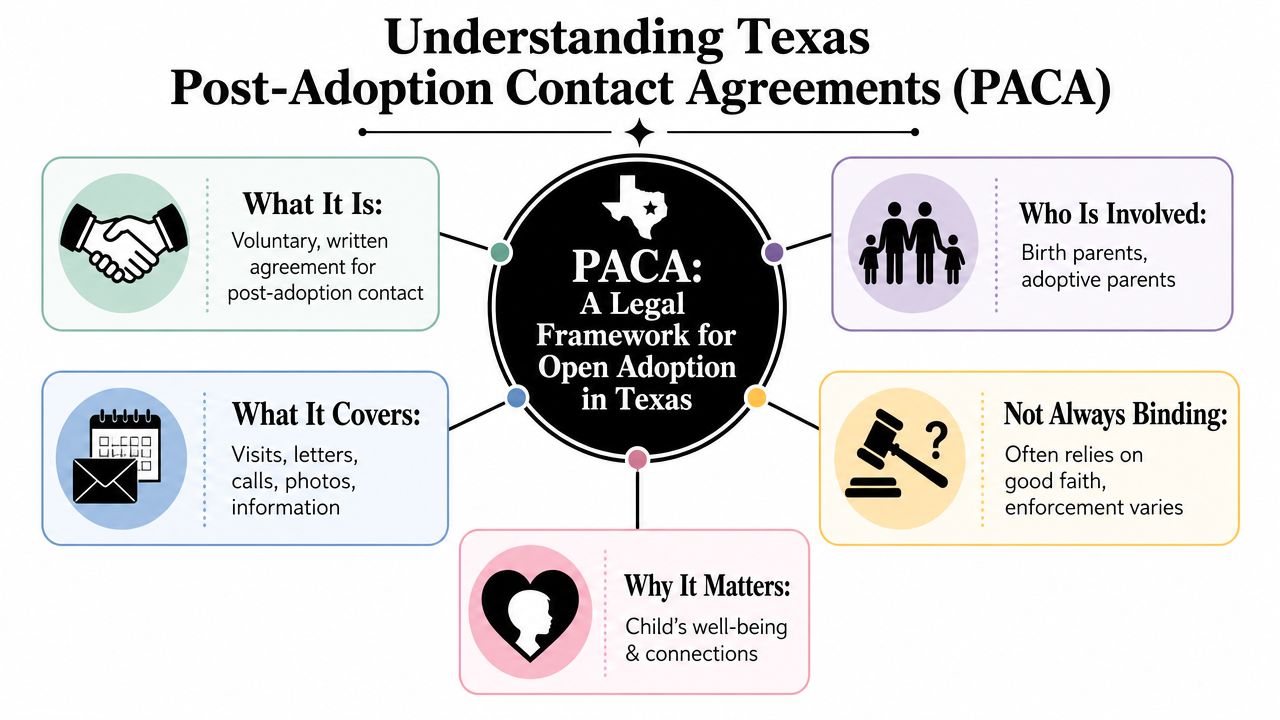
A post-adoption contact agreement, often called a PACA, is the tool families usually mean when they talk about an open adoption plan. In plain language, it is a written plan for what contact or updates may continue after parental rights are terminated and the adoption moves forward. That contact can involve things like letters, photos, calls, or visits.
A contact agreement can be meaningful without being simple. In Texas, the emotional promise and the legal remedy are not always the same thing.
That is where readers often get confused. They hear "agreement" and assume a judge can enforce every term the same way a court might enforce another family court order. In Texas, that is not the usual picture. The legal effect depends heavily on context, especially whether the adoption is a private matter or tied to the Department of Family and Protective Services.
Families who are beginning the adoption process also need to remember that contact planning is only one part of the larger path. The bigger process may include termination of parental rights, a home study, placement, required consents, and final court finalization under Texas adoption law. Contact matters. So does building a stable legal foundation for the child.
What a Texas Post-Adoption Contact Agreement Legally Is
A Texas PACA is not just a side promise written on a piece of paper after everyone leaves the hospital. Under Texas law, it is better understood as a special instruction built into a court order connected to termination of the parent-child relationship.
Think of it as part of the court's file
If it helps, picture the court order as the main document in a family's legal file. A PACA is like a carefully written note attached to that order, not a separate deal floating on its own. Texas law recognizes this structure under Texas Family Code Chapter 162, which authorizes a PACA as a binding provision within a court order terminating the parent-child relationship and states that the terms are non-modifiable once finalized, with enforcement limited to mediation.
In practice, that means the agreement is tied to the legal process that ends parental rights and allows the adoption to move forward. It is not the same as two families creating a private contract after the fact and expecting Texas courts to treat it like an ordinary commercial agreement.
For families trying to understand where this fits in the larger legal process, this guide to Texas adoption and the Family Code for parents gives useful background on how Chapters 162 through 166 shape adoption procedure.
Later in the process, some families also need to understand Voluntary Relinquishment of Parental Rights in Texas, which addresses how a birth parent voluntarily ends their rights for an adoption.
Who signs and what it can include
Texas law treats these agreements narrowly. The PACA must be connected to the termination proceeding itself. It can describe contact terms such as letters, emails, visits, or the sharing of information. It must be specific about the type, frequency, and duration of contact.
A child's consent may also matter in some situations if the child is over twelve, based on judicial standards described in Texas guidance. That detail reminds families that older children are not just bystanders in this process. Their voice may be part of what the court considers.
Here is a short explainer before you watch:
Practical rule: In Texas, a PACA is strongest when families understand what it really is. A court-linked contact provision, not a free-standing promise with unlimited future enforcement.
Private Adoptions Versus CPS Adoptions A Critical Difference
This is the issue that changes everything. In Texas, families need to know whether they are dealing with a private adoption or a DFPS or CPS adoption, because the legal power of a contact agreement can look very different.
Why the same word means different things
In many private adoption conversations, people use the phrase "open adoption agreement" as if it guarantees future contact. In Texas, that is often too broad. According to the Texas State Law Library's guide to open adoption, private adoption contact agreements are generally unenforceable by law, while in DFPS foster care adoptions a court may issue an enforceable order if continued contact is shown to be in the child's best interest. The same guidance notes that some judicial standards consider consent from a child over twelve.
So a private adoption may involve a sincere written plan, but the legal remedy is often limited or uncertain. A CPS adoption, on the other hand, may place the agreement in a more formal court-supervised setting where the judge has a clearer role in deciding whether contact should be ordered.
If you're trying to place your situation in the right category, this overview of private adoption in Texas can help clarify the difference between private placement and state-involved adoption.
A side by side look
| Feature | Private Adoption | DFPS (CPS) Adoption |
|---|---|---|
| Typical legal setting | Usually arranged outside the DFPS foster care system | Occurs through DFPS or foster care proceedings |
| Role of contact agreement | Often functions more like a good-faith understanding | May be included in a court order when the court finds contact serves the child |
| Enforcement reality | Generally limited, often dependent on continued trust and cooperation | Can be more formally addressed by the court in the right case |
| Best-interest review | Still important, but practical enforcement may be weak | Central to whether the court allows ongoing contact |
| Child's input | May matter depending on the facts | Some standards also consider consent if the child is over twelve |
Two common real-life scenarios
A private adoption example: a birth mother and adoptive parents agree that photos will be shared and there will be occasional visits. Everyone means it. Years later, the adoptive family moves, life changes, and contact slows down. The birth mother may feel that the promise was broken, but the written agreement may function more like a statement of intention than a strongly enforceable legal contract.
A CPS example: a child has an established relationship with a biological relative, and the court believes continued limited contact may support the child's welfare after adoption. In that setting, the judge may be more directly involved in whether a contact order should be part of the final legal arrangement.
Families often see this same contrast in related adoption paths, including stepparent adoptions and foster care adoptions. A stepparent adoption may focus more on final legal parentage and less on ongoing contact with a terminated parent. A CPS adoption may involve a deeper court record about the child's relationships and needs. The label "open adoption" doesn't tell you enough. The adoption channel does.
Drafting a Thoughtful and Clear Contact Agreement
A contact agreement works best when it is written with the child's daily life in mind. Broad promises feel comforting in the moment, but specific language helps reduce confusion later.
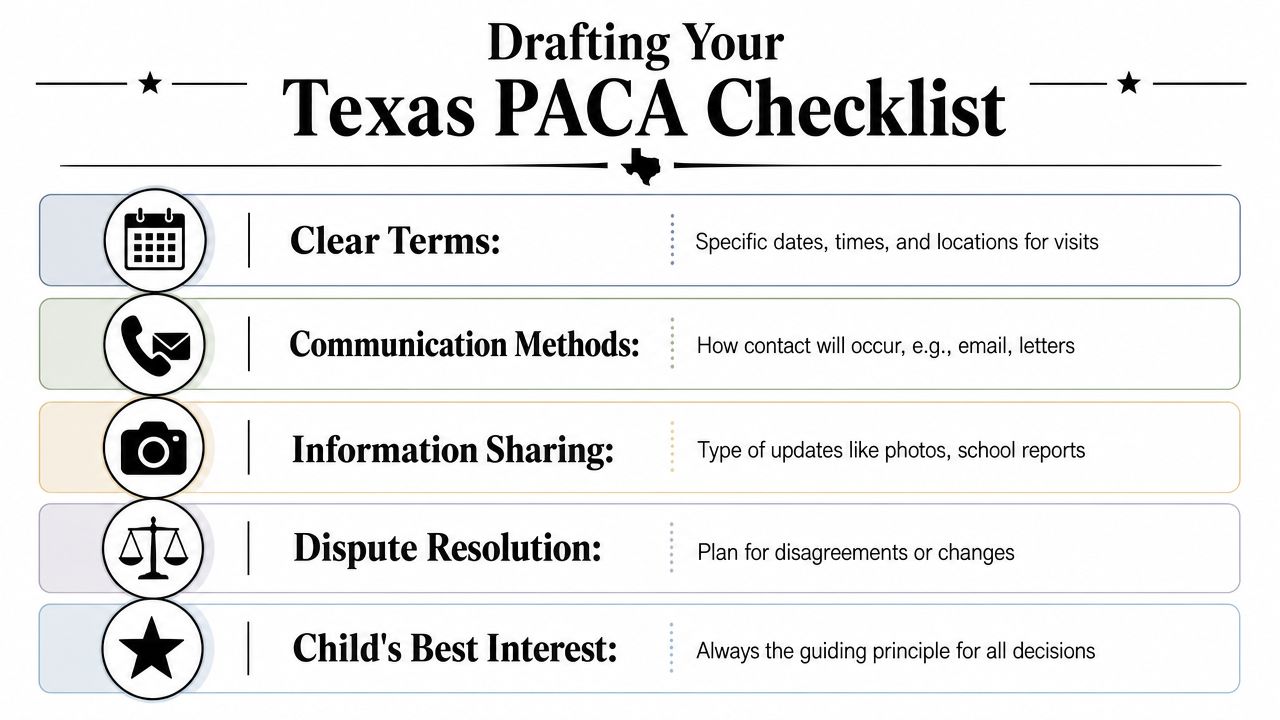
According to Adoption Art's overview of post-adoption contact agreements, PACAs are highly customizable and often cover letters, photos, phone calls, and visits, with the child's best interests guiding the approval and details. That flexibility can be helpful, but it also means families need to think carefully about wording.
What should be spelled out
A strong draft usually answers practical questions, not just emotional ones:
- Type of contact. Will contact happen through letters, emails, phone calls, video chats, in-person visits, or updates through an agency or shared platform?
- Timing. Will updates happen on the child's birthday, around holidays, at the end of the school year, or on another schedule?
- Who is included. Is contact limited to a birth parent, or does it include grandparents, siblings, or other relatives who already have a relationship with the child?
- How information is shared. Will photos be sent by email, through a password-protected album, or by regular mail?
- Boundaries. Are there topics that should be avoided, or settings where visits should happen?
Vague language versus clear language
Vague language creates room for hurt feelings. Clear language doesn't guarantee perfect outcomes, but it gives everyone a shared reference point.
Consider these examples:
Vague: "The adoptive family will send updates from time to time."
Clearer: "The adoptive family will send a written update and recent photos once each year around the child's birthday."
Vague: "Visits will happen if everyone agrees."
Clearer: "The parties will discuss one in-person visit each year in a child-appropriate setting if the child is doing well and the adults agree it remains beneficial."
Vague: "Family can stay in touch online."
Clearer: "The parties will communicate through one agreed email address unless they later choose another written method."
If families want help reducing a verbal understanding to writing, they may also look at general tools such as a Texas Rule 11 agreement overview for understanding how written settlement terms are commonly documented in Texas legal practice, even though a PACA has its own legal framework.
Write for the child you hope to protect, not for the adults you assume will always agree.
Enforcing or Changing an Agreement After the Adoption
This is the part many families are almost afraid to ask about. What happens if someone stops following the agreement?
Texas law gives a very specific answer. Under Child Welfare Information Gateway's Texas summary of post-adoption contact agreements, a contact provision under Texas Family Code § 161.2061 is not enforceable by contempt, may not be modified, and a person seeking enforcement must first plead and prove a good-faith attempt to resolve the dispute through mediation.
What that means in plain English
A contempt action is the tool courts often use when someone violates an order and the court wants to compel compliance through formal penalties. Texas does not allow that remedy for this type of contact provision.
The court also does not get to rewrite the agreement after finalization. If the original arrangement later feels awkward, outdated, or hard to follow because life changed, the statute does not treat that as a reason to modify the terms through ordinary court adjustment.
That can feel harsh, especially to a birth parent who relied on promised contact. But Texas law is structured to protect the finality of termination and adoption. The state's approach favors permanency and tries to avoid turning adoption into a continuing custody fight.
What mediation looks like
Mediation is a guided conversation with a neutral third person. The mediator does not become the child's parent and does not erase the adoption. The mediator helps the adults talk through what happened and whether they can reach a workable solution.
A mediation discussion might focus on questions like these:
- Has something changed for the child. For example, is the child struggling with transitions, school demands, or emotional regulation after visits?
- Did communication break down. Maybe one family changed email addresses or misunderstood the schedule.
- Can the original spirit still be honored. Sometimes an in-person visit becomes a photo update and a video call because that fits the child better.
Broken contact is painful. But in Texas, the strongest repair tool is often a careful conversation with structure, not a punishment from the court.
What families should remember
If you're entering a PACA, trust matters as much as wording. The law gives some framework, but it does not create endless judicial oversight. Families should go in with open eyes.
That doesn't mean a PACA is pointless. It means the agreement works best when the adults are realistic, child-focused, and willing to solve problems without treating every conflict like a lawsuit.
Is a Contact Agreement Right for Your Family
Some families benefit from a formal contact agreement. Others do better with an informal openness plan, counseling support, or agency-guided communication. The right choice depends on the child, the history between the adults, and the kind of adoption involved.

For families who adopt through foster care, the Texas DFPS post-adoption support network offers services at no cost, with a focus on support and resources rather than legal enforcement of contact. That matters because some families don't need more legal language. They need help with transitions, boundaries, grief, and communication.
Questions adoptive parents should ask
- Can we support contact without creating confusion for the child?
- Are we agreeing to something specific enough that we can realistically follow it?
- If the child's needs change, do we have a respectful way to talk about that?
- Are we saying yes out of care, or out of pressure?
Questions birth parents and relatives should ask
- What kind of contact would genuinely help the child, rather than just ease adult anxiety?
- Would written updates feel meaningful, or is in-person contact important to preserve an existing bond?
- Do we understand the difference between a moral promise and a court remedy in this adoption path?
- Who will help if communication becomes strained?
The child stays at the center
In Texas adoption law, whether the family is pursuing a private infant adoption, a kinship adoption, a stepparent adoption, or a CPS adoption, the best interests of the child stay at the center of every major decision. That principle matters during home studies, termination proceedings, placement decisions, and finalization. It should also guide any conversation about openness after adoption.
Sometimes the right answer is yes, a contact agreement belongs here. Sometimes the wiser answer is a more flexible relationship supported by counseling, mediation planning, or post-adoption services. Neither answer is a moral failure. The question is what helps this child feel secure, loved, and stable.
If your family needs legal help sorting through those choices, Law Office of Bryan Fagan, PLLC is one Texas option for guidance on adoption, guardianship, termination issues, and court procedure.
Frequently Asked Questions About Texas Contact Agreements
Does a PACA undo the adoption if someone breaks it
No. A problem with contact does not undo the adoption. The adoption remains final, and the parent-child relationship created by the adoption stays in place.
Can families make an informal openness plan without a formal PACA
Yes. Many families create written expectations or mutual understandings even when they are not relying on a formal court-linked PACA. That can still be useful because it gives everyone a shared roadmap.
Can a child have a voice in the agreement
Sometimes, yes. In some Texas settings, judicial standards consider the consent of a child over twelve. Even when formal consent is not the main issue, older children often benefit when adults listen to how contact affects them.
What kinds of contact are usually discussed
Families often talk about photos, letters, email updates, phone calls, video calls, and occasional visits. The right mix depends on the child's age, safety needs, history with the adults, and the stability of the relationships involved.
What if someone moves away
A move doesn't erase the relationship, but it may change how contact happens in daily life. Families may need to rely more on written updates, calls, or video communication if in-person visits become difficult.
Is a PACA the same in stepparent, private, and foster care adoption cases
No. The legal setting matters. That is one of the biggest sources of confusion in Texas. A private adoption often looks very different from a DFPS adoption regarding how contact is handled and how much court involvement exists.
Should families talk about contact before finalization
Yes. Early conversations are usually healthier than rushed promises made at the end. Families should discuss expectations while there is still time to think clearly, ask questions, and get legal advice.
When should I talk to an attorney
Talk to an attorney when contact after adoption is important to your decision, when termination paperwork is being prepared, or when there is uncertainty about whether your adoption is private or state-involved. It also helps to speak with counsel if relatives, stepparents, or older children are part of the picture.
If you're weighing openness, termination, or adoption finalization in Texas, legal clarity can ease a lot of fear. A lawyer can help you understand how your adoption path affects contact rights, what paperwork belongs in the court record, and how to protect the child's stability from the start. To talk through your situation with compassion and practical guidance, schedule a free consultation with the Law Office of Bryan Fagan, PLLC.

