
Some families reach this moment after years of infertility. Others arrive here after remarriage, when a stepparent has already been doing the daily work of parenting and wants the law to reflect real life. Grandparents, aunts, uncles, foster parents, single adults, and LGBTQ+ couples often come with the same question in different words: How do we make this child part of our family in every legal and lasting way?
When adopting a child in Texas, you may feel both excited and overwhelmed simultaneously. That's normal. Adoption is both a legal process and an emotional journey. The paperwork matters. So do the quiet conversations at home, the fears about delays, and the hope that one day a judge will sign the final order and your family will breathe easier.
Texas families have many reasons for pursuing adoption, and no two stories look exactly alike. What stays the same is the central goal: protecting a child, preserving stability, and building a secure future. Texas law takes that goal seriously, which is why the process includes screening, court review, and careful rules about consent and parental rights.
Your Journey to Adoption Begins With a Single Hope
Maria and James had already picked out where the child's backpack would go. They had talked about school mornings, bedtime routines, and family trips long before they felt confident enough to say the word adoption out loud. At the same time, they worried about doing something wrong. Would they qualify? How long would it take? Would one missing document delay everything?
That mix of hope and fear is familiar to many families.

Some readers are married couples pursuing a private infant adoption. Some are foster parents ready for permanency. Some are stepparents who already attend school meetings and doctor visits, but still need legal authority. Others are relatives trying to keep a child connected to family, culture, and familiar faces. Every one of those paths deserves clear guidance.
Why Texas adoption can feel complicated
Texas adoption law protects children by requiring courts to confirm that the placement is safe, lawful, and in the child's best interest. That means your case may involve background checks, a home study, training, consent rules, and a court hearing. For birth parents, it can also involve grief, reflection, and hard decisions that deserve compassion and respect.
Adoption works best when families treat it as both a legal process and a human one.
That's especially true in a state as active in adoption as Texas. Texas ranks second nationally in total adoption volume and has an adoption rate of 6.2 per 1,000 children, higher than California's 5.8 per 1,000. At the same time, foster care adoptions nationally have been declining, with about 46,935 children adopted from foster care in fiscal year 2024, a 6% decline from the prior year and a 26% drop since 2019, according to national and Texas adoption statistics compiled here. Those numbers matter because they show both need and complexity.
A calm starting point
If you're at the beginning, focus on three simple questions:
- Which kind of adoption fits your family?
- Do you meet the legal requirements to adopt in Texas?
- Who will guide you through the legal steps?
Once those answers come into focus, the process becomes far less intimidating. Families often feel better when they stop trying to solve everything at once and start by choosing the right path.
Finding Your Path Understanding the Types of Adoption
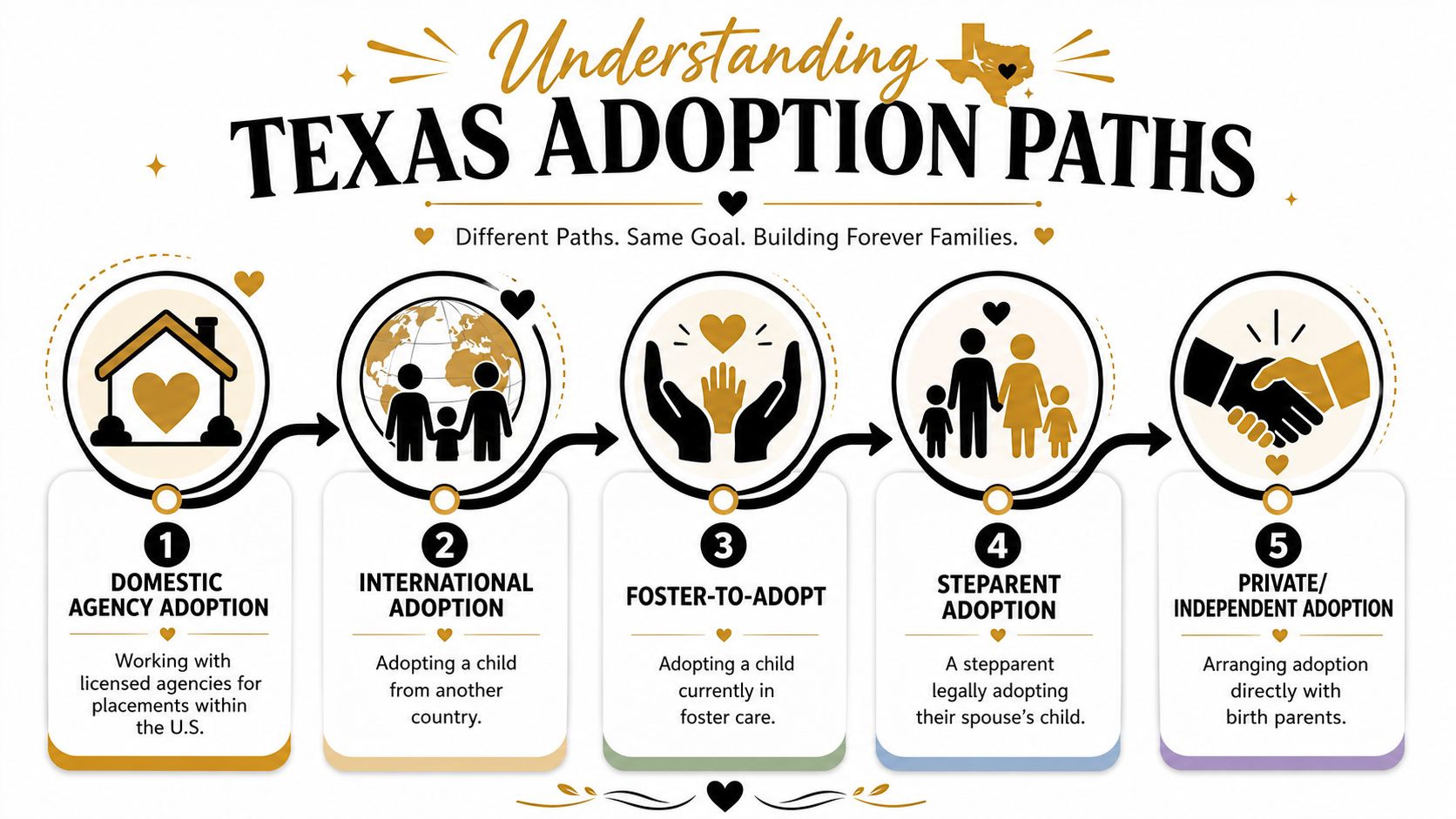
Texas doesn't offer just one adoption route. It offers several, and the right fit depends on your relationship to the child, your goals, and the kind of support you need.
Private domestic adoption
Private domestic adoption usually involves adopting an infant through an agency or through an attorney in an independent placement. This path often includes communication with the expectant or birth mother, matching, hospital planning, and legal steps after birth.
One major shift in modern adoption is openness. In the United States, 95% of domestic infant adoptions are open adoptions, reflecting ongoing contact or communication between birth and adoptive families, according to domestic adoption statistics from Adoption Network. For many Texas families, that means adoption isn't based on secrecy. It's based on thoughtful boundaries, honesty, and a child-centered relationship.
Foster care adoption
Adopting through foster care can be a meaningful path for families who want to provide permanence to a child already in state care. These cases often involve children who need long-term stability after reunification is no longer possible.
This path can be rewarding, but it also asks families to be flexible and informed. A child may have experienced trauma, multiple placements, or uncertainty about where they belong. Families who thrive here usually come in with patience, support, and a willingness to learn.
Stepparent adoption
Stepparent adoption is often the most emotionally straightforward path because the family bond already exists. A stepparent may already handle homework, discipline, bedtime, and daily care. Adoption allows the legal relationship to match the emotional one.
For many families, Stepparent Adoption in Texas is the first place to look because it explains the most common Texas adoption and how it works. These cases still require careful attention, especially when another parent's rights must be addressed.
Kinship and relative adoption
Relative adoption helps preserve family ties. A grandparent adopting a grandchild, or an aunt adopting a niece, often gives a child continuity during a difficult season. The child may keep important connections to siblings, traditions, and a familiar support system.
A relative adoption often begins with crisis, but it can end with stability and legal clarity.
Single-parent and LGBTQ+ adoption
Texas families come in many forms. Single adults adopt. LGBTQ+ individuals and couples adopt. The focus stays on whether the adult can provide a safe, stable, loving home and whether adoption serves the child's best interests.
Here's a simple side-by-side view:
| Path | Common fit | Main legal focus |
|---|---|---|
| Private domestic | Infant adoption | Consent, placement, finalization |
| Foster care | Child in state care | Permanency after CPS case |
| Stepparent | Spouse adopting child | Parent rights and family unity |
| Relative adoption | Grandparent, aunt, uncle | Stability and preserving family bonds |
| Adult adoption | Adopting an adult | Written consent and legal status |
Are You Ready to Adopt Core Requirements for Parents
Some people worry that Texas adoption law expects perfection. It doesn't. Courts and agencies are looking for safety, stability, honesty, and readiness to parent.
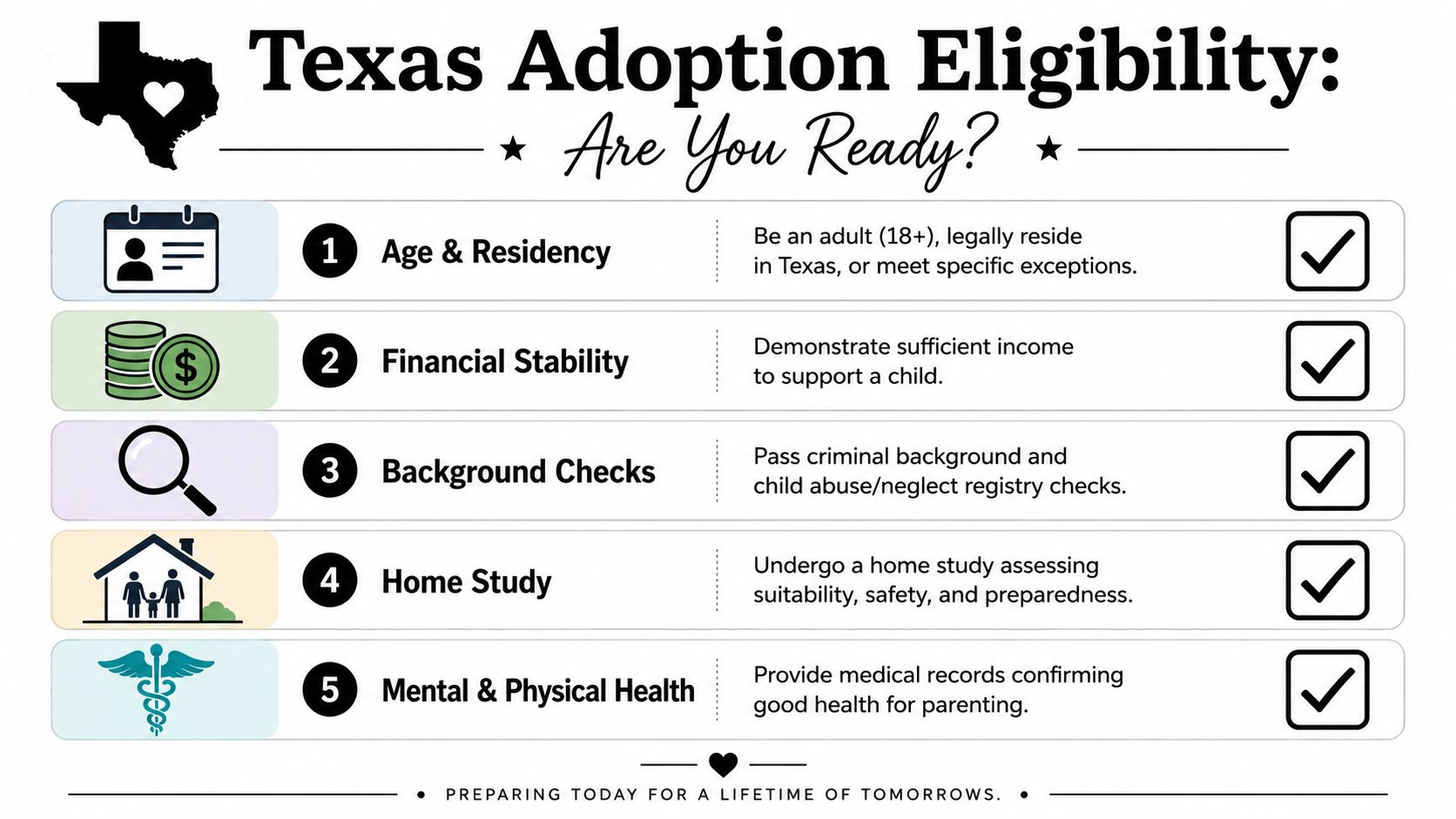
Texas requires prospective adoptive parents to be at least 21 years old, financially stable, and responsible adults. The process also requires a home study, a criminal history background check, and an abuse or neglect check for every adult in the home, as outlined in this guide on Texas adoption requirements.
The legal checklist
Most families can prepare for the basics by gathering records and asking practical questions early. Common requirements include:
- Age and maturity: You must meet the minimum age requirement and show adult responsibility.
- Financial stability: You don't need to be wealthy, but you do need to show you can support a child.
- Background screening: Every adult in the household may be reviewed for criminal history and abuse or neglect records.
- Home study participation: A professional evaluates your home and readiness.
- Training and documentation: Some cases require education on children's needs, especially in foster-related cases.
If financial records are one of the parts worrying you, it may help to address credit issues before your file is reviewed. Some families explore Texas credit repair solutions so their paperwork better reflects overall stability.
For a fuller overview, many families also review Texas adoption requirements explained before they begin gathering documents.
A short video can also help make these requirements feel more human and less intimidating.
The part families often overlook
The harder question isn't always legal. It's emotional.
Texas agencies and evaluators often look closely at emotional readiness, even though there's no single document that proves it. That can be confusing for families, especially after infertility, miscarriage, or years of trying to become parents. The concern isn't whether you've had grief. Many families have. The concern is whether you've processed that grief enough to welcome a child for who that child is, not as a replacement for a loss.
Practical rule: If you and your spouse can talk honestly about expectations, grief, boundaries, and parenting goals, you're already doing important adoption work.
Emotional readiness often shows up in ordinary ways. Can you explain why adoption is right for your family? Are both adults on the same page? Have you thought about openness, trauma, or how you'll talk to a child about their story? Those answers matter.
The Heart of the Process Navigating the Home Study and Paperwork
The home study sounds intimidating because the name makes it seem like someone is coming to score your housekeeping. In reality, it's a structured review of your home life, safety, and readiness to parent. The professional completing it wants to know whether a child will be safe and supported in your care.
A lived-in house is fine. A perfect house isn't required.
What a home study usually includes
Most home studies combine interviews, document review, and at least one visit to your home. The evaluator may ask about your childhood, marriage, support system, work schedule, discipline views, and reasons for adoption. They'll also look at safety issues such as sleeping arrangements, smoke detectors, and general living conditions.
Common paperwork often includes:
- Identity documents: Birth certificates, driver's licenses, and sometimes marriage records or divorce decrees.
- Financial records: Pay stubs, tax returns, and budget information that show stability.
- Medical information: Basic health forms, and in some cases TB tests or CPR records depending on provider requirements.
- Background documents: Fingerprinting and records for adults in the household.
- Personal references: Letters from people who know your character and family life.
Families often feel calmer when they make one folder for legal records and another for household tasks. That small step can prevent frantic searching later.
If you want a more detailed breakdown, this resource on Texas adoption home study requirements can help you organize the process.
Why timing matters so much in private adoption
Private domestic adoption in Texas has very specific consent rules. A birth mother cannot legally sign consent until 48 hours after birth, and she then has a 10-day revocation period. Failure to follow that timeline can invalidate the termination of parental rights under Texas Family Code §162.010, as described by DePelchin's overview of adopting a child in Texas.
That timing is one reason families need patience after placement discussions at the hospital. You may feel emotionally attached right away, but the legal process still has steps that must happen in the correct order.
Consent signed too early can create serious legal problems later. Slow and careful is safer than rushed and hopeful.
Emotional honesty matters here too
The home study is also where emotional readiness becomes visible. If a social worker asks how you'll speak to a child about adoption, they aren't trying to trap you. They're looking for honesty, maturity, and flexibility.
A strong answer might sound like this: “We know adoption starts with loss as well as love. We want our child to know their story in an age-appropriate way, and we want to respect the people connected to that story.” That kind of answer tells the evaluator you've thought beyond the paperwork.
Choosing Your Guide Agency, Attorney, or Private Route
A lot of hopeful parents reach this point and ask the same question: Who should walk with us through this? The answer depends less on preference and more on the facts of your case. In Texas adoption, your guide is a bit like choosing the right kind of map for the trip. Some families need full support from the first application to placement. Others already know the child or the birth family and mainly need careful legal work to make the adoption secure.
What an agency usually handles
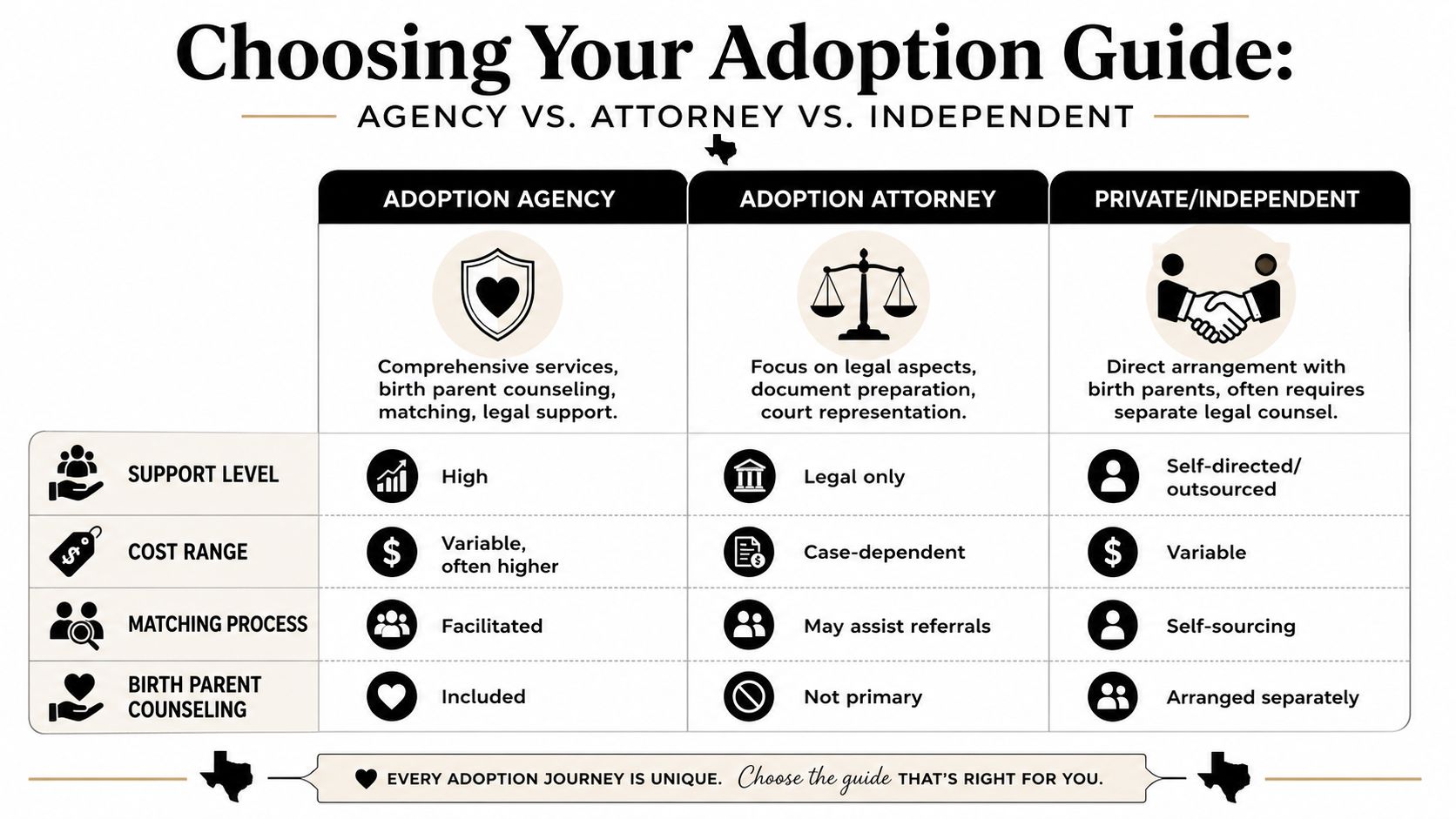
An adoption agency often serves as the organizer of the process. Agencies may screen adoptive families, provide education, help with matching, coordinate counseling, and manage many of the practical steps around placement.
That kind of structure can bring peace of mind.
It is often a good fit for families who are early in the process, do not already have a match, or want one team helping manage both logistics and support services. The benefit is not just convenience. It is consistency. With an agency, you usually have a set process to follow, which can make an emotional season feel more manageable.
What an attorney focuses on
An adoption attorney handles the legal framework that turns hope into a legally recognized parent-child relationship. That includes drafting pleadings, preparing consent and termination documents, filing the case, addressing notice issues, and appearing in court.
This legal work matters because adoption cannot move forward until parental rights are handled correctly under Texas law. In many cases, every living parent's legal relationship must be terminated before the court can grant the adoption, unless that issue is joined with the adoption suit. In a stepparent adoption, one parent remains the child's legal parent because that parent is married to the petitioner, as stated in Texas Family Code Section 162.001.
A simple way to view it is this: the agency may help carry the process, but the attorney clears the legal path. If a consent form, notice requirement, or termination step is mishandled, the case can stall or face a later challenge.
When a private route may make sense
A private or independent adoption usually means the connection between the adoptive family and the birth parent happened outside a full-service agency. That may happen through relatives, friends, faith communities, or professional referrals. These cases can feel more personal, but they also require careful boundaries and very clear legal steps.
Families taking this route often still need professional support from more than one source. An attorney may handle the court case. A licensed provider may complete the home study. A counselor may help the adults work through expectations, communication, and grief. In other words, private does not mean informal. It means the pieces are gathered separately instead of through one agency.
Here is a practical way to compare the options:
- Agency: Often helpful if you want matching assistance, education, and coordinated support in one place.
- Attorney-led case: Often a strong fit for stepparent, relative, or already-identified adoptions where the main need is legal guidance.
- Private route: Often works when a connection already exists, but it usually requires extra care in setting up the legal and support pieces correctly.
The guide When to Hire a Texas Adoption Attorney gives a factual overview of how legal counsel can help reduce delays and protect the adoption process. The Law Office of Bryan Fagan, PLLC is one Texas-based option that assists families with adoption preparation, court filings, and finalization across different adoption types.
Choose the kind of help that fits your facts, your timeline, and your emotional needs. The best path is the one that gives your future child a stable legal foundation and gives your family steady support along the way.
The Final Steps From Placement to Finalization Day
After placement, daily family life begins before the legal process is fully complete. That can feel surprising. In many cases, the child is already calling you Mom, Dad, or by another loving name while the court process is still moving in the background.
Texas requires time before finalization. The child must live in the adoptive home for at least six months before the adoption can be finalized, and if the child is 12 or older, the child's written consent is required for the final decree, according to this explanation of the Texas adoption process for stepparents and related finalization rules.
What happens during the waiting period
This part often includes post-placement supervision. A social worker may visit, ask how the child is adjusting, and check whether the home remains appropriate. These visits are usually supportive. They give professionals a chance to identify problems early and help families settle into new routines.
A child may need time to test boundaries, especially after uncertainty or loss. That doesn't mean the placement is failing. It often means the child is slowly learning that this home is safe enough to trust.
The child's voice matters
When the child is old enough under Texas law, the court wants to hear that the child agrees. Written consent for a child age 12 or older recognizes that adoption affects identity, belonging, and long-term family ties. Children in this age group may feel happy, nervous, relieved, or conflicted all at once.
Parents can help by avoiding pressure. A better approach is calm reassurance: “You can ask questions. This is about making sure you feel secure too.”
Finalization day
Finalization hearings are often brief, but they carry enormous emotional weight. The judge reviews the paperwork, confirms the legal requirements are satisfied, and signs the adoption decree. Many families bring grandparents, siblings, or close friends. Some dress up. Some cry. Some take photos in the hallway afterward holding the signed order.
The courtroom moment matters because it turns daily love into permanent legal family status. It's the day uncertainty gives way to legal security.
Your New Beginning and Common Adoption Questions
Once the final decree is signed, your attention shifts from process to everyday life. School forms become easier. Medical consent becomes clearer. Family identity feels more settled. For many parents, that legal clarity brings peace they didn't realize they were missing.
Common questions families ask
What are the estimated costs of adoption in Texas?
Costs depend heavily on the type of adoption. Foster care adoption is often free or low cost. Private agency and private attorney-led adoptions can be much more involved. Instead of focusing only on a number, focus on what services are included, whether counseling is needed, and how legal work will be handled.
Can a single parent or LGBTQ+ adult adopt in Texas?
Texas focuses on whether the adult is qualified to provide a stable home and whether the adoption serves the child's best interests. Many single adults and LGBTQ+ families successfully adopt in Texas through private, foster, relative, and stepparent pathways.
What's the difference between open and closed adoption?
Open adoption allows some level of continued contact or communication between birth and adoptive families. Closed adoption does not. Openness can range from photo updates to direct visits, depending on the agreement and relationships involved. What works best depends on the people involved and the child's needs.
What about adult adoption?
Texas also allows adult adoption. A person age 18 or older may be adopted with written consent, and adult adoption generally doesn't require termination of parental rights, a home study, or a CPS investigation, as described in this guide to adult adoption under Texas Family Code §162.501. These cases are often used to formalize long-standing parent-child relationships.
What should we do after the adoption is final?
You may need to update records, request an amended birth certificate where applicable, review estate planning, and make sure schools and doctors have the right legal paperwork. This overview of what happens after an adoption is final in Texas can help you think through those next steps.
The legal case ends on finalization day. The family story begins again the next morning.
If you're considering adoption and want guidance that is clear, compassionate, and grounded in Texas law, you can schedule a free consultation with Law Office of Bryan Fagan, PLLC. A thoughtful legal review can help you understand your options, avoid preventable delays, and take the next step toward building or protecting your family.
