
Some families arrive at this question after a long season of thought. Others feel it all at once. You see a story about a child who needs a safe place to sleep, or you realize your home has room, your heart has room, and you want to help. If that's where you are, your feelings make sense.
Becoming a foster parent in Texas is both practical and personal. It asks you to open your home, follow a legal process, and prepare for a child who may be carrying fear, grief, confusion, or hope. It can also become part of a larger family journey that includes guardianship, kinship care, or adoption under Texas Family Code Chapters 162 through 166.
Answering the Call to Become a Foster Parent in Texas
If you're searching for how to become a foster parent in Texas, you're probably doing more than gathering paperwork. You're trying to decide whether your family is ready for a serious commitment. That's the right place to begin.
Texas sets a few basic rules at the front end. A foster parent must be at least 21 years old, financially stable without depending on foster care payments for basic living expenses, and prepared to go through an application, background checks, and a home study. The process also involves training and careful review of the home environment. You can learn more about the foster and adoption path through Texas foster and adoption guidance.
What this calling usually looks like in real life
For many families, the first question isn't legal. It's emotional. You may be asking:
- Can I help a child who has been through trauma?
- Will fostering affect my own children?
- What if I get attached and the child leaves?
- Could fostering ever lead to adoption?
Those are honest questions. They don't mean you're unprepared. They mean you understand that fostering is about a child's safety, healing, and long-term best interests.
Foster care begins with temporary care. Sometimes it leads to reunification. Sometimes it leads to permanency through adoption. The child's needs guide that path.
Texas family law treats permanency seriously. Chapters 162 through 166 of the Texas Family Code govern adoption procedures, consent, court review, and finalization. If fostering later becomes adoption, the legal process shifts from placement and supervision to proving that adoption serves the child's best interest and meets statutory requirements.
That may sound like a lot. It is a lot. But it becomes manageable when you take it one step at a time.
Understanding the Foundational Requirements for Fostering
Before you fill out forms or attend classes, it helps to know what Texas is looking for. These rules aren't meant to keep caring people out. They exist to make sure children enter homes that are stable, safe, and ready for the realities of foster care.
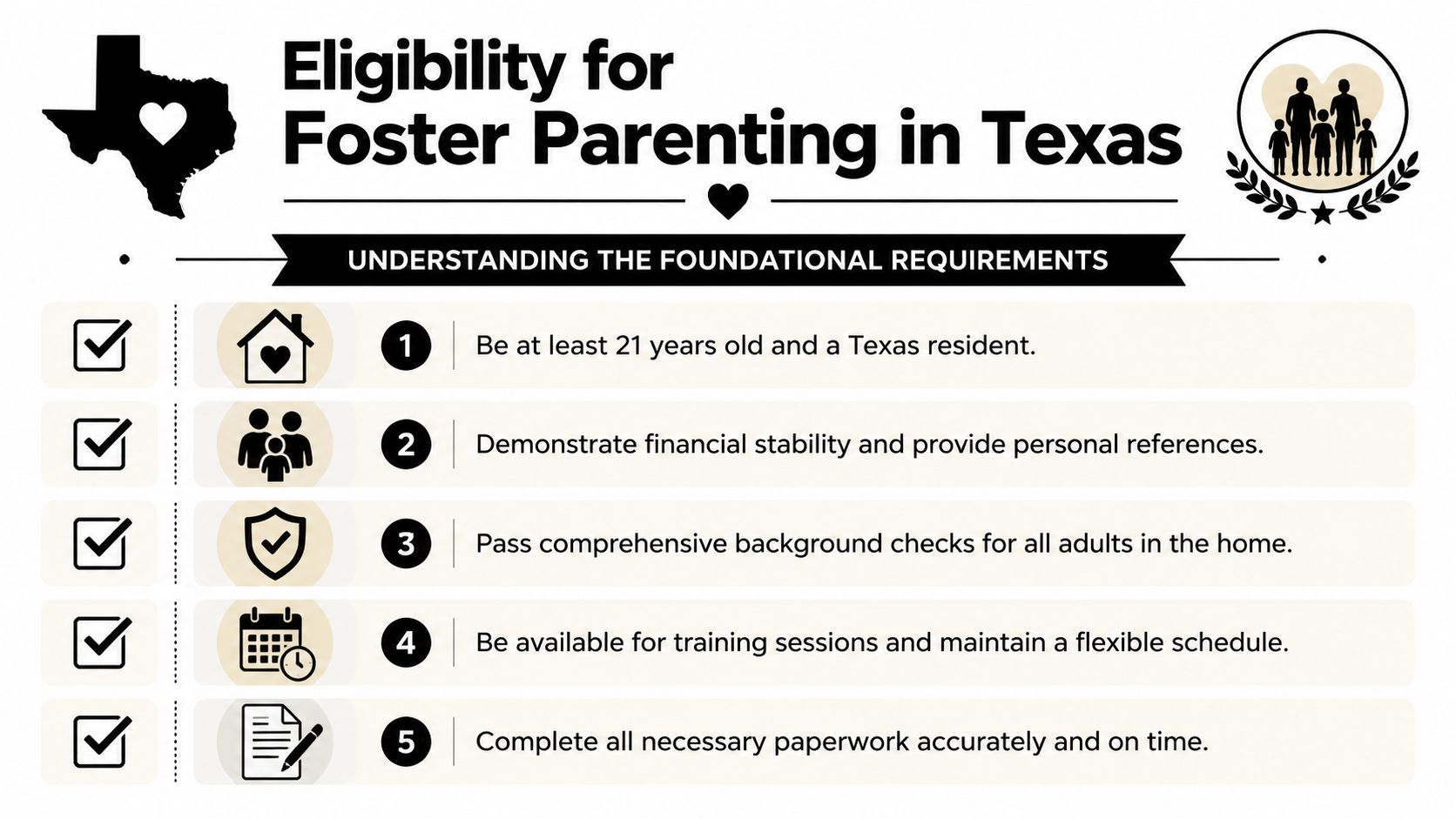
Texas requires that a prospective foster parent be at least 21 years old, show financial stability apart from foster reimbursements, and complete a licensing process that usually takes 3 to 6 months, including the application, background checks, and home study, according to Pathways Youth & Family Services on becoming a foster parent in Texas.
The core eligibility rules
Here's the simplest way to think about the starting line:
- Age matters: Texas requires adult maturity and decision-making capacity. That's why the minimum age is 21.
- Financial stability matters: Foster payments are meant to support a child's care, not to become the household's basic income.
- Safety matters: The state reviews criminal history and abuse or neglect records for adults in the home.
- Readiness matters: Families have to complete the required process on time and with accurate information.
- Home life matters: The agency wants to know whether your household can offer routine, privacy, and emotional steadiness.
If you're also comparing fostering with adoption, Who Can Adopt in Texas? Eligibility Requirements gives a basic overview of adoptive parent eligibility in Texas.
DFPS or a private agency
Most families start by choosing whether to work directly with the state or with a licensed private Child Placing Agency. Both routes involve rules from Texas and oversight tied to child welfare standards, but the day-to-day experience can feel different.
| Option | What families usually consider |
|---|---|
| DFPS | Direct connection to the state process and state-managed foster care system |
| Private CPA | Agency-based support, training coordination, and case management style that may feel more personal to some families |
Neither option is automatically right for everyone. A couple with full-time jobs may want an agency that offers closer scheduling help. A relative caregiver may care more about finding the route that fits the child's immediate circumstances. A family considering future adoption may also want to understand how the agency handles foster-to-adopt cases.
For a more focused discussion of foster parent qualifications, see Texas foster parent requirements.
Practical rule: If you're unsure whether you qualify, ask early. It's easier to clarify a concern at the beginning than to lose time during review.
Starting Your Journey with an Application and Training
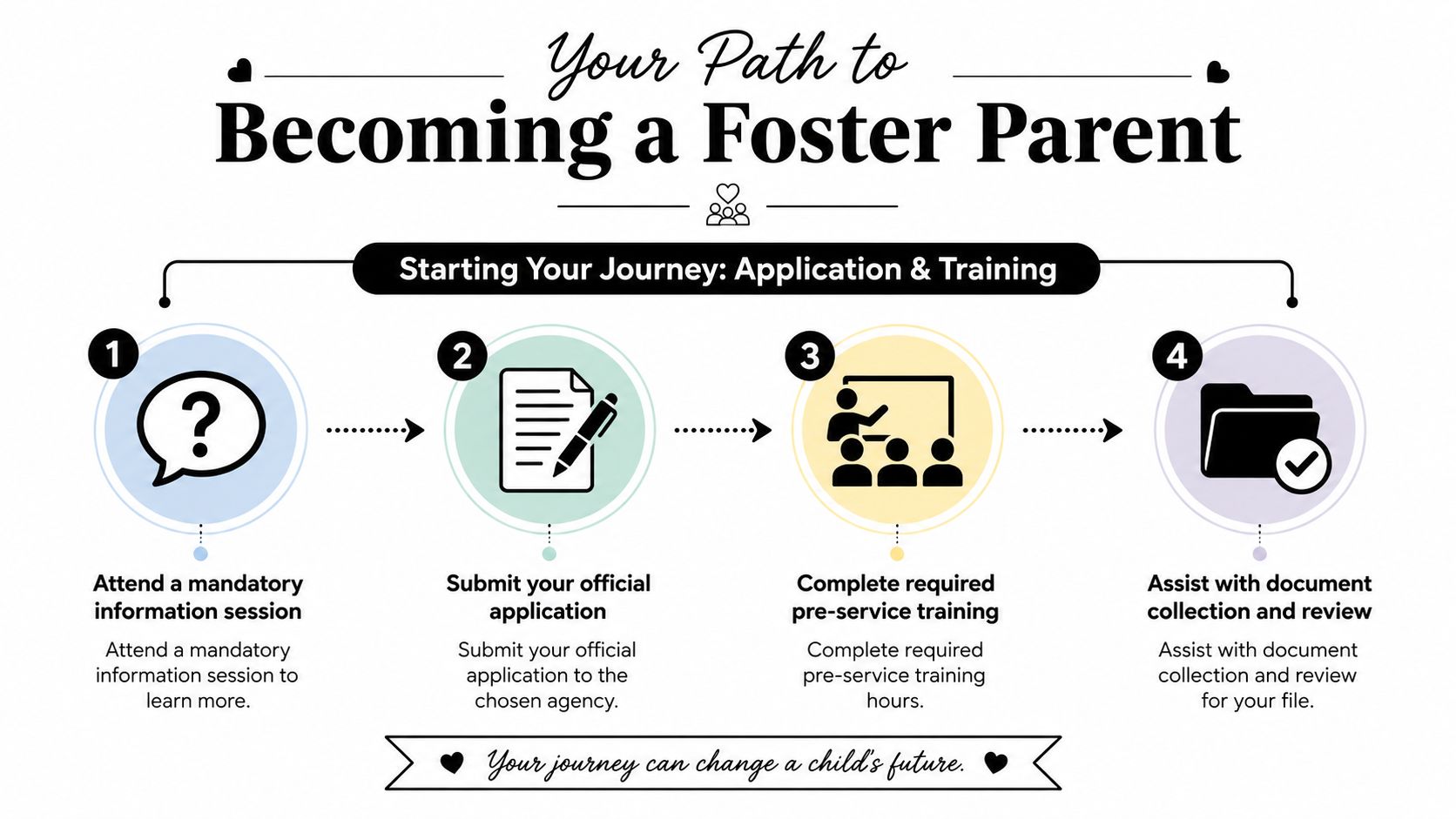
The first step is often expected to be paperwork. In practice, the first real step is learning what daily foster care looks like. That usually starts with an information session and a conversation with the agency you may work with.
A family might attend orientation feeling excited and leave with mixed emotions. That's normal. They hear about trauma, court orders, visitation, medical appointments, school transitions, and uncertainty. They also hear what children need most. Calm adults, predictable routines, and someone who doesn't give up on them.
What happens after orientation
Once you choose an agency, you'll submit an application and begin gathering documents. This stage often includes personal history, household details, references, and records the agency needs to evaluate your readiness.
A simple example helps. Sarah and Miguel, a fictional Texas couple, knew they wanted to foster school-age children. They thought the hard part would be the home visit. Instead, the challenge was collecting every record, answering personal questions carefully, and coordinating their schedules around training.
That's where patience matters.
The required training
Texas requires pre-service education before licensure. Prospective foster parents must complete the National Training and Development Curriculum (NTDC), along with certifications in Psychotropic Medication management, First Aid, and CPR, as explained by the Texas Department of Family and Protective Services foster care steps page.
Training serves a real purpose. It prepares adults for situations that can feel surprising at first, such as:
- Trauma responses: A child may seem withdrawn, defiant, or unusually watchful.
- Medication questions: Caregivers may need to understand how psychotropic medication is monitored and administered.
- Everyday safety: First Aid and CPR training help families respond calmly in urgent moments.
- Child development: You begin to see behavior in context, not just as “good” or “bad.”
Many hopeful parents worry that training will test whether they're perfect. It won't. It helps you become more informed, more observant, and more prepared.
Why this stage matters later
Families sometimes rush through this part because they want a placement quickly. But the application and training phase often shapes everything that follows. When you understand trauma, boundaries, communication, and the legal structure around foster care, you make steadier decisions.
That can matter even more if your case later turns toward adoption. Chapters 162 through 166 of the Texas Family Code come into sharper focus when a child becomes legally eligible for adoption. By then, the habits you formed during training, asking questions, documenting concerns, and working with professionals, become part of protecting the child's best interests.
Preparing Your Home and Family for the Home Study
You have finished the classes, gathered forms, and started to feel the process becoming real. Then someone says the words home study, and many hopeful parents feel their stomach drop. They worry the state is looking for a flawless house or a flawless family. The better way to understand it is simpler. A home study works like a full family snapshot. It checks whether your home is safe and whether the adults in it are ready for the daily realities of caring for a child who may arrive carrying fear, grief, or confusion.

Part of the review is concrete. A caseworker will look at sleeping arrangements, basic safety, storage of medication, and whether firearms are secured if they are in the home. Texas Health and Human Services licensing standards also set rules for bedroom space, bed arrangements, and household capacity in foster homes, as explained in the Minimum Standards for Child-Placing Agencies. Those rules point to the purpose of the visit. The state is checking for safety, privacy, and dignity for the child.
The other part is more personal, and that is where many families feel caught off guard.
A home study often includes interviews about your relationships, work schedule, support system, discipline beliefs, stress level, and past losses. That can feel less like filling out a form and more like opening your front door and your family story at the same time. For many people, that is the harder task.
What the reviewer is really trying to understand
A reviewer is usually not asking, “Is this family perfect?” The better question is, “Can this family provide steadiness when a child's life feels unsteady?”
That difference matters. A child in foster care may test routines, struggle with sleep, worry about siblings, or have mixed feelings about visits with biological family. The home study tries to see whether the adults in the home can respond with patience, structure, and honesty instead of panic or resentment.
For that reason, questions may go beyond the obvious. You may be asked how disagreements are handled in your home, what your children understand about fostering, who can help if you need respite, or how you would support a child's connection to family when the case plan calls for it. Those are not trick questions. They help the agency match children with families who can meet real needs, not idealized ones.
How to prepare without trying to perform
Preparation helps most when it is practical.
Walk through your home slowly, as if you were seeing it for the first time. Notice where a child would sleep, where personal items would go, whether cleaning supplies are easy to reach, and whether everyday routines feel calm or chaotic. Then talk with the people who live there. A spouse, partner, grandparent, or child in the home should understand that fostering can change schedules, privacy, noise level, and emotional energy.
It also helps to gather documents before anyone asks for them again. Medical forms, identification, proof of income, pet vaccination records if required, and household information are easier to manage while the process is still calm.
Then comes the part many families try to avoid. Be candid.
If your marriage went through a hard season, say so and explain what changed. If you are single and worried about support, explain the backup plan you have built. If your parenting style has changed over time, say what you learned. A thoughtful, honest answer usually carries more weight than a polished one.
Where families often get surprised
The physical checklist is usually easier than the emotional one. A smoke detector can be installed in an afternoon. A conversation about grief, infertility, childhood trauma, or conflict habits takes more courage.
Consider a common example. A single applicant may expect most of the discussion to focus on bedroom space and locked medicine storage, but spend much longer answering questions about disappointment, boundaries, and how she would handle a child who wants to go home. That is not the agency drifting off topic. Foster care asks adults to hold affection and uncertainty together. The home study is trying to see whether you can do that safely.
This stage also shapes choices you may face later. Some families hope only to foster. Others are open to adoption if reunification is no longer possible. During the home study, your answers about attachment, family contact, flexibility, and long-term commitment can clarify what kind of placement is realistic for your household. That self-knowledge can spare you pain later and help a child land in a home that fits.
Navigating Common Obstacles on the Path to Licensing
This is the part many families wish someone had explained sooner. The process isn't usually blocked by one dramatic event. More often, it slows down because of missing documents, unclear answers, scheduling problems, or household rules that weren't fully understood at the start.
One source of delay is the paperwork burden itself. A common pitfall in Texas is a 40-page interview and documentation burden, and while 60% of applicants complete orientation, only about 35% secure licensure within a year, often because of income instability or failure to meet the home capacity rule, according to Child Welfare Information Gateway's Texas home study requirements resource.
The obstacles that show up most often
The pattern usually looks like this:
Incomplete records
Health forms, screenings, and household details can stall a file if one piece is missing.
Financial misunderstanding
Some applicants treat foster reimbursements like qualifying income. Texas doesn't.
Household capacity issues
Families sometimes miscount who belongs in the total-child limit because the rule includes more than foster children alone.
Stress during waiting
Silence from an agency can feel personal, even when it's administrative.
How to handle the process with less frustration
A calm system beats last-minute scrambling.
- Create one folder for every required document: Keep digital and paper copies if possible.
- Answer questions fully the first time: Shortcuts often lead to follow-up requests.
- Ask direct questions about gray areas: If you're unsure about prior police contact, household occupancy, or income documentation, raise it early.
- Treat communication like part of the licensing review: Prompt, organized responses show reliability.
The families who move through licensing most smoothly usually aren't the families with perfect lives. They're the families who stay responsive, honest, and organized.
When fostering may later become adoption
Some applicants enter foster care hoping to adopt. Others don't make that decision until they've formed a bond with a child in their home. Either way, it helps to understand the legal milestone ahead.
Under Texas Family Code Chapters 162 through 166, adoption is a separate court process from foster placement. If parental rights are terminated or otherwise legally addressed and adoption becomes possible, the court will review whether the adoption serves the child's best interest. For birth mothers in private adoption cases, Texas law also includes a waiting period before an affidavit relinquishing parental rights can be signed. Foster care cases follow a different procedural path, but the legal theme is the same. Texas courts move carefully when permanent family rights are involved.
From Foster Placement to Finalizing a Forever Family
The phone rings in the middle of an ordinary week. A caseworker asks whether you can take a child that day, or that night. In a few seconds, foster care stops feeling like a checklist and starts feeling like a real child needing a safe place to land.

The first stage of placement usually centers on stability, not permanence. You are learning the child's routines, medical needs, school situation, comfort items, and the patterns that help the home feel safe. Many children entering care have lived through fear, loss, or repeated disruption, and those experiences can shape behavior in ways that confuse even caring adults. The Children Psych guide offers a helpful explanation of adverse childhood experiences and how healing often begins with consistency, patience, and predictable care.
That early season can feel like holding something fragile with both hands. Progress may show up in small ways. A child sleeps through the night. A backpack gets packed without tears. A hard conversation ends with trust instead of shutdown.
When a foster placement moves toward adoption
Some foster placements remain temporary. Others gradually shift toward permanency after the court and the Department determine reunification is no longer the plan. For foster parents, this is often the most emotional part of the process because love may already be present long before the legal path becomes clear.
Texas law treats adoption as a separate court process from foster placement. A child generally must live with the prospective adoptive parents for at least six months before the adoption can be finalized, and the Texas Law Help adoption guide explains that this supervision period gives the court time to confirm the placement is working in the child's best interest.
That waiting period can be hard, especially if your family already feels bonded. It helps to view it like the court's final safety check. The goal is not to slow loving families down for no reason. The goal is to make sure a temporary placement has become a stable, lasting home.
If you are trying to understand how that shift happens in practice, this guide on how to foster to adopt in Texas step by step explains the foster-to-adopt route in more detail.
What support may continue
Support does not necessarily end the day a case moves from foster care toward adoption. While a child is in foster care, families may receive monthly reimbursement tied to the child's needs, along with medical coverage through the state. If adoption later becomes possible, some families may also qualify for adoption assistance, post-adoption support, and education-related benefits.
For example, the Texas Education Agency explains the state's tuition and fee waiver for students formerly in foster care, and the Texas Department of Family and Protective Services outlines adoption assistance and post-adoption support. Eligibility depends on the child's circumstances and the legal posture of the case, so it is wise to ask specific questions before assuming what will continue after finalization.
The legal transition is significant. Foster parenting gives you day-to-day responsibility under agency and court oversight. Adoption creates a permanent parent-child relationship through a court order, with all the rights and duties that come with it under Texas Family Code Chapters 162 through 166.
For many families, the final hearing feels quiet and enormous at the same time.
Relatives and kinship caregivers can reach a similar crossroads from a different starting point. They may already be caring for a child informally and later need legal authority through conservatorship, adoption, or another permanent arrangement. The paperwork differs, but the court's question stays much the same. Which legal structure best protects this child, supports stability, and serves the child's best interest over time?
Your Next Step Toward Building Your Family
Becoming a foster parent asks for courage, patience, and honesty. It also asks you to live with uncertainty for a while. That's hard. But many Texas families find that once they understand the process, the path feels less intimidating and more purposeful.
If you've been wondering how to become a foster parent in Texas, start with the basics. Make sure your home and finances are ready. Learn the training requirements. Prepare for the home study. Stay organized during licensing. Then, if a placement eventually opens the door to adoption, remember that Texas Family Code Chapters 162 through 166 provide the legal framework for creating a permanent family.
Every step should keep the best interests of the child at the center. That applies whether you are a hopeful foster parent, a relative caregiver, an adoptive parent, or someone exploring guardianship options after a child has already come into your life.
If you're ready for legal guidance at any point in this journey, Law Office of Bryan Fagan, PLLC offers free consultations for Texas families navigating foster care, adoption, kinship care, and guardianship. A conversation can help you understand your options, prepare for the next legal step, and move forward with clarity.
