
Some families start their search late at night. The house is quiet, and a question keeps circling in your mind: who can help us do this the right way? Maybe you're a stepparent who has loved a child for years and wants the law to reflect that bond. Maybe you're a grandparent, aunt, or uncle who has stepped in and now wants permanence. Maybe you're pursuing a private adoption and feel hopeful, excited, and overwhelmed all at once.
That search for an adoption attorney near me in Texas often happens at a tender moment. You want answers, but you also want someone who understands that this isn't just paperwork. This is your family.
A good Texas adoption lawyer helps you slow down, sort through the noise, and take the next step with confidence. The law has rules, deadlines, and court procedures. Your life has emotions, relationships, and hard questions. Both matter.
Your Texas Adoption Journey Starts Here
Maria and James had already picked out a bedroom color before they called a lawyer. They weren't being reckless. They were being human. They were excited. They were also anxious because every website they read seemed to say something slightly different about how adoption works in Texas.
That confusion is common. A family may know they want to adopt, but not know whether they need an agency, an attorney, a home study first, or court approval first. A stepparent may think the process is simple because the child already lives in the home. A relative caregiver may assume guardianship and adoption are the same thing. A birth parent may wonder what "open adoption" really means after the case is finalized.

Texas law gives families several adoption paths, including stepparent, kinship, foster care, private domestic, international, and adult adoption. The legal rules also intersect with Texas Family Code Chapters 162 through 166, along with termination rules that often begin under Chapter 161. In plain English, that means the court wants to make sure every required step has happened before it creates a permanent parent-child relationship.
Why local fit matters
A lawyer who handles adoptions across Texas should understand the statewide rules. But the right local fit matters too. Courts in Houston, Dallas, Austin, San Antonio, and surrounding counties may share the same state law while still having different scheduling patterns, local expectations, and practical filing habits.
That matters most when your case has a wrinkle, such as:
- A contested stepparent adoption where the other biological parent's rights haven't been terminated yet
- A kinship case where relatives need clarity on adoption versus guardianship
- A private adoption that may involve interstate paperwork
- An adult adoption where the process is much simpler but still needs proper court filing
Adoption isn't only about getting to court. It's about building a process your family can live through with less fear and more clarity.
If you're at the beginning, you don't need to know everything today. You do need a reliable guide. Finding the right attorney is often the first solid step toward turning hope into a legal, lasting family bond.
What a Texas Adoption Attorney Actually Does for Your Family
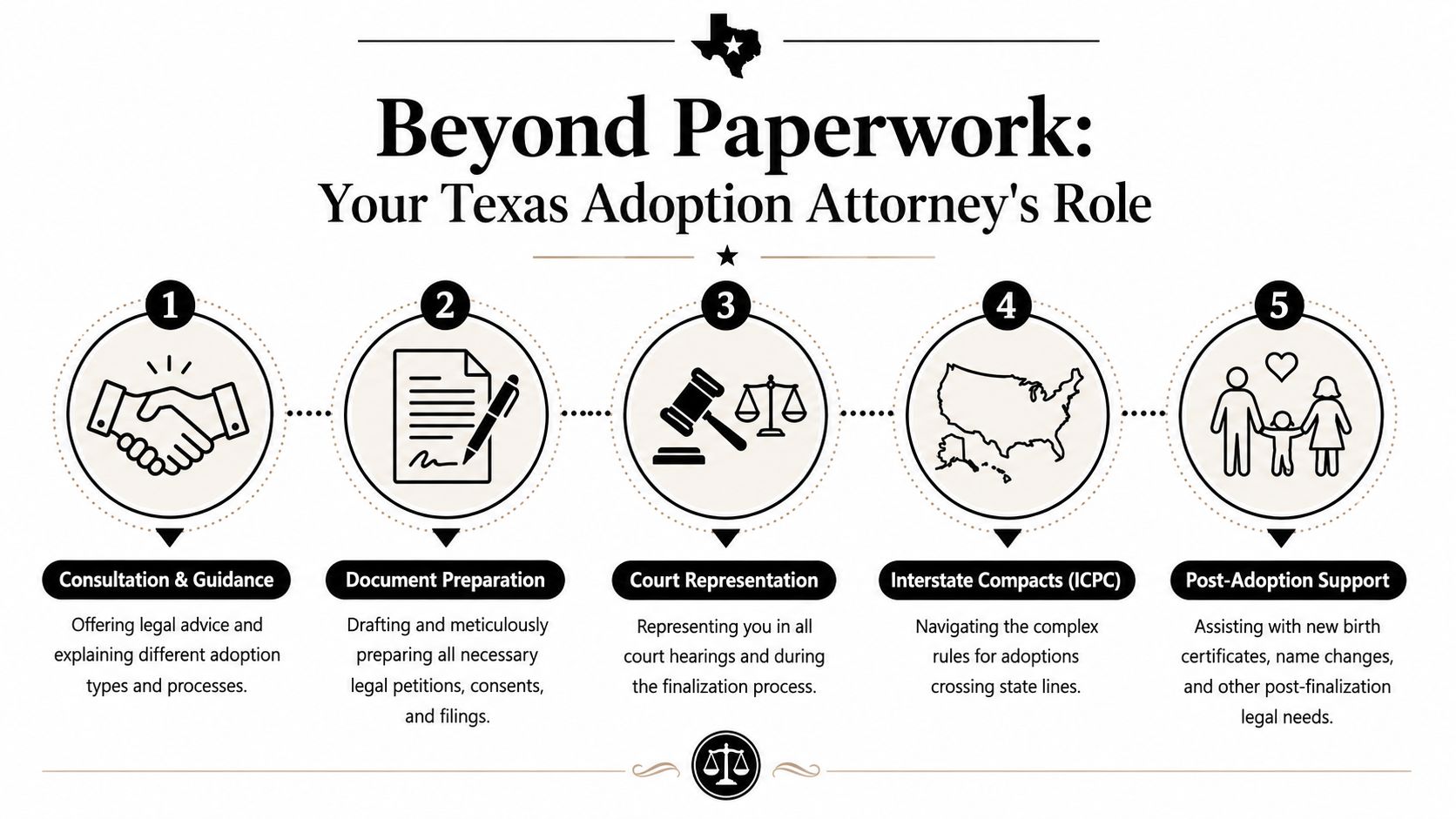
Many people think an adoption lawyer mainly files forms. In Texas, that's only part of the job. A strong adoption attorney acts as your legal guide, your procedural safety net, and, when needed, your courtroom advocate.
They map the legal path early
Texas adoptions don't all start in the same place. A stepparent adoption usually turns on termination of the other biological parent's rights. A private infant adoption may involve pre-birth planning, consents, placement issues, and post-placement steps. An interstate adoption can trigger ICPC requirements, which are the rules that govern placement across state lines.
An attorney helps identify which legal path fits your facts. That can prevent families from spending months moving in the wrong direction.
According to Texas adoption attorney guidance on timing and outcomes, early attorney engagement, ideally before birth or foster placement, reduces procedural failures by 40% and increases finalization success from 55% to 85% in private infant adoptions.
They protect the case from avoidable mistakes
An agency and an attorney don't do the same work. An agency may help with matching, education, or support services. The attorney handles the legal structure that allows the court to approve the adoption.
That includes work such as:
- Drafting petitions and consents so the court has the right documents in the right form
- Checking statutory requirements such as background checks, home study issues, and child consent when required
- Handling contested proceedings if termination of parental rights is disputed
- Coordinating post-placement visits when the court requires them
- Managing interstate paperwork if the child is crossing state lines
For a closer look at those legal tasks, this overview of what an adoption lawyer actually does step by step gives a practical breakdown.
A related resource, When to Hire a Texas Adoption Attorney, also explains why legal guidance protects the adoption from delays and challenges.
Here is a short overview if you want to hear the process explained another way.
They stand with you in emotionally hard moments
Sometimes the legal issue is tied to a painful family reality. A birth parent may be absent. A former partner may refuse to cooperate. A foster family may be ready to finalize, but the case isn't yet legally clean. In those moments, your attorney isn't there just to push paper. They're there to explain what the court needs, what can be fixed, and what patience will look like.
Practical rule: If your case involves consent questions, termination issues, interstate placement, or uncertainty about court procedure, don't wait for a problem to appear before you get legal help.
The right lawyer doesn't erase the emotional weight of adoption. They make the path steadier.
Finding the Right Fit What to Look for in Your Attorney
Not every family lawyer handles adoption work regularly. When you're searching for an adoption attorney near me in Texas, it helps to look beyond general family law and focus on specific adoption experience.
Match the lawyer to your adoption type
A stepparent case and a kinship case can look similar from the outside. They aren't the same in practice.
In a stepparent adoption, the court often focuses heavily on whether the noncustodial biological parent's rights have been properly terminated or joined with the adoption suit, which tracks Texas Family Code § 162.001 as summarized by the Texas adoption statute overview. In a kinship case, the family may already have day-to-day care but still need help navigating the legal shift from temporary caregiving to permanent parenthood.
A private adoption can add another layer. The process may move through a petition, termination of parental rights, a third-party social study, and a final court recommendation based on the child's best interests. A child over 12 must provide consent in many cases, and approximately 15% to 20% of private adoption cases in Texas encounter procedural setbacks due to incomplete documentation or unmet statutory criteria, according to Texas adoption process guidance for private cases.
That means the lawyer you hire should have direct experience with the kind of case you have, not just "adoption" in a broad sense.
Look for local knowledge and communication style
A good fit isn't only about credentials. It's also about whether the attorney explains things clearly and responds in a way that helps you stay calm and informed.
Consider these practical signs:
- They explain court steps in plain English. If they use a legal term, they define it.
- They know your county's workflow. Local court familiarity can make scheduling, filing, and expectation-setting much smoother.
- They ask about your family dynamics. Good adoption counsel doesn't treat every case like a form packet.
- They prepare you for emotional flashpoints. That includes child interviews, consent issues, and questions from relatives.
If you're comparing options, this guide on how to choose the right adoption attorney in Texas can help you evaluate experience and fit.
A quick example of why fit matters
Suppose a Houston stepparent wants to adopt a teenager who already calls him Dad. The family assumes the hearing will be simple. Then they learn the child is over 12 and consent is required, the other biological parent hasn't signed off, and the court wants a social study before moving forward.
Now compare that with a Dallas kinship caregiver adopting a niece after a longer caregiving arrangement, where the legal issues may center more on status, paperwork, and permanency planning than on an emotional dispute with a noncustodial parent.
Those are very different cases. Both deserve a lawyer who understands the details and can speak with compassion.
The right attorney should make you feel more informed after a conversation, not more intimidated.
If you're also exploring a blended-family route, a focused resource on stepparent adoption in Texas can help you understand that path more clearly.
Preparing for Your First Meeting Key Questions to Ask
Your first consultation isn't just a chance for a lawyer to learn about you. It's also your chance to learn whether that lawyer is the right guide for your family.
Adoption creates a full legal parent-child relationship, including inheritance rights equal to a biological child. Texas law also requires consent from a child age 12 or older unless the court waives it for the child's best interest, as explained by Texas Law Help's summary of Family Code § 162.017. Because the outcome is so significant, your questions should be direct and practical.
Questions about experience
Bring a written list. That takes pressure off your memory and helps you compare answers later.
How many cases like ours have you handled in this county?
What part of our case is most likely to slow things down?
Have you handled adoptions involving a child over age 12, contested parental rights, or interstate placement?
These questions help you learn whether the attorney has worked with the issues that matter in your case, not just adoption generally.
Questions about process and communication
The legal path can feel less stressful when you know who will do what and when.
Who in your office will prepare filings and keep us updated?
What documents should we start gathering now?
How do you explain home studies, background checks, and court hearings to clients who are new to the process?
What is your usual process for returning calls or emails?
A calm, organized answer tells you a lot. So does a vague one.
Questions about practical planning
Even when you don't have exact numbers yet, you can still ask for clarity around structure and expectations.
Will our case likely involve a flat legal fee, hourly billing, or a mix?
Which costs are court-related, and which are outside services like the home study?
If a problem comes up with consent or termination, how will that change the process?
Attorney needs by adoption type
| Adoption Type | Key Attorney Skillset | Critical Question to Ask |
|---|---|---|
| Stepparent | Termination issues, consent rules, local family court procedure | What happens if the other biological parent doesn't agree? |
| Kinship or Relative | Permanency planning, family dynamics, transition from caregiving to legal parenthood | How is adoption different from guardianship in our situation? |
| CPS or Foster Care | Coordination with state processes, post-placement requirements, timing issues | What court steps remain before finalization can happen? |
| Private Domestic | Consent timing, social study requirements, document precision | What documents must be complete before placement and finalization? |
| Adult Adoption | Straightforward court filing, written consent, local scheduling | Is this case likely to move as an uncontested adult adoption? |
Bring this mindset: You're not looking for a polished sales pitch. You're looking for clear judgment, patience, and honesty.
If you're interviewing multiple lawyers, write down not only what they say, but how they say it. Families remember compassion long after they forget technical phrasing.
What to Expect Adoption Timelines and Costs in Texas
One of the biggest frustrations in adoption is hearing a simple timeline that doesn't match real life. Texas cases vary a lot depending on the path you choose.
Timelines depend on the type of adoption
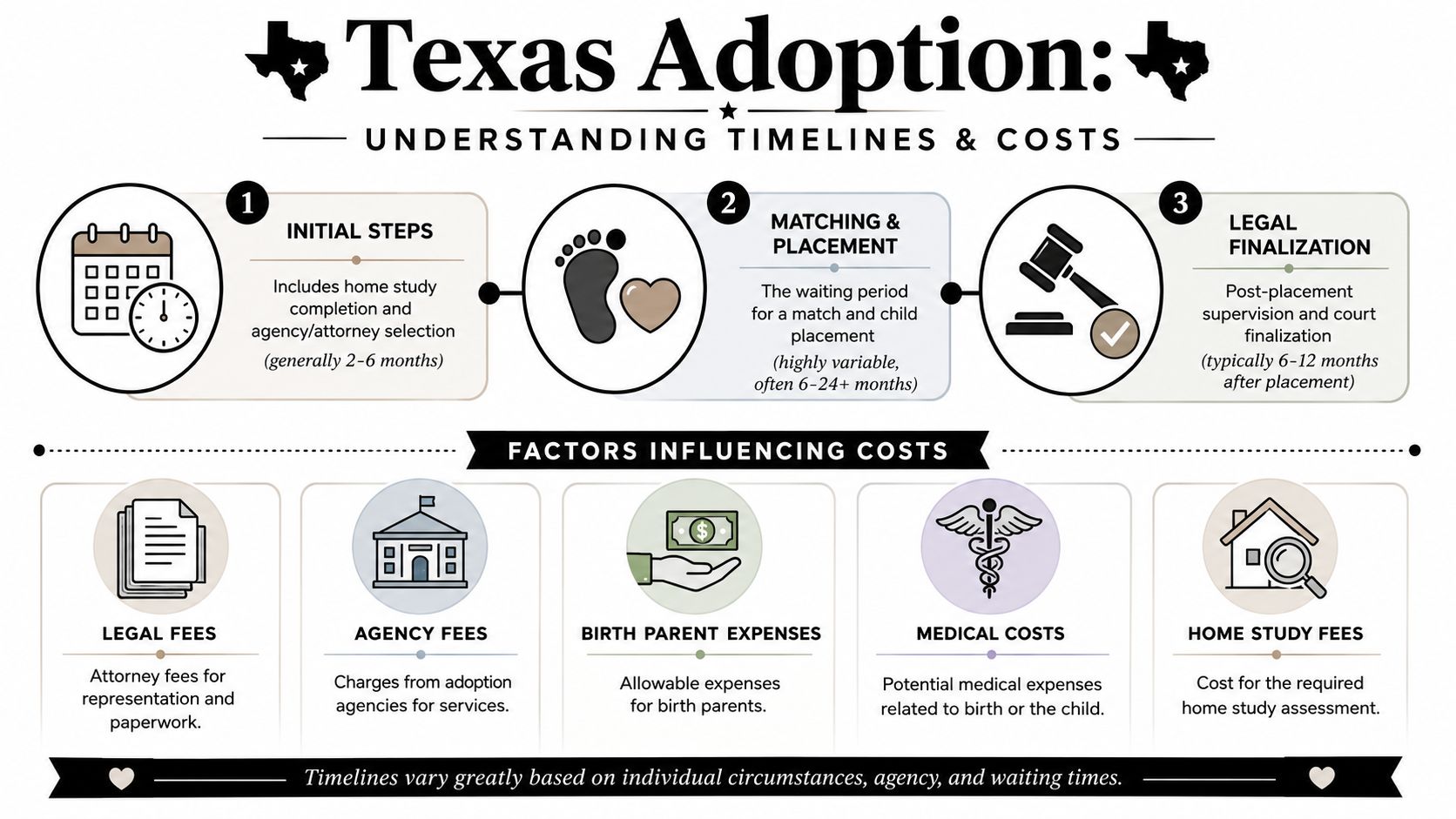
Foster care adoptions in Texas often take longer than families expect. While many firms use a general 6 to 9 month estimate, foster care adoptions often extend to 12 to 18 months because of CPS oversight, court delays, and mandatory post-placement visits. Recent data also shows over 60% of foster care adoptions exceed the standard timeline, according to Texas adoption timeline guidance focused on pathway differences.
Other pathways look different. Verified Texas adoption data also notes that foster-to-adopt placements may finalize within 6 to 18 months, while newborn adoptions can stretch much longer depending on matching, consent, and complications. Adult adoptions are often much faster because they don't require the same investigation steps as minor adoptions.
Costs come from several different places
Families often ask, "How much does adoption cost in Texas?" The honest answer is that it depends on the type of case and the services involved.
Common cost categories include:
- Attorney fees for legal advice, document preparation, hearings, and problem-solving
- Court filing fees required by the county
- Home study costs when a home study is required
- Agency fees if an agency is part of the process
- Related outside expenses such as evaluations or other required documentation
A lawyer should be able to explain which parts of the process are legal fees and which are outside costs. That's especially important if you're comparing a stepparent case, a private placement, and a foster care finalization.
For a practical look at the fee structure families often compare, this article on how much it costs to hire an adoption lawyer in Texas is a useful starting point.
A realistic timeline is a form of care. It helps your family plan emotionally, financially, and logistically instead of feeling blindsided later.
Paying for experienced legal help upfront can also help prevent the heavier cost of delays, refiling, or contested mistakes later.
Your Next Steps and Common Adoption Questions
If you've made it this far, you're already doing something important. You're preparing before you act. That matters in adoption, because thoughtful preparation often leads to a steadier experience for everyone involved, especially the child.
Your next step may be simple. Gather your questions. Write down your family situation in a few sentences. Then schedule a consultation with an attorney who handles the kind of adoption you're considering in your part of Texas. If you're weighing options, Law Office of Bryan Fagan, PLLC is one Texas-based firm that assists families with stepparent, kinship, foster, private, LGBTQIA+ inclusive, and adult adoption matters across major metro areas and statewide virtual consultations.
As you prepare for placement or finalization, practical home planning helps too. If you're getting a room ready for a child, these tips for making furniture safe can be a useful checklist alongside your legal planning.

Common questions families ask
Can LGBTQIA+ couples adopt in Texas?
Yes. What matters most is meeting the legal requirements that apply to your adoption path and showing the court that the adoption serves the child's best interests.
Can a single adult adopt in Texas?
Yes. Texas adoption law doesn't limit adoption only to married couples. The court will still look carefully at the legal requirements, stability, and the child's best interests.
What about adult adoption?
Adult adoption is much simpler than the adoption of a minor in Texas. Verified guidance on Texas adult adoption states that the adoptee must be at least 18 and give written, voluntary consent, and uncontested cases are often finalized within 30 to 60 days depending on local court scheduling.
Are open adoption agreements enforceable in Texas?
Not always. Texas does not legally enforce post-adoption contact agreements between adoptive and birth families unless they're codified in a court-approved order. A 2025 Texas Bar Association study also found that over 75% of open adoption agreements are informal and unenforceable, according to Texas open adoption guidance discussing enforceability.
Can relatives adopt a child they're already raising?
Often, yes. Relative and kinship adoptions can offer lasting legal stability when the facts support adoption rather than a temporary caregiving arrangement.
If you're feeling torn between hope and uncertainty, that's normal. Most families are. What helps is getting clear advice tied to your real situation, your county, and your child's needs.
If you're ready to talk through your options, the Law Office of Bryan Fagan, PLLC offers a free consultation for Texas families considering adoption or guardianship. A conversation can help you understand the legal path, the likely next steps, and what will best protect your family and the child's future.
