
In Texas, kinship adoption often takes about 6 months to over a year, and some cases take longer. The biggest factor is your specific family situation, especially whether the birth parents consent or whether the court must decide parental rights first.
A lot of relatives begin this process after life changes overnight. A grandmother starts keeping her grandchild “for a little while,” then months pass. An aunt steps in because school, doctor visits, and bedtime need a steady adult. At some point, love and daily care are already there, but legal security still isn't.
That's when the question gets heavy. How long does kinship adoption take, and what happens during all that waiting?
The answer matters because this isn't just paperwork. It affects school records, medical decisions, family stability, and a child's sense of permanence. Under the Texas Family Code, especially Chapters 162 through 166, adoption creates a legal parent-child relationship, while the court must also address the rights of the child's existing legal parents before adoption can be finalized.
Your Kinship Journey Starting the Adoption Process
If you're already raising a child in your family, you may feel like you've been doing the parenting job for a long time without the legal protection that should come with it. That's common in kinship cases. Relatives often step in first and ask legal questions later, because the child needs safety now, not after a family meeting.

Texas law gives relatives a path to make that caregiving role permanent. In plain terms, adoption means the court reviews whether this placement serves the child's best interests, confirms that legal requirements are met, and then signs an order making you the child's legal parent. If you want a broader overview of the process, this complete guide to kinship adoption in Texas can help.
Why the timeline feels so uncertain
Families usually get frustrated because they expect one simple countdown. Kinship adoption doesn't work that way. The timeline depends on what has already happened in the child's life and what still has to happen in court.
Some relatives begin with a stable arrangement and cooperative parents. Others are dealing with silence, conflict, missing paperwork, or a parent who objects. The court may also require background checks, a home study or social evaluation, hearings, and sometimes the involvement of an amicus attorney or attorney ad litem focused on the child's interests.
Practical rule: Your day-to-day parenting may already feel settled, but the legal system still has to catch up.
What families usually need most at the beginning
Most caregivers don't need a lecture. They need a clear map. They want to know what comes first, what causes delays, and whether waiting means something is going wrong.
It usually doesn't. Waiting often means the court is working through the required steps carefully. In adoption cases, that caution exists for a reason. Texas courts are making a permanent decision about a child's legal family, so they move deliberately.
The Two Paths That Define Your Timeline Consensual vs Contested
One issue shapes the timeline more than anything else. Do the child's legal parents agree to the adoption, or does the court have to terminate parental rights without consent?
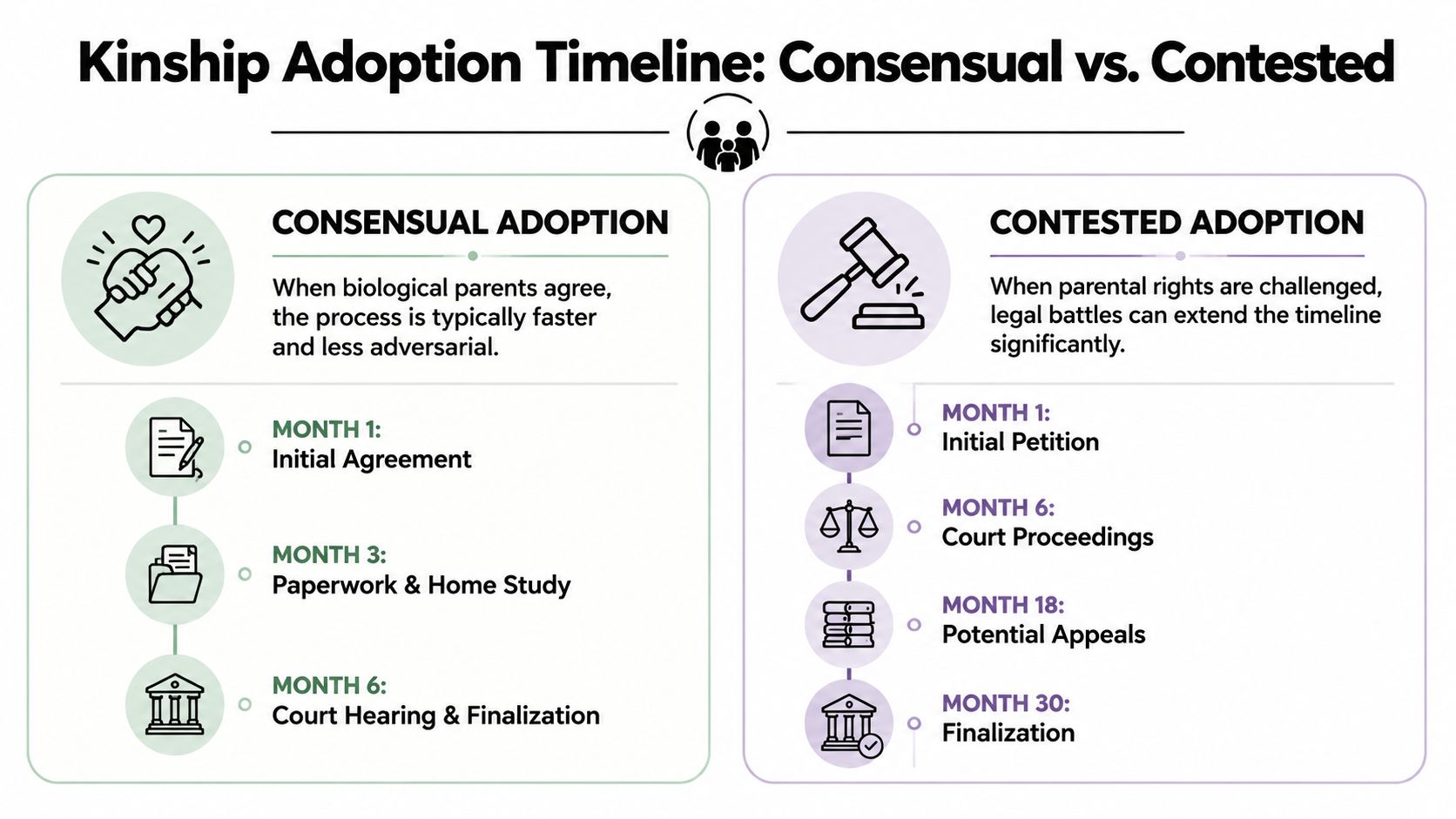
Under the Texas Family Code, an adoption can't usually be finalized unless the legal rights of the child's parents have already been ended or are ended as part of the case. That's why families often hear lawyers talk about termination of parental rights and adoption in the same conversation. Termination means the court legally ends a parent's rights and duties to the child. Adoption then creates those rights and duties in the adoptive parent.
The consensual path
A consensual case is usually the smoother path. This happens when a birth parent signs legal documents agreeing to end parental rights for the adoption.
In practical terms, this often means fewer disputes, less evidence gathering, and fewer contested hearings. The court still reviews the case carefully, but it usually doesn't need to spend as much time resolving conflict between adults. If you're trying to understand the legal document involved, Voluntary Relinquishment of Parental Rights in Texas explains how a birth parent voluntarily ends their rights for an adoption.
A verified Texas source reports that uncontested kinship adoptions are finalized, on average, 50-60% faster than those requiring a contested termination of parental rights, with the latter often adding 6-9 months of additional court proceedings, according to a Texas Family Law Foundation analysis discussed here.
The contested path
A contested case is different. One parent may refuse to consent, may be difficult to locate, or may appear and challenge the request. In that situation, the court cannot automatically move forward because a relative has been providing care. The judge must decide whether the law allows termination and whether the evidence supports it.
That adds time because the court may need:
- Notice and service: The parent must be legally notified.
- Evidence: The court may need records, testimony, or proof of legal grounds for termination.
- Additional hearings: Contested cases often require more than one court appearance.
- Careful findings: Judges know that termination is one of the most serious orders a court can enter.
When parents agree, the process usually feels administrative. When they don't, it becomes a lawsuit.
Why this fork matters so much
Families sometimes assume that because the child is already living with them, adoption should move quickly either way. Emotionally, that makes sense. Legally, it doesn't always work that way.
The court isn't only asking, “Is this relative loving and capable?” It's also asking, “Have all legal rights been handled correctly?” That second question is what stretches the timeline in many kinship cases.
A Stage by Stage Breakdown of the Kinship Adoption Timeline
Once you know which path your case is on, the process becomes easier to follow. Texas adoption procedure under Chapter 162 is often less overwhelming when you break it into stages and focus on what each stage is trying to accomplish.
What happens first
The first step is usually filing the adoption petition and any related requests involving conservatorship or termination if those issues aren't already resolved. Filing starts the case and gives the court a formal record of what you're asking for.
After filing, the court process moves through notice, investigation, and hearings. If you're worried specifically about the evaluation process, this guide on how long a home study takes can help you understand one of the most common waiting points.
Timeline table for a typical kinship adoption
| Stage | Why this stage matters | What you or your attorney usually do | Timing in plain language |
|---|---|---|---|
| Initial petition | Opens the case and tells the court what legal orders you want | Prepare and file adoption paperwork, gather family information, identify all legal parents | Early in the case |
| Service of citation | Protects due process by notifying the legal parents and other required parties | Arrange formal service, confirm addresses, document efforts to locate anyone missing | Can move quickly or cause delay if someone is hard to find |
| Consents or termination issues | Resolves whether parental rights are voluntarily ended or must be litigated | File signed relinquishments if available, or prepare evidence and pleadings for contested termination | Often the biggest timeline variable |
| Home study and background checks | Helps the court assess safety and suitability of the adoptive home | Complete interviews, submit documents, cooperate with evaluator requests, finish background checks | Often depends on scheduling and paperwork turnaround |
| Amicus attorney or attorney ad litem | Gives the child an independent voice in some cases | Cooperate with interviews, provide records, answer questions about the child's needs | Varies by county and case complexity |
| Hearing on termination and adoption | Allows the judge to review the evidence and decide whether the adoption should be granted | Testify if needed, present documents, address any remaining concerns | Scheduled based on court availability and case readiness |
| Post-placement supervision or follow-up | Some cases require a period of review before finalization | Continue caring for the child, complete any required follow-up visits or reports | Usually a waiting period rather than active litigation |
| Final decree of adoption | Makes the adoptive relationship legally permanent | Attend final hearing, receive signed order, update records after finalization | Last step |
What each stage feels like for families
The paperwork stage often feels busy but hopeful. Families are gathering birth records, school information, names, addresses, and signatures. It can seem tedious, but this is where accuracy matters. A missing detail can slow things down later.
The notice stage often feels tense. If a parent is cooperative, this part may be routine. If a parent has disappeared, moved repeatedly, or won't respond, your legal team may need to document serious efforts to locate that person before the court will move forward.
What helps most: Keep a folder with every court paper, school record, medical update, and contact attempt. Organized families usually feel less powerless during the wait.
What Chapter 162 means in plain English
Chapter 162 of the Texas Family Code is the main adoption chapter. In everyday language, it tells the court how an adoption is filed, reviewed, and finalized. It also ties into the rules that require parental rights to be addressed before a new legal parent-child relationship is created.
Chapters 163 through 166 deal with related adoption topics, including interstate issues and other legal procedures that can affect some families. Most kinship caregivers don't need to memorize chapter numbers. They do need to know that adoption is a formal court process, not just a family agreement.
Common Factors That Can Speed Up or Delay Your Adoption
Even when two families file in the same county, their cases can move very differently. The details matter. A child's history, the status of the birth parents, and even where the child has lived can all affect how long kinship adoption takes.

Family cooperation and complete paperwork
When everyone with legal rights is identified early and paperwork is completed correctly, the case usually moves more steadily. Delays often happen because a signature is missing, an address is outdated, or a background check has to be redone.
A parent's consent can also raise timing questions. If you're sorting through that issue, this article on how long a birth parent has to revoke consent in Texas gives useful context.
CPS history, missing parents, and special legal rules
Some kinship adoptions begin after CPS involvement. In certain cases, prior court orders may already have addressed conservatorship or parental rights. In others, CPS history means there are more records, more people involved, and more legal questions to sort through.
Other factors that can change the timeline include:
- A parent can't be located: The court usually won't skip notice requirements just because a parent has been absent.
- Interstate issues: If the child or a party is connected to another state, additional approval steps may apply.
- Native American heritage: If the Indian Child Welfare Act applies, there are extra protections and procedures the court must follow.
- Court scheduling: Some counties move hearings faster than others.
Families also need emotional support while the legal process unfolds. Children in kinship placements may be coping with grief, instability, or trauma. Caregivers may be carrying that strain too. This resource on Be Your Best Self counseling on trauma offers a helpful, family-centered look at why healing takes time and why slow progress can still be meaningful.
What you can control
You can't control whether another adult cooperates. You can control preparation.
That means:
- Keep records current: Save school records, medical forms, and proof that the child lives with you.
- Respond quickly: Return calls from evaluators, attorneys, and court staff as soon as you can.
- Tell the full story early: If there's CPS history, incarceration, addiction, or past violence, your attorney needs those facts up front.
- Prepare the home: A home study usually goes more smoothly when documents and living arrangements are ready.
A short explanation can also help families reset expectations.
Some delays are frustrating. Others are the court making sure the final order will hold up and protect the child long term.
Sample Timelines Real Texas Kinship Stories
Real families rarely experience the process as a neat checklist. They experience it as phone calls, school pickups, quiet worries, and court dates circled on a calendar. These examples are hypothetical, but they reflect situations Texas relatives often recognize.
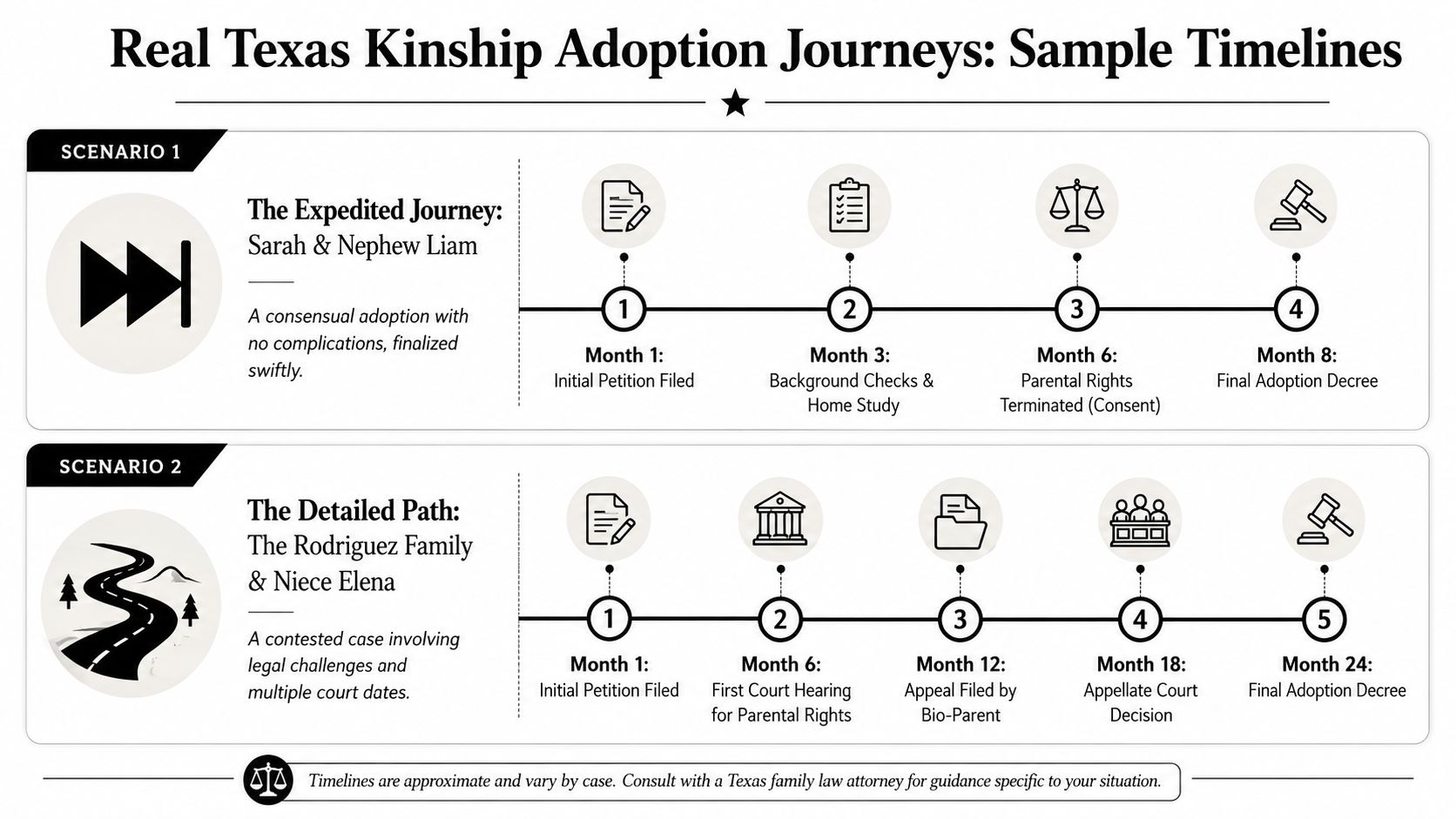
A smoother family path
Maria had been caring for her grandson for some time before she decided to adopt. The child's mother agreed that Maria had become the stable parent in daily life. The father's identity and legal status required extra attention, but there wasn't an active fight over placement.
For Maria, the hardest part wasn't conflict. It was waiting without knowing whether silence meant trouble. Most weeks were ordinary. School drop-offs. Doctor visits. Bedtime stories. Then a legal task would pop up, such as signing papers, answering evaluator questions, or attending a hearing.
Her case moved in a fairly steady way because there was cooperation where it mattered most. The court still took the required steps seriously, but the process felt manageable because no one was trying to undo the placement.
A longer and more difficult road
Danielle, an aunt, stepped in for her nephew after a period of family instability. There had already been outside involvement in the child's life, and one parent objected to adoption. Danielle wasn't trying to erase anyone. She was trying to keep a child safe and make sure he could stay in the only stable home he knew.
That kind of case often feels emotionally split. On one hand, the child may be settling in and calling the caregiver for comfort every day. On the other, the court process can remain uncertain because the adults are still in conflict.
The legal work in a situation like Danielle's is heavier. There may be more records to gather, more testimony, more court settings, and more stress around whether the objecting parent will participate or appeal. For the caregiver, this can feel like living in two timelines at once. Family life is happening now, but legal permanence is still pending.
The child may already know where home is, even while the court is still deciding how to formalize it.
What these stories teach
These stories usually reassure relatives in one important way. A longer timeline doesn't mean you're failing. A shorter timeline doesn't mean the case matters more. It means the legal issues are different.
If your family is in a peaceful, consent-based process, your experience may feel administrative and hopeful. If your case involves conflict, the process may feel slower, more emotional, and more exhausting. Both experiences are real. Both deserve clear legal guidance and patient support.
How an Experienced Attorney Can Help Navigate Your Timeline
A kinship adoption case asks a lot from relatives. You're caring for a child, managing family emotions, and trying to follow legal rules that weren't written in everyday language. An experienced attorney helps by turning that uncertainty into concrete next steps.
Where legal help makes the biggest difference
A lawyer can identify problems early, before they become delays. That includes questions about who must be served, whether a consent is legally valid, whether a termination case is likely to be contested, and what the court will expect in your county.
An attorney also helps with the practical work families don't see coming at first:
- Drafting and filing pleadings correctly
- Tracking deadlines and hearing settings
- Coordinating home study and background check issues
- Preparing evidence for a contested termination case
- Explaining court orders in plain English
For families comparing options, relative and kinship adoption in Texas offers broader information about this adoption path, and adoption timeline and cost guidance can help you think through the bigger picture. The Law Office of Bryan Fagan, PLLC handles kinship and relative adoption matters in Texas, including cases involving home studies, court filings, and finalization.
The goal isn't speed alone
Fast isn't always the right goal. Durable is the right goal. You want an adoption order that was handled carefully, entered correctly, and built around the child's best interests.
If you're asking how long does kinship adoption take, you're really asking something deeper. You're asking how long it will take before this child is fully protected, fully secure, and fully recognized as part of your legal family. That answer depends on the facts, but good preparation can make the path clearer.
If you're caring for a grandchild, niece, nephew, or another child in your family and want to understand your next legal step, the Law Office of Bryan Fagan, PLLC offers free consultations for Texas families exploring adoption and guardianship. A confidential conversation can help you understand your timeline, your options under the Texas Family Code, and what would best protect your child and your family moving forward.
