
You may be reading this after a hard conversation at a hospital, a school meeting, or a kitchen table where everyone finally admitted the same thing. A child needs stability. A parent can't safely manage alone. A sibling's condition has changed. Then the next worry shows up almost immediately: How are we supposed to pay for this?
That question is common, and it doesn't mean you're thinking about money instead of family. It means you're trying to protect someone you love without putting your own household at risk. Guardianship cases in Texas often arrive during stressful seasons, and legal costs can feel confusing when emotions are already running high.
Families looking into guardianship are often also exploring nearby legal paths, especially when a relative is stepping in to care for a child. In some homes, the conversation starts with temporary care and later grows into questions about adoption, family unity, and long-term stability under the Texas Family Code, including adoption procedures in Chapters 162 through 166. Those chapters address how adoptions are created, reviewed, and finalized in Texas courts, including consent, termination issues in some cases, required filings, and the court's duty to focus on the best interests of the child. Guardianship is different from adoption, but families often compare both because each can affect daily caregiving, decision-making, and a child's future.
Navigating the Cost of Protecting a Loved One
Maria had been caring for her grandson for months. She handled school pickup, doctor visits, meals, bedtime, and all the ordinary parts of parenting that suddenly became her job. What she didn't have was legal authority. When the school asked for paperwork and the doctor's office hesitated over treatment decisions, she realized love alone wasn't enough. She likely needed guardianship, and her first thought was not about court. It was, “Can I even afford a lawyer?”
That kind of fear is normal. Guardianship doesn't begin as a financial decision. It begins as a family crisis, a safety concern, or a quiet moment when someone realizes a loved one needs protection. The legal part comes later, and with it comes uncertainty about attorney bills, court costs, and how long the process might last.
If that's where you are, clarity helps. A plain-English guide to becoming a legal guardian in Texas can make the process feel less overwhelming, especially when you're still sorting out what guardianship would require in your family.
Practical rule: The cost question gets easier once you separate the case into parts. Attorney work, court expenses, medical evidence, and follow-up paperwork are often different pieces, not one mystery bill.
For some families, guardianship is the immediate answer. For others, especially relatives caring for a child, it may be one step in a longer path that could later include kinship adoption, a home study, or finalization under the Texas Family Code. In adoption matters, that process often includes background checks, a review of the home environment, required consents, and a court hearing to finalize the legal parent-child relationship. Guardianship usually doesn't create that same permanent relationship, but the same concern guides both paths: protecting the child and preserving family stability where possible.
Money stress feels smaller when you know what you're paying for and what choices may affect the total.
What Your Attorney's Fee Actually Pays For
Many people hear “attorney fee” and picture a single meeting or a lawyer standing up in court for a few minutes. In a guardianship case, the fee usually covers much more than that. You're paying for work done behind the scenes, careful legal judgment, and the steady management of a process that can go wrong if details are missed.
The work that happens before court
A guardianship lawyer often starts by learning the family story in detail. Who needs protection. Why now. Whether the case involves a minor child, an elderly parent, or an adult with a disability. Whether anyone may object. Whether there are urgent medical, school, or financial concerns.
That early work shapes everything that follows. The lawyer may review records, identify missing facts, and tell you what documents the court will likely expect. A practical checklist often helps families stay organized, especially if they're gathering records similar to those discussed in legal guardian documents.
In some family-building cases, people also ask whether a home study applies. The Texas Adoption Home Study Explained describes what a home study evaluates and when it can be waived. That issue is tied to adoption, not every guardianship matter, but it often comes up when relatives are deciding whether guardianship or adoption fits their long-term plan.
The filings, notices, and preparation you don't always see
Texas courts require formal paperwork, and it has to be drafted carefully. In many guardianship matters, an attorney's fee may include work such as:
- Preparing the petition: The court needs clear facts, not just general concern.
- Filing the case: Forms, attachments, and procedural requirements matter.
- Coordinating notice: Other interested people may need legal notice of the case.
- Responding to court questions: Judges often want missing details corrected quickly.
- Preparing you for the hearing: Clients need to know what to expect and how to answer basic questions truthfully and clearly.
A fee also covers the lawyer's ability to spot trouble early. If a proposed order is incomplete or a required person wasn't notified, the case can slow down or become more expensive.
Good legal work often saves money by preventing avoidable delays.
The court hearing and final orders
By the time a guardianship hearing happens, your attorney may already have spent many hours preparing the file. At the hearing, the lawyer presents the request, answers the judge's questions, and helps move the case toward a lawful and workable result. After court, there may still be orders to draft, signatures to collect, and Letters of Guardianship or other final paperwork to secure.
When families understand these pieces, guardianship attorney fees start to feel less like a vague charge and more like payment for specific protection. That matters when the goal is keeping a child safe, helping an incapacitated adult, or preserving family unity during a fragile time.
Common Billing Structures for Guardianship Cases
No family likes surprise bills. One of the best ways to reduce stress is to ask how the lawyer charges before the case begins. Most guardianship attorney fees fall into a few common billing structures. The names can sound technical, but the ideas are simple.
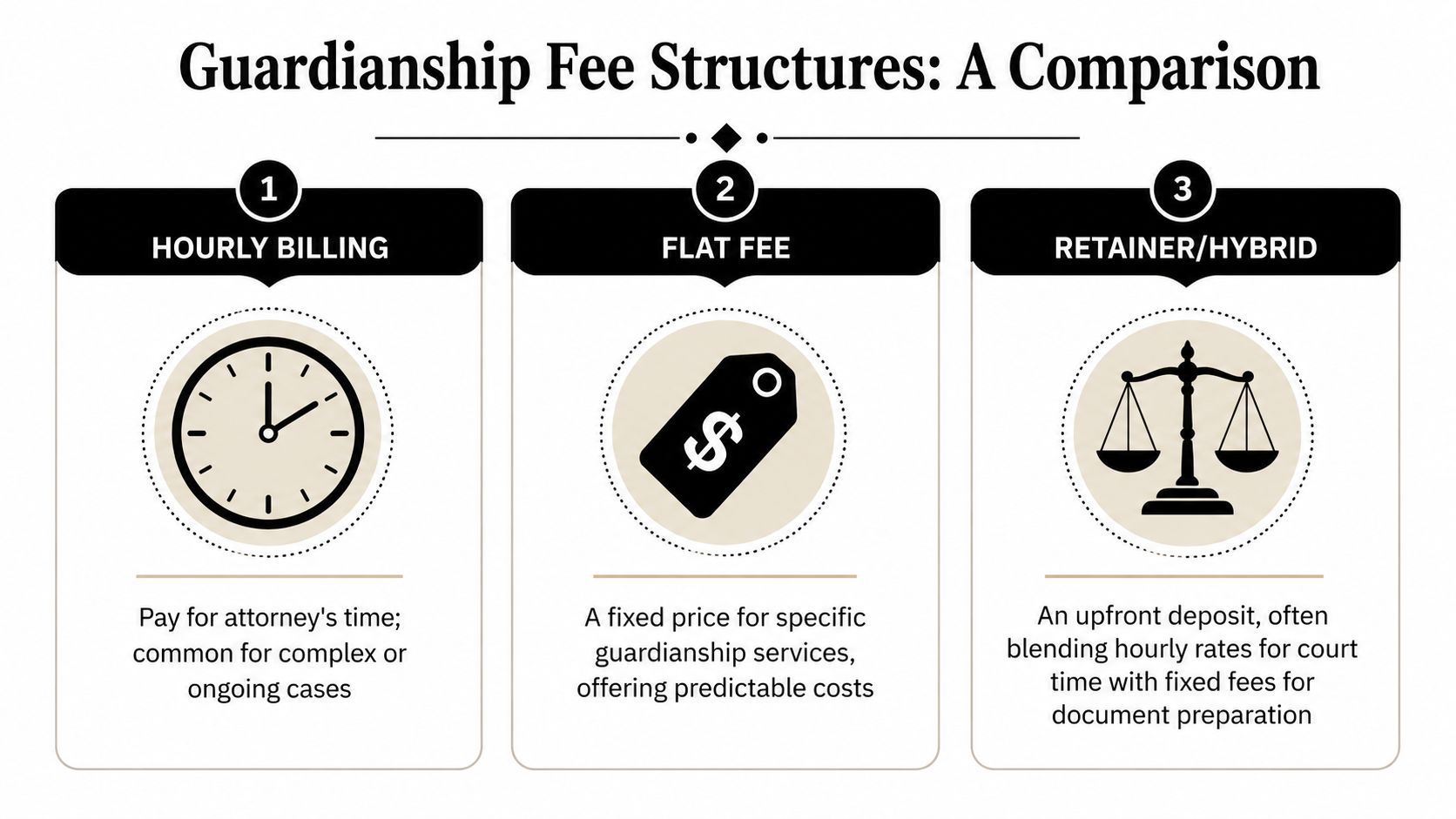
Hourly billing
Hourly billing works a lot like a taxi meter. The more time the attorney spends on your matter, the more the fee grows. This structure is common when the lawyer can't predict how many disputes, hearings, or document issues may come up.
Hourly billing may fit cases where:
- Conflict seems likely: A relative may object or challenge the request.
- Facts are still developing: Medical records or financial information are incomplete.
- The case may expand: Emergency requests, follow-up hearings, or unexpected motions could appear.
This model can feel less predictable, but it also means you're paying for the time spent.
Flat fees
A flat fee is closer to agreeing on a set price for a defined project. The lawyer charges one amount for a specific package of services. That often works best when the guardianship is expected to be straightforward and uncontested.
Families often like flat fees because they make budgeting easier. But the key question is scope. You'll want to ask what is included and what is not. For example, a flat fee may cover basic filings and one hearing, but not a later dispute.
Retainer or hybrid arrangements
A retainer is an upfront deposit placed toward future legal work. In a hybrid arrangement, some parts of the case may be billed at a fixed amount while other parts are billed by the hour. This can make sense when part of the work is routine and another part depends on what other people do.
Here's a simple comparison:
| Billing model | How it works | Best fit |
|---|---|---|
| Hourly | You pay for time spent | Cases with uncertainty or conflict |
| Flat fee | You pay one set amount for defined tasks | Simple, uncontested matters |
| Retainer or hybrid | Upfront deposit, sometimes mixed with fixed services | Cases with both routine and unpredictable parts |
Attorney fees are not the whole budget
This point confuses many families. Attorney fees and court costs are not the same thing. You may also need to budget for filing fees, service costs, evaluations, medical evidence, or a court-appointed attorney or investigator, depending on the case.
Ask for two lists, not one. One list should show the lawyer's fees. The other should show likely out-of-pocket case expenses.
That simple request can prevent a lot of anxiety later.
Key Factors That Drive Guardianship Costs Up or Down
Two guardianship cases can look similar from a distance and cost very different amounts in real life. The biggest reason is usually conflict. If everyone agrees that guardianship is needed and agrees on who should serve, the case often moves more smoothly. If family members disagree, the legal work can expand quickly.
Contested and uncontested cases
An uncontested case means the key people involved generally support the request or at least aren't fighting it in court. These cases still require careful preparation, but they usually involve fewer hearings, fewer emergency filings, and less back-and-forth between lawyers.
A contested case is different. A sibling may question whether guardianship is necessary. A parent may object to a relative seeking control over decisions for a child. Someone may agree that help is needed but disagree about who should be guardian. Once that happens, the case often requires more investigation, more court time, and more attorney involvement.
That's why contested cases usually cost more. It's not just one argument. It's the additional legal work created by the argument.
Other details that affect the final bill
Some cost drivers are less obvious at first. They include the following:
- Medical proof: If the court needs stronger evidence about incapacity, families may need records, doctor statements, or expert support.
- Financial complexity: If the proposed ward owns property, receives income from several sources, or has debts to sort through, the case may require more legal attention.
- Emergency action: Temporary or emergency requests usually move fast, and fast-moving work can increase legal time.
- County procedures: Courts in different Texas counties may have different local practices, scheduling patterns, and filing costs.
Why organization matters before you ever hire a lawyer
Families often lower cost pressure by doing early fact-gathering. Bring names, addresses, medical providers, school information, and any prior court orders to the first meeting. If the case involves a child, think carefully about what arrangement supports stability, family connection, and the child's best interests. If adoption may later become part of the discussion, Texas Family Code Chapters 162 through 166 become especially important because they govern the legal steps that turn caregiving into a permanent parent-child relationship.
That adoption process may include steps such as:
- Reviewing eligibility and consent issues
- Completing a home study when required or confirming whether one can be waived
- Filing the adoption petition
- Meeting any waiting periods or procedural requirements
- Attending finalization so the court can approve the adoption
Guardianship and adoption are not the same. But families comparing them often make better decisions when they understand both the emotional and financial impact of each path.
Planning and Paying for Your Guardianship Case
A family often calls after a hospital meeting, a school problem, or a sudden change at home. The legal question matters, but the money question often feels just as urgent: How do we protect someone we love without creating a new financial crisis?
A good plan starts by putting cost on the table early. That conversation is not a sign that you are unprepared. It is one of the best ways to avoid surprises.
Start with the budget conversation
Tell the attorney what you can realistically afford now, what you may be able to pay over time, and what worries you most. A guardianship case works a lot like a home repair after storm damage. Some work cannot wait, some work may depend on what the court requires, and some costs only appear if the problem grows. When your lawyer knows your limits and priorities, you can talk through likely expenses in a clearer, calmer way.
It also helps to come in with a basic understanding of guardianship laws in Texas so the first meeting can focus on your family, not just general rules.
This is also the right time to ask about the long-term goal. Some relatives need a temporary legal solution to stabilize a child's daily life. Some families are considering a more permanent option later. Others are seeking guardianship for an adult and are not dealing with adoption at all. Your budget will make more sense once the legal path is clear.
Small habits that can lower legal costs
If your case is billed by the hour, preparation can save time, and saved time often means lower fees. You do not need perfect records. You just need a useful starting point.
Try these habits:
- Gather documents in one place: Collect medical records, school records, names, addresses, contact information, and prior court orders before your first detailed meeting.
- Keep one running question list: Grouping questions helps your lawyer answer them efficiently instead of piecing together the story across many messages.
- Make a simple timeline: A page with key dates can shorten the time your attorney spends sorting out what happened and when.
- Mark true emergencies clearly: If something affects safety, health, or an immediate court deadline, say so. If it can wait, save it for the next scheduled update.
Legal fees feel less overwhelming when you can see what is driving them and what steps may keep them under control.
Ask who may pay and when
Many families do not realize that payment is sometimes a legal issue of its own. In some guardianship matters, the court may allow certain fees to be paid from the ward's estate if the law allows it and the judge approves. That is not automatic. It depends on the facts, the type of guardianship, and the court's orders.
Ask direct questions early. What retainer is required? What services are included? What costs are billed separately? Are there likely court costs, investigator fees, medical evaluation costs, or follow-up hearings? Is a payment plan available?
If you are comparing lawyers, use the same checklist each time. The Law Office of Bryan Fagan, PLLC handles Texas adoption and guardianship matters, including preparation, filings, and court proceedings. Whether you speak with that office or another attorney, consistency helps. When you ask each lawyer the same cost questions, it becomes much easier to compare answers and choose a plan your family can live with.
A written fee agreement can give real peace of mind. It will not remove every unknown, because court cases can change, but it gives you a map. And when family life already feels uncertain, a clear map matters.
Two Texas Guardianship Scenarios A Cost Comparison
Real families rarely live in neat categories, but examples can make the financial side easier to understand. These two situations show why one guardianship may stay fairly manageable while another becomes much more expensive.
Scenario one with broad family agreement
Aunt Denise has been caring for her niece after the child's parents became unable to provide day-to-day care. The parents support Denise stepping in. The child is already settled in Denise's home, school, and routine. No one is fighting over who should make decisions.
That case is often more straightforward. The attorney's work may center on preparing the petition, gathering supporting documents, making sure required people receive notice, attending a court hearing, and finalizing the necessary orders. Because there's little conflict, the family can often budget with more confidence.
What tends to keep costs lower in a situation like this?
- Agreement among relatives
- Clear facts about the child's living arrangement
- Limited court appearances
- Fewer surprises in the paperwork
If Denise later wants to explore a more permanent route, she may also compare relative adoption under the Texas Family Code. In those cases, the court will still focus on the child's best interests, and the process may involve a home study unless waived, required consents, and finalization.
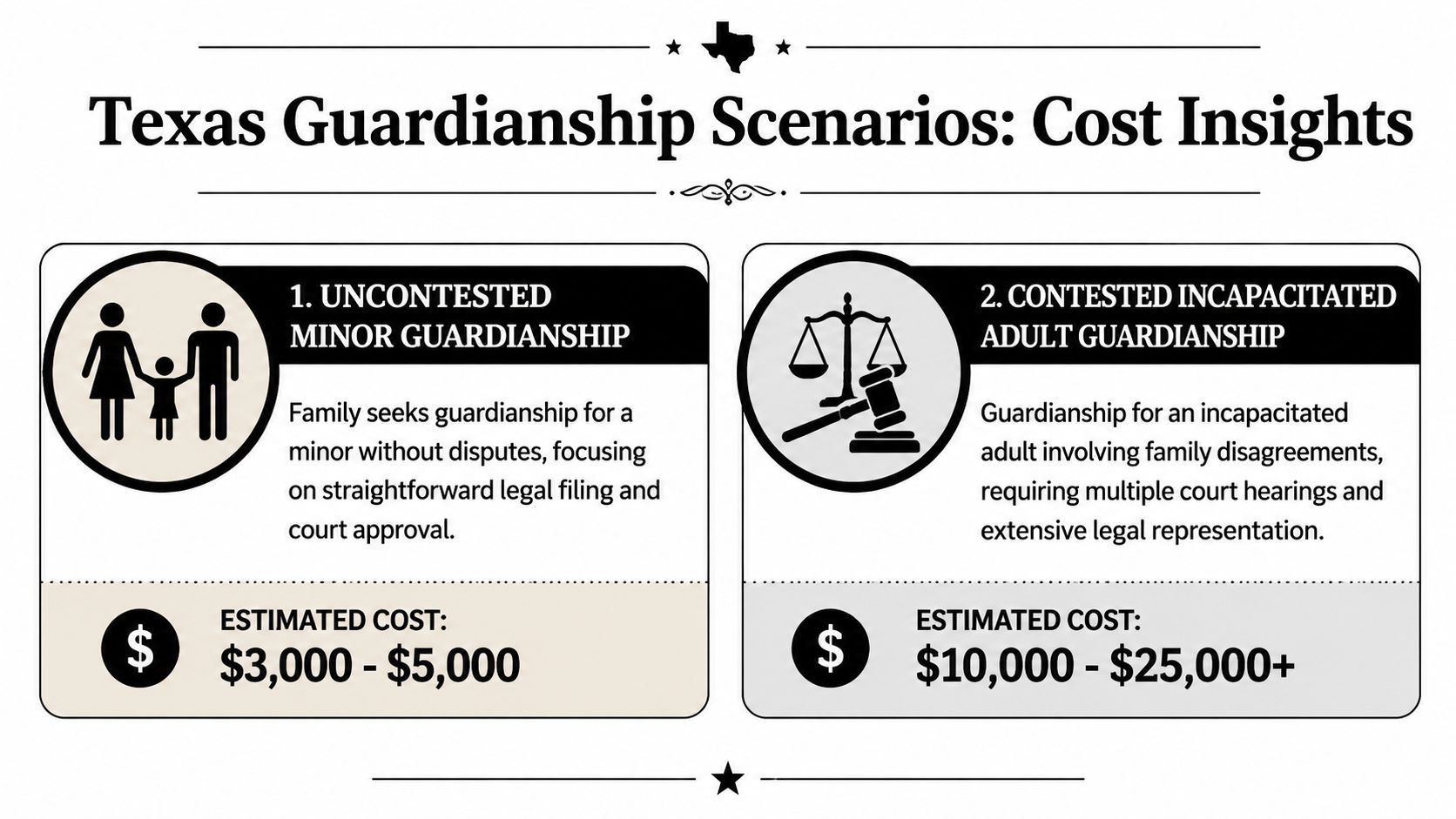
Scenario two with conflict and a complicated estate
Now consider a different family. An elderly father shows signs of dementia. One adult child believes guardianship is urgently needed. Another says it's unnecessary. There are bank accounts, a house, and questions about who has already been helping with finances. Emotions are high, and trust is low.
That case usually takes more work. The attorney may need to gather stronger medical evidence, prepare for objections, respond to claims made by other relatives, attend multiple hearings, and sort through financial issues tied to the proposed ward's estate. The legal bill grows because the lawyer's time grows.
A high-level comparison looks like this:
| Scenario | Likely cost pressure | Why |
|---|---|---|
| Minor guardianship with family agreement | Lower | Fewer disputes, fewer hearings, simpler path |
| Adult guardianship with family conflict | Higher | More evidence, more court involvement, more attorney time |
When families ask why guardianship attorney fees vary so much, the answer is usually not mystery or markup. It's the amount of legal work the facts require.
These examples also show why early honesty matters. If your family is already divided, tell the attorney that at the start. It helps everyone budget more realistically and plan for the road ahead.
Answering Your Top Questions About Guardianship Fees
Families usually ask the hardest questions last. That's understandable. By then, they've heard enough to know the situation is serious, and they want clear answers.

What if the guardianship isn't approved
You may still owe your attorney for the work performed. Lawyers are usually paid for their time and services, not only for the final outcome. That's one reason it's so important to ask early about the strength of your case, possible objections, and what evidence the court is likely to need.
Can the other side be forced to pay my attorney fees
Sometimes families hope a person who caused conflict will be ordered to cover the bill. That can happen in limited situations, but it is not something you should count on without legal advice about your facts. Courts have discretion, and fee decisions depend on the case, the conduct involved, and the orders requested.
What if I can't afford a lawyer at all
Start by talking to more than one attorney. Ask whether the office offers limited-scope help, a payment arrangement, or guidance on which parts of the process you may be able to organize yourself. Some families also look for legal aid or local bar referral resources. If the case involves a child and long-term permanence may be a concern, it can also help to ask whether guardianship is the right path or whether adoption should be part of the conversation under Texas Family Code Chapters 162 through 166.
A short video can help you think through common family-law concerns before that first meeting.
Are guardianship fees the same as adoption costs
No. These are different legal processes with different goals. Guardianship gives someone legal authority to care for or make decisions for another person. Adoption creates a permanent legal parent-child relationship. Adoption in Texas may involve consent issues, termination questions in some cases, a home study, and a final court decree under the Family Code. Because the procedures differ, the costs often differ too.
If you're a grandparent, stepparent, foster parent, birth parent, or relative caregiver trying to decide what comes next, don't assume you have to solve it alone. A clear legal opinion can help you protect the child, support family unity where possible, and avoid costly missteps.
If your family is weighing guardianship, adoption, or both, a focused conversation can bring real relief. The Law Office of Bryan Fagan, PLLC offers free consultations to help Texas families understand their options, expected steps, and likely costs in plain English so you can move forward with more confidence.
