
Adoption often begins in private. A late-night conversation at the kitchen table. A saved photo of an empty bedroom. A text from a relative asking whether you'd consider stepping in for a child who needs stability. Then the questions start piling up. What paperwork do we need? Who has to consent? Will we have to go to court? How long does this take in Texas?
Most families don't need more noise at that point. They need someone to make the process feel understandable.
That's why it helps to think of an adoption lawyer as more than a person who files forms. In real life, a good lawyer acts like a project manager, translator, and problem solver for one of the most meaningful legal steps a family can take. Adoption creates a permanent parent-child relationship. In Texas, that means the court expects careful compliance with the Texas Family Code, especially Chapters 162 through 166, and the details matter.
Maybe you're a stepparent who has already been raising a child for years. Maybe you're a grandparent caring for a grandchild. Maybe you're pursuing a private infant adoption and feel overwhelmed by agencies, home studies, and court terms that sound unfamiliar. Each path is different, but the need is the same. You want to protect the child. You want the process done right. You want to move forward with confidence.
Your Compassionate Guide Through the Texas Adoption Journey
A lot of people searching for what an adoption lawyer does step by step are already carrying a full emotional load. They're excited, hopeful, and scared of making a mistake all at once.
A couple might come in after months of talking about private adoption, only to admit they still aren't sure who handles what. They've heard about home studies. They know there will be court papers. They may even have a match or a relative placement in mind. But they don't know what belongs to an agency, what belongs to a judge, and what belongs to their lawyer.
That confusion is normal.

In Texas, adoption isn't just a heartfelt decision. It's a legal process that changes a child's permanent status. The court has to review the case, parental rights have to be handled correctly, and the final paperwork has to support a valid adoption order. That's where a lawyer becomes your guide.
More than a paperwork person
An adoption lawyer helps families do three big things at once:
- Build a legal plan that fits the kind of adoption involved
- Keep the case moving through deadlines, filings, and court requirements
- Reduce avoidable risks that can lead to delays or legal challenges later
That's true whether the case involves a stepparent adoption in Texas, a kinship placement, foster care finalization, or an independent adoption.
A family should be able to focus on preparing for a child, not wondering whether one missing signature could derail the case.
Texas families often feel relief once they understand that someone can coordinate the moving parts. The lawyer can explain what the court needs, what the social worker or agency handles, when consent becomes an issue, and what needs to happen before finalization.
If you're still trying to understand where legal help fits, this overview of working with an adoption attorney in Texas can help frame the role. The heart of the job is simple. Your lawyer helps turn a personal hope into a legally secure family relationship.
Why the legal details matter so much
Texas courts focus on the best interests of the child. That idea runs through the whole process. The law isn't trying to make family building harder. It's trying to make sure a permanent placement is safe, lawful, and stable.
That's why adoption lawyers don't just react. They plan ahead. They look for pressure points early, especially in cases involving missing parents, prior court orders, agency coordination, or questions about notice and consent.
The First Step Initial Consultation and Strategic Planning
The first meeting is rarely just a meet-and-greet. It's usually the moment when a family's scattered questions start becoming a workable plan.

A lawyer starts by listening. Who is the child? How did the placement arise? Is this a stepparent adoption, a relative adoption, a foster care matter, or a private adoption? Has the child already been living with you? Is another parent involved? Are there prior court orders about conservatorship or child support?
Those answers shape everything that follows.
Choosing the right legal path
Not all adoptions move through Texas courts the same way. As MetLife's overview of adoption attorneys notes, the legal system distinguishes between agency, independent, foster-care, and international adoptions, and stepparent and relative adoptions often center on whether the other parent's rights can be relinquished or terminated.
A lawyer uses that distinction to help you choose the right route.
Here's what that often looks like in plain English:
| Adoption path | What the lawyer is looking for early |
|---|---|
| Stepparent adoption | Whether the child's other legal parent will consent, or whether termination must be requested |
| Kinship or relative adoption | Existing caregiving history, prior CPS involvement, and whether the child's parents can or will relinquish rights |
| Private adoption | Whether matching, consents, home study requirements, and placement steps are being handled cleanly |
| Foster care adoption | Status of parental rights, agency records, and finalization readiness |
A strategic consultation also helps families avoid choosing a path based on assumptions. For example, a grandmother may think she only needs “guardianship papers,” when what she really wants is a permanent legal parent-child relationship. A stepparent may assume the biological parent's absence automatically ends that parent's rights, when Texas law still requires proper legal steps.
Building a case roadmap
Once the lawyer understands the facts, the next job is to map the process.
That roadmap may include:
- Reviewing existing court orders so nothing conflicts with the adoption case
- Identifying required parties who must be notified or involved
- Checking home study needs and any agency participation
- Planning for termination or consent issues before filing
- Preparing for the final hearing instead of treating court as a last-minute event
Practical rule: The first consultation should leave you with more than reassurance. It should leave you with a sequence.
In Texas, that sequence matters because adoption usually touches several parts of the Family Code at once. Chapter 162 addresses adoption procedure and effect. Chapter 161 often matters when parental rights must be terminated first. In some family situations, Chapters 153 and 156 may also matter if there are current custody orders or modification issues in the background. A thoughtful lawyer spots those overlaps early.
Questions families often ask first
Some of the most useful early questions are simple:
- What kind of adoption is this, legally speaking
- Whose consent will the court require
- Will a home study be needed
- Are there timing issues tied to placement or notice
- What could slow this down if we don't address it now
Those aren't small questions. They are the foundation of the case.
Managing the Mountain of Paperwork and the Home Study
Once the legal path is clear, the practical work begins. This is the stage where many families feel swamped. They don't mind effort. They mind not knowing what belongs where.
That's where a lawyer often becomes the calmest person in the room.
Turning documents into a checklist
An adoption case can involve petitions, consents, background materials, social history information, prior orders, service documents, affidavits, and court-setting paperwork. In Texas, the exact list depends on the kind of adoption, but the lawyer's role stays steady. They organize the file so the court sees a coherent story, not a stack of disconnected papers.
An adoption petition is the formal request asking the court to grant the adoption. It tells the court who the parties are, what authority the court has, and what legal result the family is requesting. If termination of parental rights is also part of the case, the lawyer makes sure those requests line up correctly.
Families usually don't need to memorize the legal titles of every form. They need to know what each document does.
- Petition documents open the case and tell the court what relief is requested
- Supporting filings provide facts, attach prior orders, and identify required parties
- Consent-related documents address whether a parent agrees or whether the court must decide termination
- Final orders turn the judge's ruling into a legally effective parent-child relationship
The home study in plain language
In many adoptions, a home study is required. It isn't a contest for perfect families. It's a process meant to help the court evaluate readiness, safety, and stability.
As American Adoptions explains, an adoption lawyer's job includes preparing and filing adoption documents, managing consent, representing clients in court, and ensuring finalization is legally effective. In independent adoptions, the lawyer is often the professional making sure required home studies and background checks are completed properly.
That matters because the lawyer usually doesn't perform the home study, but they do help you prepare for it.
Families often benefit from learning what a home study for adoption involves before they start gathering documents.
What a lawyer helps you prevent
Most paperwork problems aren't dramatic. They're small errors that create delay.
A lawyer watches for issues like these:
- Missing signatures that make a filing incomplete
- Inconsistent dates between court papers and agency records
- Old background materials that need updating
- Conflicts with prior family court orders
- Confusion about who must receive notice
The job isn't simply to collect documents. It's to make sure each document supports the next step.
That project-management role matters even more in Texas cases involving several professionals at once. An agency may handle one part. A social worker handles another. The court clerk has separate filing rules. The lawyer keeps those pieces connected so the family isn't left guessing.
Navigating Consents and Termination of Parental Rights
This is often the most emotionally delicate part of an adoption case. It's also one of the most important.
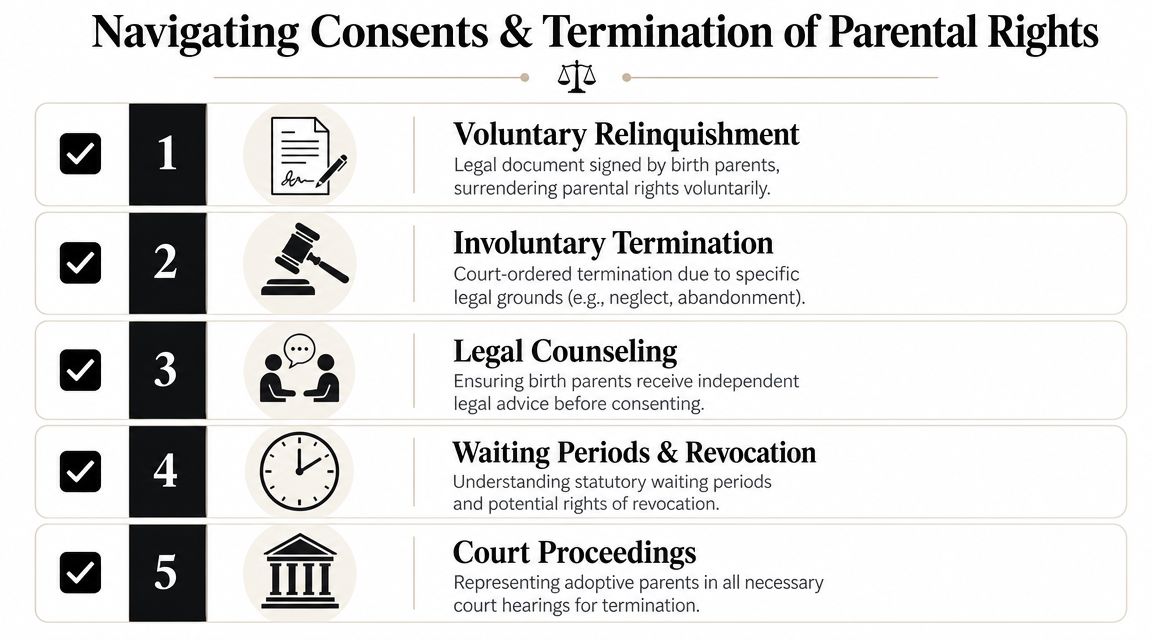
A child cannot usually be adopted in Texas unless the legal rights of the current parent or parents are properly addressed first. Sometimes that happens through a voluntary relinquishment. Sometimes it requires the court to terminate rights after notice and evidence. Either way, this step deserves care, accuracy, and respect for everyone involved.
Voluntary and involuntary paths
In some families, a birth parent wants the adoption to go forward and is willing to sign the needed documents. In others, the parent cannot be located, contests the case, or has a history that may support termination under Texas law.
For stepparent and relative adoptions, this is often where the legal work becomes highly fact-specific. The court may need evidence tied to abandonment, lack of support, neglect, unfitness, or another legal basis. The lawyer's role is to match the family's real-life facts to the legal standard the court must apply.
A compassionate lawyer also helps clients understand what this step is not. It's not about punishing a parent. It's about creating a secure legal foundation for the child's future.
Why precision matters
Texas judges take consent and termination seriously because adoption creates permanent rights. If the earlier step is mishandled, the whole case becomes more vulnerable.
That's why lawyers pay close attention to:
- Whether the correct person is signing
- Whether the signing happened in the legally required manner
- Whether notice was proper if termination is contested
- Whether the evidence supports the requested relief
- Whether the final order clearly clears the path for adoption
Families exploring this issue often need a plain-English guide to termination of parental rights in Texas, especially in stepparent and kinship cases where emotions are layered.
The most loving thing a lawyer can do at this stage is slow the process down enough to get it right.
A common real-life pattern
Take a stepparent who has raised a child for years. The other biological parent hasn't been involved for a long time. The family may think the adoption should be simple because everyone already knows who the day-to-day parent is.
Emotionally, that makes sense.
Legally, the court still needs a proper record. The lawyer may need to gather prior orders, confirm legal parentage, arrange for service or waiver, prepare termination pleadings if needed, and present evidence that supports the requested change. In other words, the lawyer protects the emotional truth of the family by building the legal proof the judge needs.
Texas Family Code Chapter 161 often governs the termination side of that work. Chapter 162 governs the adoption that follows. When those chapters are handled carefully and in the right order, the child's new legal relationship stands on much firmer ground.
From Courtroom Representation to Finalization
By the time a case reaches the court for finalization, most of the lawyer's work has happened behind the scenes. That's part of why finalization day can feel surprisingly calm. The calm is earned.

The stretch before the hearing
After placement, some cases require post-placement supervision or updated reports before the judge will finalize the adoption. The lawyer tracks those requirements, confirms filings are complete, and works to avoid preventable delays.
A recent step-by-step adoption guide notes that finalization commonly occurs 90 to 120 days after placement in some cases, and it emphasizes that a lawyer's value often lies in preventing delay risk across jurisdictions and agencies, especially in interstate private infant, foster care, and kinship matters, as discussed in this adoption process guide.
That timing doesn't apply to every Texas case. Still, it captures something important. Adoption law is not just about one court date. It's about keeping multiple requirements moving toward that hearing.
What happens at finalization
The final hearing is the legal moment when the court creates the new parent-child relationship. In Texas, that usually means the judge reviews the pleadings, confirms legal prerequisites have been met, and signs the Final Decree of Adoption if the case is ready.
The lawyer's role at that hearing usually includes:
- Presenting the case clearly so the judge has the needed legal record
- Answering questions from the court about the child, placement, or prior orders
- Confirming compliance with required reports or procedural steps
- Preparing the final decree and related documents for signature
For many families, it's one of the happiest courtroom experiences they'll ever have. There may be photos. There may be tears. There is often a huge sense of relief.
A short overview like this can help families picture the emotional side of the hearing:
After the judge signs
The lawyer's work doesn't end the second the hearing is over.
There are still practical follow-up tasks, which may include:
| After finalization | Why it matters |
|---|---|
| Obtaining signed orders | The family needs the official decree for records and future use |
| Updating records | Adoption changes legal status, so records must match the court order |
| Requesting amended birth certificate paperwork | This helps reflect the new parent-child relationship |
| Explaining the effect of the decree | Parents need to understand the rights and responsibilities that now exist |
The final decree is more than a ceremonial paper. It is the legal document that makes the family relationship fully recognized under Texas law.
Handling Complex Cases and Providing Ongoing Support
Some adoption cases stay on a fairly predictable timeline. Others change shape halfway through.
A birth parent may withdraw cooperation. An interstate placement may pause while another state reviews paperwork under the Interstate Compact on the Placement of Children, or ICPC. A relative adoption may bring old CPS records into the picture. In moments like these, the lawyer works much like a project manager for the family. They keep track of deadlines, coordinate with agencies and other lawyers, spot problems early, and help parents understand what is happening so fear does not fill in the blanks.
Complicated cases rarely fall apart because one dramatic event happens in court. More often, stress builds through delay, missing documents, conflicting instructions, or uncertainty about what step comes next. A good adoption lawyer helps hold those moving parts together.
When the case becomes more complicated than expected
Justia's guide to working with an adoption lawyer discusses situations that often need closer legal attention, including independent adoptions, interstate cases, and matters involving representation for birth parents. That is helpful because it matches what many families experience. The legal work is not only about forms. It is also about timing, coordination, and preventing small mistakes from growing into larger delays.
In Texas, that may include:
- Checking ICPC approval steps before a child can legally cross state lines
- Reviewing consent documents closely so the record is clear and usable later
- Coordinating with CPS, agencies, or prior counsel when the history is layered
- Correcting filing issues early before a hearing has to be postponed
- Preparing families for contested issues if someone objects or stops cooperating
A case like this can feel like trying to finish a road trip while detours keep appearing. Parents still know where they want to go. They just need someone in the passenger seat who knows which turns are legal, which shortcuts are risky, and when stopping to fix a problem will save time later.
Ongoing support matters after the legal issue is identified
Families do not experience adoption only as a legal process. They live it in their bodies, in their sleep, in the way they answer phone calls, and in the quiet questions they ask late at night.
A kinship caregiver may wonder whether stepping in will hurt an already strained family relationship. A foster parent may hesitate to celebrate until every order is signed. A hopeful adoptive parent in a private placement may carry both gratitude and fear at the same time. A lawyer cannot resolve every emotion, but they can bring structure to an uncertain season. Clear explanations, realistic timelines, and honest warnings often lower stress because the family is no longer guessing.
Sometimes support also means pointing parents toward simple grounding tools outside the legal process. During a hard week, resources like these calming prayers for parents can offer a small pocket of steadiness.
One quiet truth about adoption work is this. Some of the most valuable legal help happens long before a judge ever sees the case file.
A Texas-centered legal lens
For Texas families, adoption cases often involve Texas Family Code Chapters 162 through 166, while termination questions often arise under Chapter 161. That framework gives the court its rules, but each family's path through those rules can look different. A stepparent adoption, a kinship matter, and an interstate agency placement may all end with the same legal result while requiring very different planning along the way.
That is why families benefit from a lawyer who can do more than file documents. They need someone who can organize the process, explain agency expectations, prepare for delays, and solve problems without creating more worry than the case already brings.
If you are comparing legal support options in Texas, the Law Office of Bryan Fagan, PLLC handles adoption and guardianship matters involving stepparent, kinship, foster care, private, and other family-building paths across the state. The key is finding counsel who can keep the process organized and explain your route in plain language from start to finish.
The child's best interests remain at the center of every adoption case. The lawyer's role is to help the adults build a careful legal path that protects that goal.
