 Skip to content
A lot of Texas families reach the same moment. A stepparent has packed lunches, helped with homework, and sat through doctor visits for years, but the law still treats them like an outsider. A grandparent has stepped in during a hard season and wants to create something stable. A couple has finally found the path to grow their family, then opens the court forms and realizes this is more than filling in blanks.
That's where the question starts to feel urgent. Do you need an adoption lawyer in Texas?
For some families, the answer feels obvious. For others, it doesn't. If everyone agrees, the child is already living with you, and the relationship is strong, it can seem like a lawyer might be optional. But adoption changes legal parent-child rights for life, and even a loving, uncontested case can involve rules that aren't easy to spot at first glance.
The better question is often this: How legally complex is your adoption, and what risk are you comfortable carrying on your own? That's the question hopeful parents, relatives, and caregivers usually need help answering.
The Hope and The Hurdles of Texas Adoption
Maria had been “Mom” in every way that mattered except one. She handled school forms, bedtime stories, and the hard talks after a rough day. When her husband suggested stepparent adoption, it felt right immediately. Then the questions started. Did the other biological parent have to sign? What if that parent disappeared years ago? Would the child have to talk to the judge?
Those questions are normal.
Adoption in Texas often begins with love and certainty, but the legal side can bring fear, grief, and confusion into the room. Birth parents may feel torn. Relative caregivers may worry they're doing something disloyal. Adoptive parents may feel guilty for focusing on forms and hearings when their hearts are already with the child.
Adoption cases are legal matters, but families don't experience them as paperwork. They experience them as hope, loss, commitment, and protection.
That's why a simple yes-or-no answer often proves insufficient. Some adoptions move smoothly because everyone is informed, cooperative, and prepared. Others involve missing parents, contested rights, delayed records, or court requirements that surprise families halfway through.
A stepparent adoption doesn't raise the same issues as a foster care adoption. A relative adoption may look straightforward until the court asks for proof about a biological parent's status. An LGBTQ+ parent may already be parenting day to day but still want the added legal security of adoption. Each path carries its own legal pressure points.
If you're trying to decide whether to hire an attorney, the most useful approach is to understand what Texas adoption requires, where cases usually get stuck, and what a lawyer changes in practical terms. Once those pieces are clear, the decision becomes far less intimidating.
Why Adoption Is a Legal Journey Not Just Paperwork
Adoption creates a new legal parent-child relationship. That's the heart of it. It doesn't just recognize what your family feels. It changes who the law recognizes as the child's parent, with all the rights and duties that come with that change.
Consider building a house. Love is the reason for the house, but the legal process is the foundation. If the foundation is weak, the house may look complete for a while, but problems can surface later when your family needs legal protection most.
What Texas requires before a court says yes
Texas puts several safeguards in place because courts must focus on the child's best interests. According to this overview of Texas adoption requirements, an adoptive parent must generally be at least 21 years old, financially stable, and able to pass criminal background and child-abuse checks, and many counties require a home study or home visit. The same source explains that if a married person petitions to adopt, the spouse must generally join the petition, and a child can be adopted after living with the petitioner for six months, though a court may waive that period if doing so is in the child's best interest.
That list alone shows why many families feel overwhelmed. These aren't casual recommendations. They're legal checkpoints.
A home study, for example, isn't the court trying to make life hard. It's the court asking whether this home is safe, stable, and ready. Background checks serve a similar purpose. So do financial questions. None of those steps are there to judge a family unfairly. They are there because adoption is meant to last.
Why the Texas Family Code matters
Texas Family Code Chapters 162 through 166 guide adoption and related child-protection issues. In plain English, that means adoption follows court rules, filing rules, notice rules, and evidence rules. A judge doesn't just want a good story. A judge needs a legally complete case.
That's where people often get confused. They assume that because the adults agree, the court will approve the adoption. Sometimes families are emotionally ready long before the legal file is ready.
Practical rule: If your adoption changes legal parenthood, the court will expect more than signatures. It will expect proof, proper procedure, and a record that supports final approval.
A lawyer's value often starts here. Not with arguing in court, but with making sure every required piece is gathered in the right form, filed at the right time, and presented in a way the court can act on.
Legal Needs Across Different Adoption Paths
Some adoption cases are mainly about organization. Others require careful legal strategy. The difference usually depends on whose rights are involved, whether anyone contests the case, and how much proof the court will need.
Stepparent and kinship cases often look simpler than they are
Many people assume a stepparent or relative adoption is the easiest kind because the child already knows the family. Emotionally, that may be true. Legally, it can still be demanding.
For stepparent and relative adoptions, Texas adoption guidance on these cases explains that the petitioner must first show that the other biological parent's rights have been legally terminated, and the court may require proof that the parent is unfit or unwilling to parent. That's a major reason families hire counsel in these cases. The issue is not affection. The issue is whether the evidence and court process are complete enough to support a valid decree.
If the other parent agrees and signs properly, the path may be smoother. If the other parent cannot be found, refuses to cooperate, or suddenly reappears, the case can change quickly.
Other adoption paths create different pressure points
Private infant adoptions may involve coordination among agencies, hospitals, birth parents, and courts. Foster care adoptions may come after long involvement with the child welfare system and can require careful attention to agency records and final court steps. International adoptions can raise extra document and recognition issues. LGBTQ+ families may pursue stepparent or second-parent style adoptions to secure legal recognition for both parents, especially when daily parenting and legal parentage do not line up neatly.
Here's a practical comparison:
| Adoption Type | Common Legal Hurdles | Attorney Recommendation |
|---|---|---|
| Stepparent adoption | Termination of the other biological parent's rights, notice issues, consent questions | Usually strongly recommended |
| Relative or kinship adoption | Proof about parental rights, caregiver status, court evidence, final decree accuracy | Usually strongly recommended |
| Private domestic adoption | Consent documents, matching legal steps, agency or private coordination | Often very helpful |
| Foster care adoption | Court approvals, agency coordination, finalization steps | Often very helpful |
| International adoption | Recognition of foreign documents, court compliance in Texas | Typically critical |
| LGBTQ+ family adoption | Clarifying legal parentage, choosing the right adoption path, securing durable court orders | Often very helpful |
A simple framework for judging complexity
Ask yourself which of these sounds like your case:
- Everyone agrees and documents are available. This is still a legal process, but it may be more predictable.
- Someone's rights must be terminated or clarified. Legal risk rises fast here.
- A parent is missing, uncooperative, or contesting the case. This usually calls for legal representation.
- More than one system is involved. Agency, CPS, interstate, or international issues often make counsel much more important.
If you're asking whether you need an adoption lawyer in Texas, your adoption type is one of the clearest clues. The more your case depends on notice, consent, evidence, or termination of rights, the more important legal guidance becomes.
What an Adoption Lawyer Actually Does for Your Family
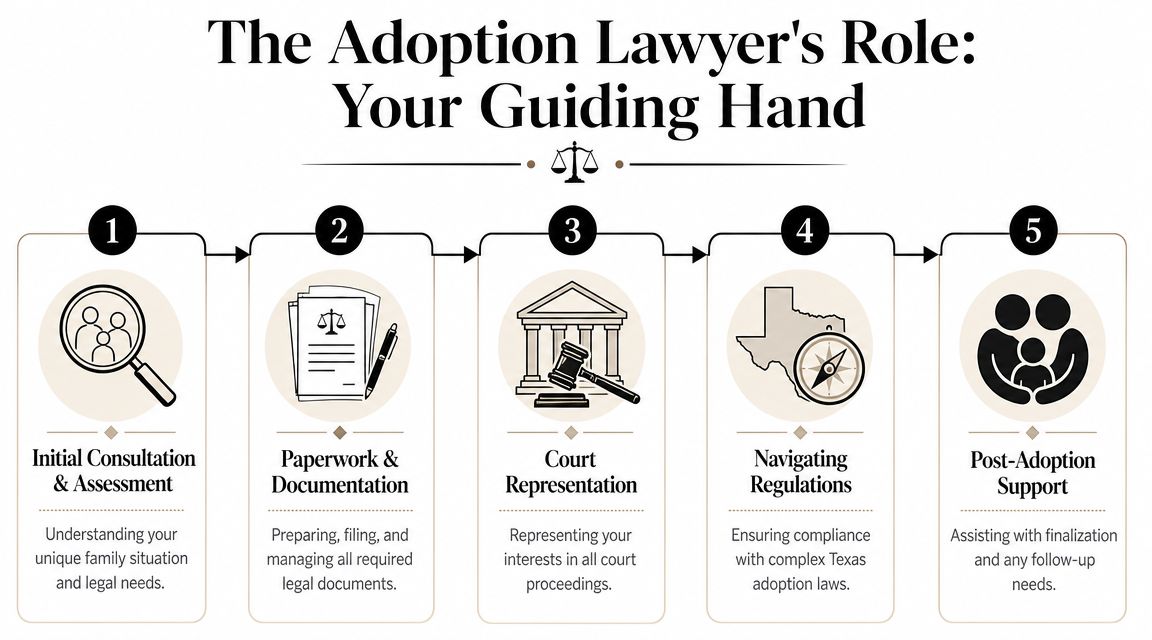
Many families picture a lawyer as the person who shows up at the final hearing. In adoption cases, that's only a small part of the job. A good adoption lawyer usually works more like a planner, editor, troubleshooter, and court guide all at once.
The legal sequence matters
In Texas, this explanation of adoption finalization makes a key point: an adoption is not legally final until the court has first terminated the relevant parental rights and then granted the adoption petition. If that order is handled incorrectly, the case can fail or be delayed because the court cannot create adoptive rights while existing parental rights still remain in place.
That sounds technical, but it matters in a very human way. Families often know where they want to end up. A lawyer helps make sure the court file gets there in the right order.
What that looks like in real life
An adoption attorney often helps with work such as:
- Case assessment early on. The lawyer identifies whether your case is likely uncontested, whether termination issues exist, and what the court will probably need.
- Document preparation. Petitions, consents, affidavits, notices, and supporting records need to be accurate and consistent.
- Coordination with others. Courts, clerks, agencies, home study providers, and opposing counsel may all be part of the process.
- Hearing preparation. Even a short final hearing goes better when everyone knows what the judge may ask and what documents must already be in the file.
- Problem prevention. Small filing errors can create major delays. Lawyers often catch those issues before they grow.
For families who want a deeper look at the day-to-day work involved, this guide on what an adoption attorney does breaks down the role in practical terms.
A short visual overview can help if you're still picturing the process as only forms and one court date.
A lawyer also protects the family's emotional bandwidth
There's another part of this work that families often don't expect. When someone else tracks deadlines, drafts filings, and explains what each step means, parents can put more energy into the child instead of spending every night trying to decode court procedure.
A lawyer can't remove the emotion from adoption, and shouldn't. But they can remove much of the avoidable confusion.
The Law Office of Bryan Fagan, PLLC handles adoption representation in Texas, including filing petitions and appearing in court. For some families, that kind of support is the difference between feeling lost and feeling prepared.
The Heartache and Headaches of a DIY Adoption
Families often consider handling an adoption without a lawyer for understandable reasons. They want to save money. They believe the case is friendly. They assume court staff will point them in the right direction if something is missing.
Sometimes that confidence lasts until the first unexpected obstacle.

Common DIY mistakes families don't see coming
A stepparent may file papers believing the absent parent's silence equals consent. It doesn't always work that way. The court may require proper notice, proof of service, or stronger evidence about why rights should be terminated.
A grandmother may have cared for a child for years and assume that history alone is enough. But if the decree language is incomplete or the supporting proof is thin, the court may refuse to sign until the record is fixed.
A couple may gather the right forms but file them in the wrong sequence. That can delay the case and force them to rework documents they thought were already done.
Important reminder: Court clerks can process filings, but they generally can't give legal advice about strategy, evidence, or whether your case is ready for a judge.
Why “simple” cases still go sideways
The trouble with DIY adoption isn't that families lack love or commitment. It's that adoption law expects precision. A wrong assumption about consent, notice, or final paperwork can keep a hopeful family in limbo.
That's especially hard when a child already sees the petitioner as a parent. A delay doesn't just feel administrative. It can feel personal.
If you're considering doing it yourself, it helps to read through this resource on filing adoption papers yourself in Texas. Even families who ultimately hire a lawyer often benefit from seeing just how many moving parts the process contains.
DIY may fit only a narrow slice of cases
A very straightforward case may be manageable for someone who is comfortable with legal forms, court procedure, and the risk of fixing mistakes later. But many families discover they don't want to learn by trial and error on something as permanent as parenthood.
That isn't weakness. It's judgment.
Your Personal Checklist for Making the Decision
By the time most families reach this stage, they don't need pressure. They need a calm way to sort their own facts. The best decision usually comes from looking clearly at your case, your comfort level, and the stakes for your child.

Questions that usually point toward legal help
Texas Law Help's adoption overview notes that adoption generally requires termination of the child's legal parents' rights, that stepparent adoption still requires termination of the other biological parent's rights before finalization, and that a child who is at least 12 years old must consent unless the court waives that requirement because adoption is in the child's best interest. Those rules alone show why many families decide they don't want to manage the process alone.
Use this checklist as a guide:
- Are both biological parents fully in agreement? If not, legal guidance becomes much more important.
- Will the court need to address termination of parental rights? If yes, that usually raises the complexity.
- Is the child old enough that consent may be required? If so, you'll want to prepare carefully for that part of the process.
- Are you missing documents or struggling to locate a parent? That can quickly become a procedural problem.
- Are you comfortable filing sworn legal papers and appearing in court? If the answer is no, counsel may bring real peace of mind.
A quick way to read your own situation
If you answered “yes” to only one concern, your case may be manageable with limited guidance. If you answered “yes” to several, it may be wiser to hire a lawyer before filing anything.
If your adoption involves disagreement, uncertain parental status, or a child whose consent may need to be addressed, waiting too long to get legal advice can make the process harder.
The right time to ask for help is usually before the case feels unmanageable, not after.
Your Questions Answered About Texas Adoption Lawyers
What does an adoption lawyer usually cost in Texas
The cost depends on the type of adoption, whether the case is contested, how much document work is needed, and whether parental rights must be terminated first. Because those facts vary so much, it's better to ask for a clear fee explanation tied to your situation than to rely on a generic number online.
When you speak with a lawyer, ask practical questions. Is the fee flat or hourly? What court costs are separate? Are payment plans available? What happens if the case becomes contested later?
Does working with a lawyer make the process faster
A lawyer can't control every part of a court calendar, and no honest attorney should promise a specific timeline without knowing the facts. But legal help often prevents avoidable delay.
Families who file on their own can lose time fixing service problems, redoing forms, or supplying missing records after the court flags a problem. A lawyer usually helps by getting the file court-ready earlier and reducing the chance of procedural setbacks.
If an agency has a lawyer, do I still need my own
Sometimes an agency's lawyer handles part of the legal process, but that doesn't always mean that lawyer represents your individual interests in the full sense families assume. If your case has any unusual issue, or if you aren't sure who the lawyer represents, ask directly.
You may want your own attorney if you need independent advice about your rights, your responsibilities, or a concern that affects your family specifically. Families exploring representation options can review Texas adoption attorney services to compare what direct legal counsel usually includes.
Can I hire a lawyer just for part of the process
In some situations, yes. Some families want a lawyer to review documents before filing. Others need help only with a hearing, termination issue, or final decree. Limited help can be useful if your case is fairly straightforward but you still want a professional check on the most sensitive steps.
What if I'm overwhelmed and don't even know what kind of adoption I have
That's more common than people think. Many families know their relationship to the child, but not the legal label for the case. A consultation can help sort that out early so you don't build your plan on the wrong assumptions.
The legal side of adoption can feel intimidating, but you don't have to understand every chapter of the Texas Family Code before taking the first step. You only need enough clarity to know what kind of support your family needs next.
If you're asking whether an attorney is necessary for your adoption, a conversation about your specific facts can make the answer much clearer. The Law Office of Bryan Fagan, PLLC offers free consultations for Texas families exploring stepparent, kinship, private, foster care, and other adoption paths. A short consultation can help you understand your legal options, the likely pressure points in your case, and what steps will best protect your child and your family.

