
Deciding to open your heart and home to a child is one of the most profound and life-changing choices you can make. Whether you are considering providing a temporary, safe harbor through foster care or building your forever family through adoption, you are taking the first step on a truly incredible path.
This guide is your starting point. We understand the journey can feel complex, filled with both hope and a lot of questions. Our goal is to demystify the process for Texas families, offering clear, compassionate explanations for these two distinct—yet often connected—paths to parenthood.

At The Law Office of Bryan Fagan, PLLC, we will walk you through the key differences between foster care and adoption, explain the legal steps involved here in Texas, and touch on the emotional considerations you'll encounter along the way. We want you to feel empowered with the knowledge to move forward, knowing you are making a profound difference in a child's life.
Understanding Foster Care vs. Adoption
People often use the words "foster" and "adoption" interchangeably, but they represent two very different journeys for a child and for the families who open their homes. Both are built on the belief that every child deserves a safe, nurturing, and loving home, but knowing the difference is the first step to finding your path.
Foster care is a temporary service. Think of it as offering a child a safe place to land during a family crisis. As a foster parent, you provide care for children who cannot safely live with their birth families at that moment. In most cases, the primary goal of foster care is reunification—giving the biological family the time, support, and resources they need to heal and bring their child back home. The focus is on providing stability for the child while supporting the entire family unit.

Adoption, on the other hand, is a permanent legal process that builds a new, lifelong family. When you adopt a child, you become their parent in every sense of the word—legally and emotionally. Under the Texas Family Code, the parental rights of their birth parents are legally terminated, and you are granted all the rights and responsibilities of a parent.
The Bridge Between: Foster-to-Adopt
Sometimes, that temporary safe harbor becomes a child’s permanent home. This is what we call foster-to-adopt.
This happens when, after careful consideration, the court determines it is not in the child’s best interest to return to their biological family. As their trusted foster parent, the state often gives you the first opportunity to adopt them. This creates a seamless transition into a forever family, right where they are.
This path provides incredible stability for a child who has already been through so much. It lets them stay with the family they already know and love, which helps minimize further trauma. For many hopeful parents, it’s a deeply rewarding way to build their family while making a profound impact on a child’s life. If you're curious about the specific requirements, you can learn more about the foster parent requirements in Texas and the difference between being a foster parent and adopting.
Every child deserves a champion—an adult who will never give up on them, who understands the power of connection, and who insists that they become the best that they can possibly be.
Understanding the Children in Care
Right now in the United States, there are thousands of children waiting for a permanent home. Many of these kids have experienced instability, neglect, or trauma that can shape their behavior and emotional needs. To truly support them, it helps to understand what they've been through.
For example, a child who has experienced repeated loss may develop an anxious-avoidant attachment style as a way to protect themselves from more pain. Learning about these dynamics is a crucial part of preparing to parent with the empathy and skill needed to build secure, healing bonds. At The Law Office of Bryan Fagan, we believe that informed parents are empowered parents—ready to meet a child’s needs with compassion and confidence.
Exploring Different Pathways to Build Your Family
In Texas, the journey to growing your family through foster care and adoption isn't a one-size-fits-all process. Think of it as a series of different roads, each designed for a unique family situation, but all leading to the same destination: giving a child a permanent, loving home that serves their best interests.
Figuring out which path is right for you is the first and most important step. Your choice will shape everything that follows, from the legal paperwork to the emotional dynamics of your new family. Whether you're looking to formalize a bond with a child you already love or open your home to a child you've yet to meet, Texas has a legal framework to help you get there.
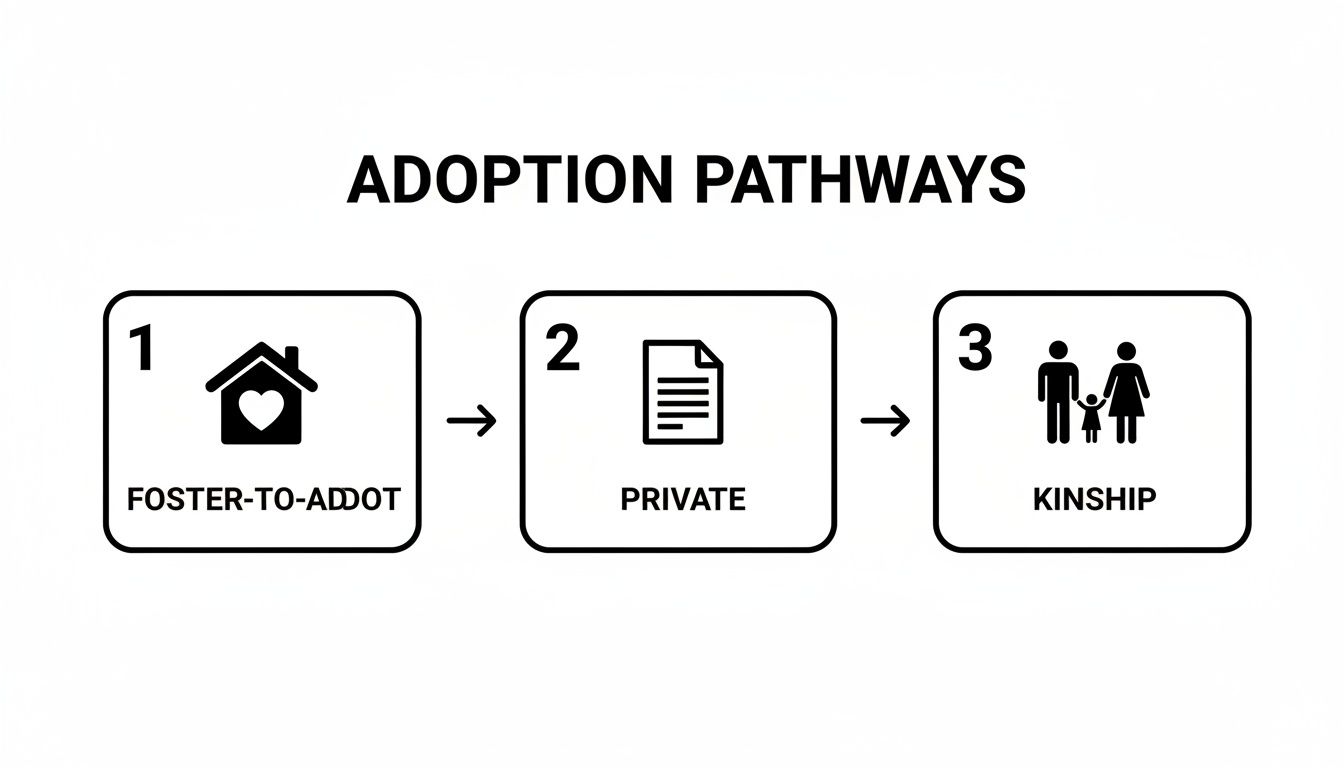
Fostering to Adopt: The Bridge to Permanency
For many families, the foster-to-adopt path is a deeply rewarding way to grow. The journey often starts with becoming a licensed foster parent and providing temporary, loving care for a child while their biological parents work on a court-ordered reunification plan.
But sometimes, it becomes clear that it isn't safe or possible for the child to return to their birth parents. When the court makes that determination, the legal goal shifts from reunification to adoption. As the foster parent who has already built a relationship of trust and security, you are almost always given the first opportunity to adopt. This prevents the child from having to move again and allows them to stay with the caregivers they already know and love as family.
Kinship and Stepparent Adoptions: Solidifying Family Bonds
Not all adoptions involve strangers. In fact, many happen right within existing family structures, giving legal weight to bonds that are already deeply in place.
Kinship Adoption: This is when a relative—like a grandparent, aunt, or uncle—steps in to legally adopt a child in their family. It often happens when a child’s parents are unable to care for them. A kinship adoption gives the child legal permanency while allowing them to stay connected to their family roots and heritage, a key factor in a child’s well-being.
Stepparent Adoption: In many blended families, a stepparent becomes a parent in every way but legally. A stepparent adoption formalizes that relationship, giving the stepparent full legal rights and responsibilities for their stepchild. It’s a powerful way to create legal security and emotional unity for the whole family. For example, a stepfather who has raised his stepdaughter since she was a toddler can legally adopt her, ensuring he has the authority to make medical and educational decisions and solidifying their bond for life.
Adopting a child you already know and love, like a grandchild or stepchild, is a beautiful way to affirm that family is built on commitment, not just biology. It legally recognizes the love that is already there.
A Snapshot of Adoption Pathways in Texas
| Adoption Pathway | Typical Child Age | Primary Process | Estimated Cost |
|---|---|---|---|
| Foster-to-Adopt | Varies (infant to teen) | State/Agency (DFPS) | $0 – Low Cost (often free) |
| Kinship Adoption | Varies (infant to teen) | CPS or Private | $0 – $2,000+ |
| Stepparent Adoption | Varies | Private Filing | $500 – $2,500+ |
| Private Infant Adoption | Newborn | Agency or Attorney | $30,000 – $60,000+ |
| International Adoption | Varies | U.S. & Foreign Agencies | $30,000 – $70,000+ |
This table provides a general overview, but keep in mind that every family's situation is unique. Costs and timelines can vary.
Private and International Adoptions
Other pathways involve working with agencies to connect with a child in need of a family.
Private adoption, often called infant adoption, is what many people picture first. This is when a family works with an agency or an attorney to adopt a newborn after the birth mother voluntarily chooses an adoption plan.
International adoption is the process of adopting a child from another country. It's a complex journey that requires navigating U.S. federal laws, the laws of the child’s home country, and international treaties.
No matter which path you consider, Texas law recognizes that loving families come in all shapes and sizes. Single parents and LGBTQ+ individuals and couples have the same legal right to adopt as anyone else. The court's sole focus is always on your ability to provide a safe, stable, and nurturing home for a child. At The Law Office of Bryan Fagan, PLLC, we proudly guide all types of families through these unique and life-changing legal journeys.
The Texas Adoption Process Step by Step
Starting the adoption process can feel like standing at the base of a huge mountain. You can see the summit—your forever family—but the path to get there looks winding and complicated. Think of this section as your trail guide, breaking down the Texas adoption process into clear, manageable steps based on the Texas Family Code.
With an experienced attorney by your side, you can navigate each stage with confidence, from the first application to the final, joyful day in court. While every foster and adoption story is one-of-a-kind, most follow a similar legal framework. Let’s walk through that path together.
Step 1: Choose Your Professional Guide
Your very first move is to assemble your team. An experienced adoption attorney isn't just a legal formality; they're your most important advocate. They file the court documents, represent you at hearings, and ensure every detail complies with Texas law (specifically Chapters 162-166 of the Family Code), protecting both you and your future child. Think of your lawyer as your guide—they know the terrain and will lead you safely to your destination.
Step 2: The Application and Background Checks
Once you’ve chosen your path and your attorney, you'll begin the official application with an agency or the Texas Department of Family and Protective Services (DFPS). A crucial part of this stage is completing extensive background checks.
Every adult living in your home must undergo these checks, which include:
- A Texas Department of Public Safety (DPS) criminal history check.
- An Federal Bureau of Investigation (FBI) fingerprint-based criminal history check.
- A review of central registry records for any history of child abuse or neglect.
These checks exist for one simple reason: to keep children safe. They are a non-negotiable part of the process designed to protect the most vulnerable among us.
Step 3: The Home Study
Many prospective parents get nervous about the home study, picturing a white-glove inspection where they have to be perfect. Let's reframe that. The home study is not a test you can pass or fail; it's a collaborative preparation process.
The purpose of the home study is simple: to educate and prepare you for parenthood while confirming you can provide a safe, stable, and nurturing environment for a child. It is a partnership between you and your caseworker.
A licensed social worker will meet with you several times to discuss your life, background, and parenting philosophies. They'll also do a safety check of your home. We help our clients see this as a chance to learn and grow, making sure they feel confident and ready for the child who will soon join their family.
Step 4: Termination of Parental Rights
Before an adoption can occur, the legal rights of the birth parents must be terminated. This is a critical legal step that a judge must approve, and it can happen in two ways:
- Involuntary Termination: This occurs in foster care cases when a court finds that a parent has not met the requirements to be reunified with their child, often due to endangerment or neglect.
- Voluntary Relinquishment: In private adoptions, a birth parent signs legal documents to voluntarily give up their parental rights. In Texas, a birth mother cannot sign these papers until at least 48 hours after the child's birth.
Step 5: Placement and Finalization
After the home study is approved and parental rights have been addressed, you become eligible for placement—the incredible moment when a child officially comes to live with you.
After placement, Texas requires a post-placement supervision period that typically lasts at least six months. During this time, a social worker will visit your home to see how everyone is adjusting and to offer support.
Once that period is successfully finished, your attorney will schedule the finalization hearing. This is the day your adoption becomes legally permanent. A judge will review your case, sign the final decree of adoption, and officially declare you a family. It’s a day of incredible celebration—the beautiful end of one journey and the beginning of another.
Navigating the Costs and Emotions of Adoption
Building your family through adoption is a process that involves both your head and your heart. It’s natural to have practical questions about the costs, but you also need to prepare for the emotional side—the hope, the waiting, and the incredible joy. Knowing what to expect financially and emotionally makes the entire experience much more manageable.
One of the first questions most families ask is, "How much does adoption cost?" The answer really depends on which path you take. For example, adopting a child from Texas foster care often comes with little to no cost to the family. The state provides financial support to make sure money isn't what's standing between a child and a loving home.
Private infant adoptions are a different story. These can range from $30,000 to $60,000 or even more. The costs cover a lot—agency fees, legal work, support for the birth mother, and medical expenses. For a more detailed breakdown of what goes into these figures, you can learn more about the cost of adoption in Texas in our article.
Financial Support for Adoptive Families
The good news is you don't have to shoulder these costs alone. There are several key resources available to help make adoption in Texas more affordable.
- Federal Adoption Tax Credit: This is a nonrefundable credit that can help you recover thousands in qualified adoption expenses.
- State Subsidies: When you adopt a child from foster care, especially a child with special needs, Texas offers monthly financial aid and Medicaid coverage until they turn 18 to help meet their ongoing needs.
- Employer-Provided Assistance: More and more companies offer adoption assistance in their benefits packages. Be sure to check with your HR department.
These programs are so important because there are thousands of children waiting. You can explore current U.S. adoption insights to learn more about the kids who are waiting for a permanent family.
Understanding the Emotional Journey
Beyond the spreadsheets and bank statements, the emotional side of adoption is its own unique experience. The waiting period, especially, can feel like a rollercoaster of hope and anxiety. It’s completely normal to feel a mix of excitement and stress while you wait to be matched.
The adoption journey is a testament to the power of hope. It requires patience during the waiting, courage through the uncertainty, and an open heart to welcome the immeasurable joy that follows.
A huge part of this journey is deciding on the level of openness in the adoption. This isn't just a simple "open" or "closed" decision; it's a spectrum.
- Closed Adoption: All identifying information is kept confidential. There is no contact between the birth family and the adoptive family.
- Semi-Open Adoption: An intermediary, like your agency or attorney, handles all communication, allowing for letters and photos to be exchanged without sharing personal contact details.
- Open Adoption: Both families share identifying information and agree to some form of direct contact, from occasional emails to in-person visits.
Today, most adoptions lean toward some level of openness, as it can help a child develop a healthy sense of identity. Ultimately, it’s a deeply personal decision centered on the child’s best interests and what feels right for everyone involved.
Taking Your Next Step Toward Building Your Family
We hope this guide has given you a clearer picture of what foster care and adoption look like in Texas. The journey to build a family has a lot of moving parts, from figuring out the right path to preparing for the legal steps and emotional milestones ahead. Just by taking the time to learn, you've already taken a huge first step.
The road ahead can feel long, but you don't have to do it alone.
Seeking Personalized Legal Guidance
Every family's story is different, and your path to adoption will have its own unique questions and challenges. While a guide like this can give you a roadmap, the most important step is getting personalized advice from someone who understands both the legal system and the heart behind your decision.
An experienced adoption attorney can clarify how Texas laws apply to your specific situation, whether you're looking at a kinship adoption, a private placement, or bringing a child home from foster care. They ensure every legal detail is handled correctly, protecting your rights and—most importantly—the child's best interests. This is so much more than a legal transaction; it's about creating a family.
At The Law Office of Bryan Fagan, PLLC, we believe in empowering you with empathy and clarity. We invite you to schedule a free, confidential consultation with our compassionate legal team. Let's talk about your hopes, answer your questions, and help you take that brave next step toward building your family.
Common Questions About Foster and Adoption in Texas
The journey to build a family through foster and adoption is full of hope, but it’s completely normal to have questions. As you think about this huge step, you deserve clear, straightforward answers. We’ve gathered some of the most common questions we hear from families across Texas to give you the confidence to move forward.
How Long Does the Texas Adoption Process Usually Take?
This is one of the first questions everyone asks, and the honest answer is: it depends on the path you take. A straightforward stepparent or kinship adoption, where the child is already a beloved part of your life, can often be finalized in just a few months.
Adopting from foster care is usually a longer road. It can take anywhere from one to two years because of the legal steps needed to terminate the birth parents' rights and make the child legally available for adoption. Private adoptions have their own timelines that vary with the matching process. A good attorney can give you a much more accurate estimate based on your specific circumstances.
What Is the Main Purpose of a Home Study?
The term “home study” can sound pretty intimidating, but its goal is to be supportive, not critical. Think of it as a partnership to prepare you for welcoming a child and to make sure your home is a safe, nurturing place. It’s not an inspection designed to find flaws.
The process usually includes:
- Comprehensive Background Checks: This is all about ensuring the child’s safety.
- Family Interviews: A chance to talk about your background, lifestyle, and hopes for parenting.
- A Home Safety Walkthrough: Just checking for basic safety measures.
- Educational Training: Equipping you with the right tools, especially for parenting a child who may have experienced trauma.
The home study is not a test to pass but a conversation to prepare. It's about ensuring you have the support and resources needed to be the best parent you can be for a child in need.
Can I Adopt if I Am Single or Part of an LGBTQ+ Couple?
Absolutely. Texas law, backed by U.S. Supreme Court rulings, is clear that your ability to provide a loving, stable home is what matters most. Your marital status, gender, or sexual orientation are not legal barriers to adoption.
Whether you are single, married, or part of an LGBTQ+ couple—and whether you rent or own your home—you have the right to adopt. We are proud to help all dedicated, caring individuals build their families through the beautiful process of adoption.
What Is the Difference Between Adoption and Guardianship?
While both roles involve caring for a child, they are very different legally. Guardianship gives you the legal authority to make decisions for a child, but it doesn't end the birth parents' legal rights. It’s often a temporary solution.
Adoption, however, is permanent. It creates a brand-new parent-child relationship in the eyes of the law, completely and forever ending the rights of the birth parents. Once an adoption is finalized, that child has all the same rights as a biological child—including inheritance—and becomes a full, legal member of your family.
Navigating the legal details of foster and adoption requires a guide who is both an expert and a compassionate partner. At The Law Office of Bryan Fagan, PLLC, we're here to answer every question and stand with you at every stage. To get personalized advice for your unique situation, schedule a free, confidential consultation with our team by visiting https://texasfamilyadoption.com.
