 Skip to content
Choosing to grow your family through adoption is one of the most heartfelt decisions you can make. It’s a journey that begins with hope, a million questions, and the simple desire to give a child a loving, permanent home. The adoption requirements in Texas were created with one guiding principle: ensuring every child finds a safe, supportive, and nurturing family.
Your Adoption Journey Starts With a Single Step
This guide is here to untangle the legal complexities and turn the steps of Texas adoption into a clear, manageable path forward. We understand the mix of excitement and nervousness is real. That’s why we’re going to break down every single requirement—from financial stability and background checks to the home study—into plain, simple English.
At The Law Office of Bryan Fagan, PLLC, we see this process not as a series of legal hurdles, but as the beautiful beginning of your family’s story. Each step is a checkpoint designed to build a safe future for a child, and we’re here to guide you through all of them with empathy and clarity.
This journey is a blend of emotion and logistics, moving from that initial spark of hope to finding the right guidance to make it a reality.
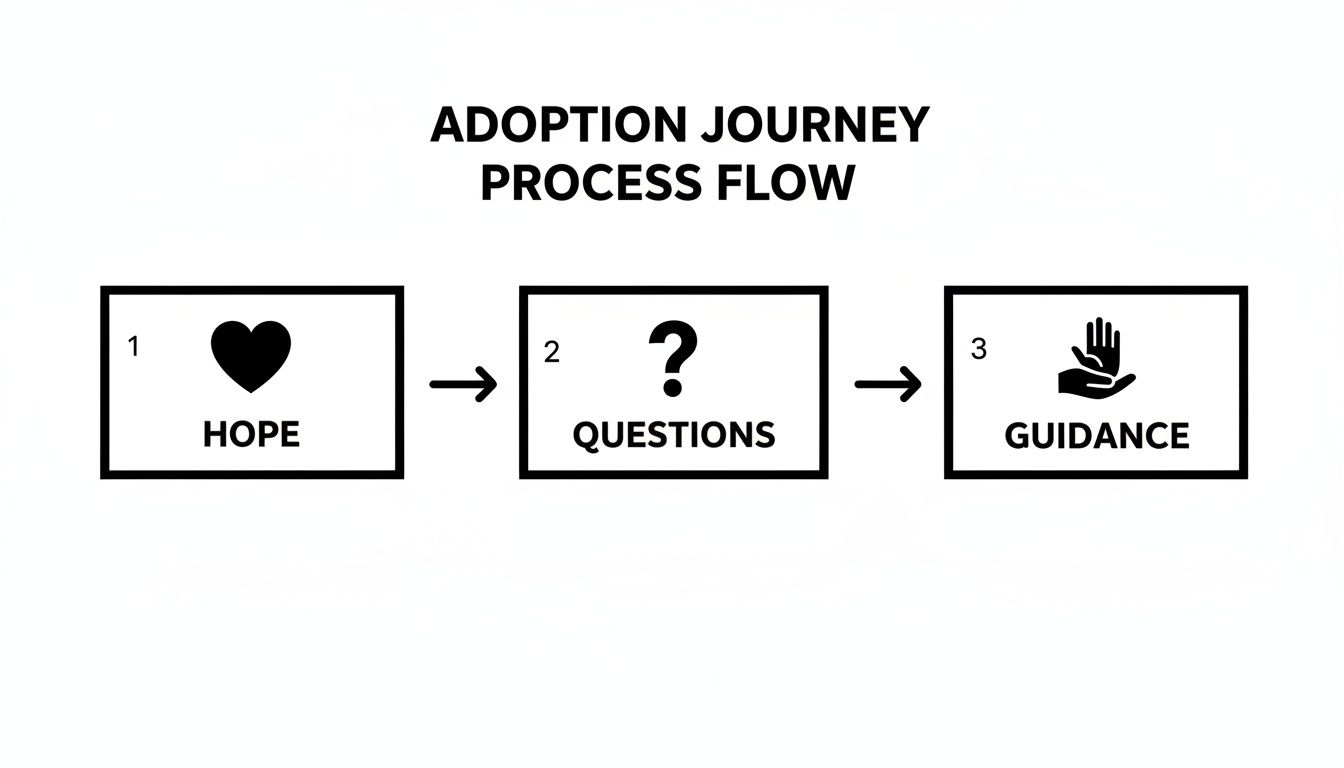
It's a perfect picture of the process: having questions is completely normal, but having compassionate support is what gives you the confidence to keep moving forward. While your heart is leading the way, the legal framework provides the structured path to get you there.
Building Your Family With Clarity and Confidence
Starting this journey means getting your heart and your home ready. The state’s legal roadmap is laid out in Chapters 162–166 of the Texas Family Code. Think of these laws as a series of guardrails, all put in place to ensure one thing: that the child’s best interests are always the number one priority.
We'll cover the essential qualifications you'll need to meet, such as:
- Being at least 21 years old
- Showing you are financially stable
- Passing a comprehensive background check
- Successfully completing a home study
These steps aren't meant to be intimidating. They’re about building a strong foundation for the family you’re about to become. For example, a young couple, Sarah and Tom, felt anxious about the home study, picturing a strict inspection. In reality, it was a warm conversation where they shared their dreams for their future child and got helpful advice on baby-proofing their home. It was a team effort to prepare them for parenthood.
Understanding the Core Texas Adoption Requirements
If you're considering adoption in Texas, the first step is understanding the legal requirements. These aren't just arbitrary rules—they’re thoughtfully designed standards from the Texas Family Code meant to ensure every child is placed in a safe, stable, and loving home. Think of them as the foundational checkpoints on your journey, confirming you’re ready for the profound responsibility of becoming a parent.

At its heart, the law simply wants to see that you’re a mature, responsible adult who can provide for a child’s needs. This isn’t about being perfect; it’s about being prepared. The state's number one priority is always the child’s best interest, and these initial qualifications are the first step in protecting it.
Who Is Eligible to Adopt in Texas?
The good news is that Texas law sets clear, straightforward criteria for who can adopt. These rules apply whether you're single, married, or in a long-term partnership. The court looks at every applicant as an individual, focusing on your ability to provide a secure and nurturing environment for a child.
To start, the basic eligibility checklist includes:
- Age: You must be at least 21 years old.
- Maturity: You’ll need to demonstrate emotional and mental maturity, which is something that gets evaluated through conversations and interviews during the home study process.
- Financial Stability: You have to show you can manage your finances and support a child. This doesn’t mean you need to be wealthy—just that you have a stable income and a track record of financial responsibility.
To make it even simpler, here's a quick look at the foundational requirements every potential adoptive parent in Texas needs to meet.
Quick Checklist of Basic Texas Adoption Eligibility
| Requirement | What It Means in Practice |
|---|---|
| Minimum Age | You must be at least 21 years old to file an adoption petition. |
| Emotional and Mental Maturity | Be prepared to discuss your life experiences, motivations, and parenting philosophy. |
| Financial Stability | You'll need to provide proof of income and show you can responsibly manage a household budget. |
| Safe Home Environment | Your home must be a safe, clean, and suitable place for a child. This is assessed during the home study. |
| Clear Background Check | All adults in the household must pass criminal history and child abuse registry checks. |
This checklist covers the absolute basics. Meeting these criteria is your green light to move forward with the more in-depth parts of the process.
The Two Foundational Milestones: Background Checks and a Home Study
Beyond who you are on paper, two critical steps form the backbone of nearly every Texas adoption: the home study and the background check. You can’t skip these. They give the court, your attorney, and any agency involved a complete picture of you and the home you’re offering a child.
The background check is exactly what it sounds like—a deep dive into your history. A huge part of the adoption requirements in Texas is ensuring a child’s safety, which means every adult living in your home has to pass a series of screenings. This includes criminal history searches and checks against child abuse and neglect registries to make sure there's nothing in your past that could put a child at risk.
The home study, on the other hand, is much more personal. It's less of an "inspection" and more of a "conversation." A licensed social worker will spend time getting to know you, your family, your home, and your reasons for adopting. It’s a collaborative process designed to prepare you for this incredible, life-changing step.
The state mandates these steps for a reason—to protect children. Whether you're pursuing a private, relative, stepparent, or foster care adoption, these safeguards ensure every child’s safety comes first. You can find out more about how these screenings protect children and learn about other vital requirements for Texas families right from the source.
The Home Study and Background Checks: Getting Ready for a Child
For most hopeful parents, the home study sounds like the most intimidating part of the whole process. Let’s clear the air on that. This isn't about judging your taste in furniture or running a white glove over your shelves; it’s about making sure your home is a safe, loving, and supportive place for a child. Its real purpose is to prepare you for parenthood, not to catch you in a mistake.
Think of it as a series of conversations with a partner who’s on your team. A licensed social worker will walk you through the process, helping you think through the real-life adjustments of bringing a child home. The whole thing is designed to trade anxiety for confidence, so you’re fully prepared for this incredible new chapter.
What Does the Home Study Actually Involve?
The home study is a detailed look at your life, background, and home, and it’s a non-negotiable step required by the Texas Family Code to protect the child's best interests. It’s made up of a few key parts, each one helping to paint a full picture of the family you’re ready to become.
You can expect to go through:
- Personal Interviews: These are one-on-one and joint chats with your social worker. You'll talk about your personal history, your relationship, your parenting philosophies, and what’s motivating you to adopt. It’s a chance to be real and honest about your hopes for your family.
- Home Visits: The social worker will come to your home to see that it’s a safe and suitable space. They aren't looking for a perfect show home—just the basics, like working smoke detectors, safely stored chemicals, and enough room for a child to thrive.
- Document Collection: You’ll need to pull together various documents like birth certificates, marriage licenses, financial statements, and letters of reference. This is the paperwork part that proves your identity and stability.
It might feel like a lot, but every step is there for a reason. It all goes into a comprehensive report for the court, showing that you’re ready and able to provide a wonderful home. If you want to get a head start, check out this adoption home study checklist to see exactly what you'll need to gather.
Understanding the Background Check Requirement
Along with the home study, every adult living in your home who is age 14 or older has to pass a thorough background check. This is a critical safety measure in Texas adoptions with absolutely no wiggle room. The goal is simple: make sure there’s nothing in an adult's past that could put a child at risk.
These checks are serious and include:
- A statewide search of criminal history records.
- A check of the Texas Department of Family and Protective Services (DFPS) abuse and neglect registry.
- A national FBI fingerprint-based criminal history check.
It is crucial to be 100% upfront about your past. A minor offense from a decade ago won’t necessarily stop you from adopting, but trying to hide it definitely will. The review zeroes in on convictions that would endanger a child, like family violence, injury to a child, or sexual assault.
The home study and background checks are not obstacles to overcome; they are foundational steps to make sure you are truly prepared. The social worker is looking for stability, healthy relationships, and a genuine heart for parenting—not a perfect person or a perfect house.
We've seen couples clean their house for days, only to find out their social worker was far more interested in how they talked to each other during a tough conversation. That's what this is all about. It’s an assessment of your capacity for love, patience, and resilience—the things that really hold a family together. These steps build your confidence, proving you’ve met the highest standards to give a child a safe and loving home.
Exploring Different Paths to Adoption in Texas
Adoption isn't a single, straight road. It’s more like a network of paths all leading to the same beautiful destination: family. The adoption requirements in Texas are built to be flexible because every family's story is unique. Your journey to parenthood is going to look different from someone else's, and that’s more than okay—it’s expected.

Whether you’re blending your family through a stepparent adoption, keeping a child with loved ones through a kinship adoption, or welcoming a newborn via a private agency, Texas law provides a clear framework. The first step is figuring out which path feels right for your heart and your circumstances.
Stepparent Adoption Requirements
When a stepparent steps up to become a legal parent, it’s a powerful act of love and commitment. A stepparent adoption doesn't create a new bond; it legally solidifies one that already exists, giving a child a profound sense of security and permanence. But before that can happen, there are specific legal requirements to address.
The biggest one? Addressing the parental rights of the other biological parent. For the adoption to move forward, that parent's rights must be legally terminated.
This can happen in one of two ways:
- Voluntary Termination: The biological parent agrees to the adoption and signs a legal document to relinquish their parental rights. This is the most straightforward and collaborative route.
- Involuntary Termination: If the other parent is absent, unknown, or refuses to consent, you’ll have to petition the court to terminate their rights. This typically requires proving things like abandonment, neglect, or a consistent failure to support the child.
Once termination is handled, the stepparent can file the adoption petition. In these cases, the court often waives the full home study, especially if the child has lived with the stepparent for at least six months. This helps streamline the process considerably.
Relative and Kinship Adoptions
Family is a child’s first and most natural support system. Texas law recognizes this and has created a more direct path for relatives—or "kin"—to adopt a child in their family. This could be a grandparent, aunt, uncle, or even a close family friend who has a deep, pre-existing relationship with the child.
Kinship adoptions often come into play when a biological parent can't care for their child due to illness, incarceration, or other serious challenges. The goal is always to maintain family connections and give the child stability in a familiar, loving place. Since the child is already with trusted family members, the home study process is usually modified and less intensive than in other adoptions.
This focus on family has made a huge difference. From 2010 to 2019, Texas saw a significant surge in adoptions from the child welfare system, with 53,412 children finding their forever homes. Relatives now adopt more than half of all children and teens from the Texas foster care system, a trend that continues to grow and strengthen families.
Private Infant Adoption
For many hopeful parents, private infant adoption is the journey they picture when they dream of bringing a newborn home. This path involves working with a licensed adoption agency or an attorney who helps match you with an expectant parent making an adoption plan for their child.
A few key things to expect in a private infant adoption:
- Creating a Profile: You’ll put together a profile book or online portfolio that tells your story, helping expectant parents get a real sense of who you are.
- The Matching Process: The agency or attorney acts as a bridge, facilitating a match based on the wishes of both the birth parents and your family.
- Consent and Termination: In Texas, a birth mother cannot legally sign the papers to relinquish her parental rights until at least 48 hours after the child is born. This critical waiting period ensures her decision is made with a clear mind, free from the immediate pressures of childbirth.
This process is a deeply personal partnership, often leading to open or semi-open adoption relationships where everyone stays connected in a way that feels right for them.
Adopting from Foster Care (CPS)
Adopting a child from the Texas foster care system—managed by the Department of Family and Protective Services (DFPS)—is a journey of immense heart. These are children who have been removed from their homes because of abuse or neglect and are waiting for a permanent, loving family to call their own.
The requirements here are a bit different because you are stepping in to help a child heal from trauma. You'll be asked to complete specialized training, like Trauma-Informed Care, to better understand and meet the needs of a child who has been through significant hardship.
While the primary goal of CPS is often to reunite families, thousands of children become legally free for adoption every year. Adopting from foster care is typically the least expensive route, and many costs are minimal or even reimbursed by the state. It is a profound way to give a deserving child the safety, stability, and love they need to truly flourish.
If you are interested in exploring the different avenues available, our firm provides detailed information on the various types of adoption in Texas.
What to Expect for Timelines and Costs
Let's talk about the two biggest questions on every prospective parent's mind: how long will this take, and how much will it cost? Understanding the practical side of adoption is a huge part of being prepared. While every journey is unique, understanding the typical timelines and financial commitments helps you plan smart so you can focus on what really matters—preparing your heart and home for a child.
Each adoption path moves at its own pace, shaped by legal requirements, the matching process, and your own family’s circumstances.
How Long Does an Adoption Take in Texas?
If you're pursuing a private infant adoption, patience is truly a virtue. Most domestic infant adoptions in Texas take anywhere from 12 to 24 months from start to finish, though some are shorter and others take longer. This timeline often depends on your own flexibility. Families who are open to various situations regarding a child's gender, race, or potential medical needs may find their wait time for a match is reduced.
On the other hand, adopting from foster care has a less predictable timeline. The process usually starts with getting licensed as a foster parent, and the clock for finalization doesn't really start until a child in your care becomes legally available for adoption. Stepparent and kinship adoptions are almost always the fastest, since the child is already living with you. The main event here is the legal step of terminating the other biological parent's rights.
Breaking Down the Costs of Adoption
The financial side of adoption is just as varied as the timeline. The path you choose will largely determine the overall investment.
- Private Infant Adoption: This is generally the most expensive route. You can expect costs to range from $30,000 to $60,000, sometimes more. These fees cover a lot of ground: agency services, legal counsel for both you and the birth mother, home study expenses, the birth mother's medical bills, and occasionally, her living expenses.
- Adoption from Foster Care: This is by far the most affordable option. Most families pay very little out-of-pocket, as the state often covers the legal fees and provides a monthly subsidy to help with the child’s ongoing care.
- Stepparent or Kinship Adoption: These adoptions are much less costly. The primary expenses are the legal fees associated with terminating parental rights and finalizing the adoption in court.
Planning for these expenses is a crucial step in fulfilling the adoption requirements in Texas. It demonstrates your financial stability and readiness to provide for a child's needs long-term.
When you're mapping out your budget, it's good to know that options like attorney payment plans can make the legal costs more manageable. Our firm believes in total financial transparency. For a closer look at the numbers, check out our guide to the cost of adoption in Texas.
Financial Assistance and Resources
The good news? You don’t have to shoulder these costs all on your own. There are several resources out there designed to make adoption more accessible for loving families.
One of the most significant is the Federal Adoption Tax Credit. It’s a non-refundable credit that can help you recover thousands of dollars in qualified adoption expenses when you file your taxes. Beyond that, many employers now offer adoption assistance as part of their benefits packages, so be sure to check with your HR department.
For families adopting from the foster care system, Texas provides subsidies and other financial support, especially for children with special needs. By looking into all these avenues, you can build a solid financial plan that turns the dream of building your family into a reality.
Celebrating Your Adoption Finalization in Court
The final court hearing is the moment your entire adoption journey has been building toward. Think of it less as a formal legal procedure and more as a deeply meaningful celebration—the day your new family officially and forever begins. This is when all the paperwork, home visits, and anxious waiting finally pay off in a beautiful, legal reality.
The Post-Placement Period
Before you step into that courtroom, you’ll go through a crucial phase called the post-placement supervision period. Once a child is placed in your home, a social worker from your agency will visit every so often—usually for about six months—to see how everyone is settling in. These aren't inspections; they're supportive check-ins designed to help your family thrive.
The social worker’s job during this time is to:
- Observe the bond forming between you and the child.
- Offer resources and guidance for any challenges that pop up.
- Document your family’s progress in a formal report for the court.
These reports are key. They provide the judge with proof that the placement is stable, loving, and truly in the child’s best interest, clearing the path for your final hearing.
What to Expect on Finalization Day
Adoption finalization day is often one of the happiest days you'll ever see in a courtroom. Many judges welcome family and friends, so don't be shy about bringing cameras, grandparents, and your closest supporters to share the moment. It’s a warm, joyful occasion, usually filled with more smiles than legal jargon.
During the hearing, the judge will look over the final report from your social worker and may ask you a few straightforward questions while you're under oath. Then comes the big moment: the judge will sign the Final Decree of Adoption.
This decree is the powerful legal document that officially makes your child a permanent member of your family. It establishes your parent-child relationship with all the same rights and duties as if the child were born to you. It also directs the state to issue a brand-new birth certificate with your names proudly listed as the parents.
Holding that signed decree is the beautiful culmination of your hard work. Every requirement you met, from the home study to the background checks, was a step leading straight to this incredible milestone. It’s the tangible proof that your family is now, and will forever be, legally whole.
Common Questions About Adoption in Texas
The road to adoption is almost always filled with questions. As you start thinking about this journey, it’s completely normal to have concerns about who is eligible, the legal hurdles you might face, and how your specific life situation fits into the picture. Below, we’ve answered some of the most common questions we hear from hopeful parents, giving you the clear, straightforward information you need to move forward.

Can I Adopt in Texas if I Am Single or Part of the LGBTQIA+ Community?
Absolutely. Texas law is clear: any qualified single adult can adopt, and there are no prohibitions based on sexual orientation. The court’s one and only focus is on your ability to provide a safe, stable, and nurturing home for a child.
As long as you meet all the standard requirements—like age, financial stability, and passing the background checks—your marital status or who you love is not a barrier. The key is proving you can act in the best interests of the child.
What Kind of Criminal History Disqualifies Me from Adopting?
Texas law is very strict when it comes to criminal convictions that could put a child at risk. Individuals with a history of certain offenses, especially those involving injury to a child, family violence, or sexual crimes, are barred from adopting.
The background check is incredibly thorough, so it’s crucial to be upfront about your history from the very beginning. A minor offense from many years ago might not be an automatic "no," but this is where an experienced adoption attorney can provide critical guidance on your specific circumstances.
What Happens if a Birth Father Is Unknown or Uncooperative?
This is a very common and understandable concern, particularly in private and stepparent adoptions. Fortunately, Texas law has specific procedures for terminating the parental rights of a biological father who is either unknown or unwilling to cooperate.
The process might involve a diligent search to find him, publishing a legal notice in a newspaper, or checking the state's paternity registry. If he can’t be found or doesn't respond after being properly notified, the court can terminate his rights, allowing the adoption to move forward. Handling this correctly is vital to ensuring the adoption is legally sound and can't be challenged later.
Your dream of building a family is within reach, and you don’t have to figure it out alone. The compassionate attorneys at The Law Office of Bryan Fagan, PLLC are here to answer your questions and guide you through every step of the adoption process with empathy and clarity. Schedule a free consultation today to discuss your unique situation and learn how we can help you take the next step toward building your family. Visit us at https://texasfamilyadoption.com to get started.

