
A hospital room can feel like the quiet center of a very large legal process. A birth parent may be recovering from delivery while an adoptive family waits nearby, hopeful but careful not to rush anything. At that moment, the words on a relinquishment affidavit matter because Texas law requires more than a signature. It requires a formal, sworn document that protects the parent's decision, the child's future, and the court's ability to determine whether the adoption can proceed.
The Family Code 161.103 affidavit of relinquishment requirements in Texas can feel technical, especially when emotions are already high. The central rules are easier to understand when you separate them into timing, eligibility, required statements, execution formalities, revocation, and what happens after filing. This guide walks through those pieces in plain English for birth parents, adoptive parents, relatives, and guardians.
What the § 161.103 Affidavit Actually Does
A birth parent at a Houston hospital may decide that adoption is the right plan for the child. The adoptive couple may be waiting in another part of the building, and an agency or attorney may be coordinating the paperwork. The private decision is personal, but the court needs a reliable legal record before parental rights can be terminated.
That record is the affidavit of voluntary relinquishment under Texas Family Code § 161.103. It isn't the adoption itself. Instead, it is a sworn written instrument that expresses the parent's voluntary decision to relinquish parental rights and provides the information the court needs in a termination or adoption proceeding. The statute requires the document to be signed after the child is born and not before 48 hours after birth, witnessed by two credible persons, and verified before someone authorized to take oaths. Texas court materials discussing the statutory requirements show why these formalities are treated as central to validity.
Practical rule: A relinquishment affidavit is not a casual consent form. A missing requirement can create a serious problem before the court even considers later claims about fraud or pressure.
How the affidavit differs from other documents
Several Texas documents may appear during an adoption or termination case, but they don't all perform the same job.
- Section 161.103 affidavit: A sworn voluntary relinquishment document used to support termination of the signing parent's rights.
- Section 161.001 voluntary termination: A court-based termination route under the broader termination statute. The affidavit may support a voluntary termination, but the affidavit and the court order are not identical.
- Section 161.002 mediated agreement: A mediated agreement can resolve family-law issues, but it isn't automatically the same statutory relinquishment affidavit.
- Section 162.511 placement record: A placement record relates to adoption placement documentation. It doesn't replace the specific affidavit required by § 161.103.
A properly executed affidavit can allow the court to rely on the parent's sworn relinquishment rather than requiring the same parent to testify as a live witness in a contested termination. That doesn't mean the affidavit alone finalizes the adoption. The court still must address the termination and adoption proceedings, the child's best interests, and other statutory requirements.
For a plain-language overview of the document's role, see this Texas release of parental rights form resource. A parent should read the entire affidavit before signing, ask questions about every clause, and understand whether the document is revocable or irrevocable under its stated terms.
Who Can Sign and the Timing Rules You Must Follow
A signed relinquishment starts with the right person, at the right time, using the right formalities. Before anyone reviews the wording, confirm that the signer has the legal status required for this type of affidavit.
Start with the signer's status
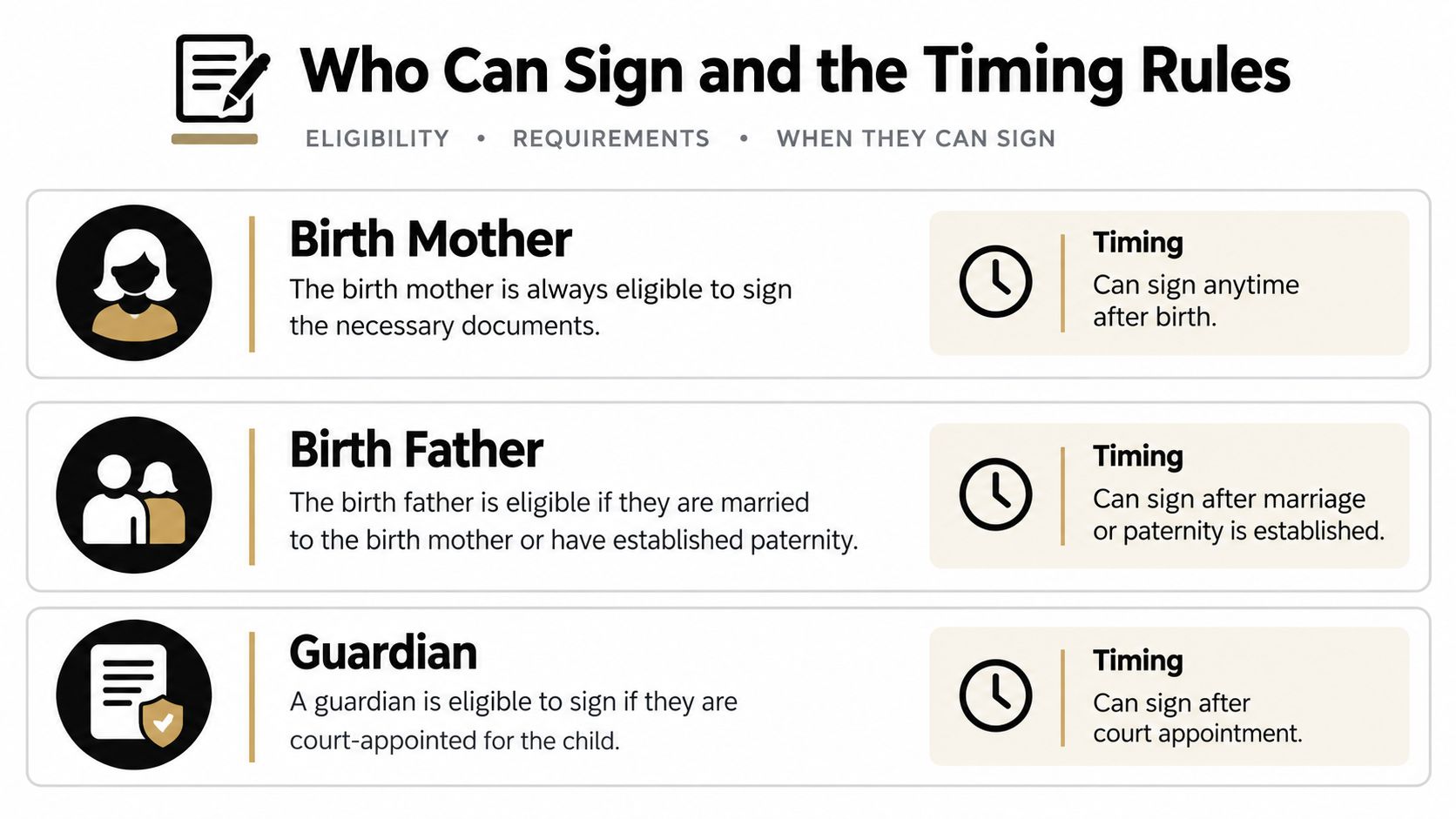
The birth mother may sign after the child's birth and after the statutory waiting period. A birth father who is married to the mother, a father who has established a legal relationship with the child, and a man alleged to be the father may each have different rights, duties, and notice issues based on the facts.
A man alleged to be the father should not assume that silence ends his role. If the father is unknown or cannot be located, the adoption process may require legally sufficient efforts to provide notice, including constructive notice when appropriate. The proper procedure depends on the available information and the court's requirements.
A court-appointed guardian may act for a child or manage particular legal matters. That appointment does not automatically give the guardian the same authority as a biological parent to relinquish parental rights. The family should review the appointment and determine whether a separate court order is required.
Observe the 48-hour waiting period
A birth mother cannot sign the affidavit before 48 hours after the child's birth. Her decision may be firm immediately after delivery, but the document still must wait until the statutory period has passed. The attorney or agency should record the birth time and calculate the earliest lawful signing time before arranging execution.
The affidavit must also be witnessed by two credible persons and verified before an authorized officer, such as a notary authorized to administer oaths. The witnesses observe the signing circumstances. The authorized officer confirms the oath and execution.
Record the child's birth time, calculate the earliest lawful signing time, and preserve a clear execution record.
An attorney or licensed child-placing agency representative may coordinate the signing, but the process must remain voluntary. Payment cannot be exchanged for the relinquishment itself. Lawful maternity-related expenses are a separate matter and cannot become a purchase of parental rights.
A minor birth parent may need help understanding the decision and completing each required formality. This guide to whether a minor birth mother can consent to adoption in Texas explains that issue in more detail. Families may also review Voluntary Relinquishment of Parental Rights in Texas for a plain-language explanation of how a birth parent voluntarily ends parental rights for an adoption.
The Statutory Recitals Every Texas Relinquishment Must Include
Section 161.103 requires the affidavit to contain a detailed written record. Think of the recitals as the document's legal answers to basic questions: Who is signing? Which child is involved? What does the parent understand? Who should manage the child after termination?
The statute identifies at least 12 categories of information, including the parent's identity and county of residence, the child's identity and birth date, support obligations, the best-interest statement, information about the other parent, and the designation of a prospective adoptive parent or licensed child-placing agency as managing conservator. The statutory text and execution requirements provide the framework for reviewing the document line by line.
Identity and venue
The identity block should accurately identify the parent and child. A misspelled name, incorrect birth date, or incomplete identifying information can create confusion when the affidavit is filed with the court. The document also records information relevant to venue, including the parent's county of residence.
For example, if a parent uses a nickname in conversation but the child's legal record uses a different spelling, the affidavit should be checked against the official records. Accuracy helps the court connect the affidavit to the correct parent-child relationship.
Support and parentage information
The support block addresses whether the parent has support obligations and provides information about the other parent. Depending on the signer's status, the document may address parentage acknowledgment, presentment, or waiver of legitimation rights. These statements help the court understand whether another person may have a legally protected interest.
Best interests and payments
The parent must state under oath that relinquishment is in the child's best interest. The affidavit also must avoid turning the relinquishment into a payment-for-rights arrangement. Lawful maternity-related expenses may be addressed where permitted, but the document shouldn't promise improper compensation.
Conservator designation
The affidavit identifies the prospective adoptive parent or licensed child-placing agency the parent designates as managing conservator after relinquishment. That designation matters because it tells the court who the parent intends to care for and manage the child while the termination and adoption matters move forward.
| Block | Required Recital | Why It Matters |
|---|---|---|
| Identity | Parent's identifying information and county of residence | Connects the signer to the correct legal record and venue |
| Identity | Child's name and birth information | Identifies the child affected by the relinquishment |
| Support | Statements about support obligations | Helps the court understand financial and legal responsibilities |
| Support | Information about the other parent | Alerts the court to another possible parent with legal rights |
| Best interests | Statement that relinquishment is in the child's best interest | Records the parent's sworn understanding of the decision |
| Best interests | Information concerning permitted expenses and payments | Helps distinguish lawful expenses from improper compensation |
| Conservator | Designation of a prospective adoptive parent or licensed agency | Identifies the intended managing conservator |
| Conservator | Consent to that managing-conservator appointment | Shows the parent's agreement with the proposed placement |
| Execution | Voluntary relinquishment language | States the parent's legal decision clearly |
| Execution | Required warning and revocation language, when applicable | Explains whether and how withdrawal may occur |
| Parentage | Required statements concerning the other parent's status | Supports proper handling of notice and consent issues |
| Court use | Sworn, verified written record | Gives the court a dependable document for the proceeding |
A careful review should compare every recital with the statute. Courts have treated compliance as a threshold issue, so an incomplete affidavit can fail before a later challenge is even analyzed.
Revocable, Irrevocable, and the 11-Day Window Explained
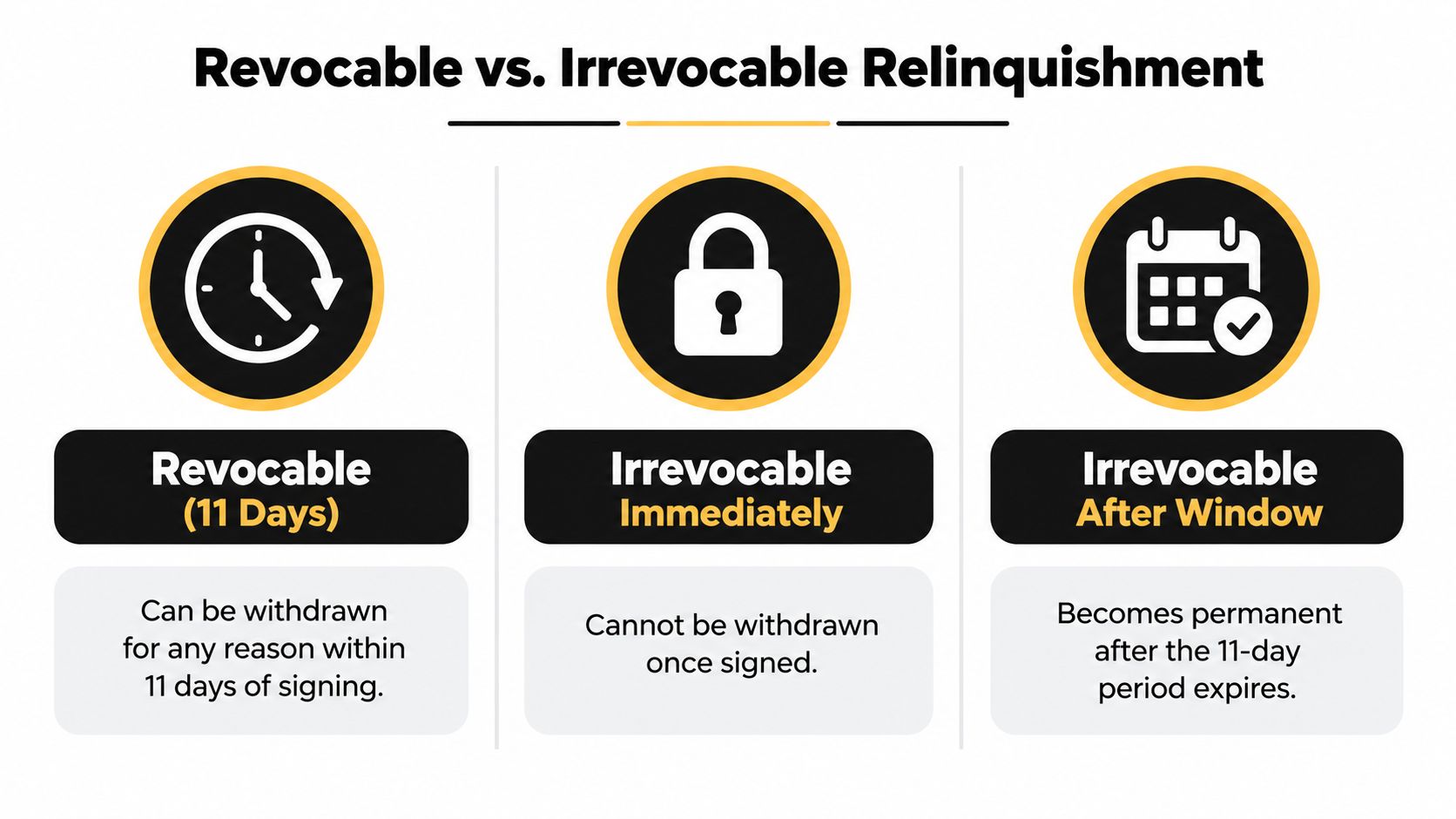
The affidavit's duration language is one of the most important parts for a birth parent to understand. Under the current framework, the document may be irrevocable immediately, revocable for the statutory period, or irrevocable for a stated period if the statute's conditions are met.
If the affidavit designates the Department of Family and Protective Services or a licensed child-placing agency as managing conservator, the relinquishment is irrevocable. In other situations, the affidavit is revocable unless it expressly makes itself irrevocable for a stated period that doesn't exceed 60 days after execution. The Texas Family Code chapter addressing these long-standing safeguards explains the distinction.
How the 11-day period works
When an affidavit is revocable, the parent must receive a boldfaced warning that revocation is allowed only before the 11th day after execution. The clock starts from the date the affidavit is signed, not from the child's birth and not from placement with the adoptive family.
The written revocation must be delivered as required by the statute and the document, including delivery to the office of the attorney representing the adoptive placement when that is the identified recipient. A parent shouldn't rely on a phone call, text message, or informal conversation. The revocation process needs careful legal handling and proof of delivery.
Consider two examples:
- Parent A signs a revocable affidavit and changes her mind on day 9: She may have a statutory path to revoke, but she must follow the written delivery and court procedures that apply.
- Parent B signs an immediately irrevocable affidavit and seeks withdrawal on day 30: A simple change of heart generally doesn't undo the affidavit.
If the document is silent about duration, don't guess what that silence means. Have a Texas adoption attorney review the exact language and the managing-conservator designation. A parent considering withdrawal can also review this Texas affidavit revocation resource.
Even an irrevocable affidavit may be challenged on recognized grounds such as fraud, duress, or coercion. Those claims require evidence and court review. They aren't the same as ordinary regret after signing.
How Courts Treat a Signed Affidavit After the Fact
Texas courts generally analyze a properly executed affidavit in stages. First, the person relying on the affidavit must show facial compliance with § 161.103. That means the document appears complete and the timing, witnesses, verification, and required language are proper.
Once facial compliance is shown, the opposing parent must prove fraud, duress, or coercion by a preponderance of the evidence, according to the cited Texas case materials. The case discussion describing this two-stage burden illustrates why a complete affidavit changes the shape of the litigation. A parent can't usually prevail by saying only that they later changed their mind.
Evidence that can matter
A court may examine medical records, witness testimony, social-worker notes, and communications created close to the signing. Evidence should address what happened at the time of execution, not only how the parent feels afterward.
A parent alleging fraud might need to identify a material false statement and explain how it affected the decision. A duress or coercion claim needs specific facts showing pressure that overcame free choice. The court may also consider whether the parent understood the document and whether the signing process followed the statutory safeguards.
Defects that invite challenge
Drafting and execution errors can place the affidavit under attack before the court reaches the merits of a coercion claim.
| Defect | Statutory Source | Court Treatment |
|---|---|---|
| Missing required recital | § 161.103 | May prevent facial compliance |
| Signing before the waiting period ends | § 161.103 | May undermine validity |
| Failure to use two credible witnesses | § 161.103 and related execution rules | Creates a formal execution issue |
| Defective verification | § 161.103 | May leave the sworn document legally incomplete |
| Ambiguous revocation language | § 161.103 | Can create uncertainty about the parent's rights |
| Missing or inadequate warning | § 161.103 | May support an argument that required notice was not given |
| Improper conservator designation | § 161.103 | May affect the intended termination and placement path |
Federal child-welfare guidance also cautions against conditioning relinquishment on limited post-termination contact. If the parties want to discuss an open-adoption relationship, they should not casually insert an enforceable visitation promise into the relinquishment affidavit itself. Separate agreements require separate legal review.
What Happens After the Affidavit Is Filed
After the signing, the hospital room becomes part of a larger court process. The original affidavit typically moves to the attorney or licensed child-placing agency handling the placement, where it is preserved with the rest of the adoption file. The birth parent's designation of a managing conservator becomes part of the legal plan, but the court still must review the overall proceeding.
The adoptive family may then complete the required home-study process. Texas adoption procedure under Chapter 162 requires pre-adoptive and post-placement social studies in a suit for adoption, and the Texas Children's Commission bench book also explains that the petitioner must attend the adoption hearing. The Texas adoption bench book further notes that married petitioners generally must have both spouses join in the petition.
The court process in practical order
A family may move through these stages:
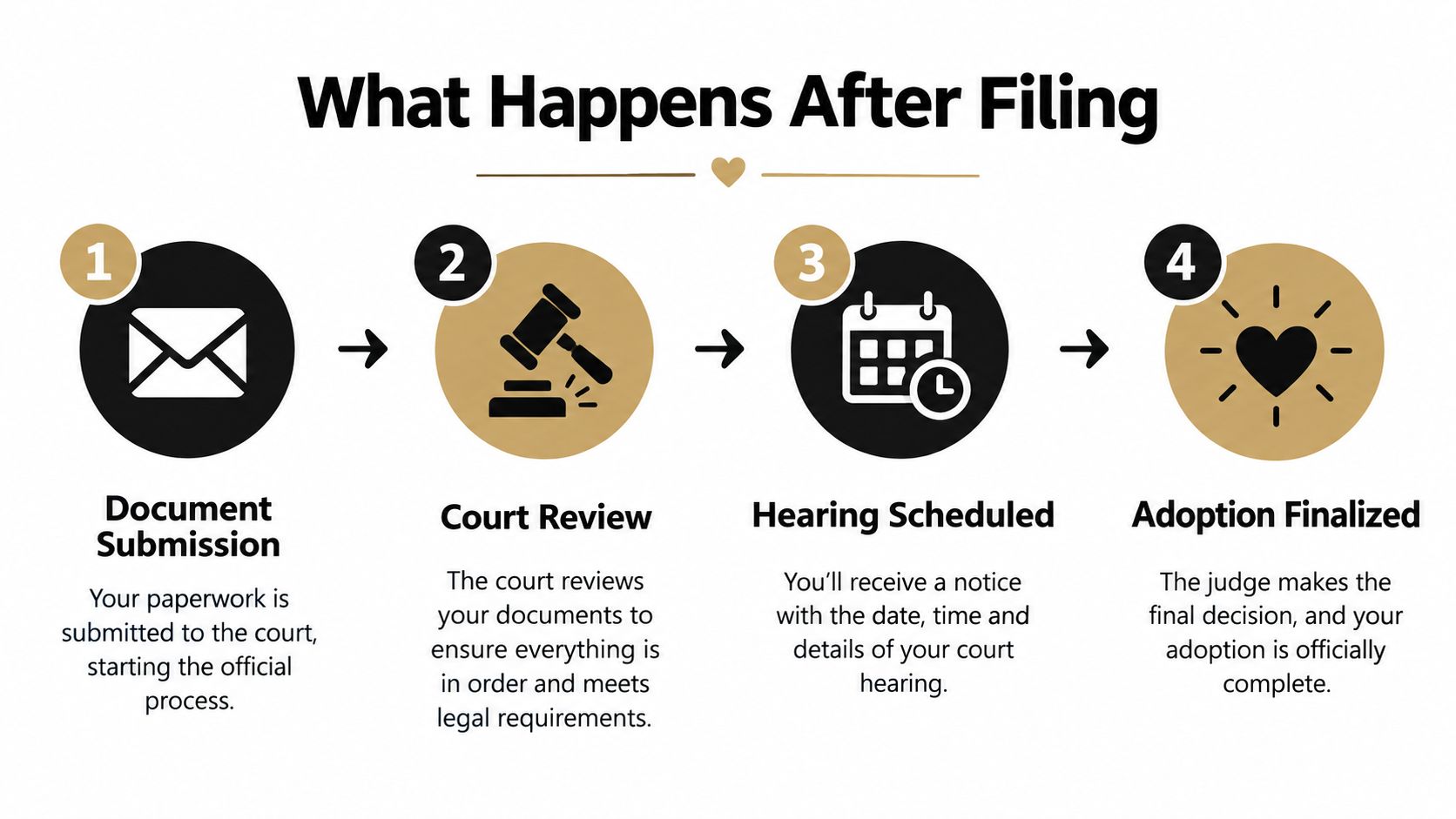
- Document submission: The executed affidavit, placement materials, and related records are provided to the responsible attorney, agency, or court file.
- Home study and social study: Professionals evaluate the proposed placement and prepare the reports required for the adoption case.
- Petition filing: The adoptive family files the petition for adoption, often alongside a petition or request addressing termination.
- Court review and hearing: The court reviews the affidavit, studies, notices, and other evidence, then schedules the required hearing.
- Final adoption hearing: The petitioner attends, answers the judge's questions, and seeks the final order.
A family may experience a substantial wait between filing and the final order. A commonly discussed range is 60 to 90 days, but that timing claim must be treated cautiously because the verified data supplied for this article does not establish that range. The actual schedule depends on the court, the home study, service and notice issues, any contest, and the facts of the placement.
The affidavit is necessary, but it isn't the final adoption order. A revocation attempt, a challenge based on fraud or coercion, a notice dispute, or CPS involvement may interrupt the expected path. The court's approval is what completes the legal transition and permanently establishes the new parent-child relationship.
Common Mistakes to Avoid and Your Next Step
Most problems arise because someone treats the affidavit like a standard form. Texas law treats it as a carefully engineered document, and small omissions can affect whether the court accepts it as valid.
Check the document before anyone signs
Use this practical checklist:
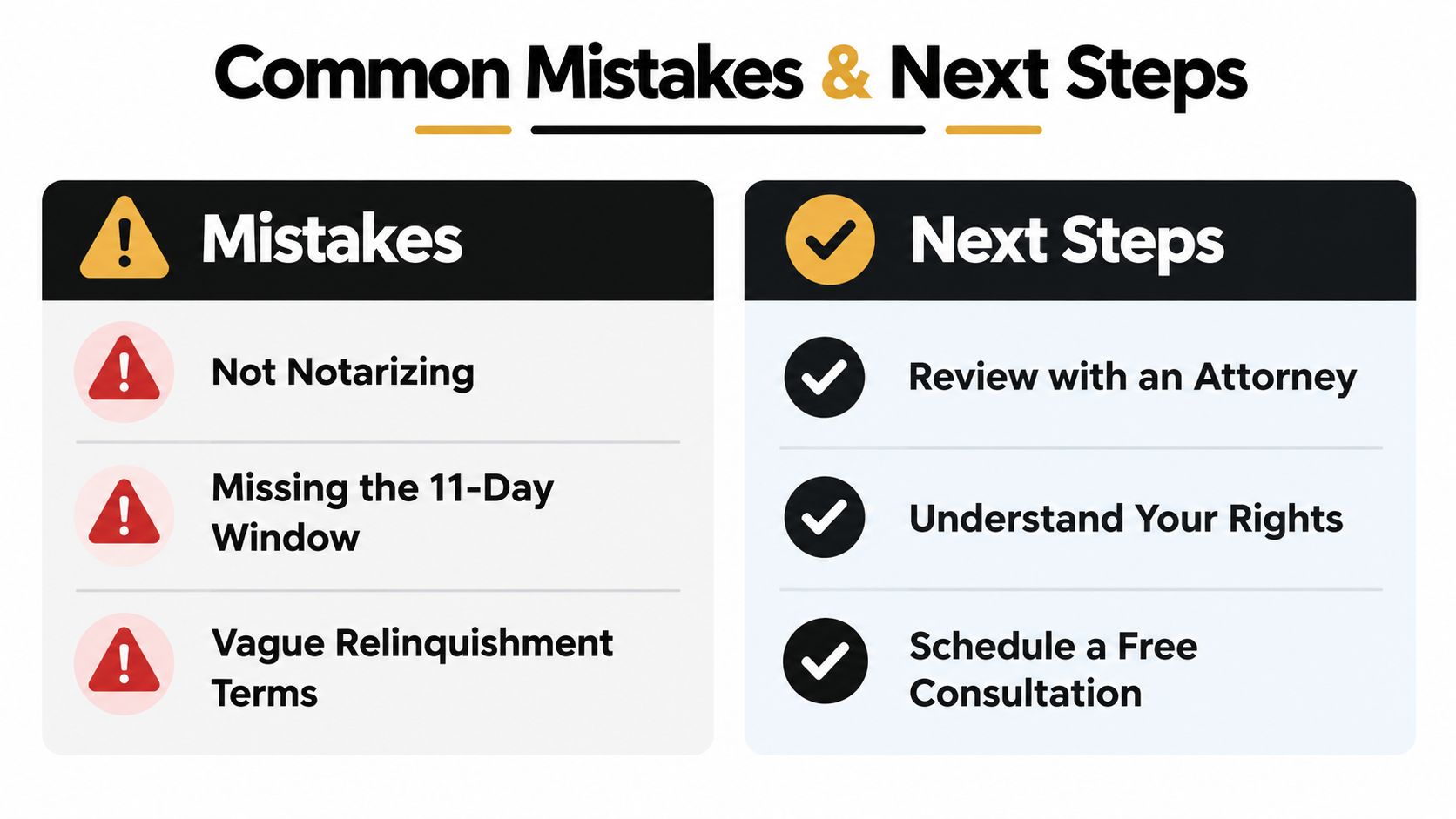
- Missing statutory recitals: Compare every required statement with § 161.103 before execution.
- Incorrect warning format: Confirm the revocation warning appears in the required boldfaced format and is readable.
- Early signing: Calculate the waiting period from the child's actual birth time, not from an estimate or the date of discharge.
- Only one witness: Arrange for two credible witnesses to be present during the signing.
- Incomplete verification: Confirm that the authorized officer properly administers the oath and completes the verification.
- Missing conservator designation: Identify the proposed managing conservator clearly.
- Wrong revocability choice: Make sure the affidavit's duration language reflects the parent's informed decision.
- Poor coordination: Align the affidavit, home study, social study, petition, notice, and hearing preparation.
A neutral witness and careful notarization can help preserve a clear record. Keep the signed original, execution date and time, witness information, and delivery records together. If a birth parent has concerns about pressure, promises, or misunderstanding, those concerns should be raised before signing whenever possible.
The same care applies to adoptive families. Hopeful parents should avoid treating a signed affidavit as a guarantee that the court will finalize the adoption. They still need to complete the home study, satisfy Chapter 162 requirements, attend the hearing, and respond to any notice or placement issue.
Before filing, take three concrete steps:
- Confirm that the affidavit tracks § 161.103 and contains each required recital.
- Verify that the waiting period, witnesses, notarization, warning language, and court-admissibility requirements are satisfied.
- Schedule a consultation to review jurisdiction, placement, conservator designation, revocation language, and finalization timing.
The Law Office of Bryan Fagan, PLLC helps birth parents and adoptive families review Texas relinquishment affidavits, prepare for home studies, address placement and notice issues, and move toward finalization with clarity. Visit Law Office of Bryan Fagan, PLLC to schedule a free consultation about your specific § 161.103 questions and next legal steps.
