
When a CPS case lands in your life, it often starts with paperwork that feels far bigger than the moment you're living in. A parent may walk into court scared about where the children slept last night, then walk out holding a family service plan filled with classes, testing, counseling, visits, and deadlines. The words are formal. The stakes are personal.
For many Texas parents, the hardest part isn't refusing to do the work. It's trying to understand what counts, what must be done exactly as written, and what happens if life gets in the way. That's where the issue of failure to comply with a service plan termination ground in Texas becomes so frightening. A missed task can feel like the State is measuring your whole future by a checklist.
This part of Texas law sits at the intersection of child safety, family reunification, and permanency. It also matters to relatives, foster families, and hopeful adoptive parents, because a termination case can reshape the path toward guardianship or adoption under the Texas Family Code, including the broader adoption procedures families later encounter in Chapters 162 through 166. In CPS cases, one legal track may still aim at reunification while another begins moving toward a permanent home if reunification breaks down.
A Texas Family, a Court Order, and the Question of Compliance
Maria leaves the courthouse with a stack of papers on the passenger seat and a knot in her stomach. Her children are in foster care. The judge has approved a service plan. By the time she gets back to her car, the hearing is over, but the harder question is just starting. What, exactly, does she have to do to get her children home?
On paper, the plan sounds clear enough. Parenting classes. Weekly drug tests. Counseling. Supervised visits. Stable housing.
In real life, each line can turn into three more problems.
A drug test may be scheduled across town while Maria is trying to keep her job. A counseling referral may depend on a callback she never gets. A parenting class may meet during the same hours she is supposed to visit her children. Parents in CPS cases often are not confused because they do not care. They are confused because court language is formal, the deadlines are strict, and daily life does not pause just because a case has begun.
That gap between the written order and real life matters. In Texas, this termination ground historically was tied to whether a parent followed a court order that specifically laid out what had to be done for reunification. The question was not whether CPS felt frustrated or whether a parent seemed disorganized. The question was more precise. What did the order require, and what did the parent do?
That is why two families can look similar from a distance and end up in very different places in court. One parent may miss a service because of a transportation breakdown, then reschedule, stay in contact, and keep working the plan. Another may stop testing, stop visiting, and stop responding for months. Those situations do not carry the same weight, and judges are supposed to look closely at that difference.
A service plan works a lot like a blueprint. If the blueprint says, "complete counseling," the court looks for counseling. If it says, "submit to testing," the court looks for testing records. General effort still matters to the human story of the case, but this ground has usually turned on something narrower. Specific tasks. Specific proof. Specific failures the Department can show.
Parents often ask, "Do I have to be perfect?" Usually, the issue is more practical than that. Courts look at whether the parent complied with the order in the ways that mattered under the wording of that order. A missed appointment may hurt. A pattern matters more. So does whether the parent tried to fix the problem, asked for help, or told the caseworker what was getting in the way.
For grandparents, relatives, foster parents, and caregivers, this stage can feel like standing at a fork in the road. One path still points toward reunification. The other begins to point toward a more permanent placement if the court decides the parents did not meet the court's requirements. That decision is not just about a checklist. It can reshape where a child will grow up, who will make decisions for them, and whether the case later turns toward adoption.
Where the Rule Comes From in Texas Law
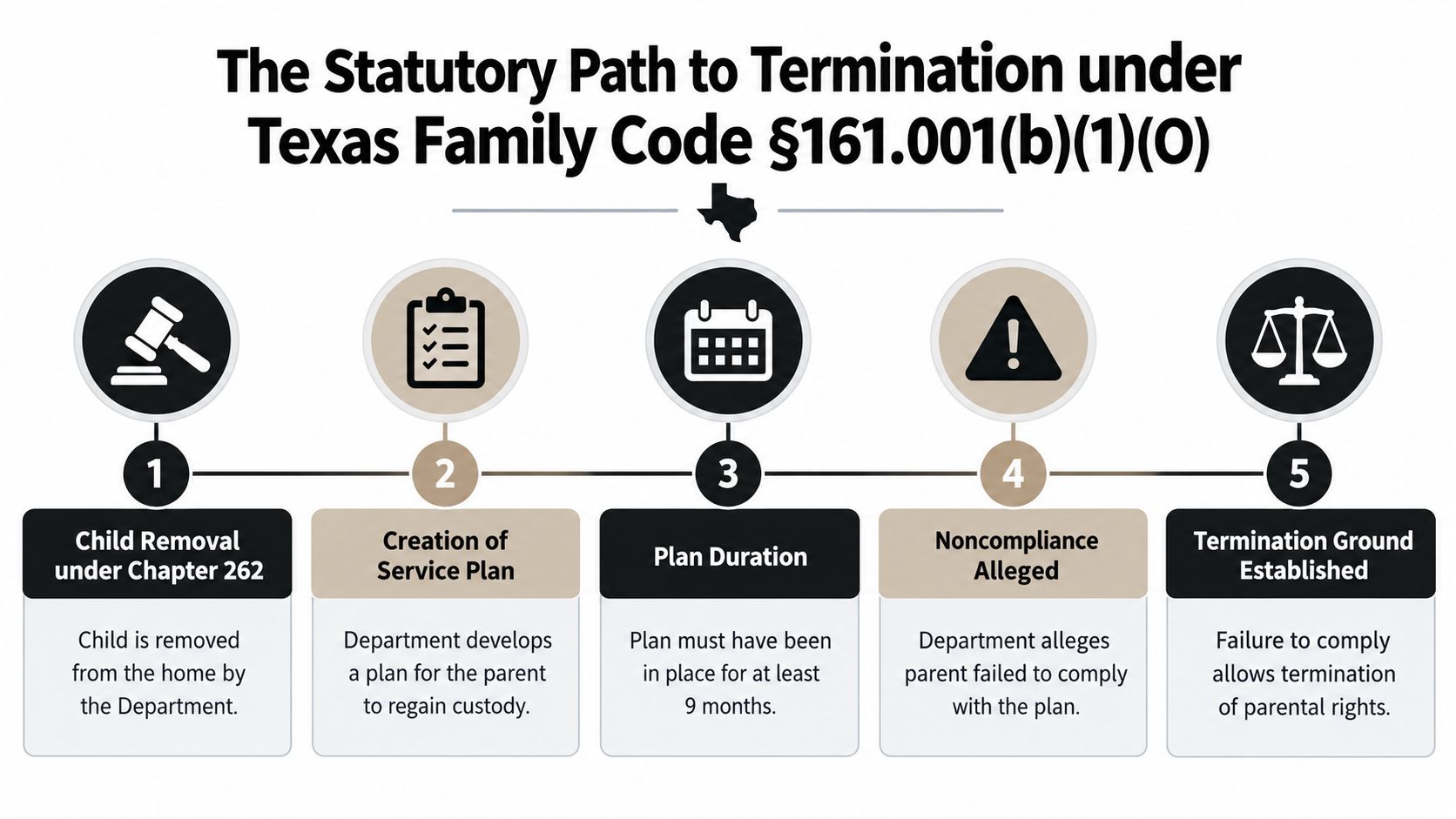
The legal rule called the "O ground" came from Texas Family Code § 161.001(b)(1)(O). Before its repeal, it allowed a court to terminate parental rights when several conditions lined up. The child had to be removed under Chapter 262 for abuse or neglect, the Department had to hold conservatorship for at least nine months after that removal, and the parent had to fail to comply with a court order that specifically set out the actions required to regain the child, as reflected in this Texas appellate discussion of subsection (O).
Plain English translation
In everyday terms, that meant:
- CPS removed the child through the legal removal process.
- The court signed an order that didn't just say "do better." It had to spell out what the parent needed to do.
- Enough time passed for the parent to work that plan.
- The Department claimed the parent didn't do what the order specifically required.
That made the statute narrower than many parents fear. The court order mattered. The wording mattered. The details mattered.
A simple example
Take a father in El Paso. He completes anger-management classes, keeps in touch with his worker, and gets an apartment. But before the permanency hearing, he misses two drug screens that the court-ordered plan required.
The legal question wouldn't be, "Has he become a perfect parent?" The question would be much tighter. Did the court order specifically require those screens? Did he fail to comply? Was that failure significant enough, in context, for a judge to use this ground?
Texas appellate courts and the Texas Supreme Court have stressed that subsection (O) didn't reach vague expectations or technical gotchas. The order had to specifically establish the actions necessary for reunification, and judges still had discretion because the statute said a court may order termination, not that it must, as explained in the Supreme Court opinion discussing material versus trivial violations.
Where this ground fit in the larger system
Subsection (O) sat inside the larger termination framework of Section 161.001, alongside other grounds involving different kinds of parental conduct. If you'd like a broader overview of that framework, Family Code 161.001 grounds for involuntary termination in Texas gives a fuller picture.
And for some children, if reunification doesn't happen, a relative may become the long-term answer. That's where Relative and Kinship Adoption in Texas can become relevant, when a family member adopts a related child.
One more legal development matters here. Texas changed this in 2025 by repealing former subsection (O), even though courts still analyze earlier cases under that provision and the due process concerns tied to it, as noted in this discussion of the historical O ground and its repeal.
What the Department Has to Prove in Court
A parent can walk into trial believing, "I did a lot of what they asked. Why is termination still on the table?" That question sits at the center of these cases.
A service plan, by itself, did not end parental rights. The Department had to prove each required part of this ground by clear and convincing evidence, which is a demanding standard. The court also had to make a separate finding that termination was in the child's best interest. In other words, the judge was not checking whether a parent had a few missed tasks. The judge was deciding whether the legal proof was strong enough, and whether ending the parent-child relationship was justified under Texas law.
The legal building blocks
For this ground, the Department generally had to bring the court four building blocks that fit together:
| Legal Element | What the Law Requires | Strong Evidence | Weak Evidence |
|---|---|---|---|
| Removal basis | The child was removed under Chapter 262 for abuse or neglect | Court orders, removal records, hearing findings | General statements that CPS was involved |
| Time in conservatorship | The child remained in the Department's managing conservatorship long enough for the statute to apply | Conservatorship orders and court timeline records | Unclear dates or mixed placement history |
| Specific court order | The plan, as ordered by the court, specifically identified the actions required for return | Signed service plan, incorporated court order, plainly listed tasks | Verbal expectations, vague directions, unwritten demands |
| Failure to comply | The parent failed to complete required tasks in a meaningful way | Missed services with records, provider discharge paperwork, repeated uncompleted requirements | One isolated slip, unclear referrals, disputed scheduling problems |
That table may look technical, but the courtroom question is fairly human. Did the Department show a clear order, a real opportunity to follow it, and a meaningful failure to do so?
Paper matters here. So does context.
Attendance logs, discharge summaries, text messages about transportation problems, screenshots asking for a new referral, certificates of completion, drug test results, and visitation records can all change how a judge sees the same parent. A case can turn on whether the record shows avoidance, confusion, or steady effort with some bumps along the way.
What judges actually look for
Judges do not decide these cases in the abstract. They look at whether the required tasks were concrete enough that a parent would understand what had to be done, and whether the claimed violation goes to the heart of the safety concerns that brought CPS into the family's life.
A simple comparison helps. A service plan works a lot like written instructions from a doctor after a serious injury. If the instructions say "attend physical therapy twice a week" and the patient never goes, that is easy to measure. If the instructions only say "do better" or "show progress," nobody can fairly say what counts. Courts faced the same problem with service plans. The order needed to spell out the actions required for reunification in a way that was clear enough to enforce.
That is where many parents get blindsided. They may hear broad phrases during meetings, but at trial the question is narrower. What exactly did the court order? What exactly was completed? What exactly was missed?
Proof had to be more than frustration
The Department could not rely only on a general feeling that a parent had not made enough progress. It needed proof tied to the actual court-ordered tasks.
For example, a caseworker's testimony that a parent was "hard to work with" may explain the working relationship, but it does not by itself prove noncompliance. Compare that to records showing the parent never completed a court-ordered psychosocial evaluation, repeatedly missed drug tests, and was discharged from counseling after multiple no-shows. Judges tend to give much more weight to the second kind of evidence because it connects directly to the written plan.
This also explains why parents sometimes still have room to push back. If a referral was delayed, if the parent asked for help in writing, if housing proof was submitted but never filed correctly, or if the Department complained about tasks that were never clearly included in the order, those details matter. They can narrow the issue from "bad parent" to the legal question: "Did the Department prove failure to comply with this specific order?"
The bigger picture at trial
Even if the Department proved noncompliance, the case did not automatically end there. The judge still had to decide whether termination should happen and whether it served the child's best interest.
That distinction matters for families trying to understand what they are facing. A parent may lose ground on one element and still contest the overall outcome. If you want a broader explanation of how statutory grounds and best-interest findings work together, this guide on termination of parental rights in Texas gives the larger framework.
What Compliance and Noncompliance Look Like in Real Cases
A lot of parents hear "failed to comply" and picture a simple pass or fail. Real cases rarely work that way. In a Texas courtroom, compliance often looks less like a perfect report card and more like a paper trail showing what the parent did, what got in the way, and whether the missed pieces were minor gaps or part of a larger pattern.
One way to picture it is a judge sorting a file into two stacks. In one stack are completed services, messages asking for help, receipts, attendance logs, and proof of follow-through. In the other are missed appointments, silence, discharges from programs, and tasks left undone without explanation. The court is deciding which stack tells the more believable story.
Maria's record
Maria takes every drug test. She attends every visit with her children. She brings snacks, coloring books, and asks the supervisor how the kids are doing in school. She starts counseling, misses two sessions after her ride falls through, texts her caseworker the same day, keeps the messages, and asks for make-up dates.
A judge could still view those missed sessions as a problem. But the bigger picture matters. Maria's record shows effort, communication, and a reason tied to the missed service. That is very different from a parent who stops going and leaves no explanation behind.
James's record
James receives a plan that requires a drug assessment, counseling, stable housing, and regular contact with the Department. Months pass. He does not complete the assessment. He does not provide housing records. He stops answering calls. He appears for some visits, misses others, and offers excuses in court without emails, texts, certificates, or appointment records to back them up.
That file reads differently. Judges often see that kind of record as noncompliance because the missing pieces are not isolated. They go to the heart of what the court ordered.
What judges usually focus on
Parents are often surprised by what carries weight in court. A judge is usually not grading personality, attitude, or whether a parent and caseworker got along. The judge is looking for concrete proof tied to the written order.
That means details matter. Did the parent finish the drug assessment, or only say they planned to? Did they attend counseling regularly, or were they discharged for no-shows? Did they provide a lease, pay stubs, or a letter from the person they lived with? Did they ask for a referral that never came? Did they try to reschedule after a missed class, or let the issue sit for months?
Small facts can change how the same missed task looks.
A missed class with a saved text asking to rebook can land very differently from a missed class with no follow-up at all. An incomplete service may look less serious if the parent completed related tasks, stayed in contact, and kept trying to get back on track. On the other hand, a parent who does a few visible things, such as attending visits, but ignores the core services aimed at safety concerns may still face a strong noncompliance claim.
Parents often think, "I wasn't perfect, so I've already lost." Courts are supposed to ask a narrower question than that. What exactly did the order require, and what does the evidence show about compliance with those specific requirements?
This distinction matters for relatives and foster parents too. Families watching a case from the outside may see love and effort during visits and assume reunification is close. The court may be seeing something else in the file. If the services tied to the safety issues remain unfinished, the case can shift toward permanency even when visits are going well.
That is why subsection (O) cases can feel so confusing to parents. Daily life may feel full of effort, while the court's decision turns on whether that effort shows up in records connected to the exact tasks in the order.
Defenses Parents Can Raise Under the Statute
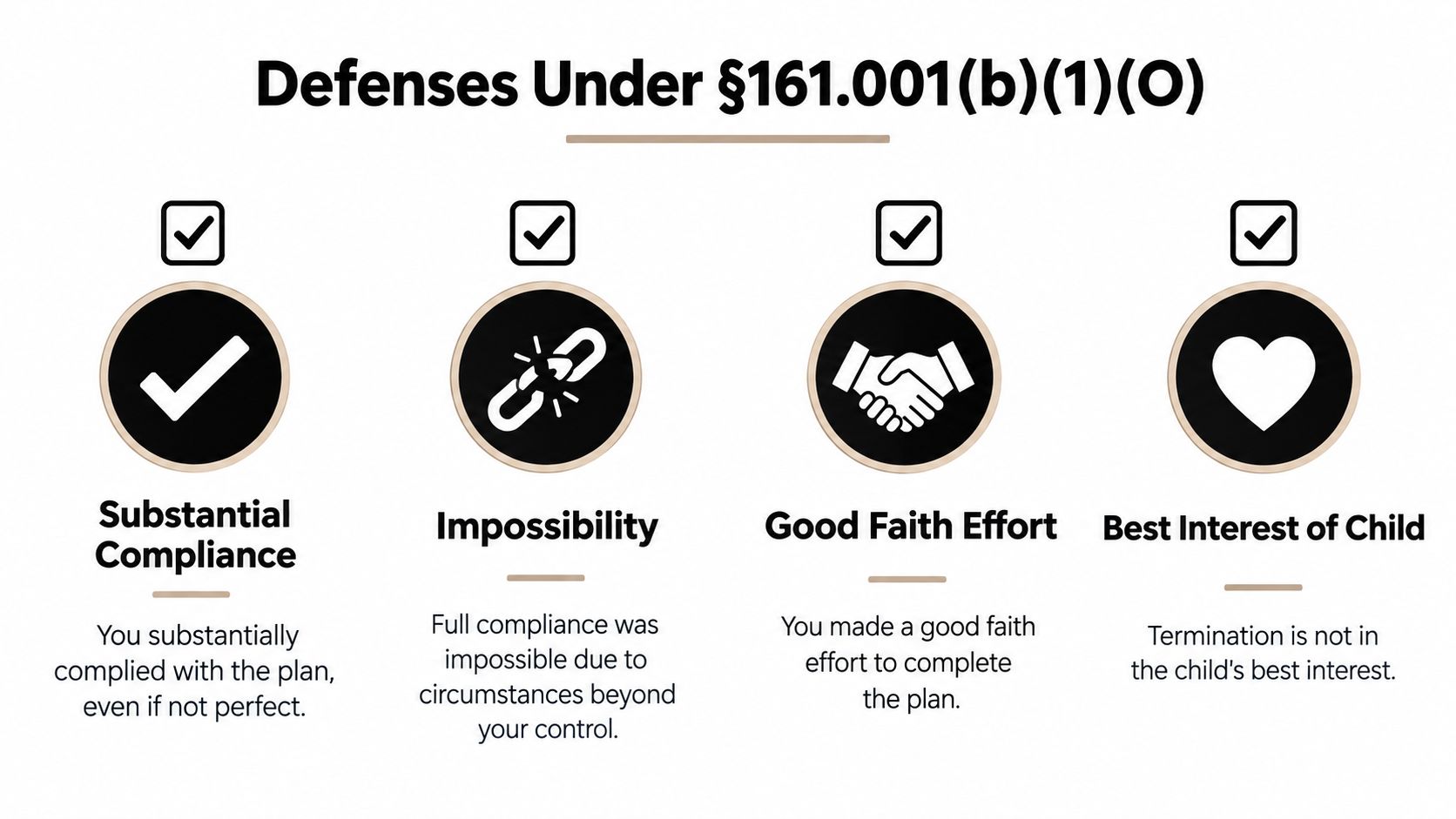
A parent can have a real defense under subsection (O). Texas law recognizes that some parents do not finish every service because they will not, while others cannot, despite trying. If the parent proves by a preponderance of the evidence that complying was impossible through no fault of the parent, and that the parent still made a good-faith effort, the court cannot terminate on that ground alone.
That sounds technical, so put it in plain English. The court is asking two separate questions. Was the task beyond the parent's control? And did the parent keep trying in reasonable ways instead of giving up?
That difference matters.
A missed counseling session looks one way if a parent decided not to go. It looks very different if the provider cancelled twice, the referral was never processed correctly, or the parent was in the hospital and asked to reschedule. The statute leaves room for that kind of reality, but only if the parent can show it clearly.
What this defense really means
"Impossible" does not mean life was hard in a general sense. Courts usually want something more specific. They look for a concrete barrier tied to a specific requirement in the court order.
For example, a parent may have been jailed in a facility that did not offer the ordered class. A parent may have been referred to a program with a long waitlist and no alternate provider. A parent may have lacked transportation, asked for help, and received none. A parent with limited English may have been handed a plan without a working interpreter or clear explanation of what had to be done.
Good faith is the second half of the defense, and it often decides the issue. Good faith looks like calling the provider, saving screenshots, showing up when possible, asking for another referral, completing similar services that were available, or telling the court early that a requirement could not be completed as written. Courts tend to respond better to a parent who kept pushing than to a parent who stayed silent and hoped the problem would sort itself out.
What to document if barriers are real
Paper gives the judge something solid to hold onto. Without it, a real obstacle can sound like an excuse.
Useful records may include:
- Transportation problems: bus delays, repair receipts, ride cancellations, or texts asking to reschedule.
- Service access issues: waitlists, provider messages, intake denials, or notices that a referral wasn't accepted.
- Medical barriers: discharge papers, doctor's notes, prescription records, or proof of hospitalization.
- Incarceration limits: jail records, program completion records, grievance requests for services, or mail logs.
- Language or communication problems: requests for an interpreter, translated materials, or emails showing confusion about instructions.
Written requests matter too. If a task becomes impossible, the parent should ask in writing for a change, a new referral, or clarification. Phone calls help, but emails, texts, jail requests, and letters are much easier to prove later in court.
Here is a simple way to think about it. The service plan works a lot like a checklist handed out in a class. If the school never gives you the textbook, locks the classroom, or changes the assignment without telling you, that does not automatically mean you failed on purpose. But you still need proof that you tried to get in, asked questions, and did what you could with what you had.
Here's a video that may help families think through CPS concerns in a practical way.
Best interest still matters
Even when parents raise this defense, the case usually does not turn on one missed service by itself. The court still has to decide whether termination is in the child's best interest, and that is a separate question.
That point can get lost in the stress of a CPS case. A parent may hear the Department focus heavily on noncompliance and assume the outcome is already set. It is not that simple. The judge must weigh the statutory ground and best interest separately, and families can still challenge both. A discussion of those two parts appears in this Texas CPS quick guide discussing statutory grounds and best interest.
For parents, the practical lesson is this. If a barrier was real, treat it like something you may need to explain to a judge months later. Save the text. Ask for the referral again. Get the doctor's note. Keep the bus receipt. Small records often make the difference between "I tried" and "I proved I tried."
Practical Steps to Protect Your Family
When a service plan is handed to you, the clock doesn't wait for you to calm down. The best response is organized, steady action.
Start with the document itself
Read every paragraph. If a sentence is vague, circle it. If a requirement seems impossible, raise that issue right away and in writing.
Parents sometimes make a costly mistake here. They assume they'll be able to explain later what they thought the plan meant. It's much safer to ask for clarification while the plan is still fresh and deadlines are still manageable.

A practical checklist
- Read for specifics: Look for exact provider names, deadlines, testing rules, and whether the plan says you must complete, begin, or participate in a service.
- Ask for written changes: If you can't meet a condition because of distance, work, illness, or jail restrictions, ask for a written modification rather than relying on a verbal understanding.
- Keep your own file: Save receipts, certificates, discharge papers, screenshots, and emails in one folder. Paper copies help.
- Track visits and calls: Write down who you spoke with, when you called, what was said, and whether you asked for help.
- Show up early: Arrive with enough time to sign in and keep proof that you were there, even if a service later gets canceled.
Communicate like the judge may one day read it
Every text, email, and voicemail may later become part of the story told about you in court. Keep your messages direct and respectful.
Courtroom mindset: Write to your caseworker the way you'd want a judge to see it later. Short, calm, and focused on solving the problem.
Parents can also ask for family team meetings, ask that barriers be addressed on the record, and request review hearings when confusion is growing. If you're dealing with a CPS matter that overlaps with placement or permanency concerns, what if CPS is involved in your adoption case helps explain how those tracks can intersect.
One practical option for case-specific legal guidance is the Law Office of Bryan Fagan, PLLC, which handles Texas family law, adoption, guardianship, and CPS-related matters statewide.
From the Courtroom to a Permanent Home
A finding under this service-plan ground didn't happen in a vacuum. It changed the direction of the case.
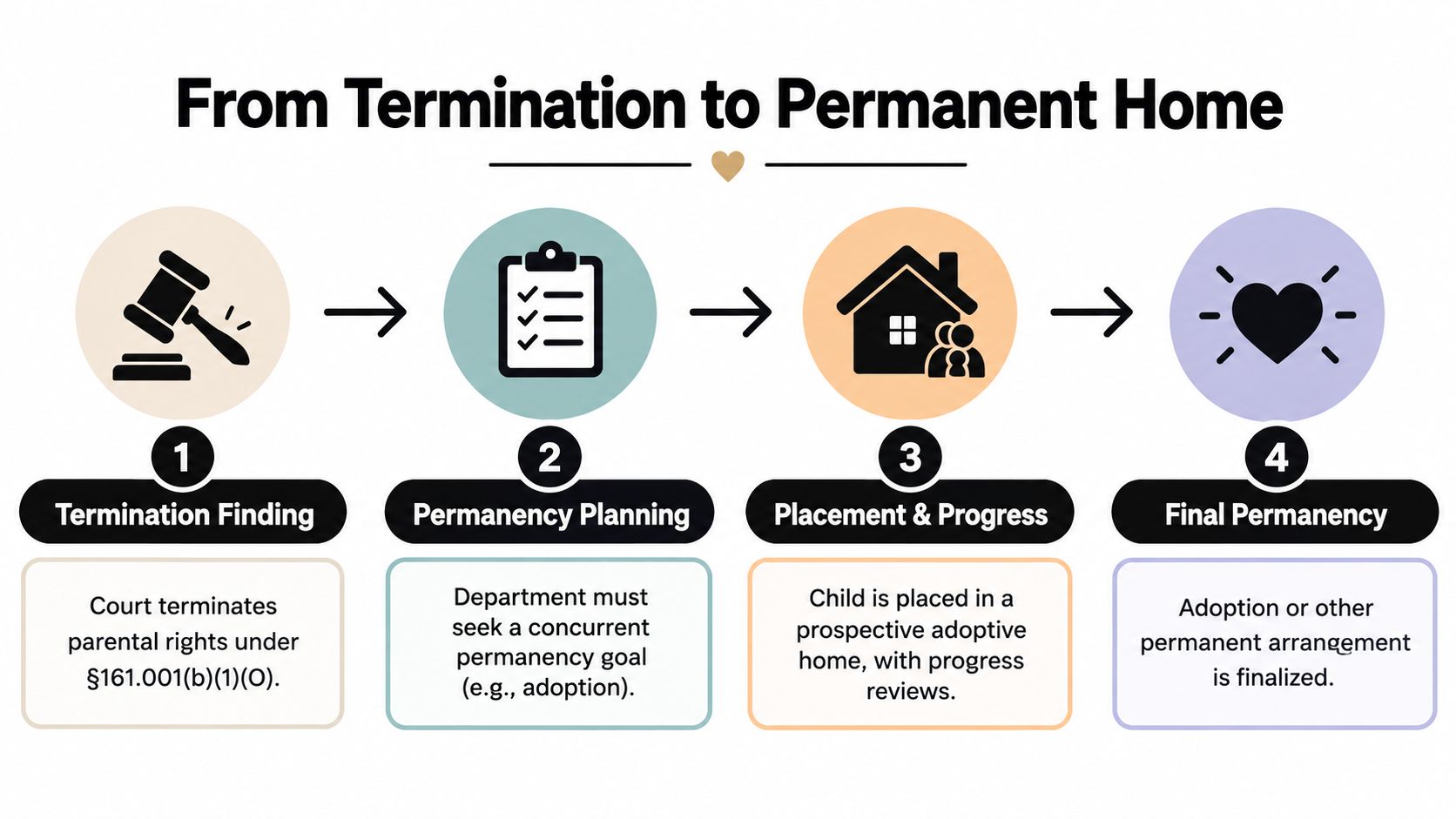
Once a court moves toward termination, the focus often shifts from reunification efforts to permanency planning. Under the broader CPS framework, that can mean relative placement, adoption, or another permanent arrangement built around the child's long-term stability. For some families, that next chapter may later involve adoption procedures under Chapters 162 through 166, including consent issues, placement review, and the final adoption order.
How the case changes after termination becomes real
A parent often experiences the service-plan period as a fight to get the child home. Relatives may experience the same period as uncertainty. Foster parents may experience it as waiting without knowing whether they should emotionally prepare for goodbye or for permanency.
When a termination ground is proven and the court also finds best interest, that uncertainty narrows. The legal system starts moving more decisively toward a permanent home.
The larger lesson for every family in the case
For parents, the lesson is that the service-plan window matters enormously. What you do, what you save, what you ask in writing, and how you respond to barriers can shape whether the court sees a family working toward reunification or moving away from it.
For relatives, this may be the point where guardianship or adoption becomes more concrete. For hopeful adoptive parents, especially in CPS cases, this is often where the legal path begins to align with a child's need for stability and finality.
And for everyone involved, the best-interest standard remains central. Texas courts don't terminate rights to tidy up a file. They must decide whether that profound step serves the child's welfare and long-term security.
If your family is in this window now, don't wait for confusion to become a court record. Questions about service plans, termination risk, relative placement, voluntary relinquishment, guardianship, and adoption procedures are easier to address early than to fix later.
If you're facing a CPS case, worried about a service plan, or trying to understand how termination could affect a kinship placement or adoption path, the attorneys at Law Office of Bryan Fagan, PLLC help Texas families sort through those next steps with clear, practical guidance. You can schedule a free consultation to talk through your deadlines, your documents, and what options may still protect your family or support a stable permanent home for the child.
