 Skip to content
A lot of Texas families arrive at this question in the middle of something emotional and urgent. A grandmother is caring for her grandchild after a CPS case. A stepparent has raised a child for years and wants to adopt. A foster parent is finally close to permanency. A birth parent is trying to understand what the state must prove before rights can be ended.
The phrase Family Code 161.001 grounds for involuntary termination in Texas sounds technical, but the issue is personal. Before many adoptions can move forward, a court has to decide whether a parent's rights should be terminated. That decision can shape a child's future, a family's stability, and the path toward adoption or guardianship.
Texas law gives courts a checklist, but real cases are rarely just a checklist. The practical question families ask is simpler: What facts matter most, and which grounds do courts use together in real life? In many cases, especially CPS cases, the answer involves a pattern of endangerment paired with failure to complete a court-ordered service plan. Understanding that pattern helps hopeful adoptive parents, relatives, and parents facing these cases make better decisions early.
Understanding Involuntary Termination Under Texas Family Code 161.001
A common Texas family story starts like this. A child has been living with an aunt, grandparent, or stepparent for months. Daily life feels settled, but the legal piece is still unsettled. The family wants to know one thing: when can a court end a parent's rights so adoption or another permanent plan can go forward?
Under Texas Family Code § 161.001(b), involuntary termination means the court ends the legal parent-child relationship without the parent's consent. That is one of the most serious decisions a Texas judge can make, so the court has to answer two separate questions. First, did someone prove at least one statutory ground for termination? Second, did someone also prove that termination is in the child's best interest, as explained in this Texas court opinion?

Why the law uses a two-part test
The two-part rule protects both the child and the parent. A court needs a legal reason listed in the statute, and it also needs a child-focused reason for ending the relationship. One without the other is not enough.
A simple way to picture it is a gate with two locks. One lock is the statutory ground. The other lock is best interest. Both have to open before the court can terminate rights.
Texas also requires a high level of proof in these cases. The evidence must be strong enough to leave the judge with a firm belief or conviction, not just a suspicion that termination might be the better outcome.
Practical rule: One proven ground can support termination if the court also finds that termination serves the child's best interest.
That matters because families often assume CPS or a private petitioner must prove several grounds. The statute lists 21 grounds, but many real cases turn on one or two strong ones. In Texas litigation, the pattern that appears often is endangerment paired with failure to complete a court-ordered service plan. That pairing shows up repeatedly because it gives the court both a backward-looking picture of harm or risk and a forward-looking picture of whether the parent corrected the problem. Families who want a fuller overview of that process often start with this guide on Texas termination of parental rights.
Why this matters for adoption
For relatives and stepparents, this section of the Family Code is often the hinge point between caregiving and legal permanence. If a grandmother has been doing the school pickups, doctor visits, and bedtime routine, termination may be the step that clears the path to adoption. In a stepparent case, it may be the step that lets the child's daily parent become the child's legal parent too.
The way grounds are combined can shape the outcome. In CPS cases, endangerment findings often appear with service-plan failure because the court is looking at both past conduct and whether the parent used the reunification chance the court provided. In kinship and stepparent cases, the pattern may look different, but the same basic rule applies. The judge must connect the statutory checklist to the child's real life, safety, and long-term stability.
Families also run into older case citations that use different numbering for the statute. Texas reorganized this part of the code in 2015, so older opinions may refer to § 161.001 in an earlier format. The numbering changed, but the basic framework stayed the same: a statutory ground plus best interest.
How Texas Courts Apply the Clear and Convincing Evidence Standard
A judge doesn't terminate parental rights because one person makes an accusation. The court looks for a reliable record. In Texas, clear and convincing evidence is stronger than the standard used in many civil disputes, but it is not the criminal standard of beyond a reasonable doubt.
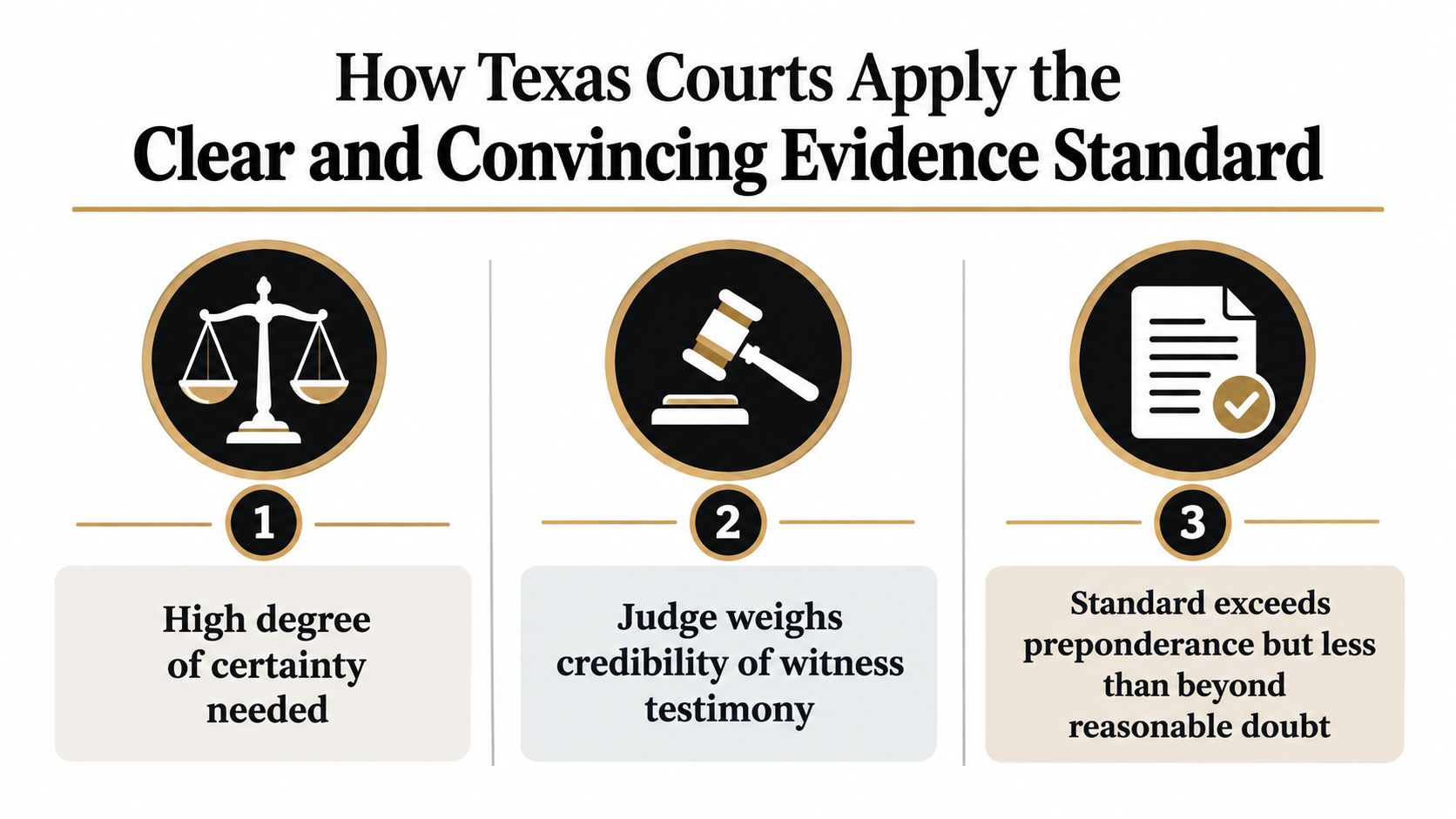
One helpful way to think about it is this. If ordinary civil proof means, “this is probably true,” clear and convincing evidence means, “the court has a strong, settled belief this is true.” Texas courts applying § 161.001(b) follow that higher burden for both the statutory ground and the best-interest finding, as explained in this Texas judicial opinion.
What judges usually want to see
A strong termination case usually has more than one type of proof. Courts often focus on how the evidence fits together:
- Records that match the story: Court orders, DFPS records, treatment records, or other documents can show whether concerns were ongoing rather than isolated.
- Witness testimony with specifics: Judges listen closely for dates, observations, and firsthand details instead of broad claims.
- Conduct over time: Repeated choices often matter more than one disputed event.
That's one reason isolated allegations often aren't enough. The evidence usually needs to show a pattern, especially where endangerment is alleged.
Later in the case, families often learn that Termination of Parental Rights Before Adoption is the necessary first step in most adoptions. That isn't a slogan. It's a legal sequence. The court must deal with parental rights before it can permanently create a new parent-child relationship.
A short visual summary helps many families understand the proof standard:
Why the two findings stay separate
Even when a statutory ground looks strong, the court still separately asks whether termination is best for the child. Those aren't the same question. A parent may have serious deficiencies, but the court still has to examine the child's needs, placement, safety, and long-term stability.
Good documentation doesn't replace human judgment. It gives the judge a solid basis for using it.
If you're trying to understand how termination fits into the larger adoption framework, this guide to Texas adoption and the Family Code helps connect the legal steps in plain language.
The 21 Statutory Grounds Explained in Plain English
A grandmother has been raising her grandson for months. CPS is involved. The child's parent has missed visits, ignored services, and keeps returning to the same unsafe home and the same dangerous people. At that point, relatives usually do not need a law school outline. They need a clear way to sort the statute into real-life categories.
Texas Family Code § 161.001(b)(1) lists 21 statutory grounds for involuntary termination. The full list can feel long and technical, so it helps to read it like a checklist with themes. One group asks whether the parent stayed involved. Another asks whether the child was exposed to danger. Another asks whether the parent followed court-ordered steps meant to make reunification possible.
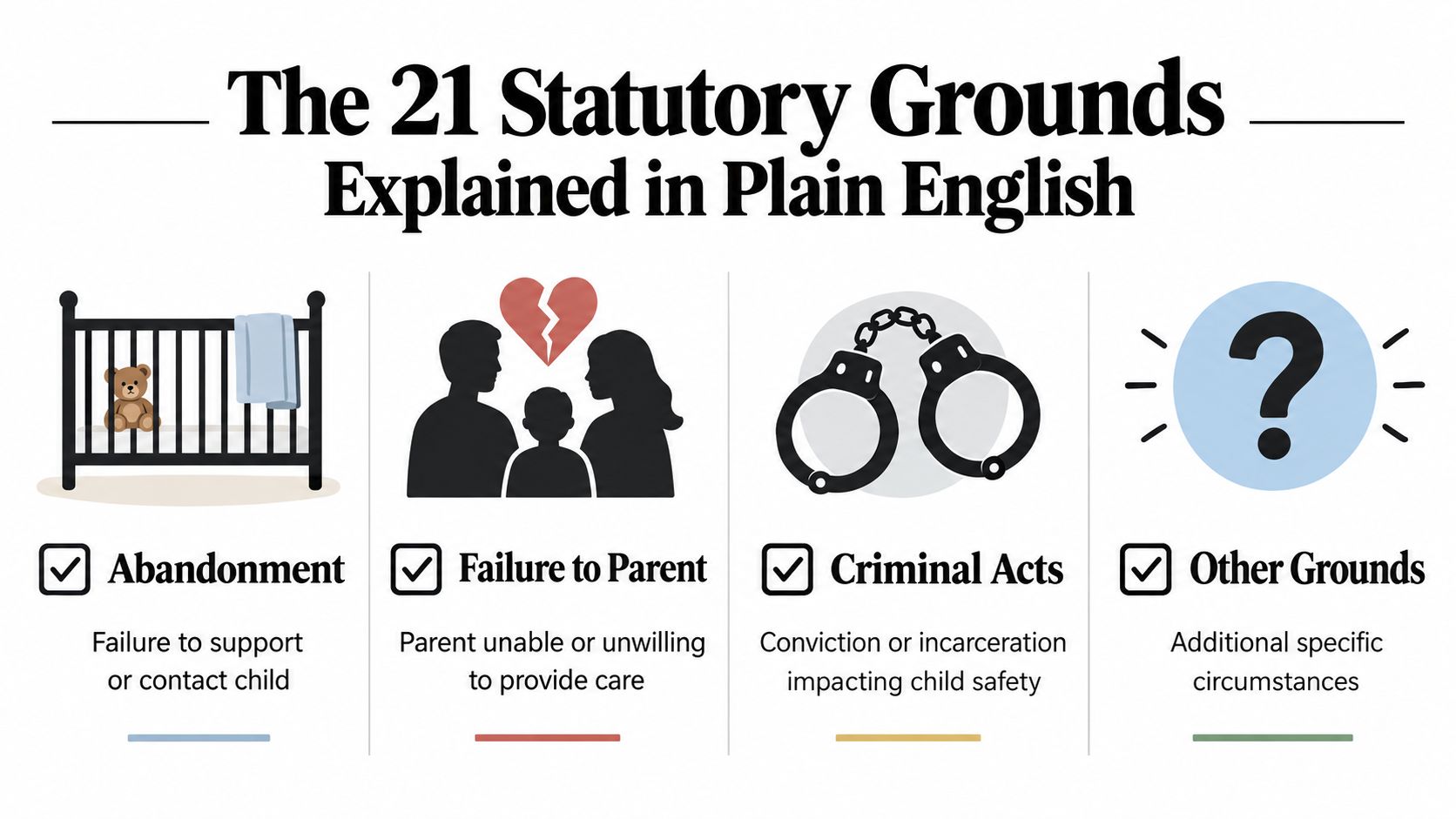
Abandonment and failure to support
Some grounds focus on absence. In plain English, the court asks whether a parent left the child, stayed away, or failed to provide support when able to do so.
A common family pattern looks like this. A child ends up with grandparents, an aunt, or the other parent. The absent parent calls once in a while, promises help, then disappears again. School pickup, doctor visits, clothes, food, and day-to-day care all fall on someone else. Those facts can fit one of the abandonment or nonsupport grounds.
These cases are not always dramatic. Sometimes they are defined by long silence and little follow-through.
Endangerment and unsafe living conditions
This group matters in many Texas termination cases because it gets at the central question of safety. Subsection (D) focuses on dangerous conditions or surroundings. Subsection (E) focuses on a parent's conduct or pattern of behavior. The statutory text appears in FindLaw's text of Texas Family Code § 161.001.
That difference can confuse families, so here is a simpler way to picture it. Subsection (D) asks, “What kind of environment was the child living in?” Subsection (E) asks, “What kind of choices did the parent keep making?” A dirty home by itself may not tell the whole story. A home with drug activity, violence, untreated addiction, or repeated exposure to unsafe adults points to a much more serious pattern.
A parent does not have to strike the child with his or her own hands for a court to find endangerment. Repeatedly bringing a child around violence, meth use, drunk driving, sexual abuse risks, or unstable caregivers can be enough if the evidence shows real danger to the child's physical or emotional well-being.
This is also the cluster that often anchors the whole lawsuit. In practice, CPS cases often start with endangerment concerns, then build outward from there.
Court orders, service plans, and measurable noncompliance
Another set of grounds focuses less on the original danger and more on what happened after the case began. The best-known example is subsection (O), which applies when a parent fails to comply with a court order that specifically sets out the actions needed to regain the child after the child has been in DFPS conservatorship for the required period.
Families often understand this ground fastest because it is concrete. Did the parent take the drug tests? Finish treatment? attend counseling? keep stable housing? complete parenting classes? maintain contact with the caseworker? Judges often see written records, attendance logs, test results, discharge papers, and missed appointments.
That is why subsection (O) is so often paired with endangerment grounds in real litigation. Endangerment explains why the child was removed in the first place. Service-plan failure shows the court that the parent did not correct the problems after getting a clear road map. In stepparent, kinship, and foster-to-adopt pathways, that pairing often shapes whether the case moves toward adoption rather than another round of delay.
Criminal conduct, substance issues, and other specific grounds
Some statutory grounds address narrower but still important situations. They include certain criminal conduct, substance-related circumstances, serious failures involving the child, and repeat-case findings that carry over from an earlier termination history.
One example families often miss is subsection (M). If a parent previously had rights terminated based on endangerment findings under (D) or (E), that earlier result can matter in a later case involving another child, as noted in DFPS handbook guidance on termination grounds.
That can feel harsh at first glance. Texas courts view it as a warning sign that a past pattern may not have changed.
A practical way to read the list
The 21 grounds make more sense if you read them like a case story rather than a memorization exercise. What danger existed. Who exposed the child to it. What did the court require to fix it. What changed, and what did not.
For hopeful adoptive parents and relatives, that framework usually answers the question more clearly than a bare list of letters and numbers. It shows why some grounds appear only occasionally, while others, especially endangerment and failure to complete services, show up together again and again in Texas courtrooms.
Which Grounds Texas Courts Use Most Often and Why They Are Combined
Families usually don't ask, “What are all 21 grounds?” They ask, “Which ones are driving cases right now?” That question matters in CPS cases, foster-to-adopt matters, stepparent adoptions with prior state involvement, and relative adoptions after a long caregiving arrangement.
Texas guidance points in a clear direction. Endangerment under subsections (D) and (E) is identified as the most common ground in DFPS materials, and Texas commentary also describes endangerment as the most common termination basis in practice, as discussed in this overview of Texas termination litigation.
Why these grounds are often paired
Courts often see the same pattern. The case begins with danger to the child, then shifts into a service plan designed to fix that danger. If the parent doesn't complete the plan, the legal theory becomes stronger and easier to document.
That pairing matters because each ground does different work:
- Endangerment under (D) or (E): Explains why the child wasn't safe.
- Failure to comply under (O): Shows the parent didn't complete the steps the court required for reunification.
- Prior D or E findings under (M): Can become highly significant in a later case involving another child.
Common Ground Pairings in Texas Termination Cases
| Fact Pattern | Primary Ground | Often Paired With | Evidence Focus |
|---|---|---|---|
| Unsafe home, violence, dangerous caregivers | Endangerment under (D) | Service-plan noncompliance under (O) | Home conditions, witness testimony, court-ordered tasks left incomplete |
| Repeated risky behavior, drug use, criminal activity | Endangerment under (E) | Service-plan noncompliance or substance-related failures | Pattern of conduct, treatment records, missed tests, ongoing instability |
| Earlier case with D or E findings, new child now involved | Prior termination under (M) | Fresh endangerment allegations or noncompliance | Prior orders, new risk evidence, whether old conduct connects to current safety concerns |
| Child cared for long-term by relatives, absent parent offers little support | Abandonment or failure to support | Endangerment if unsafe choices are also present | Support history, contact history, caregiver records |
Why patterns matter more than one event
Texas courts often look beyond a single incident. A parent might argue, “That happened once,” but the judge may focus on the larger pattern. Under subsection (E), a court can examine a parent's course of conduct, not just direct injury.
Families often get stuck on one dramatic event. Courts usually look harder at what kept happening before and after it.
This is also why old cases can matter. If a parent has a prior D or E finding, that history may shape a new case in a serious way, a concern discussed in recent Texas case materials on prior-conduct and termination issues.
From Petition to Permanency How Termination Connects to Adoption and Guardianship
A Texas grandmother may already be doing everything a parent does. School pickup. Doctor visits. Bedtime routines. Yet until the court changes the legal relationship, she can still be living with daily uncertainty about who has final authority and what permanent plan is available.
Termination is often the doorway, not the finish line. In many Texas cases, the ground that supports termination also shapes what permanency option makes sense next. For example, a CPS case built on endangerment plus failure to complete a service plan often points the court toward a more lasting placement, because the judge is not just looking at one problem. The judge is looking at whether the unsafe pattern continued even after the parent was given a road map to fix it.
That pattern matters in private cases too. A stepparent adoption may move more directly if one parent is absent and the legal notice issues are handled early. A kinship case may take longer if there are paternity questions, prior court orders, or relatives trying to decide whether adoption is the right final step.
How the case usually unfolds
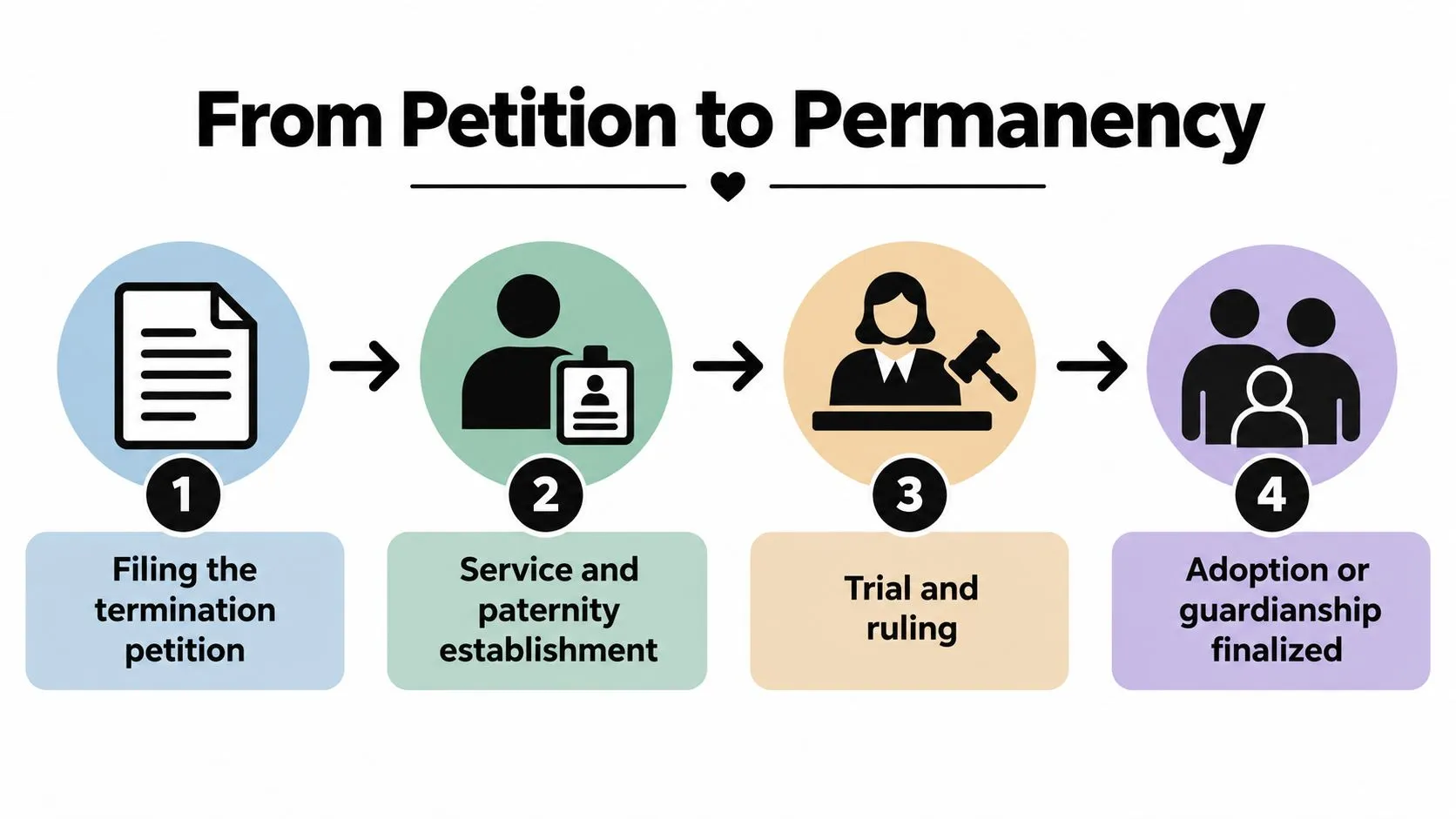
A joined termination and adoption case often follows a practical sequence:
- A petition starts the case. The filing may ask for termination, adoption, or both in the same lawsuit.
- Notice and parentage issues are sorted out. The court must address service, alleged fathers, and paternity questions before a final order.
- The judge decides termination first. The court hears evidence on the alleged ground, best interest, and whether the legal standard has been met.
- The court addresses permanency. If termination is granted, the case can proceed to adoption or another long-term arrangement.
Texas law sets an important timing rule here. In a suit that joins termination with adoption, the court must terminate the parent-child relationship when it renders the adoption order, and it must make separate best-interest findings for termination and adoption under Chapter 162 of the Texas Family Code.
Adoption usually requires more than paperwork
Families are often surprised that finalizing an adoption is not just a matter of signing forms after termination. The court may require an adoption evaluation unless that requirement is waived under the law discussed earlier. The judge is checking whether the proposed adoptive home is ready for the long haul, not just whether it is better than the child's past situation.
A child's voice can matter too. A child who is 12 or older must consent to the adoption in writing or in court under Texas Family Code § 162.010(c). In a stepparent or kinship case, that moment can be emotional because the child is not only receiving a new order. The child is also confirming a relationship that may have already been functioning like family for years.
Alleged fathers can change the timeline
Many delays happen here.
If an alleged father has not been properly identified, located, served, or addressed through the paternity process, a case that otherwise seems ready can stall. Texas child welfare guidance explains that an alleged father's consent may not be required in some circumstances if he is served and does not respond as required, or if the child is under age 1 and he did not register with the paternity registry, subject to the statutory conditions described in Texas consent to adoption guidance.
For older children, petitioners still need real diligence in trying to identify or locate an alleged father whose whereabouts are unknown. That is a common pressure point in relative and stepparent adoptions.
Adoption and guardianship solve different problems
Adoption creates a new permanent legal parent-child relationship. Guardianship usually gives an adult authority to care for a child without fully replacing the legal parent-child bond. Those paths can look similar at first because both are about safety and stability. They lead to different legal results.
For some relatives, guardianship of a minor in Texas may be the better first step while the family decides whether termination and adoption are realistic, necessary, or emotionally appropriate. That can happen when a child needs immediate structure but the facts do not yet support a final break, or when the family wants to stabilize school, medical care, and daily decision-making before pursuing permanency through adoption.
A foster family may wait while the court finishes the termination case. A stepparent may be ready to adopt soon after the legal parent's rights are addressed. A grandparent may begin with temporary stability and move toward kinship adoption later.
The path is different in each case, but the question underneath is usually the same. What legal arrangement gives this child the safest and most dependable future?
Common Defenses Remedies and Best Interest Considerations
When termination is requested, families often assume the ground listed in the petition decides everything. It doesn't. The court still examines the evidence carefully, and families still have options for response, correction, and alternative planning.
Challenging the evidence
One common defense is that the proof is too thin, too old, or too disconnected from the child's current situation. If the petition relies on stale conduct, a parent may argue that the court should look at what has changed since then. Records showing completed treatment, stable housing, consistent visitation, or negative drug tests may help counter a one-sided picture.
Another issue is whether the evidence really proves the specific ground alleged. A messy life isn't automatically legal endangerment. A missed appointment isn't automatically enough to prove a pattern. The legal fit matters.
Bring records early. Waiting until the last hearing to gather paperwork can make a hard case harder.
Best interest is its own question
Even when a statutory ground is disputed, the best-interest analysis stays child-centered. Judges often look at the child's need for safety, routine, emotional stability, and a permanent home. They may also consider whether the proposed placement is meeting the child's daily needs and whether the child has formed a healthy bond there.
That matters in relative and kinship cases. A court may hesitate to terminate rights if a less permanent arrangement would still protect the child. In other situations, adoption may provide the clearest long-term stability.
Remedies and practical options
Families should discuss more than one path with counsel. Depending on the case, options may include:
- Defending the petition: Challenge whether the petitioner met the burden of proof.
- Improving compliance quickly: If a service plan is in place, every completed requirement matters.
- Considering appeal or post-judgment review: Some cases turn on whether the proof met the heightened standard.
- Exploring guardianship or kinship care: Adoption isn't the only child-focused outcome in every case.
- Reviewing prior case effects: Old D or E findings can have serious consequences in a later case and should be examined carefully.
The right approach depends on the family's history, the child's present needs, and the strength of the evidence the court will hear.
Taking the Next Step Toward Adoption With Compassionate Legal Guidance
Understanding Family Code 161.001 grounds for involuntary termination in Texas gives families something valuable in a stressful moment. It turns a confusing legal phrase into a practical set of questions. What ground is being alleged. What proof exists. Is the child's best interest being addressed separately. Is adoption, kinship placement, or guardianship the right next step.
For hopeful adoptive parents, stepparents, relatives, and birth parents, early legal guidance can make the process more manageable. It helps families prepare for evaluations, gather records, address paternity questions, and understand how termination fits with adoption under Chapters 162 through 166. It also helps families avoid a common mistake, treating termination as only a statutory checklist instead of a child-centered court process.
If you're weighing kinship adoption, stepparent adoption, CPS permanency, or a guardianship option, it helps to get advice that matches your exact stage of the case. Some families need help reviewing a service plan. Others need help preparing a joined termination and adoption petition. Others need a realistic assessment of whether the evidence supports termination at all.
The Law Office of Bryan Fagan, PLLC is one option Texas families may consider for adoption and guardianship matters, including help with applications, evaluations, and court proceedings. The firm serves families in Houston, Dallas, Austin, San Antonio, and through statewide virtual consultations.
If you're preparing for the next step, bring the basics to a consultation: court papers, any service plan, prior orders, records of support or contact, and questions about the child's current placement. Clear answers usually start with organized facts.
If your family is trying to understand termination before adoption, kinship care, or guardianship, the attorneys at Law Office of Bryan Fagan, PLLC help Texas families handle those legal steps with clear guidance and compassion. We can help you evaluate the grounds being alleged, understand how termination connects to adoption, and prepare for the court process with your child's best interests at the center.

