
A man sits across from an adoption professional, reading a form that could affect a child's future. He may be unsure whether he's the biological father, supportive of the adoption plan, or trying to understand what signing means. The birth mother may also feel pressure, hope, grief, or all of those emotions at once. These decisions deserve patience and clear legal advice.
Texas Family Code § 161.106 addresses a specific document called a waiver of interest in a child. It can help an adoption case move forward when a man is disclaiming an interest in the child and giving up notice or service in a lawsuit involving the parent-child relationship. But it isn't the same document as every form used in adoption, and signing it can have permanent consequences.
This guide explains the family code 161.106 waiver of interest in a child Texas families may encounter, including who may sign it, how the document must be completed, what “irrevocable” means, and how it compares with relinquishment and court-ordered termination. It also explains how the waiver may fit into private adoption, stepparent adoption, relative adoption, and permanency planning.
The child's best interests remain central. A correct document can support a stable plan, but an incorrect or misunderstood document can create delays and serious legal problems. Understanding the difference helps birth parents, putative fathers, relatives, and hopeful adoptive parents make informed decisions with greater confidence.
Introduction to the Waiver and Why Texas Families Use It
A birth mother may have chosen an adoptive family and begun preparing for placement. Then someone asks whether the child's possible father will sign a waiver. The word “waiver” can sound simple, but the decision may carry lasting effects. A putative father may wonder whether he's giving up a chance to parent, whether he's admitting paternity, or whether he'll receive notice of a court case.
Those questions are reasonable. Adoption paperwork often uses familiar words in a legal way, and family members may hear different terms used for similar goals. A person who is considering a waiver should understand the document before signing, not after the adoption case has already moved forward.
Texas Family Code § 161.106 has long provided a way for a man to sign a sworn statement disclaiming any interest in a child and waiving notice or service of citation in a lawsuit affecting the parent-child relationship. The statute allows the document to be signed before the child is born, which can matter when a family is planning adoption before delivery.
A compassionate legal process protects more than paperwork. It protects the child's need for safety and permanence while respecting the rights and emotions of the adults involved.
The waiver may be relevant when a putative father doesn't intend to establish a legal relationship with the child. It may also appear in an adoption plan involving a licensed child-placing agency or another permanency arrangement. Still, it isn't a universal substitute for consent, relinquishment, or a termination order.
The pages ahead use plain language to explain where the waiver fits. You'll see practical examples, a comparison of common legal documents, and a step-by-step look at the records and court procedures that may accompany an adoption case. The purpose isn't to push anyone toward signing. It's to help each person understand the choice and seek advice that respects the child, the birth family, and the hoped-for family structure.
What a Waiver of Interest in a Child Means Under Texas Law
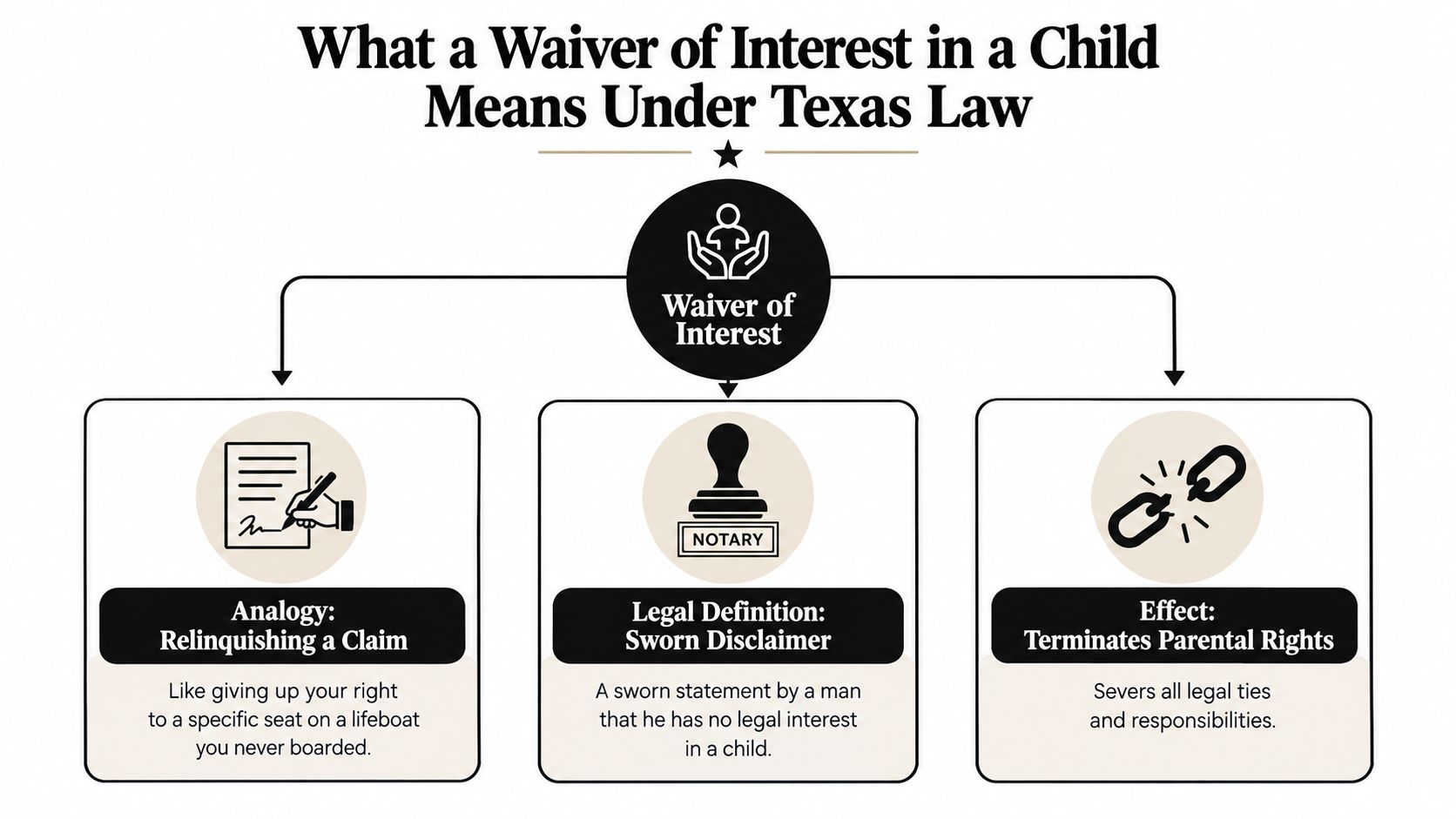
Think of the waiver as a formal statement about a legal claim. In everyday life, someone might tell a group that they aren't claiming a reserved seat. In a family law case, the statement is made under oath and concerns a possible legal interest in a child.
Under Texas Family Code § 161.106, a man may sign an affidavit stating that he has no interest in the child. The affidavit also waives notice and service of citation in any suit affecting the parent-child relationship. In plain English, he is telling the court that he isn't claiming a legal role in the child and doesn't require the usual formal notice of that type of lawsuit.
The waiver isn't the same as denying paternity
A person may confuse “I have no interest” with “I'm not the father.” Those statements don't mean the same thing. A waiver under § 161.106 is a legal disclaimer of interest and a waiver of notice. It functions as a legal mechanism, not as a genetic test result or a standalone declaration that biological paternity is impossible.
The statute also includes important limits. The affidavit may be used if the person who signed it later tries to establish an interest in the child. However, another person, a licensed child-placing agency, or the state can't use the affidavit to establish paternity.
That distinction matters. The document may prevent the signer from later asserting an interest, but it doesn't give someone else a shortcut to prove that he is the child's father.
What “irrevocable” means
The statute states that the waiver is irrevocable under subsection (f). A person shouldn't sign it assuming there will be an automatic opportunity to withdraw it later. The document may support a permanency plan, but it still must be prepared, signed, witnessed, verified, and used in the right legal setting.
Families considering Stepparent Adoption in Texas should be especially careful not to treat this waiver as a universal answer. A stepparent adoption has its own consent and termination questions, and the other legal parent's status must be addressed separately.
Who May Sign and the Requirements Texas Courts Require
A Texas court doesn't evaluate only the signer's intention. It also looks at whether the document follows the statutory formalities. A family may have a clear agreement, but a missing witness, incomplete verification, or improper signature can create a problem in the adoption file.
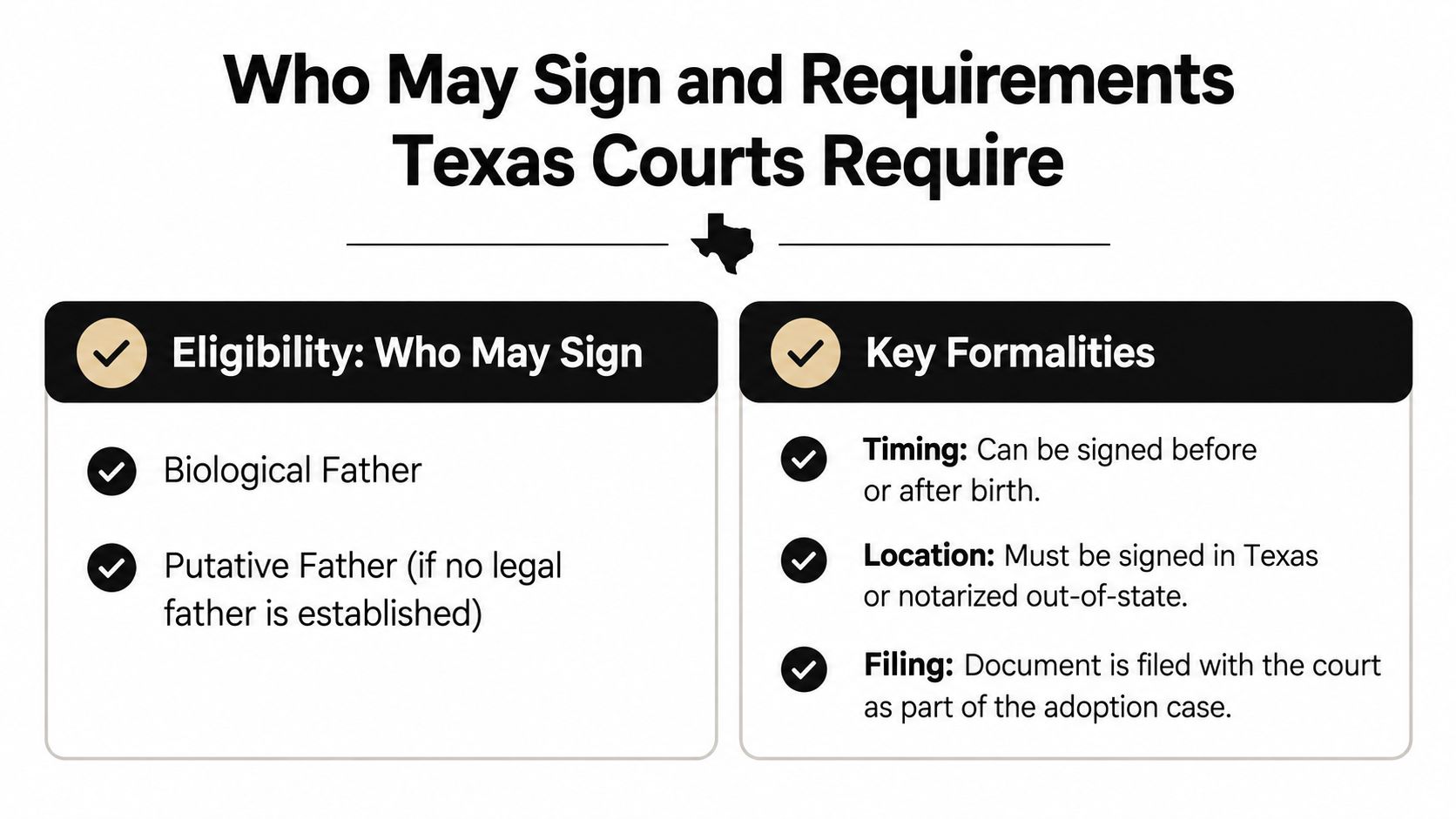
The statute permits the affidavit to be signed before the child's birth. That can help families plan ahead, but early timing doesn't reduce the importance of informed consent. The signer should understand the document and its consequences before putting pen to paper.
A practical signing checklist
Before the affidavit is submitted, confirm the following points:
- Correct signer: The affidavit is signed by the man who is disclaiming an interest in the child. The statute requires his signature even if he is a minor.
- Personal execution: The man signs the document himself. Someone else shouldn't sign on his behalf as a substitute.
- Two credible witnesses: Two credible witnesses must observe and authenticate the signing as required by the statute.
- Verification: The affidavit is verified before an authorized officer, such as an officer able to administer the required oath or acknowledgment.
- Clear identity: Names and identifying details should match the rest of the adoption and court records.
- Proper filing: The completed document should be placed in the court file in the manner required for the case.
A putative father may sign before birth, after birth, or at another stage that fits the case. The important question isn't whether the form was signed early. It's whether the document was completed in a legally valid way and accurately reflects the signer's decision.
How the document fits into the larger adoption file
The waiver is only one part of a Texas adoption case. Courts may review adoption applications, background information, interviews, home evaluations, and other reports addressing the child's safety and best interests. The Texas Department of Family and Protective Services describes a home study as a structured review that gathers information about issues relevant to placement and safety, including the home and relationships affecting the child. Texas Department of Family and Protective Services home study information
A home study doesn't replace a valid waiver, and a waiver doesn't replace a home study when the court requires one. Families should keep the documents together as one legal story. The court needs to understand who the parents are, what consent or termination documents exist, where the child will live, and why the proposed arrangement serves the child's best interests.
For more help identifying which parent or alleged parent must provide consent, review who must provide consent to a Texas adoption. Early review can reveal gaps before a hearing is scheduled.
Legal Effects Limits and Why Irrevocability Matters
The most important word in § 161.106 may be irrevocable. Once a valid waiver is signed, the signer generally can't treat it like a temporary promise that can be canceled whenever circumstances change. A person may experience new emotions, family pressure, or uncertainty later, but those changes don't automatically undo the document.
The affidavit also waives notice and service of citation in a suit affecting the parent-child relationship. Service of citation is the formal process used to notify someone about a lawsuit. By waiving it, the signer gives up a procedural protection that would otherwise require formal notice of the case.
The waiver's use and its boundaries
Texas law states that the affidavit may be used if the affiant later tries to establish an interest in the child. This creates a cause-and-effect relationship. If the signer later attempts to claim a legal interest, the earlier sworn statement may be presented to address that claim.
The statute places a boundary around that use. Another person, a licensed child-placing agency, or the state can't use the affidavit to establish paternity. The waiver may affect the signer's ability to assert an interest, but it doesn't independently prove who the biological or legal father is.
Irrevocable doesn't mean unimportant. It means the decision deserves careful review before signing, not casual correction afterward.
How termination and finality enter the picture
Texas appellate practice recognizes that a court may terminate parental rights when a parent has executed an unrevoked or irrevocable affidavit of relinquishment and termination serves the child's best interest. The waiver and a relinquishment affidavit aren't identical documents, so the court must examine the specific paperwork and legal grounds in the case.
Once parental rights are validly terminated, the parent-child legal relationship ends for custody, visitation, and other rights. That's why adoption and stepparent adoption cases often focus closely on consent, relinquishment, termination pleadings, and the resulting orders. A family should never assume that signing one affidavit automatically completes every step required for adoption.
Texas law also creates a strict deadline for challenging a termination order based on an affidavit of relinquishment. A validity challenge is generally barred after the sixth month following the order's signing. Texas law on challenges to termination orders based on relinquishment affidavits Because finality matters so much, anyone considering a waiver or relinquishment should obtain legal advice before signing and act promptly if a concern arises.
For a closer look at the separate relinquishment document, see whether an affidavit of relinquishment in Texas can be revoked.
Common Scenarios for Birth Parents Putative Fathers and Relatives
Legal forms become easier to understand when connected to real family situations. The same waiver can have a different role depending on who is involved, what rights have already been established, and what the child needs.
A putative father with uncertain paternity
A man learns that he may be the father of an unborn child. He doesn't plan to parent and supports the birth mother's adoption plan. He may be asked to sign a § 161.106 affidavit before the birth, after receiving an explanation of the document and completing the required witnessing and verification.
That choice may help address his potential claim to notice. It doesn't turn the affidavit into a paternity test, and it doesn't automatically resolve every consent or termination issue. If he has questions about whether he should claim parentage, he should get independent legal advice before signing.
The Texas Putative Father Registry may also be relevant to understanding how a possible father communicates a claim of parental interest. The right path depends on the facts, not on which form appears fastest.

A birth parent working with an agency
A birth mother may work with a licensed child-placing agency and choose an adoptive family. She may hear the word “waiver” used in connection with the possible father, while her own documents involve consent or relinquishment. Those forms serve different purposes.
Her decision deserves the same care as the father's. She should understand whether the adoption is open or closed, what communication agreements may exist, and which rights the court order will address. Promises between adults can be meaningful, but the legal documents and court orders control enforceable rights.
Relatives caring for a child
A grandparent or other relative may care for a child whose parent is absent. The relative may hope to provide a permanent home, but the parent's absence doesn't automatically eliminate parental rights. The court may need to determine whether consent is available, whether a waiver applies, or whether a termination case is necessary.
A kinship caregiver should gather records showing the child's living arrangement, school or medical involvement, and family relationships. The court's focus remains the child's safety, stability, and best interests, while preserving family connections when the law allows.
How the Waiver Compares to Relinquishment and Termination Orders
Families often use “waiver,” “relinquishment,” and “termination” as if they describe the same act. They don't. One is a sworn disclaimer, another is a parent's formal surrender of parental rights, and the third is a court's order ending those rights.
| Document Type | Purpose and When Used | Key Legal Effect |
|---|---|---|
| Waiver of interest | Used by a man who disclaims an interest in the child and waives notice or service in a suit affecting the parent-child relationship. It may be signed before birth. | The waiver is irrevocable under § 161.106 and may be used if the affiant later tries to establish an interest. It doesn't let another person or agency establish paternity. |
| Affidavit of relinquishment | Used when a parent formally relinquishes parental rights as part of an adoption or termination plan. | An unrevoked or irrevocable relinquishment affidavit may support termination when termination is in the child's best interest. The exact legal effect depends on the document and court order. |
| Court-ordered termination | Requested when parental rights must be ended through a judicial proceeding. | A valid termination order ends the legal parent-child relationship for custody, visitation, and other rights. |
When a waiver may not be enough
For a stepparent adoption, the child's other legal parent generally must consent or have parental rights terminated before the adoption proceeds. The stepparent doesn't replace the spouse who remains the child's parent just because the couple is married.
Texas law also requires a child who is 12 or older to consent to the adoption in writing or in court, unless the court waives that requirement. Texas stepparent adoption requirements and child consent information These details show why choosing the right document matters. A waiver from a possible father may address one issue, while the legal parent's consent, termination, or the child's own consent addresses another.
Relative adoption can raise different questions about parents, existing orders, and family placement. Families should review Relative and Kinship Adoption in Texas when a grandparent, aunt, uncle, or another relative is considering a permanent legal relationship.
The safest approach is to identify every person with a possible legal claim before selecting a form. Filing the wrong document can cause delay, confusion, or a challenge that could have been prevented through early review.
Next Steps Forms Proof and Getting Compassionate Legal Guidance
A family considering a § 161.106 waiver should begin by collecting the documents that explain the child's legal history. That may include the child's birth information, existing court orders, paternity records, adoption pleadings, and any signed consent, relinquishment, or waiver documents. The exact records depend on the case, but missing information can make it harder to identify the proper legal path.
The waiver should be reviewed for the required signature, two credible witnesses, verification before an authorized officer, and accurate identifying information. The timing should also be recorded, especially when the affidavit was signed before birth. A lawyer can compare the affidavit with the adoption petition and determine whether the paperwork addresses the right person and the right legal issue.
Proof beyond the affidavit
Texas adoption cases may include personal interviews, home evaluations, and assessments of the child's relationships with the adults involved. These reports help the court evaluate safety, placement, family connections, and the child's best interests. A waiver may address notice or a claimed interest, but it doesn't answer every question the court must consider before finalization.
Families should also keep their emotional needs in view. A birth parent may need independent advice. A putative father may need time to decide whether he wants to assert parentage. A relative may need help balancing family unity with the child's need for a dependable legal home.
The Law Office of Bryan Fagan, PLLC helps Texas families with adoption and guardianship matters, including preparation, home-study coordination, court filings, and finalization. The firm offers virtual consultations statewide, which can make it easier for families in Houston, Dallas, Austin, San Antonio, and surrounding communities to discuss a waiver before signing.
The next step is a focused legal review, not a rushed signature. Bring the proposed affidavit and any adoption or court documents to a consultation so an attorney can explain what the waiver does, what it doesn't do, and whether another form or court order is required.
If you're considering a Family Code § 161.106 waiver, Law Office of Bryan Fagan, PLLC can review the paperwork and help you understand the adoption, relinquishment, or termination process. Schedule a free consultation to discuss your family's situation and take the next step toward a safe, stable plan for the child.
