 Skip to content
A preferential setting is a procedural tool that moves a Texas termination case forward on the court's calendar, giving it priority over ordinary civil cases once discovery is complete and the child becomes eligible for adoption. Under Texas Family Code § 161.202, the court must grant the request after a hearing when those two conditions are satisfied. Texas Family Code § 161.202
A family may reach this point after months of uncertainty. A child may be living with a foster family, relative, or prospective adoptive parent, while the adults wait for discovery, court dates, and decisions about parental rights. Every delay can feel personal and painful, especially when everyone is trying to give the child a stable, permanent home.
The phrase preferential setting sounds technical, but its purpose is practical. It helps an eligible termination case receive priority on the court's calendar. It doesn't guarantee termination, decide who should adopt, or remove a parent's right to participate. It creates a path toward a timely final hearing while keeping the child's safety, permanency, and best interests at the center.
Understanding Your Family's Path Through Termination Proceedings
A relative may be caring for a child who could eventually become part of that household through adoption. The caregiver has stayed involved with school, medical appointments, and daily routines, yet the case can remain suspended while the court waits to set the final termination hearing. Preparing for adoption does not itself resolve the legal relationship with a birth parent.
That uncertainty affects everyone. A child may need steady reassurance about where they will live. A birth parent may need time to answer allegations and participate in the case. A foster or kinship caregiver may be preparing for adoption while recognizing that termination must be decided lawfully first. The child's best interests remain the center of that process.
A preferential setting addresses the court calendar, not whether termination should occur. Once the statutory requirements are satisfied, the termination hearing receives priority over other civil cases. The parties still must present legally sufficient proof, and each parent retains the opportunity to respond, appear, and protect their rights. Speed can support permanency, but speed cannot replace due process.

Why the calendar matters
A child's need for a permanent home continues while adults wait for a hearing. A predictable schedule gives caregivers more clarity, allows attorneys to prepare, and gives the court a practical route to a final decision, particularly when adoption is the planned permanency outcome.
Termination and adoption are related but separate legal events. What termination of parental rights means in Texas explains the first stage. Termination ends the legal parent-child relationship after the court makes the required findings. Adoption then creates a new legal parent-child relationship after its own requirements are met.
For a relative caregiver, the later process may involve Relative and Kinship Adoption in Texas. The path depends on the family's circumstances, the child's needs, and the court's findings. A preferential setting may reduce scheduling delay, but it does not promise termination or adoption. It helps the case reach a decision while preserving the protections that make that decision lawful.
What Is the Preferential Setting Under Family Code 161.202
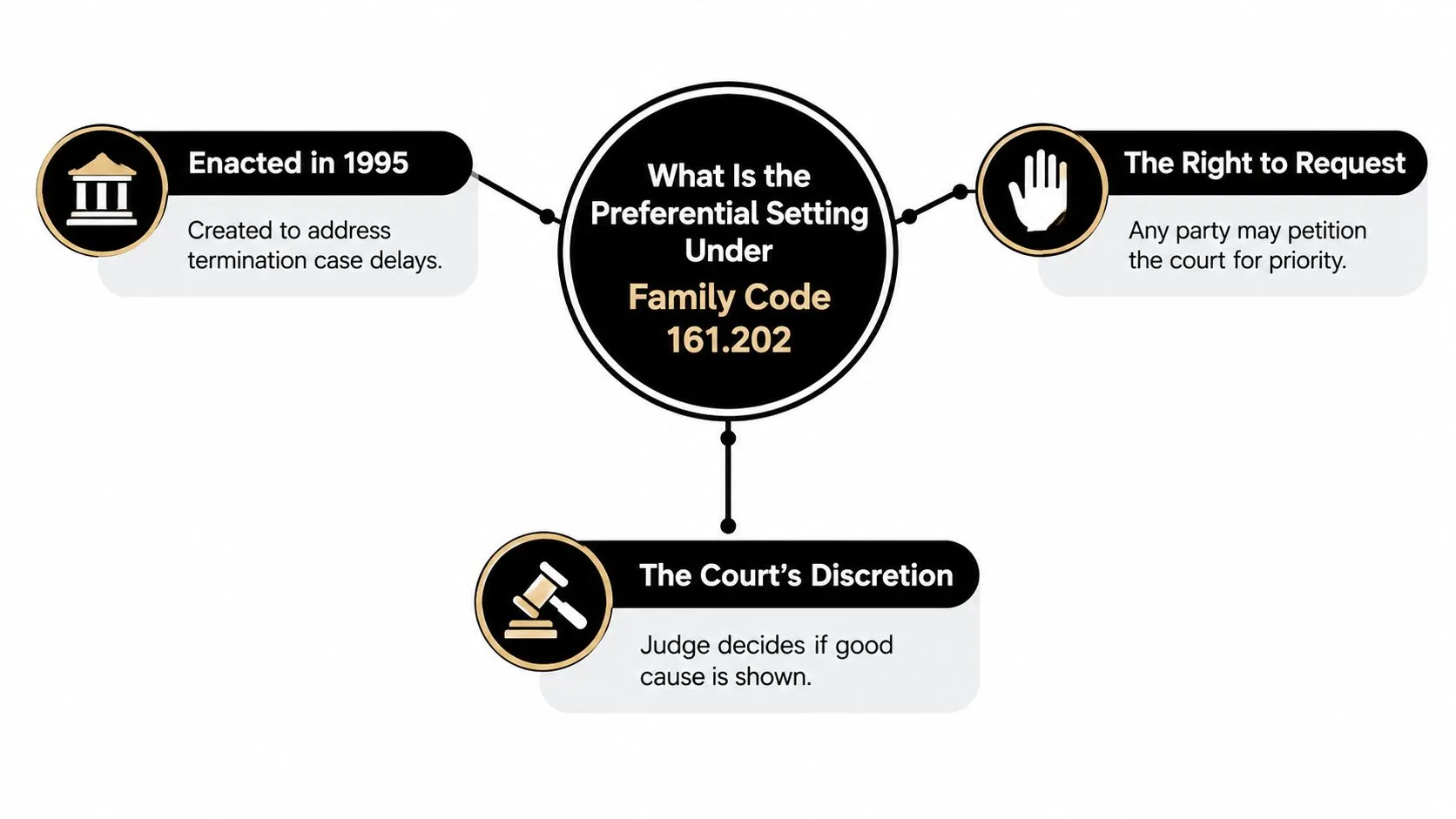
A termination case may be ready for trial while other civil matters already occupy the court's calendar. Family Code § 161.202 gives an eligible party a way to request priority for the final hearing, helping the case receive attention without skipping the legal safeguards that protect every person involved.
The provision was added by Acts 1995, 74th Legislature, chapter 20, section 1, and became effective on April 20, 1995. It is therefore a long-standing scheduling rule in Texas termination practice, not a recent option created for today's adoption cases. The statute gives priority to a termination proceeding when the requested order would make the child eligible for adoption and the case is ready for a final hearing. The text and history of Texas Family Code § 161.202
The two requirements
The court's duty to grant the request depends on two conditions:
- Adoption eligibility: The requested termination would make the child eligible for adoption.
- Discovery readiness: Discovery has been completed, or enough time has passed for the parties to conduct it diligently.
Discovery is the information-gathering stage of a lawsuit. Parties can request records, submit written questions, take depositions when appropriate, and investigate the evidence expected at trial. This process gives each side a fair opportunity to understand the allegations, prepare a response, and identify disputed facts.
The second requirement protects that preparation. A faster hearing can support a child's need for stability, but speed cannot replace a meaningful chance to gather evidence or respond to the case. That balance becomes especially important when families are weighing an accelerated path against due process protections and the strategic effects of Texas's updated reinstatement rules.
What “precedence” means
Precedence means the court should place a qualifying termination hearing ahead of other civil cases competing for time. It does not require an immediate hearing, and it does not direct the judge to grant termination. It gives the ready case priority on the calendar after the statutory conditions are satisfied.
For a relative caregiver considering adoption, this rule may shorten scheduling delay between temporary care and a possible permanent legal relationship. The outcome still depends on the evidence, the court's findings, the child's best interests, and each party's opportunity to be heard. A preferential setting changes the order of the calendar, not the legal decision itself.
How the Preferential Setting Works in Practice
The simplest way to understand the rule is to separate calendar priority from legal proof. A preferential setting moves a ready case forward. It doesn't change what the party seeking termination must prove.
Termination under Chapter 161 remains governed by the clear and convincing evidence standard. That is a demanding burden. The court must evaluate the evidence and make the findings required by law before ending the parent-child relationship. A scheduling order cannot substitute for those findings. Texas family law practice materials on termination proceedings

What the request can accomplish
Once discovery is complete, or sufficient time for diligent discovery has passed, the motion can reduce the risk that a ready case sits behind unrelated civil disputes. That can help everyone plan for the next stage, including preparation for adoption proceedings if termination is granted.
Practical rule: A preferential setting can speed up the hearing, but it can't guarantee the result.
This distinction is important for prospective adoptive parents. Moving a hearing forward may provide a clearer timeline, but the court must still consider the evidence and the child's best interests. A parent opposing termination also retains the right to respond, present evidence, and challenge the case.
The legal relationship between termination and adoption is discussed in Termination of Parental Rights Before Adoption, which explains why TPR is the necessary first step in most adoptions. In a stepparent case, for example, the other biological parent's rights typically must be resolved before the adoption can proceed.
The better analogy is an express lane, not a shortcut. The case may move through scheduling more efficiently, but every required legal safeguard remains in place.
Procedural Steps and Sample Language for Requesting a Setting
A preferential setting request usually begins with a motion filed in the existing termination case. The attorney identifies the statutory basis, explains why the child would become eligible for adoption if termination is granted, and addresses the status of discovery.
The process commonly follows this pattern:
- Review the case posture. Counsel confirms that the requested termination would make the child eligible for adoption and evaluates whether discovery is complete or sufficiently advanced.
- Prepare the motion. The filing identifies the requested preferential setting and provides the facts supporting the request.
- Serve the parties. Other parties receive notice and an opportunity to respond according to the applicable rules and court procedures.
- Attend the hearing. The judge hears the request, considers objections, and determines whether the statutory conditions are satisfied.
- Obtain the setting. If the requirements are met, the court grants the preferential setting and gives the final hearing precedence over other civil cases.
The exact filing requirements, notice procedures, and available dates can vary by court. A party should not assume that filing the motion alone places the case on a final trial docket.
A plain-language example
Suppose a child is living with a relative who hopes to adopt. The parties have exchanged the relevant information, the attorneys have had enough time to investigate, and the requested termination would make the child eligible for adoption. The attorney might present language such as:
“The child would become eligible for adoption if the requested termination is granted. Discovery has been completed, or the parties have had sufficient time to conduct discovery diligently. The moving party therefore asks the Court to grant a preferential setting for the final hearing on the merits and to give that hearing precedence over other civil cases as provided by Texas Family Code § 161.202.”
That sample is educational, not a form to copy without legal review. The motion should accurately describe the record. If discovery remains active, witnesses have not been identified, or a party has not received meaningful notice, requesting immediate priority may create problems rather than solve them.
Preparing for the hearing
Before asking for a setting, discuss:
- Discovery status: Which records, witnesses, and responses remain outstanding?
- Adoption eligibility: What legal event would make the child eligible for adoption?
- Notice and participation: Has every required party received proper notice?
- Child-focused timing: Would advancing the hearing support stability without weakening fairness?
- Court practice: How does the assigned court handle preferential-setting requests?
Families can review how to terminate parental rights in Texas before meeting with counsel. The purpose isn't to predict the result. It's to arrive with a clearer understanding of the issues that may affect scheduling and proof.
Common Misconceptions and Strategic Considerations
Many families hear “preferential setting” and assume faster is automatically better. A timely hearing can be valuable, but speed must be weighed against preparation, notice, and the reliability of the final result.
Texas child-welfare guidance states that the termination grounds framework was updated effective September 1, 2025, and that reinstatement of parental rights now has a defined hearing process with a 60-day deadline and a two-year waiting period after termination in qualifying cases. Those provisions add important context for families thinking about permanency and finality. Texas child-welfare guidance on termination grounds and reinstatement

Speed and due process can pull in different directions
In a straightforward, fully prepared case, priority may help prevent unnecessary calendar delay. In a contested case, however, the parties may need additional time to investigate allegations, locate witnesses, review records, or address service and notice concerns. A rushed hearing can increase the risk of an incomplete record, an appeal, or later disputes about whether everyone had a fair opportunity to be heard.
That doesn't mean a family should avoid a preferential setting. It means the request should be strategic. The child's best interests include safety and permanency, but they also include a legally sound decision that is less vulnerable to future challenge.
Questions worth asking before moving quickly
- Is the evidence ready? If important evidence is still developing, a short delay may protect the integrity of the hearing.
- Are notice issues resolved? Missing or defective notice can affect the reliability of a judgment.
- Does the adoption plan depend on termination? The timing may matter differently in a stepparent, kinship, foster, or CPS-related case.
- Could additional preparation reduce future risk? A complete record can support a more durable outcome.
- What does the child need right now? The best schedule is the one that balances stability with fairness.
A birth parent considering Voluntary Relinquishment of Parental Rights in Texas is addressing a different legal path, how a birth parent voluntarily ends their rights for an adoption. That choice still deserves independent advice and careful attention to notice, consent, and the child's long-term needs.
How the Preferential Setting Connects to the Adoption Process
A child may already be living with a prospective adoptive family when a parent's rights still need to be resolved. The preferential setting can help align the termination hearing with the family's permanency plan, but speed is only one part of the decision. A faster hearing may reduce uncertainty, while an underprepared record can threaten due process and create problems for the adoption later. Texas families must weigh both concerns, especially as updated reinstatement rules create additional strategic tradeoffs.
Texas adoption law in Chapter 162 provides for a preferential setting for the final adoption hearing and gives that hearing precedence over other cases. The provision reflects the importance of reaching a final decision when the legal and factual requirements are ready. Texas Family Code Chapter 162
When termination and adoption are joined, the court terminates the parent-child relationship when it renders the adoption order. The judge must make separate best-interest findings for termination and adoption. These decisions connect, much like two doors in the same hallway, but each door has its own legal requirements and evidence.
The larger timeline
A family's case may include these connected stages:
- Placement and planning: The child lives with a prospective adoptive family, relative, foster parent, or another caregiver under the applicable arrangement.
- Home study and review: Texas generally requires a pre-adoptive home study and post-placement review before finalization. Reports and studies help the court evaluate the child's best interests. Texas adoption guidance on home studies and finalization explains these requirements.
- Termination proceedings: If another parent's rights must be addressed, the court resolves that issue under Chapter 161.
- Adoption hearing: The court reviews the adoption evidence, the child's best interests, and the requirements for a final order.
- Finalization: The judge signs the decree after the required findings and procedures are complete.
The Texas Adoption Home Study Explained describes what the home study evaluates and when it may be waived. It is part of the court's broader assessment, not merely paperwork.
For a child placed through the child-welfare system, families can review adoption after CPS placement in Texas. Coordination matters because the permanency plan, parental rights, notice, and adoption evidence must support one legally sound outcome.
Next Steps for Families Navigating Termination and Adoption
A child may be waiting for a permanent home while a termination case remains unresolved. If you are considering a preferential setting, first identify the case's current position. The request should support timely permanency without cutting short the other parent's opportunity to receive notice, investigate, present evidence, and be heard.
A practical preparation list
- Gather case documents: Keep pleadings, court orders, discovery responses, notices, and placement information together.
- Ask about eligibility: Confirm whether the requested termination would make the child eligible for adoption.
- Review discovery: Identify what remains outstanding and whether the parties have had enough time to investigate diligently.
- Discuss the child's needs: Consider school, medical care, attachment, sibling relationships, and the child's need for a stable plan.
- Prepare for adoption requirements: Home evaluations, interviews, reports, and post-placement review may be required before finalization.
- Plan for both outcomes: An earlier hearing date does not guarantee termination or adoption.
Use the preparation list like a case map. It helps your attorney see which facts support the request, which safeguards still matter, and whether the proposed schedule is workable. Texas Family Code Chapter 162 requires the court to consider reports and studies relevant to the child's best interests before finalization. Families should also review Texas adoption procedures and finalization guidance as they prepare for the next stage.
Match the strategy to the family
A stepparent may need to resolve the non-spouse biological parent's rights before adoption can proceed. A child who is 12 or older must consent to a stepparent adoption under the applicable requirements. Texas stepparent adoption guidance Relatives, foster parents, birth parents, LGBTQIA+ families, and single adoptive parents may face different facts and procedural questions.
Timing deserves special care in a contested case. An accelerated setting can reduce delay, yet an overly compressed schedule may create due process problems or leave important evidence unexamined. Updated reinstatement rules also create a strategic tradeoff: families may pursue permanency promptly while considering how reinstatement could affect finality and long-term planning.
Bring your documents and questions to a Texas family law attorney. Ask what must occur before a preferential-setting motion can be filed and heard, and how the proposed schedule protects the child's best interests.
The Law Office of Bryan Fagan, PLLC helps Texas families understand termination proceedings, preferential settings, home studies, and adoption finalization. Visit Law Office of Bryan Fagan, PLLC to learn about scheduling a consultation.

