
Yes. A minor can legally consent to an adoption in Texas, and the law also builds in 48 hours after birth plus added signing safeguards to help make sure that choice is free, informed, and understood.
If you're a pregnant teen, a parent trying to help your daughter, or an adoptive family waiting anxiously for answers, this question can feel overwhelming. You may be wondering whether age changes everything, whether parents can step in, or whether a young mother has any real voice in the process.
In Texas, she does.
That doesn't make the decision easy. Adoption is personal, and for a minor, it can come with fear, family pressure, confusion, and grief all at once. But Texas law doesn't treat a young birth mother like her wishes don't matter. Instead, it recognizes her decision while putting protections around it so she has time, privacy, and legal formality before anything becomes final.
Facing a Difficult Choice With Hope and Support
A young woman sits in a hospital room after giving birth. Her phone keeps buzzing. One relative says she should keep the baby. Another says adoption would give the child stability. She feels exhausted, scared, and unsure who is really listening to what she wants.
That moment is where many families start asking, Can a Minor Birth Mother Consent to Adoption in Texas?
The answer matters because this isn't only a legal issue. It's a human one. A minor birth mother may love her child and still believe adoption is the most responsible path. She may also be sorting through school, housing, family conflict, or a relationship with the baby's father that feels uncertain or unsafe.
Practical rule: If anyone is pressuring a minor to place a child for adoption, that pressure should be taken seriously and addressed right away.
Support can look different for every family. Sometimes it means speaking with an adoption attorney. Sometimes it means involving a counselor, hospital social worker, or a trusted adult who will listen without taking over. And if the young mother is dealing with fear, abuse, or intimidation at home or in a relationship, a comprehensive directory of help lines can be an important place to start finding immediate support.
What many families get wrong
One common misunderstanding is that a minor's parents automatically control the decision. In Texas, that isn't how consent works in this setting. Another misunderstanding is that adoption papers can be signed right after delivery while everyone is emotional and tired. Texas law puts protections in place to slow that moment down.
A real-life example
Consider a seventeen-year-old who wants to pursue adoption, but her mother strongly disagrees. The young woman may still have the legal ability to make that decision herself if the required legal steps are followed. Her age alone doesn't cancel her voice.
That can be a relief to hear. It can also be emotional.
Choosing adoption doesn't mean a young mother doesn't care. Often, it means she's trying to make a careful decision in a very hard season of life.
The Legal Foundation for a Minor's Consent in Texas
Texas law gives a clear answer on this issue. Under Texas Family Code Section 162.010, a minor birth parent can consent to adoption if the required protections are followed. That means her age, by itself, does not make her consent invalid. The rule is explained in plain terms in this discussion of Texas adoption consent requirements and is grounded in the legal principles summarized by this review of Texas consent law.
What legal capacity means here
The phrase legal capacity sounds technical, but the basic idea is simple. It means the law recognizes that this person has the authority to make this decision.
For a minor birth mother in Texas, that authority exists when the process is handled properly. She doesn't lose that authority just because she hasn't reached adulthood.
What has to happen for consent to count
Texas requires the consent document, often called an affidavit of voluntary relinquishment, to be signed with formal protections in place. The verified legal framework states that a minor's consent is not invalidated by age when she signs before a notary and two credible witnesses and when procedural safeguards are followed, including court attention to whether she understands the permanent consequences of the decision.
That tells families something important. Texas is trying to do two things at once:
- Respect the young mother's voice by allowing her to consent.
- Protect that voice by requiring a careful signing process.
Parents and guardians can't force the choice
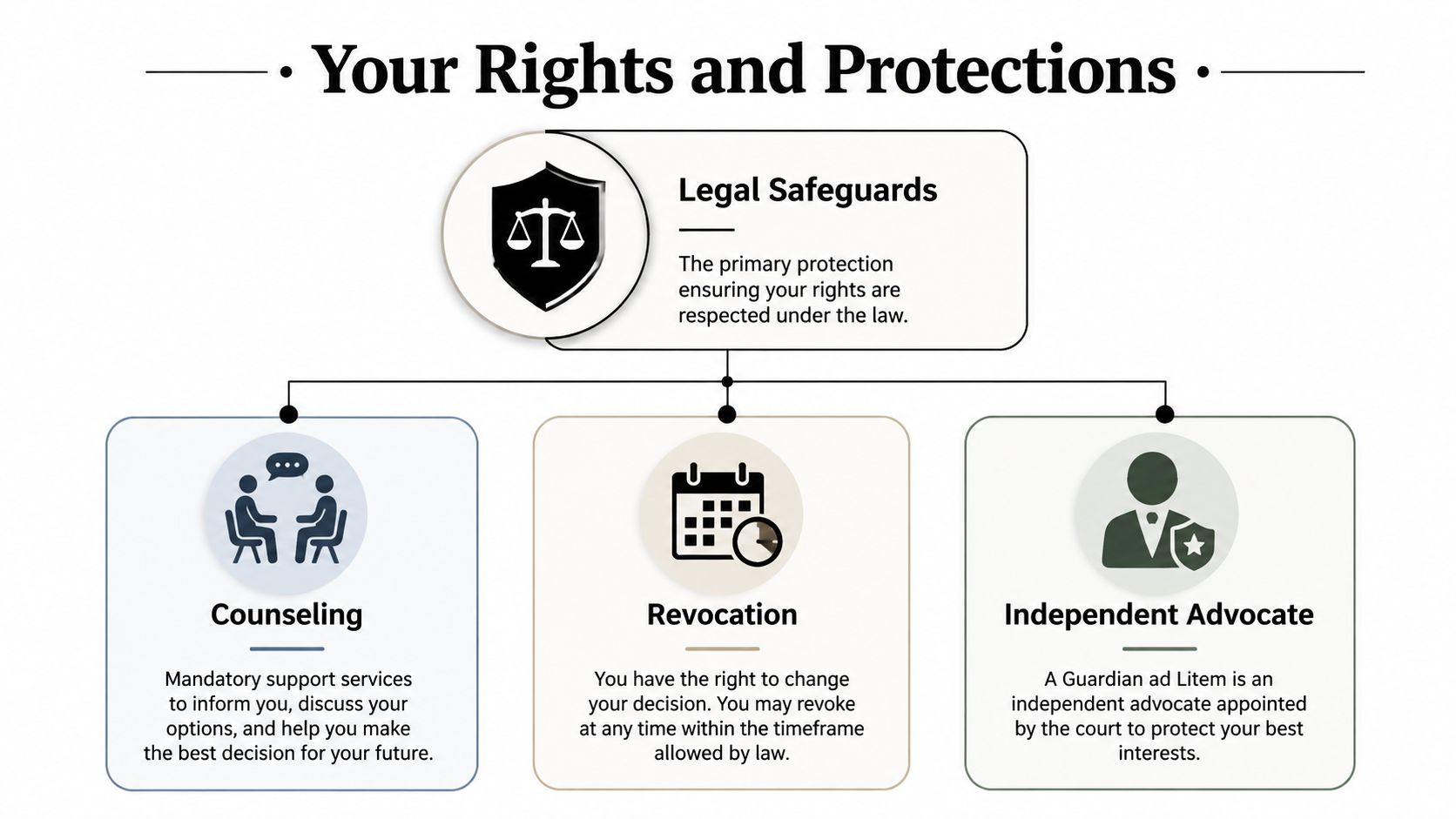
This point is often the most reassuring. Texas law explicitly protects minor mothers from being forced into adoption by a parent or guardian. The minor's own voluntary consent is legally required under the verified framework summarized in the source above.
A family can advise. A family can worry. A family cannot replace the minor birth mother's voluntary consent.
That protection matters in real life. Some minors face heavy pressure from adults who believe they're helping. Others face pressure from the baby's father, extended relatives, or even adoptive families eager for certainty. The law is structured to focus on whether she is choosing adoption freely and with understanding.
Why the court may look closely
Because adoption permanently changes legal rights, courts can take deliberate steps to confirm that a minor understands what she's signing. That doesn't mean the court assumes she is incapable. It means the court treats the decision with the seriousness it deserves.
For many readers, that's good news. It means the system is not supposed to rush a scared teenager through papers she doesn't understand. It is supposed to slow down, verify, and protect.
Your Rights and Protections in the Process
The strongest protection for a birth mother in Texas is time. Under Texas Family Code §161.103(a)(1), a birth mother cannot sign consent until 48 hours after delivery. The purpose of that waiting period, as described in this explanation of Texas birth mother legal rights, is to allow recovery from childbirth and space for real reconsideration.
Why the waiting period matters
A young mother may be physically sore, emotional, medicated, tired, or overwhelmed right after giving birth. Texas doesn't allow consent in that immediate window. The law recognizes that such a major decision shouldn't be made in the first rush of childbirth.
For minors, this can be especially protective. It creates breathing room. It gives space to ask questions, call an attorney, talk to a counselor, or sit with the reality of the choice.
The signing process protects against pressure
The consent document must be signed with outside verification. That includes witnesses and a notary. These aren't empty formalities. They help create a record that the decision was made knowingly and voluntarily.
Here is what those safeguards do in practical terms:
- Slow the process down so no one pushes papers across a hospital tray and demands a quick signature.
- Create independent confirmation that the person signing is the birth mother and appears to understand the document.
- Support later court review if anyone questions whether pressure, confusion, or manipulation played a role.
What to remember: A careful process is a form of protection, not a sign that anyone doubts your worth or your ability.
Privacy matters too
Families often overlook the privacy side of adoption paperwork. Medical and legal records need to be handled carefully, especially when hospital staff, attorneys, and agencies are involved. If you're trying to understand how sensitive documents should be shared securely, this overview of technical safeguards for healthcare providers gives useful background on protected document handling.
Questions young mothers often ask
A minor birth mother may ask whether she can use this waiting period to change her mind. She may ask whether she has to meet adoptive parents before signing. She may ask what happens if she feels pressured after the baby is born.
Those are exactly the kinds of questions she should ask.
Families looking deeper into timing and finality often also want to review how revocation of consent works in Texas adoptions. The details can depend on the wording of the document and court involvement, so legal guidance matters.
A Step-by-Step Guide to the Consent Document
For many people, the hardest part is not the law itself. It's not knowing what paper gets signed, who has to be there, and what happens after that. The central document is usually the Affidavit of Voluntary Relinquishment of Parental Rights.
A practical starting point is reviewing Texas consent to adoption forms and filing basics, because the exact language and filing steps matter.

Step one, get the right document and legal advice
This isn't a do-it-yourself form that should be downloaded casually and signed without explanation. The affidavit has to be prepared correctly and matched to the facts of the case.
That is one reason families often work with adoption professionals, agencies, or attorneys. The Law Office of Bryan Fagan, PLLC helps with adoption paperwork, court filings, and consent-related legal guidance for Texas families, which can be especially important when a minor's consent must be documented carefully.
Step two, wait until signing is legally allowed
The birth mother must not sign before the legal waiting period has passed. If paperwork is presented too early, that should raise immediate concern.
A careful attorney or adoption professional should confirm the timing before anyone signs anything.
Step three, review what the affidavit says
The document is not just a permission slip. It is a serious legal statement that the parent is relinquishing parental rights. A minor birth mother should understand what rights she is giving up, whether the affidavit contains language about revocation, and what court process follows.
A simple checklist can help:
| Question | Why it matters |
|---|---|
| What document am I signing | You should know the name and purpose of the affidavit |
| What rights does this affect | Adoption changes legal parent-child rights permanently |
| Can this be revoked | The wording of the affidavit and court process matter |
| Who is present | Proper witnesses and notarization help protect validity |
Step four, sign with the required formalities
When the affidavit is signed, the right people need to be present. In Texas, that means the process must meet formal legal requirements, including witnesses and notarization, as discussed earlier in this article.
That setting should feel orderly, private, and respectful. If it feels rushed or intimidating, speak up.
If a young mother says, "I don't understand this," the process should stop until she does.
Step five, prepare for court review
Signing the affidavit is a major step, but it is not the only step. The court still reviews the case before an adoption is finalized. Judges look for compliance with the law and for a process that protects the rights of everyone involved.
This short video gives general background on the adoption process and can help families understand how the legal pieces fit together.
Step six, understand that timing after signing can still matter
Some affidavits address revocation in their terms, and court approval may be part of that process. Families often get confused by this particular step. They hear broad statements online, but the actual answer depends on the exact document and the court procedure in the case.
That is why clear legal review matters before signing, not after regret or conflict appears.
Navigating Common Scenarios and Emotional Questions
The legal answer is only part of the story. The harder questions usually sound more personal. What if my parents disagree? What if I don't know where the father is? What if I want some contact later but not a fully open relationship?
Those questions deserve calm answers.

When your parents don't agree
A sixteen-year-old may say, "My mom wants me to parent, but I don't think I can right now." Another may say, "My family is pushing adoption, but I'm not ready."
In both situations, family opinions may be loud, emotional, and sincere. But the process should still focus on the minor birth mother's own voluntary decision. She should have room to ask questions outside the presence of people who may be influencing her.
Sometimes the healthiest next step is a private conversation with an attorney or counselor. A young mother often thinks she has to choose between obeying family and protecting her future. In reality, she needs accurate legal advice and space to think.
What about the birth father
In any Texas adoption, the birth father's rights must be addressed. He may sign voluntarily, or if he is unknown or unresponsive after diligent search efforts, a court can move through a legal process to terminate rights, including notice procedures, before the adoption can proceed, as described in Texas Family Code Chapter 161.
That means a minor birth mother is not expected to solve every legal problem by herself. But she should tell her attorney or adoption professional what she knows about the father so the case can be handled correctly.
Open adoption or closed adoption
This question is emotional, not just legal.
Some young mothers want updates, photos, or occasional contact because it helps them feel connected and reassured. Others feel that more distance would be less painful. Neither feeling is wrong.
A simple comparison can help:
- Open adoption may involve agreed communication, updates, or contact.
- Closed adoption usually means much less direct communication.
- Something in between is often what families choose.
The right choice depends on personalities, boundaries, safety concerns, and what kind of relationship everyone can realistically maintain in a healthy way.
Choosing adoption doesn't require choosing one emotional script. Relief and sadness can exist at the same time.
When the adoptive family lives outside Texas
This is another area that confuses families. If the adoptive parents are from another state, there can be extra steps involving interstate approval. The verified material available here notes that this area often raises unanswered questions for families, especially when Texas consent rules interact with out-of-state placement rules.
That doesn't mean the adoption can't move forward. It means families should get state-specific legal advice early so the consent paperwork will hold up across jurisdictions.
You Are Not Alone Let Us Help You Find Your Path
A minor birth mother in Texas can consent to adoption. Just as important, she is supposed to be protected while making that decision. Her age does not erase her voice. The law recognizes her authority, requires formal safeguards, and insists that consent be voluntary.
For adoptive parents, that can feel both reassuring and nerve-racking. For relatives, it can be hard to step back and let a young mother make such an important choice. For the birth mother herself, it can feel like everyone wants an answer before she's had time to breathe.
She deserves better than pressure.
She deserves clear information, respectful guidance, and a process that treats her with dignity. She also deserves to understand all available paths, including parenting, kinship care, guardianship, and adoption, with the child's best interests at the center of every conversation.
If your family is facing this decision, a confidential legal conversation can bring clarity. The right guidance can help you understand the consent rules, the father's rights, the paperwork, the court process, and the options that fit your family's situation.
If you need clear, compassionate guidance about adoption consent, birth parent rights, or the next legal step for your family, you can schedule a free consultation with Law Office of Bryan Fagan, PLLC.
