
You may be sitting at your kitchen table right now, phone in hand, heart racing, because someone just told you a birth parent may not sign the adoption papers. Maybe you've already painted the nursery. Maybe your child already calls your spouse “Mom” or “Dad,” and you're trying to make that bond legal. Maybe you're a grandparent or relative who has been caring for a child and thought the hardest part was behind you.
When a birth parent refuses consent, it can feel like the floor drops out from under you. The fear is real. So is the confusion. People often ask, “Is it over?” In Texas, the answer is not always. A refusal matters, and the law takes it seriously, but it doesn't always end the story.
What happens next depends on who is refusing, what legal status that parent has, whether rights were already surrendered, and whether a court has grounds to step in. Texas adoption law, especially the parts of the Family Code that deal with termination and adoption procedure, has rules for these situations. Those rules can feel cold on paper, but they exist to protect children, respect parental rights, and create a stable path toward permanency.
The Heart-Stopping Moment a Birth Parent Says No
For many families, this moment comes suddenly.
A hopeful adoptive couple may get a call from an agency after months of planning. A stepparent may learn that the absent parent who hasn't shown up in years is now refusing to sign. A grandmother raising her grandchild may discover that a parent who has offered little support still won't agree to an adoption. The facts differ, but the feeling is often the same. Panic, grief, anger, and a dozen unanswered questions all at once.

A refusal can happen in different ways. Sometimes a parent clearly says no. Sometimes they avoid calls, ignore paperwork, or refuse to appear. Sometimes a birth mother changes course after delivery and decides to parent. Sometimes an alleged father appears late and objects. In each of those situations, Texas law treats the details as important.
Why this feels so overwhelming
Adoption is never just paperwork. By the time consent becomes an issue, families have often already invested emotionally and financially. They may have completed home studies, gathered records, prepared for placement, and told loved ones the child is coming home. When consent is suddenly uncertain, the legal issue lands right on top of deep hope.
What feels like a dead end is often the start of a specific legal process.
That process may involve waiting periods, notice requirements, court hearings, or a request to terminate parental rights without consent. It may also involve a painful but necessary reset if the law does not allow the adoption to move forward yet.
One confusion that comes up often
People mix up refusal to sign with revoking consent. Those are related, but they aren't the same. If no valid consent was signed, the question is whether the adoption can proceed without it. If consent was signed, the question becomes whether it can still be withdrawn under Texas law. If you're sorting through that issue, it helps to read more about how long a birth parent has to revoke consent in Texas.
The good news is that you don't have to guess your way through this. Texas law has a path for voluntary consent, a path for contested cases, and a path for cases where a parent cannot be found. The right path depends on the facts, and facts matter a great deal in adoption court.
Understanding Consent the Foundation of Texas Adoption
Consent is the legal foundation of most adoptions. In plain English, it is the formal agreement that allows a parent's legal rights to end so a child can join another family through adoption. Without that legal step, a judge usually cannot finalize the case.
Think of it this way. Consent is the legal key that enables the adoption process. If the appropriate individuals sign the correct documents at the designated time, the case can move forward much more smoothly. If that key is missing, the court has to decide whether another lawful route exists.
Who may need to consent
In Texas, the answer depends on the family situation. The mother's rights matter. A father's rights may also matter, but that depends on whether he is legally recognized as a presumed, acknowledged, or alleged father.
That distinction confuses many people. A husband is often treated differently from a man who was never married to the mother and never established paternity. A man named on legal documents may stand in a different position from someone who claims he may be the father. Those categories affect notice, consent, and whether the court can move forward.
Voluntary relinquishment and court approval
Texas adoption procedure under Chapters 162 through 166 of the Family Code involves more than signatures. The court still reviews the case. In many adoptions, there is also a home study, background review, and evidence that the placement serves the child's best interests.
Here is the broad sequence families usually see:
- Preparation begins: The adoptive family gathers records, completes required screenings, and works through the home study when one is required.
- Parental rights are addressed: This happens either through signed relinquishment documents or through a court order terminating rights.
- Placement and supervision: Depending on the type of adoption, there may be a period of placement before finalization.
- Final hearing: The judge decides whether the legal requirements have been met and whether the adoption is in the child's best interests.
Practical rule: An adoption is not final just because everyone expects it to happen. Finality comes from a court order.
Why timing matters so much
Texas law is careful here because adoption permanently changes legal relationships. A signed document may be valid in one situation and not in another if it was signed too early, signed under pressure, or signed by someone who did not have the legal status to give effective consent.
That's why families should slow down when emotions are running high. If a birth parent is uncertain, if paternity is unresolved, or if an absent parent suddenly resurfaces, the safest next step is to get clear legal advice before anyone assumes the case is either doomed or secure.
When a Birth Mother Has Second Thoughts
This is one of the most emotional parts of any domestic adoption.
A birth mother may spend months making an adoption plan and still feel differently after delivery. That doesn't mean she acted in bad faith. It means she is facing a life-changing decision under enormous emotional pressure. Texas law recognizes that reality and gives important protections around consent.
The waiting period and revocation window
In Texas, a birth mother cannot sign a relinquishment right away after birth. There is a waiting period before that consent can be signed. Even after signing, Texas law may allow a period in which consent can be revoked depending on the type of affidavit used and the language in it. The article you read earlier on revocation goes deeper on that distinction, and it matters.
For hopeful adoptive parents, that can feel unbearable. For birth mothers, it is part of the law's attempt to make sure consent is informed and voluntary.
Failed matches are painful, but they do happen
One fact often helps families understand that this experience, while devastating, is not rare or personal. About 7% of matched birth mothers ultimately decide to parent, and that rate can be much higher, about 25% to 50% or more, when a match is made early in pregnancy and the plan is not yet firm, according to Creating a Family's discussion of failed adoption matches.
That doesn't make the loss easier. It does help explain why experienced professionals often focus so much on counseling, careful matching, and realistic expectations.
What this means in real life
Take a common private adoption scenario. A family has been matched. They attend appointments, buy baby clothes, and prepare for placement. After the child is born, the birth mother spends time with the baby and decides she cannot go through with the adoption. That decision may break the adoptive family's heart, but if her legal rights have not been permanently and validly relinquished, the adoption cannot move forward.
That's why compassionate support matters for everyone involved. Pressuring a birth mother rarely helps. It can create more conflict, more legal risk, and more trauma.
A steadier approach looks like this:
- Protect the legal process: Let attorneys and professionals handle the paperwork and communication.
- Protect the people involved: Avoid angry calls, social media posts, or blame.
- Protect your expectations: Until consent becomes legally secure and the court process is complete, keep hope grounded in reality.
A birth mother's change of heart is often experienced by adoptive parents as rejection. Legally and emotionally, it is better understood as a protected decision point in the adoption process.
Navigating a Birth Father's Refusal or Absence
Fathers' rights in adoption cases often create the most confusion. Families are sometimes told, “He was never involved, so it won't matter,” or “If he isn't on the birth certificate, you can ignore him.” Those shortcuts can create major problems.
In Texas, the first question is often what kind of father the law says he is.
The different legal categories matter
A presumed father may be a man who was married to the mother when the child was born or conceived. An acknowledged father is someone who formally established paternity through the proper legal process. An alleged father is a man who claims he may be the father but has not fully established legal paternity.
Those labels aren't just technical. They affect who must be notified, whose consent may be required, and what rights the court must address before finalization.

The putative father registry
Texas has a putative father registry, and it plays a major role in some adoption cases. An alleged father must register no later than the 31st day after the child's birth to be entitled to notice of the adoption. If he is notified and fails to act to establish paternity within the required timeframe, his rights can be terminated and the adoption may proceed, as explained in this overview of whether an adoption can happen without the father's consent in Texas and supported by the underlying discussion from Lifetime Adoption.
That rule surprises many families. A father's rights are important, but Texas also requires timely action to protect those rights.
If he objects versus if he disappears
These are two very different cases.
| Situation | What it usually means |
|---|---|
| He objects and takes legal action | The adoption may become contested, and the court may need to resolve paternity, notice, and possible termination issues before anything can be finalized. |
| He receives notice but does nothing | The court may allow the case to move forward if the legal requirements for notice and termination are met. |
| His identity or location is unknown | The adoptive party usually must show due diligence in trying to locate him before the court will proceed without consent. |
Due diligence is real work
“Due diligence” means a judge expects real effort, not a shrug. Families may need to check last known addresses, search available records, document returned mail, and sometimes use an investigator. The exact proof needed depends on the facts, but the basic idea is simple. Before the court cuts off rights without consent, it wants to see that reasonable steps were taken to find the parent.
If you're a stepparent, relative caregiver, or adoptive parent, this can feel frustrating. Still, it serves an important purpose. It protects the final adoption from being attacked later by a parent who argues they were never properly notified.
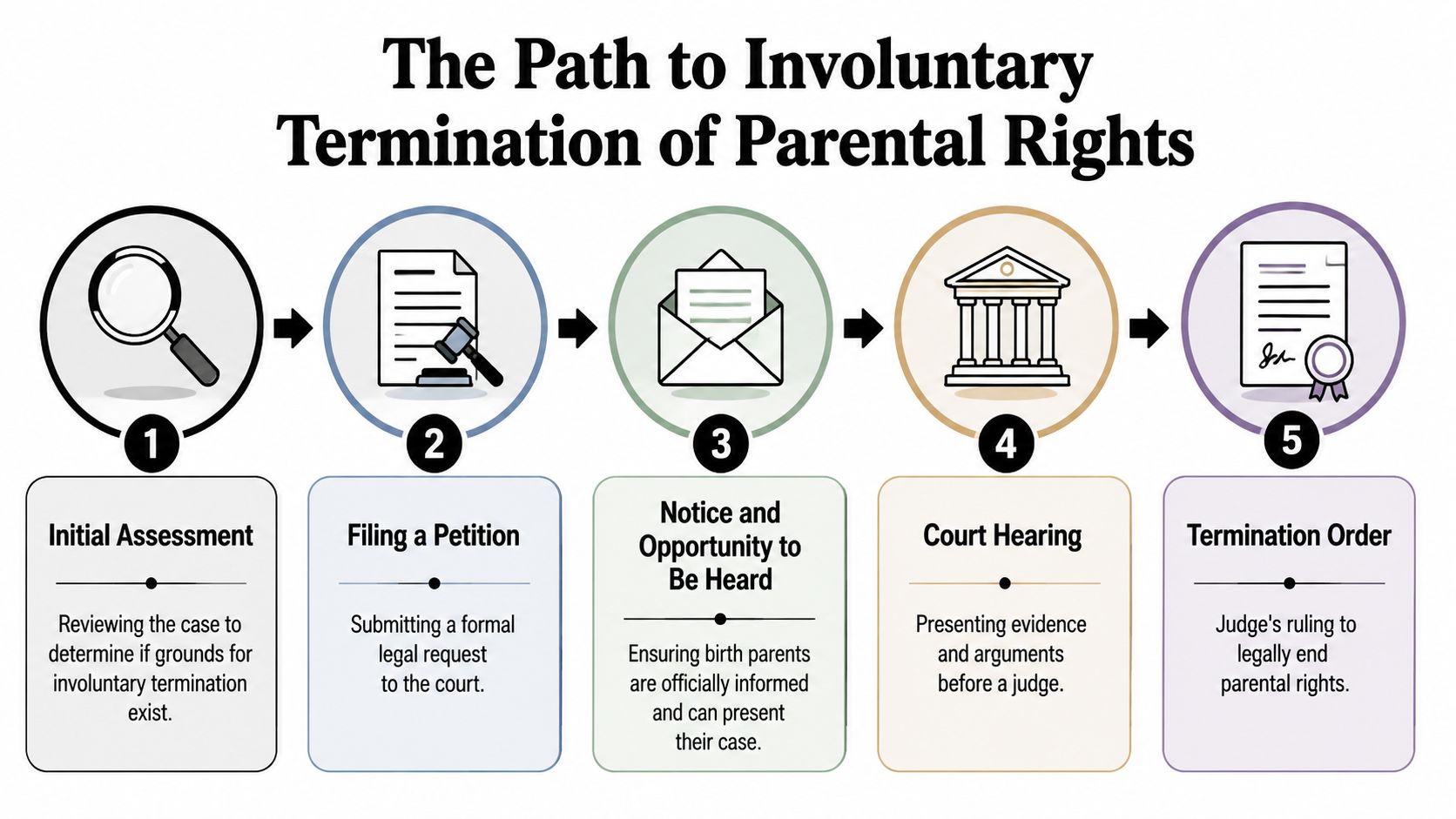
The Path to Involuntary Termination of Parental Rights
If a birth parent refuses to sign adoption papers, the legal question often becomes whether the court can terminate parental rights without consent. In Texas, that path exists, but it is serious and demanding.
The governing rule is not “someone else would be a better parent.” Texas courts do not terminate rights just because another family can offer more stability, more money, or a more organized home. The court must find legal grounds and must also find that termination serves the child's best interests.
The legal standard is high
Texas law requires clear and convincing evidence that a parent engaged in conduct listed in Texas Family Code § 161.001, such as abandonment or neglect, and that termination is in the child's best interest. A parent's failure to contact or support the child for over a year can create a rebuttable presumption of abandonment, as described in this overview of termination of parental rights in Texas and reflected in the supporting explanation from California Courts Self-Help discussing consent disputes and termination principles.
What grounds may matter
Different facts support different grounds. A court may look at issues such as:
- Abandonment: A parent has been absent from the child's life and has not provided care or support.
- Neglect or endangerment: The parent's conduct put the child at risk.
- Failure to support: Lack of financial support may be part of the larger picture.
- Other statutory grounds: The Family Code contains specific categories, and the details matter.
A simple example
Suppose a child has lived with a grandmother for a long time. The father has not visited, sent money, called, or asked about school or medical care for over a year. The grandmother's lawyer gathers school records, text messages, payment history, testimony from caregivers, and proof of the child's stable home. That evidence may support a petition arguing abandonment and best interest.
But the result is never automatic. If the father appears and offers a different version of events, the judge has to sort out credibility, timing, and whether the legal standard is met.
Termination cases turn on proof. Courts want dates, records, notices, testimony, and a clear story that fits the statute.
Why this standard protects everyone
Families sometimes feel frustrated that the process is so strict. This rigor protects the child and ensures the final adoption remains secure. If courts ended parental rights casually, adoption orders would be more vulnerable later. Careful procedure helps create permanence that will hold.
What to Expect in a Contested Adoption Hearing
A contested adoption hearing is not usually dramatic in the way television makes court look. It is often quieter and more tense. People sit with folders, photos, affidavits, and a lot of nerves. Every word matters.

A judge may hear from the adoptive parent, the contesting parent, relatives, caseworkers, or other witnesses depending on the kind of case. The lawyers present records and testimony. The court looks closely at notice, parental conduct, the child's current needs, and whether the law allows termination or adoption to proceed.
What the judge is listening for
The legal center of gravity is the best interest of the child. That phrase can sound vague, but in court it becomes very concrete. Who has been caring for the child day to day? Who makes sure the child goes to school, sees doctors, gets emotional support, and has stability? Is the parent who is objecting offering a genuine parenting plan, or only trying to block the adoption?
The hearing may involve questions like these:
- About the child's routine: Who handles school, meals, bedtime, therapy, and medical appointments?
- About the parent's involvement: When was the last visit, call, gift, or support payment?
- About safety and stability: Has the child lived in one home consistently, or experienced repeated disruption?
- About legal procedure: Was the parent served properly, and did everyone follow the Family Code requirements?
Courtroom reality: A contested hearing is often less about one dramatic moment and more about whether the documents and testimony consistently tell the same story.
The emotional and financial strain is real
Families deserve honesty about this part. The financial and psychological costs of a contested adoption can be significant. Beyond legal fees, the process can extend timelines by months or even years. That is one reason mediation or post-adoption contact agreements may be explored where appropriate, although the court's final decision always turns on the child's best interests, as explained by Hebbon Law's discussion of biological parents' consent issues in adoption.
That reality hits families hard. Waiting can affect work schedules, child care, mental health, and relationships. It can also reopen old family conflicts, especially in stepparent and kinship adoptions.
This video gives a helpful overview of how these issues can unfold in family court:
Middle-ground options sometimes exist
Not every conflict has to end in a full courtroom battle. In some cases, attorneys may explore negotiated solutions. That could include better communication around notice, a voluntary surrender after counseling, or discussion of contact arrangements if the law and the facts support it. In other cases, there is no workable middle ground, and the court must decide.
The key is not to improvise. A text message argument with the other parent rarely helps. A carefully planned legal strategy usually does.
Your Next Steps and Alternatives to Full Adoption
When families ask, “What happens if a birth parent refuses to sign adoption papers?” they're usually asking a second question underneath it. “What do I do tomorrow morning?”
Start there.
A calm checklist helps
- Call an adoption attorney quickly: Early legal advice can prevent mistakes with notice, filings, or communication.
- Save everything: Keep texts, emails, payment records, photos, school records, and notes about contact or missed contact.
- Don't fight directly with the other parent: Angry messages often become evidence.
- Ask about the exact posture of the case: Is this a missing-consent case, a revocation issue, a paternity issue, or a termination case?
- Think about support for yourself and the child: Contested cases can be draining. If the stress is building, mental health support can help steady the family. For readers outside Texas or those looking for examples of counseling support, Grande Prairie trauma and anxiety therapists offer a useful example of the kind of specialized help families sometimes seek during high-stress legal transitions.
If adoption isn't the right legal fit yet
Sometimes the safest path forward is not immediate adoption. In some families, a permanent managing conservatorship or another guardianship-style arrangement may provide stability when termination of parental rights is not yet possible or not clearly in the child's best interests. That can allow a child to remain in a secure home while legal issues are sorted out.
For stepparents, relatives, foster parents, and hopeful adoptive parents, the hardest part is often not knowing whether there is still a path. In many Texas cases, there is. It may not be fast. It may not look the way you first imagined. But a refusal to sign does not automatically erase every option.
If your family is facing a consent dispute, a missing parent issue, or a contested adoption in Texas, the Law Office of Bryan Fagan, PLLC offers compassionate guidance for stepparent, kinship, private, and CPS-related adoption matters. A free consultation can help you understand where your case stands, what the Texas Family Code requires, and what path may protect your child and your family best.
