
A placement can unravel quietly.
One parent notices the child is struggling more each week. Another is losing sleep over paperwork that still isn't complete. A birth parent starts asking whether signed documents can be taken back. A grandparent wonders who has legal custody right now, today, not months from now. In that moment, most families aren't asking abstract legal questions. They're asking, “What happens if an adoption fails in Texas?”
The answer depends on where the case stands. Some adoptions fall apart before a judge signs the final order. Others are challenged after finalization, which is much harder to undo. In both situations, the emotional weight is heavy, and the practical questions come fast.
A Compassionate Guide Through a Difficult Journey
A family may spend months preparing a room, completing a home study, attending meetings, and telling loved ones that a child is finally coming home. Then something shifts. Consent becomes disputed. A required court order hasn't been entered. The child's needs turn out to be more complex than anyone understood. Suddenly, everyone feels scared and ashamed.
That reaction is normal.

When an adoption falters, families often blame themselves first. Adoptive parents may think they've failed the child. Birth parents may feel guilt and panic at the same time. Relatives may step in and make urgent decisions without understanding the legal consequences. The child is left in the middle of adult fear and uncertainty.
A failed adoption isn't one single event. It's a fork in the road. The legal path changes depending on whether the adoption was only planned, already filed, or fully finalized under the Texas Family Code. Chapters 162 through 166 matter here because they govern adoption procedure, consent, court review, and related child-protection issues. But legal rules only help if someone explains them in plain English.
Practical rule: The first question is not “Who is at fault?” The first question is “Has the adoption been finalized by court order?”
That one question affects custody, parental rights, available court motions, and how quickly you need to act.
Families also get confused because “failed adoption” can describe very different situations. A private infant adoption that stops before finalization is different from a stepparent adoption delayed by missing termination paperwork. A CPS adoption that dissolves after finalization creates another set of problems, especially around placement and services.
There is still a path forward. It may involve pausing the case, correcting legal defects, seeking counseling, requesting temporary orders, or asking the court for a more stable placement plan. The point is not to promise an easy outcome. It's to make the next step manageable and protect the child while adults sort out the law.
Adoption Disruption vs Dissolution in Texas
The most helpful starting point is learning the right term.
In Texas, an adoption disruption happens before the adoption is finalized. An adoption dissolution happens after a judge signs the final adoption decree. The difference is a little like the difference between a broken engagement and a divorce. One ends before the legal bond is complete. The other tries to undo a bond the court has already recognized.
Why timing matters so much
Before finalization, the court can't complete an adoption unless the legal foundation is in place. Texas adoption guidance explains that adoption generally requires termination of the biological parent's rights, and the case can move forward only after those rights are terminated. In practical terms, if that termination order is missing, defective, or not yet final, the adoption usually fails for procedural reasons rather than because the family did something wrong. Texas guidance also notes that a child becomes legally free for adoption only when birth parents agree to give up parental rights or those rights are otherwise legally terminated through court process, making legal freedom the gatekeeping issue in the case, as explained by Texas Law Help's adoption overview.
That's why a family can feel emotionally ready while the case is still legally incomplete.
Adoption Disruption vs. Dissolution at a Glance
| Factor | Adoption Disruption | Adoption Dissolution |
|---|---|---|
| Timing | Before the final decree | After the final decree |
| Legal status of child | Child has not yet become the adoptive child by final court order | Child has already been legally adopted |
| Typical problem | Missing consent, unresolved termination, placement change, procedural defect | Challenge to the decree, serious legal defect, or later breakdown requiring court action |
| Parental rights question | Prior rights may still be active or not fully terminated | Adoptive parent rights already exist unless a court changes them |
| Court process | The pending adoption case may stop, be withdrawn, or require correction | A separate court challenge or dissolution-related proceeding is usually needed |
The confusion families often face
People often say, “We were matched,” “the child was placed with us,” or “we already had a hearing,” and assume that means the adoption is complete. It may not be. Placement, matching, and finalization are not the same thing.
If you're unsure where your case stands, review the signed orders, not just agency emails or verbal updates. A family dealing with a post-finalization challenge may also want to understand whether an adoption can be reversed in Texas because the answer depends heavily on procedure and timing.
A child living in your home does not automatically mean the adoption is final.
That distinction can feel harsh, but it gives you a clearer roadmap for what to do next.
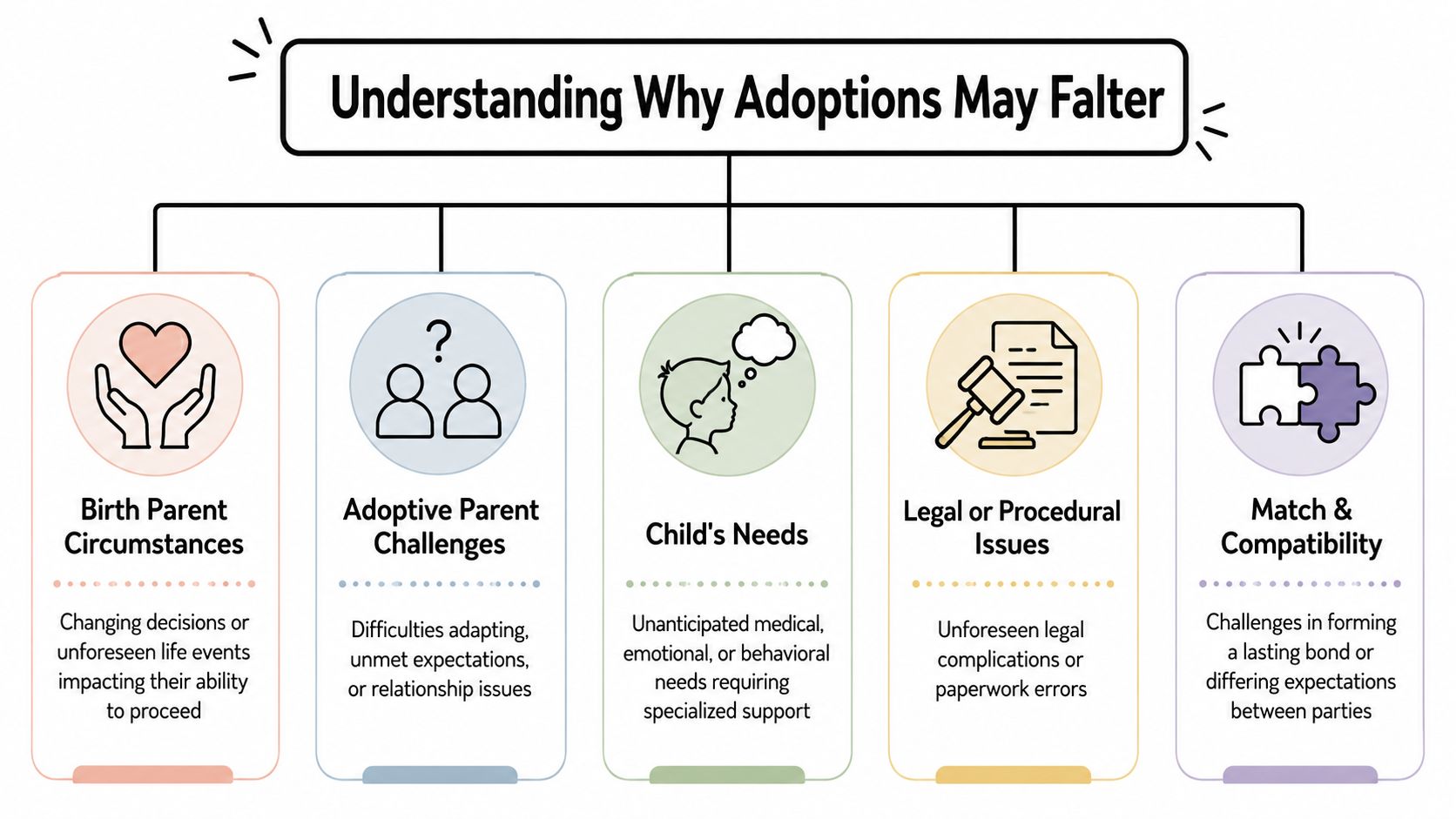
Common Reasons Adoptions Falter
Most failed adoptions don't come from one dramatic moment. They usually grow from a mix of legal problems, unmet expectations, and stress that no one managed early enough.
Procedural and legal hurdles
Some cases stall because the legal groundwork was never fully secure.
A common example is a stepparent adoption where everyone assumes the absent parent's rights will be easy to terminate, but the court needs more proof, better notice, or a separate ruling before adoption can proceed. Another example is a private adoption where consent paperwork is attacked as invalid because someone alleges fraud, duress, incapacity, or a serious procedural defect.
These problems can feel personal, but they're often structural. The court can't finalize an adoption just because all parties hoped it would work out.
Relational and emotional challenges
Other cases fail because daily life becomes harder than expected.
A child may struggle with attachment, grief, trauma responses, school issues, or intense fear of abandonment. Adoptive parents may love the child and still feel overwhelmed. Birth parents may agree to adoption and later experience powerful emotional regret, especially if they didn't fully understand how permanent the decision would feel.
Here are a few patterns families recognize quickly:
- Expectations didn't match reality: A family may expect gratitude or an immediate bond. The child may instead show anger, distance, or testing behavior.
- Support arrived too late: Counseling, respite care, and agency help may be offered only after the household is already in crisis.
- Conflict between adults escalated: Disagreement about openness, contact, discipline, or medical needs can destabilize a placement.
- The child's needs were underestimated: Some children need a level of therapeutic, educational, or medical structure that the placement wasn't ready to provide.
The wider Texas context
Texas has pushed many children toward legal permanency through termination of parental rights, but permanency doesn't always become adoption. Since 2006, Texas has terminated parental rights for 91,589 children, the highest total in the country over that span, yet many children still were not adopted afterward, creating periods of legal limbo and instability, as reported in The Imprint's review of Texas termination and adoption patterns.
That broader pressure matters. When a system moves children through high-stakes legal changes but families and children don't get enough support, disruptions become easier to understand, even if they remain heartbreaking.
The Legal and Emotional Impact on Everyone Involved
When an adoption breaks down, every person in the case loses something. They just lose it in different ways.

For adoptive parents
Many adoptive parents describe the experience as grief mixed with confusion. They may still be caring for the child while fearing the placement won't survive. Or they may already have lost the placement and feel they have no right to mourn because “it wasn't final.”
They do have that right.
Some also face money stress from agency costs, home-study expenses, travel, counseling, and legal fees. On top of that, they may worry a later court challenge will accuse them of wrongdoing. If the issue involves disputed paperwork or alleged misconduct in the consent process, legal advice becomes urgent. Families in that situation often need to understand what happens if fraud is discovered in an adoption case.
For birth parents
A birth parent may feel pulled in opposite directions. One part of them may want stability for the child. Another part may feel deep panic once the emotional reality of adoption settles in.
If the adoption hasn't been finalized, they may ask whether the case can still be stopped. If it has been finalized, the path is much narrower and usually depends on proving a serious defect in consent or jurisdiction. Birth parents also face an emotional burden that people around them may overlook. They may be grieving while also being asked to gather records, speak to lawyers, and revisit painful facts.
For the child
The child carries the heaviest load.
Adults often talk about “the case” or “the placement.” The child experiences loss, routine changes, adult tension, and fear about where they'll sleep next month. Even a very young child can sense instability. An older child may blame themselves or start believing every caregiver eventually leaves.
The child's behavior after a failed adoption may look defiant on the surface, but it often comes from fear and broken trust.
That's one reason post-adoption services matter. A Texas Child and Family Services report estimated that based on national dissolution rates of 1% to 5% of consummated adoptions, between 534 and 2,670 adoptions from the Texas child welfare system during fiscal years 2010 through 2019 may have dissolved. The same report noted that Texas providers spent $3.9 million in state contract funds on post-adoption services for 2,153 families in fiscal year 2019, averaging $1,834 per family, showing that failed adoptions are not just isolated events and that support services are part of the practical response, according to Texas Child and Family Services' post-adoption services report.
Families coping with that level of upheaval may also benefit from mental health support outside the legal system. For general transition-focused coping tools, Be Your Best Self & Thrive's guide offers practical ideas for managing stress during major life changes.
What healing can look like
Healing doesn't always mean the adoption goes forward. Sometimes healing means the adults stop making panic-driven decisions, get the child into stable care, and let the court create a lawful path. Sometimes it means reunification efforts, a kinship option, or another permanency plan.
The legal outcome and the emotional outcome aren't always the same. A court order can end a case. It can't erase hurt. But careful, child-focused action can keep the hurt from getting worse.
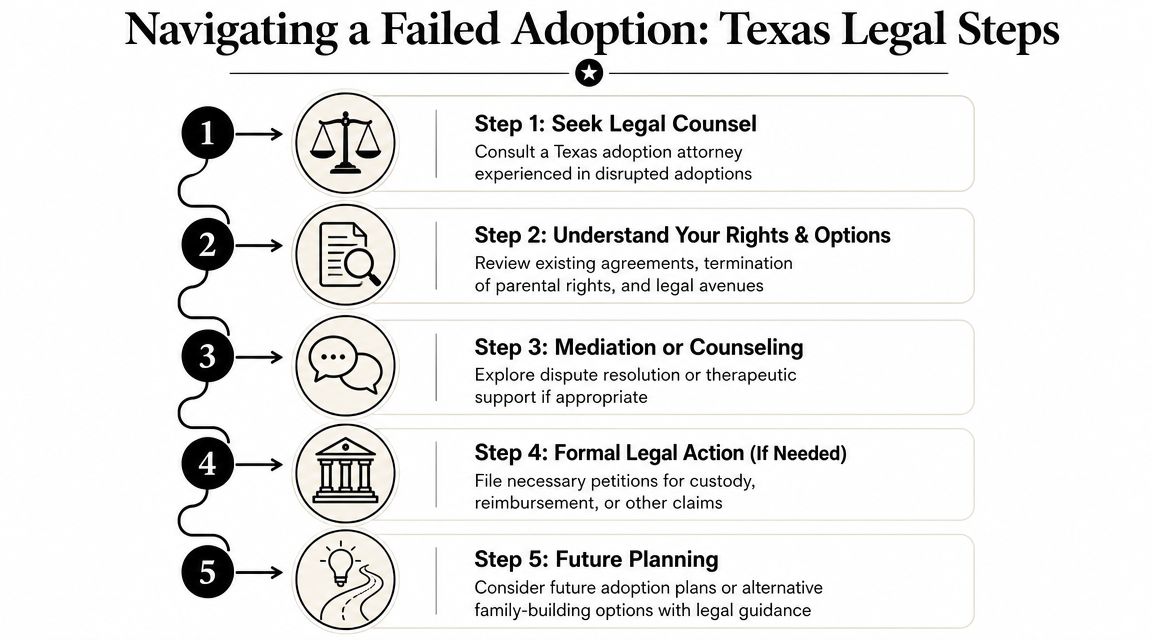
Your Legal Next Steps in Texas
Once you know whether you're dealing with a disruption or a post-finalization challenge, the next moves need to be deliberate. Quick decisions matter, but rushed mistakes can make things worse.
If the adoption hasn't been finalized
When the case is still pending, the immediate goal is to determine whether the problem can be corrected or whether the petition should be withdrawn.
A family may need to review the home study, placement agreement, consent forms, termination orders, and any agency communications. In some cases, the proper next step is to nonsuit or withdraw the pending adoption petition. In others, the case may need amended pleadings, corrected service, or a separate termination action before adoption can continue.
Focus on these practical steps:
- Get every signed document together. That includes court orders, consents, placement paperwork, and agency notices.
- Confirm who currently has legal authority over the child. Physical possession and legal custody are not the same.
- Ask whether the defect is procedural or placement-related. A missing order is handled differently than a household crisis.
- Avoid side agreements. Don't make informal custody deals outside court-approved channels.
If the adoption has already been finalized
A finalized adoption is much harder to challenge.
Under Texas Family Code §162.012, there is a strict six-month deadline to challenge a final adoption decree, and exceptions are very limited, usually involving fraud or lack of jurisdiction, as summarized in this discussion of contesting adoption in Texas.
That deadline changes the whole case. If someone wants to attack the final decree, they usually need evidence, records, and legal analysis immediately. A change of heart is generally not enough. The court will want proof of a legally recognized defect.
Save texts, emails, signed forms, and timelines early. In adoption litigation, evidence often matters as much as emotion.
A post-finalization case may involve a petition to vacate or set aside the decree, requests for temporary orders, and urgent hearings about the child's placement while the challenge is pending. Families facing that situation often start by reviewing what happens if an adoption is challenged after finalization.
Where legal counsel fits in
Families sometimes wait too long because they think they need to “calm things down first.” That delay can be costly.
An adoption attorney can help you identify whether this is a Chapter 162 finalization issue, a consent challenge, a termination problem, or a custody emergency requiring separate relief. The Law Office of Bryan Fagan, PLLC handles Texas adoption and guardianship matters, including court filings and hearings connected to complex adoption cases.
A simple roadmap for the next 48 hours
- Protect the child's routine: Keep school, medical care, therapy, and daily structure as stable as possible.
- Stop informal transfers: Don't let the child move from home to home without legal guidance.
- Use one communication channel: Keep important facts in writing so dates and statements are preserved.
- Request legal review fast: Time-sensitive cases need answers before positions harden and records disappear.
The law gives families tools. It just doesn't give much room for delay.
Protecting the Child and Planning a Stable Future
When an adoption fails, adults often focus first on blame, reimbursement, or whether the case can still be saved. The child needs something more basic first. Stability tonight, this week, and next month.
The urgent questions families ask
Who has temporary custody right now?
That depends on the case posture. If the adoption never finalized, legal custody may still rest with the managing conservator, the agency, a birth parent, or another person named in court orders. If the adoption did finalize, the adoptive parent usually remains the legal parent unless and until a court says otherwise.
Can the child stay with the same caregivers?
Sometimes yes. Sometimes no. The safe answer is that placement should happen through supervised legal channels, not through private handoffs that leave the child unprotected.
What if no one agrees?
The court can step in with temporary orders. In contested cases, the judge may appoint an amicus attorney or guardian ad litem to focus on the child's best interests. Those roles differ, but both are designed to help the court understand what arrangement protects the child during conflict.
What not to do
Texas families should be especially cautious about informal “re-homing.” National adoption guidance consistently warns families to use supervised custody-transfer or guardianship pathways and to involve an agency, licensed attorney, or the foster care system when necessary. Informal transfers can create a second crisis on top of the first.
That means:
- Don't rely on private online arrangements: A child is not a placement problem to solve through social media or personal networks.
- Don't assume a notarized note is enough: Private paperwork usually doesn't replace a valid court order.
- Don't delay emergency legal help: The longer uncertainty lasts, the harder it is on the child.
A lawful temporary plan is not a failure. It's often the first responsible step toward safety.
The best future plan may be reunification, kinship placement, guardianship, or a different adoptive home. What matters most is that the child gets a legal, supervised transition with adults who understand both the emotional and court-related stakes.
Frequently Asked Questions About Failed Adoptions
Can a birth parent change their mind after signing consent forms in Texas
Sometimes families assume there's an automatic revocation window. Texas adoption guidance doesn't provide an automatic period to take consent back after signing. Once consent is executed, a reversal usually requires court action based on serious grounds such as fraud, duress, incapacity, or another procedural defect.
What happens to the money we paid to the agency or for legal fees
That depends on the contract, the stage of the case, and the reason the adoption failed. Some costs are nonrefundable because the work was already performed. Others may depend on agency terms, court orders, or whether misconduct occurred. A lawyer can review fee agreements and tell you what claims, if any, may exist.
Can we try to adopt again after a disruption
Often, yes. A disruption doesn't automatically disqualify you from future adoption. But families usually benefit from a careful review first. Courts and agencies may want to know what happened, what support was missing, and what has changed since then.
If the child is already living with us, can we decide where the child goes next
Not safely unless you also have legal authority to do that. Physical possession is not the same as legal custody. Before making any transfer, get legal advice and confirm what the current court orders allow.
If your family is facing uncertainty, grief, or an urgent custody question after a failed adoption, legal clarity can make the next step less overwhelming. The Law Office of Bryan Fagan, PLLC helps Texas families understand adoption, guardianship, and child-centered court options. You can schedule a free consultation to talk through your situation confidentially and get guidance customized for your case.
