
You may be sitting at your kitchen table right now with a stack of notes, a browser full of tabs, and one painful question running through your mind: what disqualifies you from adopting a child in Texas? That question can feel heavy because adoption is personal. It's about your future family, not just paperwork.
Many hopeful parents assume Texas is looking for perfection. It isn't. Texas is looking for a home that is safe, stable, and able to meet a child's needs. That difference matters. A hard disqualifier is very different from a concern that can be explained, documented, and worked through.
Texas adoption law, including the court process found in Texas Family Code Chapters 162 through 166, is built around the child's best interest. Those chapters govern adoption procedure, consent, termination issues tied to adoption cases, and final court approval. In plain English, the judge is asking a practical question: Will this adoption serve the child well? Everything else flows from that.
How Texas Views Adoption Eligibility
The most stressful part of adoption is often the fear of an unseen problem. People worry about age, income, health, marital status, or something from years ago that still feels embarrassing. Texas does have rules, but those rules are not designed to punish families. They exist to protect children.
A helpful way to think about Texas eligibility is as a two-layer review. First, there are baseline requirements. Then there is a closer review of whether the placement is suitable in real life.
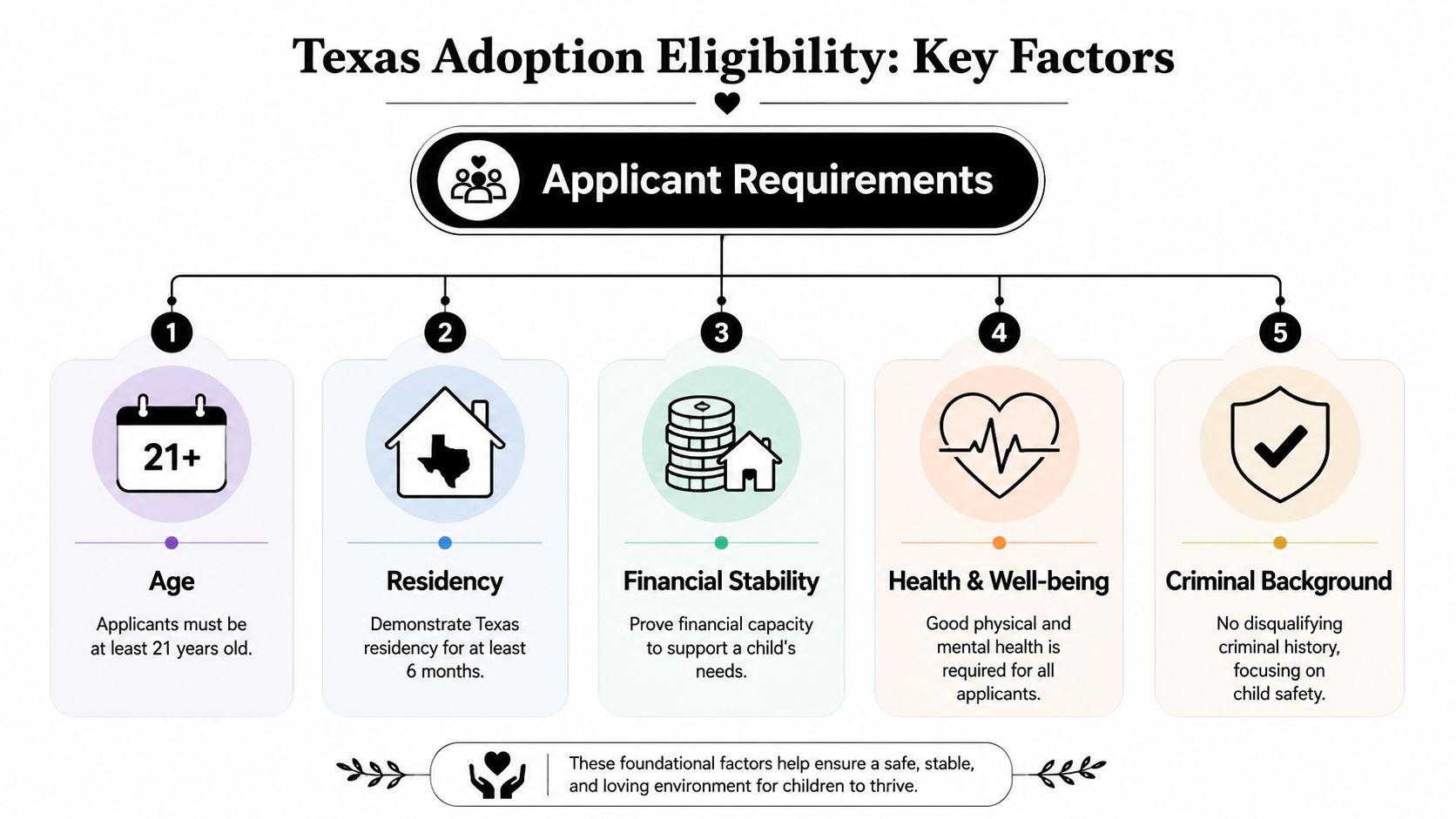
Texas guidance explains that adoption screening works as a two-layer eligibility filter. Applicants generally must be at least 21, financially stable, and clear criminal history and child abuse registry checks, but the decision can still turn on the broader home study if the home is unsafe or the overall picture suggests the child's needs may not be met, as explained by American Adoptions of Texas on Texas adoption requirements.
The first layer is basic eligibility
At the starting line, Texas asks whether you meet the basic threshold to be considered at all. That includes:
- Age requirement. You must be 21 or older.
- Financial stability. Texas is not asking whether you are wealthy. It is asking whether you can support a child responsibly.
- Background screening. Adults in the household must clear required checks.
- Home study participation. You must complete the home study process.
- References and documentation. You need to provide information that helps the agency and court evaluate your home and history.
The second layer is suitability
Readers often get confused because passing the first layer doesn't mean the case is automatically approved. The home study and court review look at your actual day-to-day life.
A family can meet the minimum rules and still face trouble if the home study reveals unresolved instability. For example:
| Situation | Likely concern |
|---|---|
| Home has serious safety issues | Child's immediate safety |
| Income is inconsistent and undocumented | Ability to provide stable care |
| Applicant hides past legal or personal problems | Credibility and trust |
| Household conflict is ongoing | Emotional stability for the child |
Practical rule: Texas is not measuring whether your life looks perfect. Texas is measuring whether your home is safe, truthful, and stable enough for a child.
Family structure is often less important than people think. Single adults can adopt. Married people can adopt, though a spouse usually must join the petition. In many cases, a child who is 12 or older must consent unless the court waives that requirement, which is part of the broader Texas adoption process described in the same Texas adoption guidance already noted above.
That's why the better question isn't “Am I perfect enough?” It's “Can I show the court that this adoption is in the child's best interest?”
Absolute Bars to Adoption in Texas
Some issues are not gray areas. They are hard stops.
Texas places the strongest restrictions on serious crimes tied to violence, sexual misconduct, or child safety. Texas-focused legal guidance explains that certain violent or sexual convictions can permanently bar adoption, while some other convictions trigger long waiting periods instead. The same guidance notes examples of a 20-year probation period for some convictions involving enticing a child, aggravated assault, prohibited sexual contact, terroristic threat, interference with child custody, and prostitution-related offenses, and a 5-year probation period for some financial, DUI, or drug-related offenses, as discussed by Proffitt Family Law in its review of what might disqualify you from adopting in Texas.
What counts as a hard disqualifier
In practical terms, the most serious concerns are usually tied to child safety. These cases often involve:
- Violent offenses
- Sexual offenses
- Crimes involving children
- Substantiated child abuse or neglect history
These are the kinds of facts that make agencies and courts stop the case before it gets very far.
Why Texas draws a hard line
This isn't about moral judgment. It's about risk. Adoption creates a permanent legal parent-child relationship under Chapter 162 of the Texas Family Code. Before a court creates that relationship, it has to be satisfied that the child is not being placed in danger.
That same child-centered focus also shows up in related procedures under Chapters 161 through 166, including termination of parental rights when necessary, required consents, and the final court order. If a legal barrier exists at the safety stage, the court won't move to finalization.
A true hard disqualifier usually involves a history that the state treats as incompatible with child safety, not a minor mistake or an old embarrassment.
What this section should tell most readers
If you are worrying about an old misdemeanor, a rough financial season, therapy, or the fact that you are single, this section is probably not about you. Hard bars tend to involve serious, specific, and high-risk facts.
Most anxious applicants are dealing with soft disqualifiers, not absolute ones. Those are the concerns that require honesty, explanation, and preparation.
Understanding Your Criminal Background Check
For many people, this is the section they need most. A past charge, arrest, plea, or conviction can feel larger than life when adoption is on the line. But Texas does not treat every offense the same way.
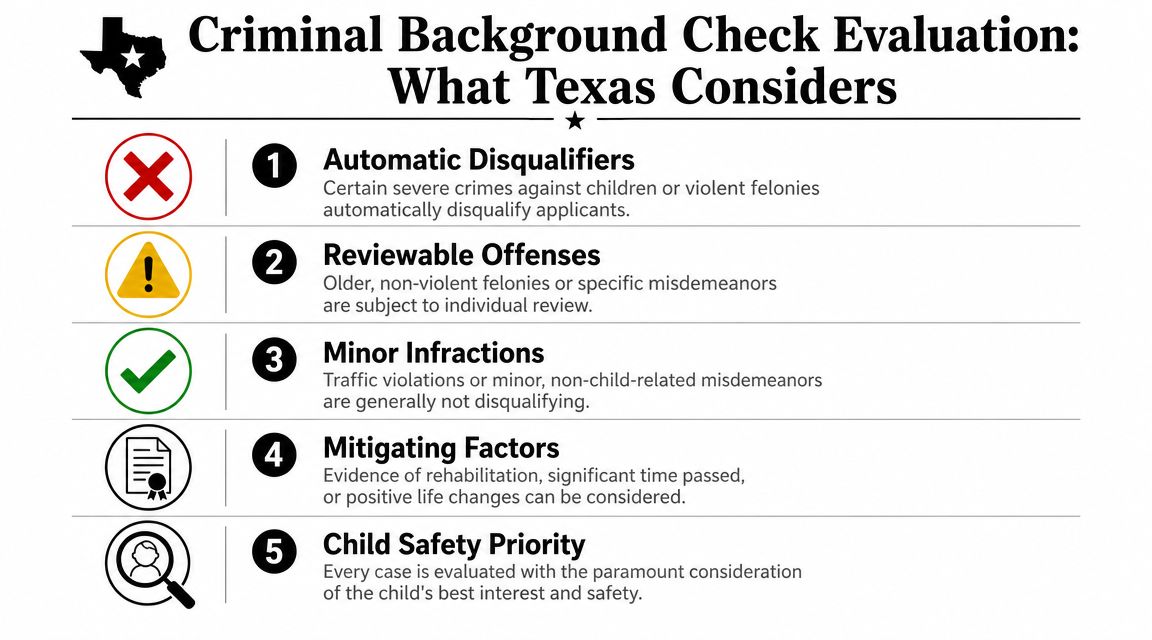
The basic pattern is clear. Serious violent or sexual offenses are treated much more harshly than lower-level or older offenses. Texas guidance also notes that a misdemeanor does not automatically disqualify a foster parent, while violent offenses and child-abuse history remain major red flags, according to this explanation of whether a criminal record can prevent adoption in Texas.
Texas looks at the type of offense
Not all criminal history carries the same weight.
A helpful way to sort it is like this:
- Most serious concerns. Violent, sexual, or child-related offenses are the most likely to create denial.
- Reviewable concerns. Some nonviolent offenses may trigger deeper scrutiny rather than an automatic no.
- Less serious concerns. Minor misconduct may matter far less, especially if it is old and isolated.
The question is not only “What happened?” It is also “What does this history suggest about current risk to a child?”
Time matters too
An older offense is usually viewed differently from a recent one. That doesn't erase the past, but it does change the analysis. If years have passed and your life shows stability, that can matter.
A social worker or agency may look at:
- whether probation was completed
- whether there have been repeat offenses
- whether substance use or violence remains a current issue
- whether your life since then shows consistency and maturity
Honesty matters more than most people realize
A person with a difficult past can still sometimes move forward. A person who hides that past often creates a much bigger problem.
Consider two simple examples:
| Scenario | How it may be viewed |
|---|---|
| Applicant discloses an old DUI, explains treatment, and provides records of stability | Reviewable |
| Applicant denies the DUI, but it appears in the background check | Credibility problem |
| Applicant had a remote nonviolent offense and no repeats | Context may help |
| Applicant has recent violent conduct | Serious barrier |
If you have a record, your job is not to pretend it never happened. Your job is to show who you are now.
What you can do before the check happens
Start gathering your own documents before the agency asks. That may include court records, proof that requirements were completed, and letters that speak to your present character.
A short written explanation can also help. Keep it calm and factual. Describe what happened, accept responsibility where appropriate, and explain what changed. Courts and agencies usually respond better to a clear, accountable story than to defensiveness.
If your case has unusual facts, legal guidance can help you decide how to present them. Adoption cases can involve overlapping issues from background checks, home studies, and the final court hearing. In that setting, clarity matters.
The Home Study and What Can Raise a Red Flag
Upon hearing “home study,” people often picture judgment. They worry someone will notice laundry on the couch, a crack in the sidewalk, or a bad week in their bank account. The actual question is much simpler: is this home safe and stable for a child?

The Texas Department of Family and Protective Services states that prospective foster or adoptive families must be at least 21 years old, financially stable, and responsible mature adults, and they must complete a home study, provide references, and pass criminal history and abuse or neglect checks on all adults in the household, according to DFPS requirements for foster and adoptive homes.
What the home study is really looking for
A home study usually focuses on patterns, not one imperfect moment.
That includes:
- Safety. Is the home physically safe?
- Stability. Are finances, routines, and relationships reasonably steady?
- Readiness. Do you understand what parenting through adoption may involve?
- Support. Do you have people who can help when life gets hard?
If you want a clearer sense of what this process can involve, this overview of Texas adoption home study requirements can help you understand the practical side.
Three common red-flag scenarios
A cluttered house
A cluttered house is not the same as an unsafe house. Toys in the corner, dishes in the sink, and a lived-in family room usually do not sink an adoption. But exposed wiring, unsafe weapons storage, dangerous animals, or hazardous sleeping arrangements can create serious concerns.
A shaky financial history
A past bankruptcy or debt problem does not automatically make someone unfit. What matters is whether the current picture shows stability. If you can document income, explain what happened, and show responsible budgeting now, that looks very different from ongoing chaos.
A health diagnosis
A managed physical or mental health condition does not mean you can't adopt. The concern is whether your condition interferes with your ability to safely and consistently parent. If treatment is working and you have support, that may be reassuring rather than disqualifying.
This short video gives a useful look at how families often experience the process in real life.
The home study is a conversation, not a trap
People do best when they treat the home study as a chance to explain their real life. If your finances were messy during a divorce, say so. If you take medication for anxiety and it helps you function well, say that too. If a relative in the home has a complicated history, raise it early.
A reassuring truth: social workers are not looking for magazine-cover families. They are looking for safe homes, honest answers, and adults who can meet a child's needs over time.
That same focus appears in court. Before finalization under Chapter 162, the judge reviews whether the legal and practical pieces line up. The home study is often one of the clearest windows into that question.
Strategies for Mitigating Potential Disqualifiers
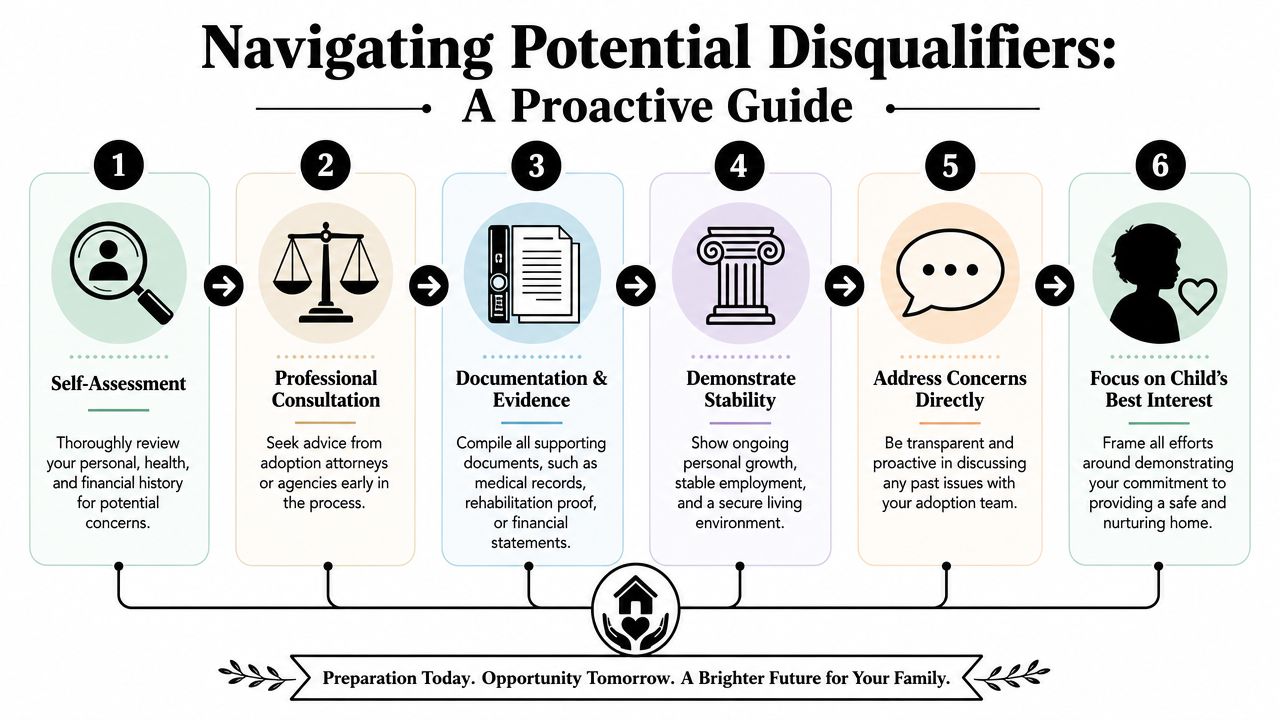
A soft disqualifier doesn't fix itself. It gets easier to manage when you address it directly.
That means stepping back and asking, “If an agency or judge sees this concern, what would help them understand the full picture?” You are not trying to polish your life into something unreal. You are building a record that shows stability, accountability, and readiness.
Build your file before anyone asks for it
If there is a concern in your background, gather proof that puts it in context.
That may include:
- Court paperwork showing how a case ended
- Treatment records if substance use or mental health has been addressed
- Employment records that show consistency
- Reference letters from people who know your current life well
- Financial documents that show your household is stable now
A vague explanation rarely helps. Documents help.
Write the story carefully
You don't need a dramatic personal essay. You need a short, honest statement that answers four questions:
- What happened?
- When did it happen?
- What did you do to address it?
- Why does your life now look different?
For example, if you had a DUI years ago, your explanation might note the offense, the completion of all requirements, changes in drinking habits, counseling if applicable, and the stable routine you've maintained since then. Calm facts are more persuasive than excuses.
Use professional help when the facts are sensitive
Some families benefit from early legal guidance, especially when the issue involves criminal history, prior CPS involvement, or a complicated stepparent or kinship adoption. One option is working with an attorney who handles these cases, such as an adoption attorney in Texas, to review records and prepare for the court side of the case.
This is also the one place where it makes sense to note that the Law Office of Bryan Fagan, PLLC handles Texas adoption matters, including case evaluation, paperwork, and court proceedings. That kind of support can be useful when a family needs help presenting difficult facts clearly and lawfully.
Show stability, not just promises
A judge and a home study provider will care more about patterns than intentions.
| Concern | Helpful response |
|---|---|
| Old criminal issue | Records, completion documents, no repeat behavior |
| Financial instability | Current budget, steady income, documented recovery |
| Mental health concern | Ongoing treatment, provider support, daily functioning |
| Household tension | Evidence of healthier routines and support systems |
The strongest mitigation strategy is simple. Tell the truth early, support it with records, and show a stable pattern over time.
For some cases, there may be legal paths to address a concern. For others, the answer may be waiting longer so your record better reflects sustained stability. Either way, taking control of the narrative is better than hoping the issue will be overlooked.
Common Questions on Eligibility for Texas Adoptions
Can a single person adopt in Texas
Yes. Texas allows single adults to adopt. Being unmarried is not, by itself, a disqualifier. The question stays the same: can you provide a safe, stable, loving home?
Do married couples both have to be involved
Usually, yes. Texas guidance indicates that married applicants must have their spouse join the petition. In practical terms, the court wants the legal and family structure to be clear before granting the adoption.
Does being LGBTQIA+ disqualify someone from adopting
No. Texas adoption law focuses on the child's best interest and the applicant's ability to parent. Sexual orientation, standing alone, is not the issue. In real cases, families still benefit from careful legal guidance if they expect procedural complications, but LGBTQIA+ applicants can and do pursue adoption in Texas.
Can a relative adopt a child more easily
Sometimes the process feels more familiar because the child already knows the caregiver, but relative adoptions still involve legal requirements. Depending on the situation, the court may still need to address parental rights, consent, background checks, and whether the adoption serves the child's best interest.
What about stepparent adoption
Stepparent adoption is often more straightforward emotionally, but it still requires legal groundwork. Under the Texas Family Code, the noncustodial parent's rights generally must be terminated voluntarily or by court order unless a specific legal pathway applies. Once that issue is resolved, the court can consider whether the stepparent adoption should be granted.
Can a child object to being adopted
Sometimes. Texas guidance says a child who is 12 or older generally must consent unless the court waives that requirement. That becomes especially important in stepparent and kinship cases where the child is old enough to express a strong view.
Is low income an automatic disqualifier
No. Texas looks for financial stability, not wealth. The concern is whether you can meet a child's needs consistently and responsibly.
Will a misdemeanor automatically end the process
Not necessarily. As covered earlier, a misdemeanor does not automatically disqualify a foster parent, and lower-level offenses are often treated differently from violent or child-related conduct. The details matter.
Your Path Forward to a Texas Adoption
If you've been asking what disqualifies you from adopting a child in Texas, the answer is more nuanced than many people expect. Some facts are hard barriers. Many others are concerns that can be addressed with honesty, preparation, and the right legal strategy.
Adoption under the Texas Family Code is not about proving you've lived a flawless life. It's about showing that you can give a child safety, stability, and permanency. If you're unsure where your situation falls, getting clear advice early can save heartache later.
If you have questions about your eligibility, home study concerns, a prior criminal issue, or the legal steps required under Texas adoption law, the Law Office of Bryan Fagan, PLLC can help you understand your options. A free consultation can give you a clearer picture of where you stand and what steps may help you move forward.
